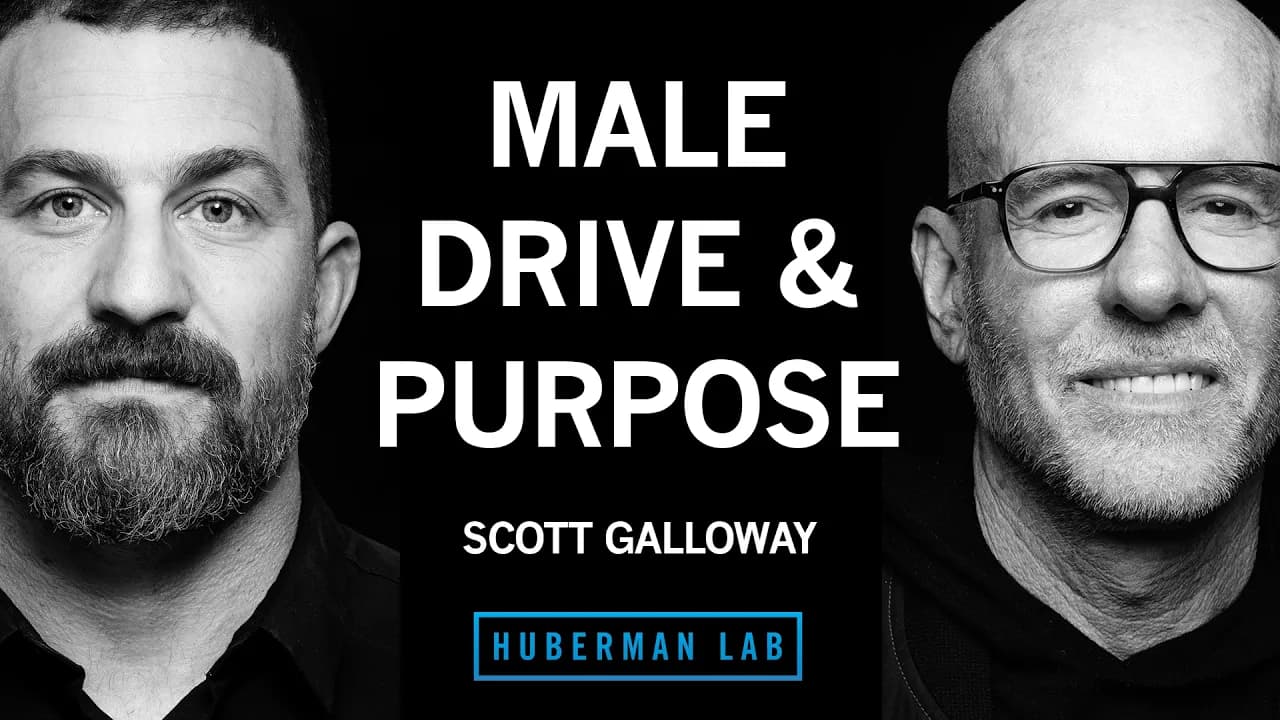
Is Andrew Huberman Threatened By Retardmaxxing?
In a Nutshell
Huberman defends retardmaxxing as a practical antidote to excessive rumination, arguing that constant introspection without action leads to stagnation and fails to address men's mental health issues. He pushes back against blanket hatred of billionaires like Marc Andreessen, noting that high achievers often have rough edges and complicated personalities that shouldn't be judged without concrete evidence. The discussion highlights the tension between traditional stoic action and modern demands for emotional openness, while promoting mitochondrial support supplements for aging recovery.
These notes were generated by AI and may contain inaccuracies.
Andrew Huberman is asked whether he feels threatened by the retardmaxxing movement. He responds that he is personally offended and questions if the movement is something he should engage with directly. The term is presented as an extension of lookmaxxing, focusing on avoiding excessive thinking and rumination.
Marc Andreessen, founder of Netscape and a16z, is identified as a key figure who popularized retardmaxxing. He appeared on the David Senra podcast, where he advocated for less introspection and more action. Andreessen stated that great men of history did not spend time sitting around thinking about their thoughts. He recommended a figure who practices retardmaxxing by sitting in his backyard on a farm, handling business without overthinking problems.
David Senra, host of the Founders podcast, brought Marc Andreessen onto his show. The discussion highlighted the value of action over excessive self-reflection. Andreessen positioned retardmaxxing as a philosophy of simply doing what needs to be done and ignoring unnecessary mental noise.
Dana White reinforced similar ideas, expressing that he is not a fan of men publicly discussing their emotional challenges. He advocated for getting up, going to work, and providing for one's family, aligning with traditional stoic values. Both Andreessen and White's comments sparked debate about whether emotions should be dismissed in favor of relentless action.
Huberman clarifies that Andreessen is not a sociopath and is actually a very kind person with a strong family life. He acknowledges that Andreessen's public stance against introspection opened him up to criticism, but defends his character based on personal knowledge.
Retardmaxxing is defined as ignoring unnecessary thoughts and focusing solely on handling responsibilities. The movement critiques excessive rumination and promotes practical action instead of prolonged self-analysis. It gained momentum following Andreessen's endorsement.
The discussion acknowledges that men's mental health issues, including high suicide rates, are serious. However, both speakers note that constant introspection without action can become a trap. The consensus is that some self-reflection is useful, but it must be paired with concrete steps rather than remaining stuck in feelings.
Spending excessive time thinking about emotions without taking action leads to stagnation. The point is made that simply stating how one feels without follow-through accomplishes nothing. A balanced approach involves checking in with oneself while still maintaining forward momentum.
Many accomplished individuals possess rough edges and high levels of disagreeableness. Historical figures and modern high achievers often combine conscientiousness with friction-generating personalities. These traits can contribute to significant accomplishments but may also create interpersonal challenges.
In the past, big personalities with rough edges were often celebrated for their achievements. Today, there is greater pressure for public figures to be flawless in every dimension. Cameras and constant scrutiny have made it harder for imperfect but productive individuals to operate without criticism.
Steve Jobs is cited as someone who exhibited rough edges—he did not wear shoes, drove fast, and was known for yelling at people. These behaviors were tolerated because of his major contributions. The conversation notes that such tolerance has decreased in the current cultural climate.
There is significant public animosity toward billionaires. Huberman, having grown up in Silicon Valley, observes that going big is culturally embedded in tech. He personally knows several billionaires, including Marc Andreessen, and does not view them as terrible people despite acknowledging they are not perfect.
Many historical high achievers, including Nobel Prize winners, were complicated individuals. Science funding and personal relationships have often intersected in ways that enabled major discoveries. The point is made that even groundbreaking figures remain human and imperfect.
The ubiquity of cameras has raised the standard of evidence required to judge someone's character. Past judgments could be based on single statements, but now people increasingly demand video evidence before accepting serious claims.
The Diddy case showed that despite widespread speculation, concrete video evidence was limited to specific incidents. The Coldplay concert incident, where a couple was caught on camera in a compromising situation, demonstrated how real-time footage creates immediate public reaction and sets a higher threshold for belief.
Modern audiences require actual video or data rather than secondhand reports. Claims about billionaires being sociopaths or terrible people are dismissed unless supported by direct evidence. Without such proof, accusations tend to remain as unsubstantiated chatter.
Not all billionaires behave the same way. While some may engage in problematic activities, having significant wealth alone is not considered a valid reason for hatred. The conversation distinguishes between different individuals rather than applying blanket judgments.
Retardmaxxing is described as genuinely difficult. Many people in their 30s maintain strong discipline with training, protein intake, and sleep, but recovery becomes more challenging with age. The margin for error shrinks, making consistent execution harder.
Timeline is promoted as a supplement containing the clinically validated form of urolithin A. It supports mitophagy, the body's process of clearing damaged mitochondria and renewing healthy ones. Studies show it helps maintain mitochondrial function and muscle strength in older adults.
The product is positioned as useful for individuals in their 30s, 40s, and 50s who want to support recovery and strength. It offers a 30-day money-back guarantee, free shipping in the US, and international shipping. Up to 20% off is available using the code "modernwisdom" at timeline.com/modernwisdom.
Keep Chris Williamson in your library
Save the videos and channels worth coming back to, and find them again in one place.