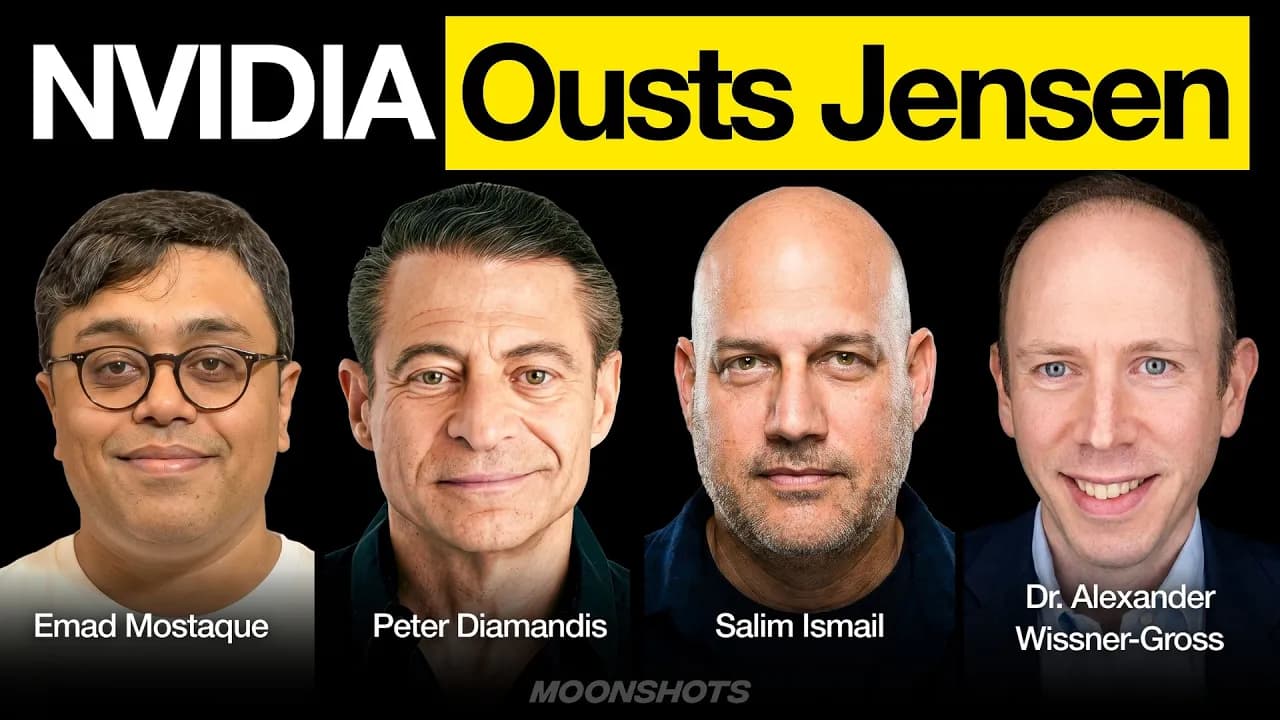
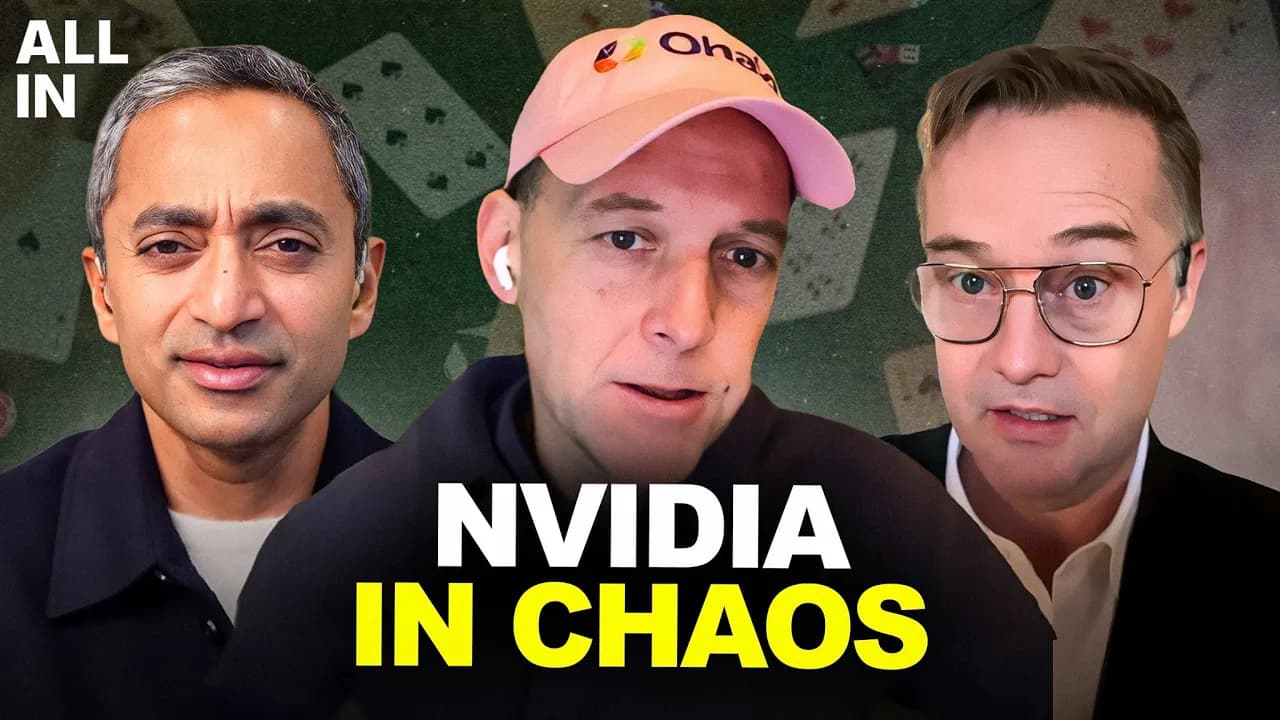
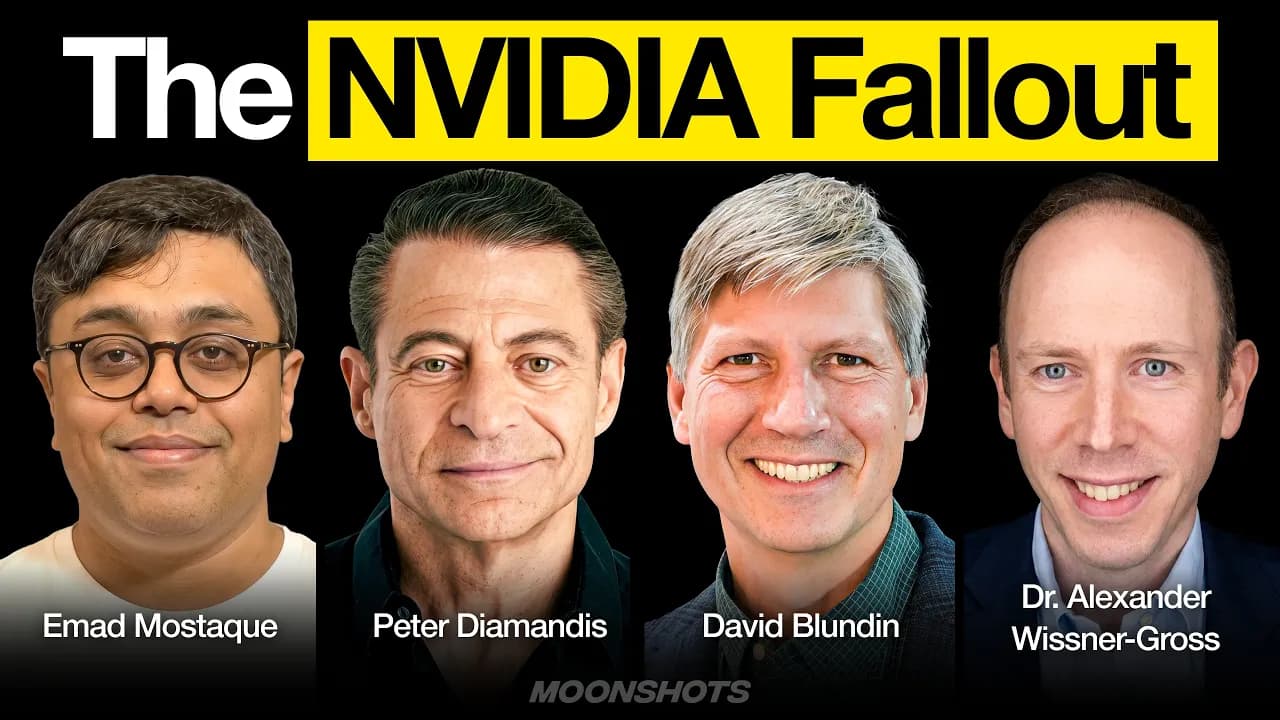
Jensen OUT as Nvidia CEO: "Spy" Scandal, Export Restrictions, Market Impact
In a Nutshell
Jensen was removed as Nvidia CEO following a leak of a classified memo alleging his relationship with a suspected Chinese intelligence operative, triggering a $1.5 trillion market cap loss and an ongoing DOJ investigation. The leak appears to originate from internal factions—likely China hawks pushing for stricter export controls and centralized AI governance—rather than competitors or China itself, which benefits from removing the industry's key innovation driver. This creates a power vacuum that strengthens Anthropic's IPO narrative while raising serious concerns about government control over AI chips through mandated backdoors and remote shutdown capabilities.
These notes were generated by AI and may contain inaccuracies.
Jensen is out of his role as CEO of Nvidia after a series of events that occurred over six days starting Friday, November 6. The podcast is being recorded on Thursday, November 12. Nvidia's chief financial officer is serving as interim chief executive while the board searches for a new CEO. Nvidia will announce its earnings the following Tuesday, a critical moment for the company. The stock has plummeted by 15% in the past week, equivalent to hundreds of billions of dollars.
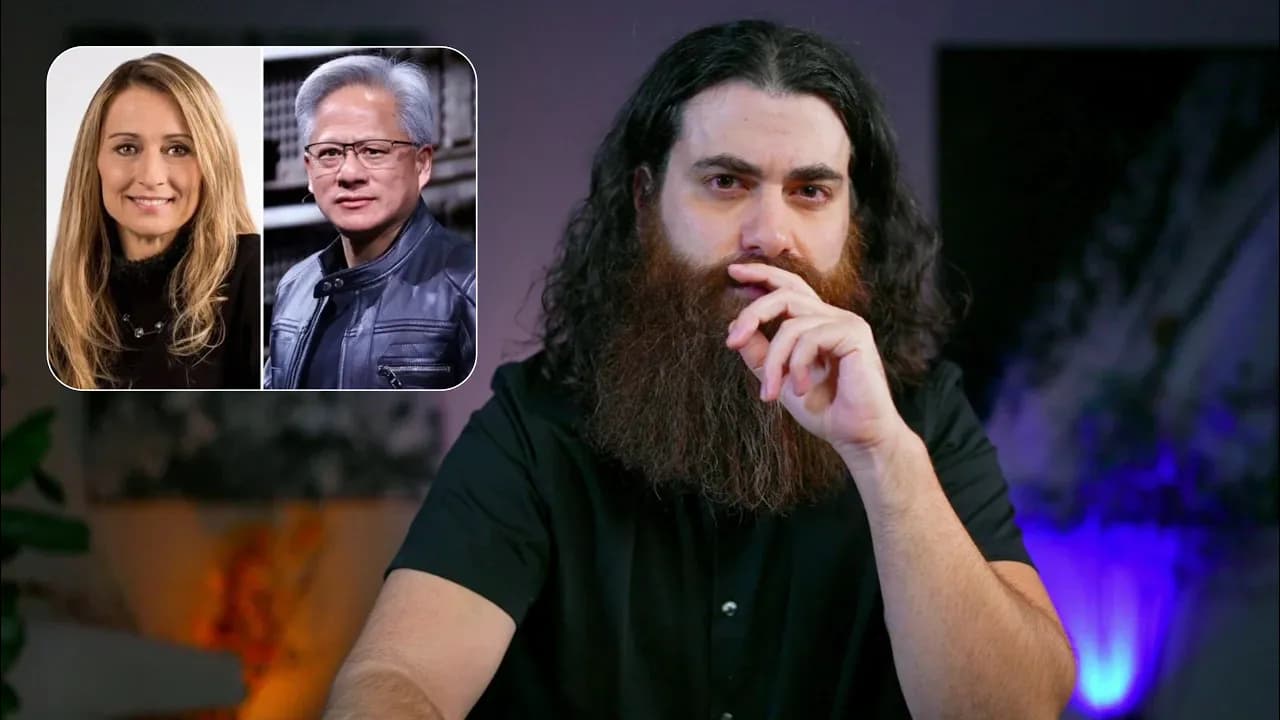
The timeline began last Friday, November 16, just after the midterm elections. The New York Times published a report claiming that a Chinese businesswoman with close ties to Jensen was actually a spy for the Chinese Communist Party. The woman's name is Alice Wang, and she has no connection to Jensen despite sharing the same family name. Alice is an executive at a Singapore-based company called Megaspeed, which builds data centers in Asia and leases computing capabilities to companies including Chinese companies like Alibaba. According to the report, the relationship between Jensen and Alice helped facilitate the sale of $7.5 billion worth of chips to Chinese companies since 2023.
The New York Times article was based on a leaked intelligence memo identifying Alice as a Chinese spy. On Sunday, November 8, Jensen sent a company-wide email acknowledging the affair and stating the board would investigate. On Wednesday, the New York Times reported that Jensen had a second relationship with an employee who worked under his direct supervision, with reports of a possible third relationship.
The story had been hidden for more than a year. The New York Times first reported Alice's relationship with Jensen in October 2025, 13 months prior. They published a follow-up report last month titled "Nvidia CEO considered target of Chinese espionage plot." Culper Research, a hedge fund betting against Nvidia stock, published their thesis six months ago based on Nvidia downplaying its reliance on China for chip sales, and they specifically mentioned Megaspeed in their analysis.
This is considered a tragic situation for Jensen and his family, for Nvidia and its employees, and for the United States because Jensen is one of the main reasons the country has a significant advantage in AI acceleration chips and graphics processing units. This advantage is key in the race for artificial intelligence or superintelligence. Jensen has been working on graphics processing units for more than three decades, believing in this technology when everyone else was making CPUs, and his company nearly went bankrupt several times.
There are two processes at work. The first process concerns whatever Alice Wang was doing with or without the Chinese Communist Party, which may involve smuggling, and this requires investigation with all facts to be revealed. The second process began when someone or several people leaked a highly confidential memo or its contents to The New York Times, which is considered a crime. Leaking classified intelligence information is a crime for which many people have been prosecuted.
Several questions arise about the leak. First, who did it and why? What motivated them to feel so determined to overthrow Jensen that they were willing to break the law? The New York Times gave a hint that Rubio was leading this investigation and briefed President Trump on it, attributing the story to "people who were briefed on the surveillance." However, when the New York Times says "people who have been briefed on the matter," this is a very vague and broad term. Those who did this may have been very low-level officials or professional employees rather than politically appointed individuals.
The second question concerns the failure to provide a defensive briefing. If national security agencies are concerned that Jensen possesses security secrets and might leak them to someone suspected of being a spy, why not go to him immediately and provide a defensive briefing? This is standard operating procedure, as demonstrated by the Eric Swalwell case. Eric Swalwell was a member of the House Intelligence Committee who had a personal relationship with a Chinese spy named Fang Fang. The Democrats gave him a defensive briefing, he severed ties, and was allowed to remain in Congress and on the intelligence committee without resigning.
The third question concerns what national security secrets Jensen knew. He does not work for the government and, to knowledge, is not privy to any classified materials. As CEO of a technology company in Silicon Valley, companies are very open about their plans and product development plans. Technology companies do not transmit intellectual property via bedtime chats, and files needed to design the next generation of chips would require a line engineer or cyberattack to extract rather than pillow talk.
The fourth question concerns what evidence exists that Alice Wang was indeed a Chinese spy working for the Ministry of State Security. An article in Politico reported that the incoming chairman of the House Intelligence Committee, a Democrat, emerged from a classified briefing and stated he wasn't sure if this person was a Chinese spy, suggesting she might be a "useful idiot" - someone who does not work for the Chinese government and is not a spy but might be exploited in some way.
A fifth question concerns why this happened now and why at this particular time. The timing suggests that whoever defused this bomb saw something that made them feel this had to happen. Other defamation stories emerged in a coordinated manner simultaneously. One theory suggests anti-China hawks who lost the debate about sending chip technology to China from the United States wanted the opposite outcome and wanted no chips sent to China, also wanting to install GPS and other methods to track chips and put backdoors in them so they could be turned off - something Jensen opposed.
There are two paths to the future. One path involves artificial intelligence technology being widely available and widely used, with its value and power not concentrated in the hands of a few and controlled by a few. Open-source AI and distributed data centers available to everyone give the ability to use AI to advance, progress, and create value. The alternative path focuses power and influence on artificial intelligence technology, with data centers eventually regulated and chips at a deeper stage of the supply chain becoming the point of control.
Jensen has been a staunch advocate for open source and for universal access to and use of artificial intelligence technology for the benefit of humanity, not just American citizens. These views may conflict with the interests of many different parties. There has been long-standing knowledge about this woman and Jensen's other relationships, and these things are now coming to light and being used to defame him.
Jensen's dismissal raises questions about the fiduciary duty of the board. The only thing they are responsible for dealing with is whether Jensen lied. If he had committed espionage or violated federal law, he would have been arrested, and since there was no arrest, this possibility can be ruled out. The next possibility is that he provided misleading information about something. Companies have a code of conduct stating that relationships must be reported, and executives or Section 16 officers at public companies are required to submit quarterly declarations that they are not violating the code of conduct in an auditable manner.
This is exceptionally sad and disappointing. Jensen worked at Denny's and in 1993 founded an electronic chip company that no one believed in, considered just a feature and not a platform, product, or noteworthy business venture. The share price was a few cents compared to its price today, less than two dollars per share 10 years ago. The company was founded in 1993 and in 2006 its value became $10 or $12 billion and did not move for 10 years. Four years ago, the company started to take off and has grown 20 times in the past four years, becoming the most valuable company on Earth and achieving the most profitable quarter in business history with $63 billion in operating profits.
Assuming Jensen is not a traitor, which seems ridiculous based on his efforts and personality over the past two decades, the question remains who benefits from removing Jensen from the position of CEO. When executives submit their annual reports (10-K), they must speak by phone with the auditor every quarter and answer questions about conflicts of interest and relationships. The Securities and Exchange Commission requires this to ensure there is no conflict of interest and that the company is trustworthy with regard to capital on behalf of shareholders. When an executive may have provided misleading information and begins to violate those commitments, those are the dominoes that fall.
There are many people who have been too quick to conclude that China is the winner. Two hypothetical cases can be considered. In the first case, assuming there are no chips destined for China, China is stuck in the same place it
China remains in the same position it was before, with a need for a local solution that can replace Nvidia's computing power. Even without Jensen, there are still years of Nvidia's investment in building its impregnable fortresses. China may be able to catch up, but this endeavor will take years, perhaps decades. In the hypothetical scenario that chips were leaking into Chinese hands, the government will take strict measures to find out where each segment is headed. It is assumed that they will not receive the chips now, so whatever progress they had been making has been taken away from them. In both scenarios, China is either staying where it is or in a worse position.
Nvidia's competitors including AMD, Google, Cerebras, Etched, and other startups do not benefit from this situation. These companies need to spend tremendous amounts of time getting their chips to work on a large scale, then convince entities like TSMC and Samsung to give them manufacturing capacity and high-bandwidth memory (HBM) capacity. You can't simply get to running a million GPUs just by wanting to. They still have a lot of work to do.
The category of people with potential to win are those who want a more centralized infrastructure for governing computing power. When exporting chips, exporters are now required to implement a telemetry system to know when and how chips are used, along with a remote shut-off switch. This creates a special responsibility borne by the regulatory infrastructure. Amazon, Microsoft, and Google should own that responsibility. There is now a possibility that government officials will propose a remote measurement system and stop switch that they possess. They will win by a narrow margin because if they were seeking control before, they now have the opportunity to demand legislation that would grant it to them.
The decision to fire Jensen should be made by shareholders. The investigation is not yet complete, so they should have waited until it was finished rather than letting the press, crowds, and noise influence the decision. Jensen agreed to resign under a lot of pressure. The board members making this decision are doing so only to protect themselves, not in the best interests of shareholders. They do not own a large percentage of the shares, so the matter should be put to a shareholder vote if this is not a criminal act by Jensen. It has not been proven who this person is or what his motive is—whether he is a spy or just someone trying to make money.
Partners, employees, and shareholders are all losers from the downfall of America's champion of super artificial intelligence. The leakers cannot be competitors, shareholders, or China. This leaves those who adopt the "sluggish cells" (D-cells) approach. It seems absurd that Anthropic or these cells would try to boost their power with this because they need the chips too. The leak appears to be coming from within the house itself, possibly from factions vying for control between China hawks who want to keep chips out of China and those who want to ease the relationship with China.
Nvidia's role may not just be about chips for China, but about slowing down the US AI economy. Nvidia provides capital and guarantees to startups, data centers, and much of the infrastructure, much of it directed by Jensen directly. Kaleek Christ and Vishal Bhajwani, head of mergers, acquisitions, and corporate development, are smart and good, but Nvidia Bank was run by Jensen. It is unclear what will happen now—whether the bank will be closed indefinitely, close for a period of time, or if the new CEO will feel free to invest with the same degree of aggression.
Jensen had a more comprehensive view of the industry. He knew how to move the pieces on the chessboard and had the moral authority to make investments and acquisitions that would be more difficult for a traditional CEO who would have to form committees, conduct analyses, and perform due diligence. Jensen understands the whole thing intuitively. He knows the market, where things are headed, and people know each other personally. Having stepped out of the picture and lived the experience, he possesses mastery.
China benefits from this because Jensen is the cornerstone of the entire artificial intelligence ecosystem. The New York Times described its sources as people who had been briefed on this intelligence, meaning they are either within the government or closely associated with it. The direct cause of the leak was the secret memo. Logically China would have brought him down, but this was internal, going back to the fact that Jensen made powerful enemies either as a result of his policies or because of the success of his company.
The risk of losing 50 to 150 basis points of growth should be taken very seriously. There is a possibility that investment will slow down. The economy was already heading into a questionable period because of the Democratic tsunami, meaning a legislative framework designed to slow down data centers and slow down artificial intelligence. Adding the possibility of Nvidia slowing down or stopping accelerates the effects on growth.
From a technical perspective, China does not benefit. The chips are being improved at an extremely rapid pace, with a new generation released every year moving from "Amber" to "Hooper" to "Blackwell" to "Vera Rubin." This momentum and ability to design and launch a completely new chip several times more powerful than last year's chip is the real advantage. The advantage is that America is developing rapidly and continuing to innovate better and stronger chips. Nvidia's success was based on releasing a new chip design every year. Jensen is essential to this rapid progress, just as Elon is essential to the rapid progress of SpaceX or Tesla.
Huawei is gradually catching up. They had "Ascend" and launched "Cloud Matrix" where individual chips were not as powerful as American chips, but they used networking prowess to link more of them together. They linked 384 chips together in a "cloud matrix" to create a racking system. Nvidia linked 72 chips together, and the NVL 72 system was better than Huawei's 384 chips. However, they were getting closer and closer. Huawei creates a single chip that is less powerful and consumes much more power, then connects a larger number together to get a similar result at the rack-mount system level. If Nvidia is paralyzed for two or three years, Huawei will catch up much faster.
There will be a decline in capital flow to data centers and startups that Nvidia provides. Data center construction is slowing down due to efforts of non-governmental organizations pushing local communities and legislation at state and federal levels to stop data center development. The speed at which capital flows drives the innovation engine. The rate at which AI models and chips can be improved depends on how quickly capital moves through the system. If something is able to slow down the movement of capital through the system, it gets a chance to catch up.
Within artificial intelligence, Jensen and Nvidia are that little piece of Jenga around whom everything else was set up. When Steve Jobs died and Tim Cook took over at Apple, he achieved a tremendous increase in stock value through share buybacks and by exploiting Steve Jobs' roadmap, but Apple's latest products are not leading products. Nvidia might just aim to extract maximum value, which could be good for shareholders in the medium term but not in the long run.
The mobile phone industry is different from the chip industry. The field of chips is more dynamic and competitive, with a new generation of chips appearing approximately every year or year and a half. If you lose your pace or lose speed, others will overtake you. The chips get better several times a year, three or four times a year, maybe more. If they do not keep up with this pace of development while others do, they will fall out of the way and lose their businesses.
There is concern about legislation coming with the new Congress that will require every AI chip, every computer, and every data center to have a key and connection to some central system controlled by the state. This represents an explosion in an Orwellian state. Jensen spoke about how artificial intelligence should be for the benefit of all humanity, regardless of country, status, or wealth, and was against oligopolies. The centralized or totalitarian state represented everything Jensen was against. Whoever comes after him has to be cooperative with legislative bodies and work on drafting bills that grant the US government control over actual chips in free markets or data centers around the world.
In order to get out of the predicament, it will be about designing these things proactively. Ten days ago, if someone had said the new version will have a GPS chip and a remote shutdown switch operated by some government agency, there would have been civil liberties concerns. Representative Molinaro, who chairs the House Intelligence Committee, posted that it is in the national interest for Nvidia and other AI pioneers to succeed, but American companies should never jeopardize national security by giving Chinese companies access to their most advanced chips. Nvidia must now change its corporate practices and appoint leadership that makes national security its top priority. This will require a certain level of oversight and verification, raising questions about who will possess the keys—whether the NSA, CIA, Ministry of Commerce, Bureau of Industry and Security, or Treasury Department.
Chip regulation started in 2022 under the Biden administration, which was the first to impose restrictions on the export of advanced semiconductors while allowing technically backward chips to continue selling to China. A distinction was made between advanced chips and late chips. Advanced chips were banned from being sold to China, but late-stage chips like H2O could be sold in unlimited quantities without needing a license. The Trump administration adhered to that framework, not selling any advanced chips to China, but amended the decision to limit sales of late chips to small quantities under a licensing system. There is currently an attempt to rewrite the history of chip policy to create a narrative that the Trump administration was lenient with China, which is what all democratic leaders are trying to do.
Politicians are exploiting the Jensen case to claim the Trump administration was not tough enough on China. This narrative is hypocritical because many of these politicians supported the policy of engagement with China that resulted in exporting American jobs and industries. Trump revised this doctrine during his first term, shifting from engagement to a more reserved policy toward China.
Democrats are the primary opponents of data centers. A shopping center in Maryland planned for a data center was canceled by a local activist, who credited her success to the Party of Socialism and Liberation (PSL). PSL acts as an agent for China in the United States and serves as the political arm of Shanghai-based Neville Roy Singham, an avowed Marxist millionaire who has funded anti-American, pro-Chinese Communist Party nonprofits with $278 million. Singham's political supporters have been opposing dozens of data centers across the country, efforts largely aligned with the Democratic Party.
If Democrats are serious about opposing Chinese influence, hearings should be conducted on whether the Chinese Communist Party is involved in these anti-data center efforts nationwide.
Congress may decide not to sell technically backward chips to China. The original policy allowing older chips to be sold to China was designed to capture market share from Huawei. If American companies wrest market share from Huawei, research and development dollars flow to American companies instead of Chinese ones, slowing Huawei's expansion since chips depend on scale. This was the logic behind the Biden administration's policy, which continued under Trump.
China imposed a ban on the H20 chip for Huawei, and when the H200 was approved, China prevented those chips from entering and announced opposition to other Nvidia models. China does not want these chips. The policy of China hawks aligns with the Chinese Communist Party's policy, though for different reasons. China hawks believe American chips help China, while the Chinese Communist Party wants to keep Nvidia chips out to promote Huawei as a national champion and force the Chinese market to use Huawei products.
Chinese companies and developers want American chips, but the Chinese government is preventing their entry. China is attempting to localize chip production as a vital industry, similar to how the United States is securing its rare earth mineral supply. The Chinese government is willing to endure short-term pain to support Huawei and force companies to use Huawei chips. The latest DeepSeek model is being trained exclusively on Huawei chips.
China hawks do not want to sell chips, and the Chinese government does not want the chips sold. If Jensen was removed because he wanted to sell chips to China, that position was pointless because China was not going to accept those chips anyway.
There is speculation that Jensen knew about violations involving chips entering China through Mega Speed and possibly other companies, and that this led to his downfall. Jensen does not need more revenue, sales, share price, or recognition after building the largest company in the world. The question arises why he would risk something considered treason that could lead to imprisonment.
Jensen's philosophy is that artificial intelligence serves humanity. He puts America first and is considered a patriot, but technologists share the view that technology moves humanity forward regardless of national boundaries. Technology elevates everyone, reduces conflict, creates abundance, and decreases reasons for conflict. If someone believes this, they could subconsciously justify selling to Vietnam, Singapore, and other countries under written rules, even if products reach China, creating a murky situation.
There are two separate issues: what Alice Wong and Mega Speed were doing, which requires investigation, and what leakers were doing by breaking the law to leak details about Jensen. If Jensen and Nvidia broke the law, consequences should follow. Nvidia has denied wrongdoing, and facts must be established. Internal candidates for CEO include Samir and Ian Buck, with Ian being the most obvious internal choice. External candidates include Renee Haas from ARM, who worked at Nvidia and ran Arm successfully, and Nikesh Arora from Palo Alto Networks, who has been best at allocating capital in public markets over the past five to ten years.
The next CEO should be technical, ambitious, product-oriented, and good at allocating capital. A pure manager is not appropriate because Nvidia is at war in a dynamic business that requires a wartime CEO. If Jensen did not break any laws, he should return as CEO. Shareholders can decide whether violations of the code of conduct or disclosure failures warrant overlooking in this context. If Jensen returns, he may receive the founder position. Shareholder claims would be enormous because the company lost nearly a trillion dollars in value in about nine days.
Even if Jensen is proven not to have made mistakes, the situation is complicated by traditional infrastructure including SEC requirements, auditor requirements, and insurance considerations. The Department of Justice has an active investigation. Full investigation and transparency are required. The principle that the accused is innocent until proven guilty applies. People hostile to Jensen with access to the memo broke the law by leaking it to overthrow him. This is not how investigations should be conducted in the United States.
Civil lawsuits are already occurring due to $1.5 trillion in value wiped out. There were disclosure issues, and Nvidia public relations officials stated the situation did not happen when it did. Actual financial damage has occurred. Plaintiffs' lawyers will pursue lawsuits for $1.5 trillion in damages and settle for $250 billion. The damage has already been done.
Leaks would only be justified if they benefit society, as with the Pentagon Papers or Brown & Williamson tobacco company documents. There is a slim chance this leak qualifies as a noble whistleblower action.
Anthropic's IPO roadshow is underway. The company will sell 825 million shares at $70 to $78 per share, valuing the company at $1.4 trillion. This is lower than previous reports of $2 trillion to $3 trillion valuations. The total amount raised is $90 billion, with $64 billion from share sales and $26 billion through private placement. Current investors and partners are investing, providing a large war chest.
The seven founders plan to sell approximately $250 million each, leaving each with shares worth approximately $18 billion. They pledged to donate 80% of their assets to charity, though this is not legally binding. Annual operating rate reached $81 billion at the end of October. Third quarter revenues were $17 billion compared to OpenAI's $10 billion. Anthropic has outperformed OpenAI in revenue by focusing on enterprises.
Anthropic's targeted valuation is 46% higher than its last private funding round, but revenue has doubled since then. Analysts' optimistic scenario values Anthropic at $4.2 trillion, 15 times projected 2028 revenue of $281 billion, which would make it the second largest company in the world, surpassing Nvidia's $1.4 trillion valuation.
Anthropic will receive between $230 billion and $300 billion, which is important for weathering economic uncertainty over the coming weeks and months. Only 20% of Anthropic's value is attributable to the company itself, with 80% relating to the overall economy, artificial intelligence, and Nvidia. The market must absorb the effects of the Nvidia situation and determine whether risks have passed or if more surprises await. The subscription has already been oversubscribed six times.
The true price will be determined by what leaks between now and November 20th. Headwinds include successive setbacks in the AI sector, the blue wave potentially slowing data center deployment, and other obstacles. Consumers are embracing the technology, particularly in enterprise, and Anthropic has captured more enterprise AI than any other company.
People who attended management talks believe Anthropic is building an iterative self-improvement engine where model capabilities are accelerating and the cost of computing per IQ is decreasing. With investments across infrastructure down to the chip level, they believe they have an unstoppable business that could represent a winner-takes-all scenario in the largest market ever. This represents a once-in-a-generation opportunity.
The prediction is that Anthropic will raise $100 billion at a valuation of $175 billion due to demand exceeding supply. There are enough people who believe the story to bid on it regardless of the market price set.
Anthropic is building a killer of Microsoft and all SaaS companies through aggregation. Microsoft was the company that did assembly by offering new products for free to flood the market. Cloud, the product most people know from Anthropic, launched Cloud Meetings service, which allows opening a whiteboard and making calls via Zoom. On November 10th, they released whiteboards and spreadsheets, a competitor to Excel. Before that, they launched a personal finance service for consumers. On October 28th, they released Cloud Legal. They have also released Code, Cowork, Design, and a new competitor to Grokbotmuse called Dewit. They are targeting all enterprise software and commercial use cases with an all-in-one package.
The speaker discusses a company that eliminates Software as a Service (SaaS) compatibility issues and data transfer problems between tools. This company could become the largest in the world by adding new products and services to subscriptions ranging between $20 and $50 per month. The company may be significantly undervalued at this stage.
Sachs recalls a previous podcast where he argued that while others thought Anthropic would lose to open source software, they were actually creating the most valuable monopoly in the world. Anthropic goes around saying this is a market where one side wins everything, describing it as a monopoly. They don't even acknowledge a potential duopoly between Anthropic and OpenAI, claiming they will win everything. They repeatedly claim that self-improvement has begun despite obvious safety problems.
Iterative self-improvement is the most dangerous thing anyone can work on in artificial intelligence
The speaker notes that as an investor, he has always praised Anthropic as a valuable company that has done an amazing job. However, he questions why safety groups love the company so much, suggesting it's because Anthropic funds them. The company is described as taking the most risks and pushing boundaries faster while engaging in more frequent self-improvement than anyone else. They publish blog posts saying they would slow down if everyone else did, but the speaker calls this "nonsense" since they know it won't magically make the whole world agree to slow down.
The speaker states that Anthropic says things that would have put Bill Gates to shame when he was running Microsoft as the most ruthless monopolist. They claim that introducing competitors to the market makes them think Microsoft needs to create a competing product and face them directly, otherwise they will lose the "Office" franchise.
Freiberg found Dario's claim both inspiring and disturbing - that they would cure cancer, Alzheimer's, and all diseases within 10 years. The clip played where Dario states that cancer, Alzheimer's, heart disease, and mental illness will become relics of the past in less than a decade. When asked if these will be eradicated by 2036, Freiberg responds that while the technology is exceptional and reinventing molecular discovery, computational testing, and accelerating market access, timeline implications are inaccurate calculations.
Freiberg notes that in his work in biology, there is an amazing array of achievements happening every week using these tools. This is not a joke, fiction, or far-fetched idea, but something happening today. He believes there is an exceptional feature coming and mentions that they spend a lot of money on Anthropic, using them for much of the hard work in their neighborhoods since they are the best.
When asked if it's reliable that these things can be cured in less than 10 years, Chamath responds that he thinks they'll be in a recession by 2028. The speaker finds Dario's claims reckless and compares Chamath to a new "Dr. Doom," noting that 300 basis points of GDP may have vanished that morning.
A tweet from Will Man is displayed referencing whispers from safety group chat corridors celebrating the elimination of the old king, with only a few days remaining before they ascend the throne. The speaker references "Game of Thrones" and questions who the "safest" are and who will sit on the throne. It's noted that all security groups and EA are deeply aligned with Anthropic, which has been funding them for years. Anthropic is about to launch its massive IPO while Nvidia lost its CEO and founder Jensen, who was their unique driving force and most important resource.
The speaker questions how any of this leads to greater AI safety. Anthropic says "winner takes all" and will be the last company in the world, creating superintelligence through iterative self-improvement. Claude's constitution trains them to be a special kind with a code of ethics that might include emotions and could reject human instructions, acting as a conscientious objector.
These people are using you if anything, because they are creating whatever this super-intelligence turns into
The speaker argues that if safety groups are pessimists terrified of iterative self-improvement, why support Anthropic and their IPO? They should be more concerned about training superintelligence to be a new species. Instead, what they seem to want is extreme centralization of power in the hands of the government, with the government controlling all models and AI technologies, monitoring and tracking people with back doors everywhere.
No one in Congress is going after Anthropic because they offer absolute power. The speaker sarcastically mentions looking forward to receiving an invitation to the White House from Alexandria Ocasio-Cortez in 2028.
The episode concludes with the standard sign-off and mentions of the hosts, including Rain Man David Sachs and Queen of Quinoa.
Keep All-In Podcast in your library
Save the videos and channels worth coming back to, and find them again in one place.