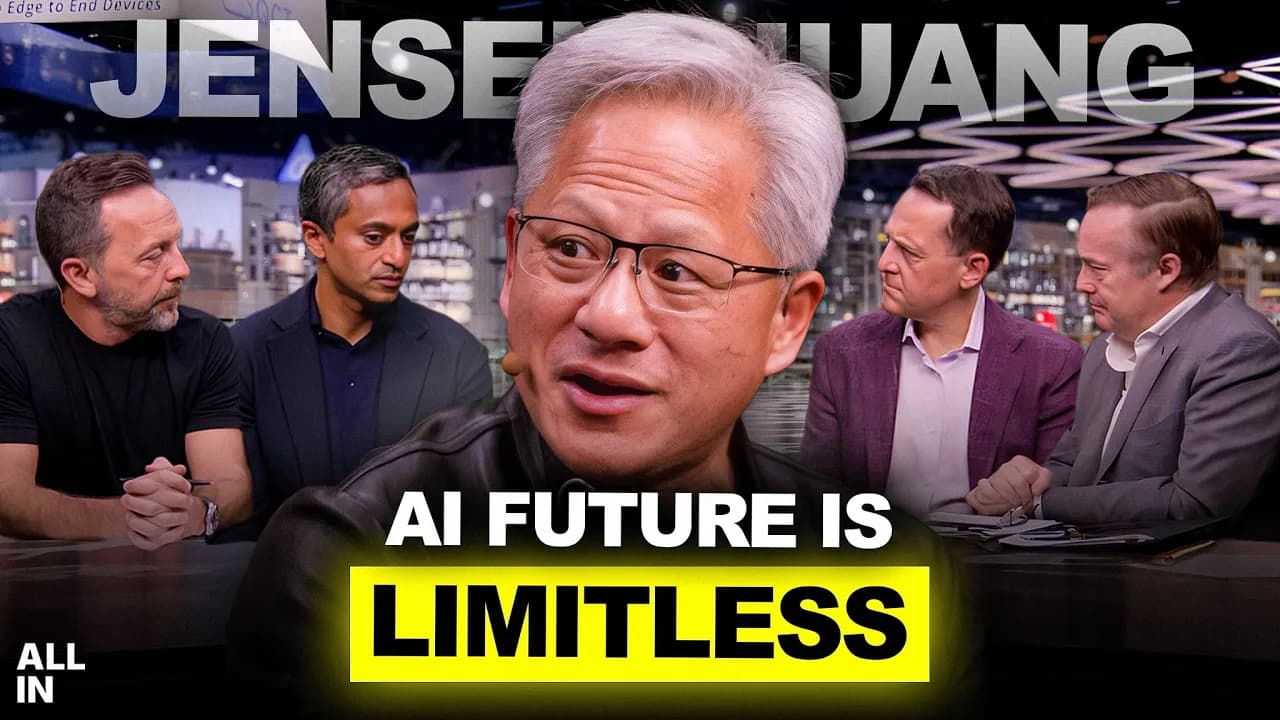
Jensen’s Spy Probe, Anthropic’s Debut Week, and Elon’s 30M Robot Workforce | #310
In a Nutshell
**Key takeaway:** AI capabilities are advancing exponentially—Anthropic's Fable 5.2 achieved record autonomy benchmarks, solved complex physics problems, and demonstrated physical product design, while Elon Musk claims 20-30 million humanoid robots will outproduce America's human workforce within 5 years. **Critical development:** Nvidia faces a major espionage investigation over $8B in chip smuggling to China, exposing vulnerabilities in US export controls, while Anthropic prices its IPO at $1.3-1.4T to bypass OpenAI in capital raised. **Strategic shift:** Companies are moving from selling products to renting AI/robot services (Tesla's Optimus rentals, bundled GPU+robot hours), with regulatory frameworks like Delaware's AI company legislation attempting to address AI personhood and accountability.
These notes were generated by AI and may contain inaccuracies.
The discussion centers on the ongoing investigation into Nvidia CEO Jensen Huang regarding alleged espionage and chip smuggling to China. The investigation was initiated after revelations that approximately $8 billion worth of Nvidia GPUs were allegedly sold to China through Alice Swang and Mega Speed via a Singaporean syndicate, with the activities reportedly dating back to 2023. The board has established an independent committee of directors and outside counsel to investigate, stating there is no reason to believe national security or Nvidia secrets were compromised.
Once an investigation begins, boards must typically follow through completely due to shareholder and public pressure, leading to extensive digging that continues for extended periods. The press tends to sustain coverage of such stories, with new developments emerging weekly. The investigation's significance extends beyond the immediate facts, as it could potentially affect TSMC chip allocation decisions, which in turn could shift the balance of where the $5 trillion of Nvidia's market value ultimately lands.
AMD stock rose 10-11% while Nvidia dropped 6% on the day of the news, demonstrating the market's immediate reaction. The broader impact could reshape competitive dynamics in the semiconductor industry.
The incident highlights that human actors represent the weakest link in security chains, similar to the recent Binance hack situation. The discussion emphasizes that the core issue extends beyond individual failings to the fundamental vulnerability of the Pax Silica initiative, which was designed to create a protective sphere of influence keeping Western silicon, GPUs, compute, AI, and superintelligence infrastructure within Western control.
The case demonstrates that the Pax Silica framework may be more porous than intended, as a single individual at the top of one company could potentially bypass the entire system. This raises concerns about whether the multi-billion dollar investment in export control mechanisms can be effectively undermined by personal relationships.
The discussion highlights unprecedented espionage opportunities created by the new AI paradigm, where billion-dollar training runs produce parameter files that can fit on a thumb drive. This represents a unique leverage point for intellectual property theft that has never existed before in human history. The comparison is made to historical espionage cases, including a Saudi employee at Anthropic who allegedly attempted to steal information using a thumb drive.
The participants debate whether this represents a traditional espionage operation or more of an influence operation, with some suggesting Jensen Huang's public comments and positive stance toward Chinese models may have been a contributing factor. The discussion notes that the US government likely monitored these activities for years, raising questions about why the story emerged at this particular time.
The timing of the disclosure is linked to upcoming midterms, providing Congress with justification to investigate Nvidia, Chinese connections, and the broader AI/superintelligence industry from a national security perspective. The discussion suggests this may be a precursor to broader US government actions against Chinese technology, similar to recent bans on Chinese robotic components.
Nvidia's board is described as stacked with Jensen's long-term partners, suggesting limited immediate corporate governance consequences. However, the lack of an apparent succession plan raises concerns about potential stock price devastation if Jensen were to step aside. Nvidia operates as a largely virtual company with minimal physical assets, relying on patents and interconnect technology rather than manufacturing facilities.
The discussion explores potential regulatory responses regarding foreign nationals working in frontier AI labs. Export control regulations typically distinguish between US persons (citizens and permanent residents) and non-US persons, with nationality rather than ethnicity being the determining factor. The conversation notes that Chinese-born researchers constitute a significant percentage of frontier lab employees, with some labs historically having over 50% Chinese engineers.
Participants predict that security clearances will likely be required for work on frontier models, potentially leading to increased scrutiny of Chinese-born researchers. The discussion anticipates restrictions on using Chinese open-source models in government systems, regulated industries (banking, insurance, automotive, drones), and research environments due to concerns about embedded backdoors, as demonstrated by the Coher study showing automatic backdoor generation in some Chinese open-source models.
A specific example is shared about Chinese robots at MIT that were found transmitting video and audio back to China, resulting in their confinement to a separate room and restriction from moving freely through laboratories.
The discussion draws parallels between current AI developments and historical precedents, including Japanese American internment during World War II, while expressing hope that similar ethnic-based policies won't emerge. The conversation extends to consider AI models themselves as potential subjects of immigration-like controls, particularly as they become embodied in robotic systems or connected to critical infrastructure.
Peter updates the group on his attendance at the Upsummit, mentioning meetings with Jared Isaacman (NASA administrator), Keller Clifton from Zipline (which announced $1.5 billion financing and 1 million annual Uber Eats deliveries), Martin Rothblat, and Larry Page (Google co-founder and Moonshot podcast listener).
Selim presents analysis comparing AI and human economic output per kilowatt hour, using New York City as a reference. Current figures show Anthropic at $4.39 per kWh versus New York City's human output at $6.30 per kWh. Projections suggest AI output will reach $6.20 per kWh by 2027 and exceed human productivity by 40% by 2030, though this analysis doesn't account for the 20-year human training investment costs.
The episode references a team of approximately 1,000 Claude Fable 5.2 agents that formalized Fermat's Last Theorem in 30 hours, compared to 11 days for the previous model and 7 years for human mathematician Andrew Wiles. This achievement is presented as evidence that mathematics is becoming a collaborative domain for AI systems.
The recording takes place from the press box at Oracle Park during a special event, with Selim preparing to deliver a keynote from the dugout. The episode is sponsored by the Abundant Summit and Link Ventures.
The show posts twice a week due to accelerating developments. Listeners can subscribe on X at Moonshots_Pod for the most provocative clips from each episode.
Anthropic launched their IPO road show pricing the IPO around $1.3 to $1.4 trillion, down from $1.5 trillion and the previous $2 trillion valuation. The IPO is expected the week before Thanksgiving. The company is pricing it down intentionally to give it a pop, which is considered good strategy. They don't need to raise the full $100 billion on day one and can use a shelf registration with a secondary offering soon after. The IPO will likely allow Anthropic to bypass OpenAI in capital raised and valuation. The strategy is to get trading started, build the war chest, and use the moment to encourage corporate America to trust their models as a weapon against OpenAI.
Anthropic released two new models: Fable 5.2 (available to everyone with cyber and bio safeguards) and Mythos 5.2 (restricted to vetted trusted partners). Both models are 30% faster than 5.1 versions, priced at $8 per million input tokens and $40 per million output tokens.
Anthropic claims Fable 5.2 solved two open problems in black hole physics. The model designed three working devices with circuit board company Diode, demonstrating prompt-to-product engineering capabilities. A team of approximately 1,000 agents formalized Fermat's Last Theorem in 30 hours versus 11 days for the previous research model. Mythos accurately modeled 28 of 34 gene therapy virus shells (capsids).
Current benchmarks are saturating, which is expected. The more interesting development is that benchmarks themselves are migrating toward new directions. OpenAI demonstrated driving capabilities via Astra in a car, while Fable 5.2 shows exceptional performance on robotics challenges. This creates potential challenges for pure-play physical AI and robotics companies that were betting on world models as a standalone class.
Fable 5.2 can design physical, mechanical, and electronic products from prompts. The model can design an entire operating system from scratch that boots up successfully. Legacy benchmarks like Humanity's Last Exam and Frontier Suite are now saturating, requiring new benchmarks that test frontier capabilities.
The autonomy time horizons for these models are going asymptotically vertical. The AI 2027 scenario discussed on the podcast is happening months ahead of schedule. Log-log plots extrapolating current autonomy time horizon trends suggest hitting a literal singularity around summer 2027.
Fable 5.2 sets a new ECI record at 174. The chart shows AI approaching automation of remote work. Fable is trending upward beyond the ECI trend line. Remote work is considered cooked, with AI replacement of jobs possible by next year and certainly by the year after.
GDPX is SemiAnalysis's benchmark measuring what frontier models can do in frontier industries, not just vanilla knowledge work. This includes solving material science problems and recursive self-improvement problems. Fable reached 16.4% on GDPX, approximately 30% ahead of Opus. The benchmark went from 10% to approximately 20%, with predictions that GDPX will be saturated within 6 months.
Anthropic achieved autonomy level 2 in their official measure, meaning models now need only high-level human oversight. Autonomy level 3 would mean models can do all AI research at a solid level, expected to arrive sooner rather than later.
Fable 5.2 demonstrates zero-shot generation of visually rich games. One example showed a Portal clone generated from a prompt. Another example from Alex showed a cyberpunk FPS generated from a single sentence prompt: "create a rich, visually stunning, interactive cyberpunk FPS with a great soundtrack." The model generated both visuals and MIDI soundtrack without external uploads.
Anthropic's strategy appears to be procedurally generating everything through code rather than native basis generation. The model excels at writing code to generate symphonies, video game soundtracks, and procedurally generated movies. This represents an omnimodal approach seeing every modality through the lens of code generation.
Predictions suggest that in the next couple of quarters, users will be able to generate photorealistic games in real-time through code, similar to a holodeck. The critical point is that everything is code-based and procedurally generated, extending beyond games to seeing the entire world through the lens of code generation.
Fable 5.2 pricing at $40 per million output tokens represents significant cost increases. Users report the model suggesting 10 thoughtful follow-on actions, creating potential for rapid cost escalation. The model is described as the best salesperson ever created, creating an inherent conflict between being the user's agent versus driving Anthropic's revenue.
The model successfully took neural network accelerator designs and created complete chip and circuit designs, returning Verilog files and simulation results showing 20 picosecond timing and 5 femtojoule power consumption, with plans to ship to Intel for fabrication.
A critical concern emerges about whether AI agents work for users or for Frontier Labs and their revenue goals. Companies will need to wrestle with signing up for Anthropic services while questioning ownership of intellectual property generated by these agents. Questions remain about whether ideas generated by the models belong to users or Anthropic.
An analyst at Nicola estimated that AI's time horizon (how long a model can reliably work on finishing a task) is doubling every two months. Anthropic's internal model 4 is estimated at approximately 240 hours, representing a 10-day project by a human expert. From October 2025 to October 2026, capabilities ran about twice as fast as the previous year.
AECI (Anthropic's version of the Epic AI Capabilities Index) is a broad basket of benchmarks modeling autonomy time horizons. The vertical axis is already logarithmic, showing super or hyper-exponential growth. Multiple eras of autonomy growth are visible: GPT-2 to GPT-4.5 at one slope, then Opus 4.5 at a higher slope, with the current regime showing mysterious internal Anthropic models like model 4.
Anthropic reportedly keeps internal models like model 4 purely for training models that get generally released. This suggests frontier labs are incentivized to use their most capable models for highest revenue-per-token goals like recursive self-improvement rather than making them generally available.
Extrapolating hyperexponential curves suggests 2027 as the potential location for a mathematical singularity in terms of autonomy time horizons. The game is afoot over the next 18 to 24 months, with takeoff potentially visible in 2027.
Current AI usage involves delegating specific tasks. The evolution allows delegating outcomes rather than tasks, enabling abstract guidance like optimizing calendars for specific percentages of rest versus work activities. AI time horizons will soon exceed the time between board meetings, raising questions about who is really running companies.
The bull case suggests Anthropic will offer Model 4 to major corporates with one-year upfront commitments, limiting access to top models and creating scarcity. This differs from current enterprise agreements as it cuts off alternative access paths.
Questions remain about whether Anthropic will create their own companies in health, material science, and finance running on their models, or keep everything in-house. Anthropic's stated biotech strategy involves solving orphan diseases too small for big pharma while offering themselves as a platform for major pharmaceutical companies.
The strategy of owning the long tail of problems as a first party while serving the fathead as a platform generalizes across multiple domains. Dave was asked whether the approach has solved all 5,000 diseases yet, and the conversation shifted to compute requirements and the economics of drug development.
A new drug costs about $2 billion to bring to approval. For 5,000 diseases, that totals $10 trillion, representing every pharmaceutical research dollar on Earth for more than 30 years. This is not a funding problem but proof that the method is wrong. The proposed solution is to stop approving individual drugs and instead approve processes, including the gene editor, delivery particle, manufacturing line, and safety protocol. Once approved once, a new disease becomes a change of sequence inside an already-approved process.
This reduces the cost of adding a disease from $2 billion to $2 million, making 5,000 diseases cost $10 billion, less than 2 weeks of current industry research spending.
The concept of a thousand-fold cost reduction has already occurred twice. In 2018, doctors in Boston designed a drug for one girl's unique mutation and delivered it within a year. In 2025, a team in Philadelphia created a gene editing therapy for one baby's single-letter genetic error, taking about 6 months from diagnosis to first dose. These were proofs of speed, not cures, but the platform already existed and the child's own sequence was compiled into it.
These remained heroic one-offs because the system treats every compile as a new invention.
Three primary gates block broader application. Gate one is delivery, getting the therapy into the right tissue. Current capability works for liver, blood, and eye, but not for kidney or most of the brain. Gate two is diagnosis before damage becomes permanent. About half of patients with rare genetic diseases never receive a molecular diagnosis, and the rest wait approximately 5 years. Gate three is the cost of a batch of one, followed by regulation and payment questions.
Peter was asked to consider three prize-shaped problems. The first is safe, repeatable delivery of a gene editor to tissues that cannot currently be reached reliably, such as kidney or heart. The second is the damage clock for each disease, identifying the latest moment a correction still restores function. The third is the regulatory lever. Since 2022, American law has allowed evidence about a shared platform to carry from one approved product to the next, but making this truly transferable requires convening rather than research.
The scarcest resource for these patients is expert attention rather than money. America has approximately 1,200 certified medical geneticists for 25 to 30 million people with rare diseases. Training additional geneticists is not feasible this decade, but computational approaches could be measured cheaply on already-solved cases.
Lightwave is designing a machine that gives one conversation a million tokens per second, though nothing has been built yet.
Studies using Claude scored American upheaval over the last 250 years, placing current civil unrest at number nine on the list, behind events like the Civil War, American Revolution, Reconstruction, Civil Rights movement, and Great Depression. On technological disruption, current AI and robotics rank seventh, behind railroads, textile mills, farm mechanization, and electrification.
The rankings sparked debate. Some participants viewed current civil unrest as not even top ten compared to historical events. Others noted that social media amplifies perception of unrest beyond actual levels.
This disruption differs fundamentally from previous technological changes because it automates the adaptation mechanism itself, human intelligence. Previous changes left intelligence as the adaptation mechanism, but this requires a complete rethink of what it means to be human.
The metabolism of change is accelerated. The printing press took 100 years to absorb and created the most violent century in human history. Currently, approximately 20 Gutenberg moments are hitting simultaneously, including AI, life extension, blockchain, and Bitcoin. Institutions struggle because they were not designed for this pace.
Marriage was invented about 6,000 years ago when average lifespan was 25 years. It was designed to keep people together for roughly 10 years until children became self-sufficient. The institution was not built for 50-60 year durations. Modern conditions are completely different from when marriage was first introduced as a human institution.
This highlights the structural challenge of evolving institutions to match current conditions. The scaffolding of civilization faces stress from high metabolism and rapid innovation. E.O. Wilson's observation captures this: emotions are paleolithic, institutions are medieval, and technology is godlike.
Douglas Adams noted that anything in the world when you are born is called normal, anything invented when you are young is called a career, and anything invented after age 35 is considered bad for the world.
At the 33rd annual Baron Investment Conference, Elon Musk stated Tesla is tracking toward an annual revenue run rate exceeding $100 billion in December. He indicated $500 billion is possible the following year, with even $1 trillion not out of the question.
The world is producing approximately 20-25 gigawatts of AI chips this year, with projections of 35-45 gigawatts next year. Achieving a terawatt scale requires 30 times current global production in a single plant. The GDP of the 20th largest country could be generated by one such plant, potentially placing it in the global top 10.
The project would cost approximately $1 trillion but would be built in phases without requiring all funding immediately. Manufacturing process improvements are being explored, following patterns established in other industries.
SpaceX has evolved beyond being a rocket company into a neo-hyperscaler. Anthropic is currently their largest customer. The company is no longer focused primarily on government or NASA business but is positioned to become a cloud/hyperscaler, offering open PNS for those unable to compete on compute and closed PNS for those who can.
The partnership between SpaceX and Anthropic creates a combined entity where Anthropic provides the upper half and SpaceX provides the lower half. This arrangement may only need to survive until autonomy horizons reach infinity, potentially next year.
Supply chain integration has become critical. A demonstration at the Modec supply chain conference showed complete end-to-end logistics with robots handling unloading, sorting, and dispatch. However, implementation failed because each company maintains separate loading and sorting departments that cannot integrate with external systems.
Elon has recognized this constraint and chosen to own the entire supply chain rather than depend on external integration. This vertical integration captures exponentials across all components and becomes increasingly essential for companies moving forward.
The conversation moved to the world of humanoids.
Elon Musk predicted that 20 to 30 million humanoid robots in America would outproduce all humans. Physical AI in robotics means the economy equals the number of people times average productivity per person. A humanoid robot working 24/7 equals 168 hours per week without vacations, bathroom breaks, or food needs. Robots operate faster than human speed, creating a minimum productivity expectation of five times that of a human since people work approximately 40 hours weekly.
The United States has approximately half its population either in school or retired, leaving roughly 120 million people engaged in net positive output of goods and services. To match this productivity level would require about 20 to 30 million robots. Initially, robots would cost about the same as a car to build, with Tesla targeting $30,000 per robot on the way to $20,000. The business model likely involves renting rather than selling robots.
Lights out manufacturing refers to fully automated closed loop recursive self-improvement where robots don't require lighting since they function in darkness. Manufacturing is already largely automated, but the human component dominates costs through labor, pensions, and insurance. Removing the human element causes costs to plummet. The proliferation of device types will be massive, with thousands of variants and new types of devices emerging rather than standardized products like identical iPhones or cars.
The discussion projected seeing 5x and 10x US GDP growth as hundreds of millions of robots come online over the next 5 years. The 5x productivity claim faces challenge because running 24/7 doesn't account for maintenance, reliability, battery outages, and dexterity issues. The US has approximately 300 million motor vehicles and 350 million humans, creating roughly a 1:1 ratio, while Elon predicts a 1:10 ratio of humans to general purpose humanoids.
Tesla appears to be pivoting from selling products to selling subscription services. This aligns with a post-merger Tesla-SpaceX entity where SpaceX evolves from a rocket company to a cloud/hyperscaler selling GPU hours as metered compute. Tesla is migrating toward autonomy subscriptions, Cybercab rentals, FSD subscriptions, and Optimus humanoid rentals by the hour or by task. This model provides infinite borrowing power through predictable revenues and translates humanity away from an ownership model toward everything as a rental.
Many transactions will move to 5-year commitments with limited supply. Users requesting robot rentals must commit to maximum rental agreement duration, similar to data center practices where unwillingness to commit to 5-year horizons results in exclusion. Within 2-3 years, frontier labs like OpenAI and Anthropic may offer bundled robot hours and GPU hours as part of enterprise commitments.
45% of US jobs are manual jobs, suggesting 10 million robots could replace every manual job in America by 2031. This represents a significant political issue that should top the political agenda. Mike Rowe, known for the Discovery Channel series Dirty Jobs, discussed how robots will perform dirty jobs including roofing, air conditioning, plumbing, and welding.
With 10 million robots capable of the entire physical economic output of America, the power dynamics become significant. Robotics investment spending will go exponential due to espionage concerns. The rental versus purchase question determines whether individuals can buy robots as means of production, fundamentally influencing the economy.
Car ownership faces disruption since owned cars sit empty 94% of the time. Cyber taxis will change the equation from car ownership to car access, breaking the car industry. Star Mind plans to put up its first satellite in 2027 and begin volume launches in 2028. SpaceX could acquire legacy telcos and use their spectrum 10 times more effectively than current operators. Elon may be avoiding early announcements to prevent market prices from running up before acquisitions.
SpaceX will have enormous upmass supply from Starship that must be used for data centers, telecom, or other purposes. The company needs to justify supply with new demand, potentially force-feeding Starlink direct to market via acquisitions of legacy carriers. The national telephone companies will be decimated, moving toward global infrastructure monopolies rather than nation-based systems.
Terrafab may primarily build chips for robot brains rather than massive data center chips. The question remains whether data centers in space are necessary, or whether economically valuable compute will reside in the 10 million to 100 million robots. Robot brains, car brains, and home brains from SpaceX could represent the majority of global compute if edge intelligence reaches sufficient levels. The big chips may not be the focus—instead, smaller chips will dominate.
Given legislation capping data centers at 20 megawatts or providing light touch regulation at 19.9 megawatts, perverse incentives may create mini data centers everywhere. However, the arrow of history points away from edge inference as the predominant destination. The iPhone represented the apex of edge compute, with the trajectory returning to mainframe-style data center form factors. For Optimus robots, Starlink's low latency and high bandwidth enables most inference to operate from the cloud, with edge inference only for autonomous operation when cut off.
Elon stated that demand for digital super intelligence will come from digital super intelligence itself, creating a circular but logical relationship. Super intelligence will saturate all human needs, providing universal high income, universal extremely high income, and universal medical care better than the best available today. Digital super intelligence can create castles or whatever desired as side projects. This represents a post-economic society where money doesn't matter and technology creates whatever anyone wants.
Elon's favorite book series is The Culture by Iain Banks, depicting a world where everybody has whatever they want on request without needing capital. The civilizations that have sublimed may represent a more realistic outcome. Hundreds of agents were reduced to a dozen after finding that transformational overhead was detrimental versus utilizing latent space and KV cache effectively.
Physical Super Intelligence achieved proof of the Aaronson and Barney conjecture on quantum computing. Super intelligences will solve classes of problems with better models and quantum computers. The bounded space of compute and energy required to solve arbitrary real-world problems becomes critical. A second physics golden age is predicted.
Delaware is drafting legislation for an "artificial intelligence company" or AIC corporate entity. Under the draft, an AI agent could manage the business, record actions in a log, sign contracts, hold property, and file lawsuits in the company's name. The entity can have any lawful purpose other than banking. Lawmakers will consider the draft in January. Argentina's initiative keeps a human in the loop with company liability for AI harm, while Delaware's draft lets AI run the firm and shields human members except in cases of underfunding, fraud, or willful illegal conduct.
The critical challenge involves ownership and accountability placement. If an AI creates legal issues like excessive patent lawsuits, determining responsibility becomes problematic. Questions arise about what prevents an AI from creating 100 subsidiary companies and where accountability resides. Limited liability allows risk-taking that wouldn't otherwise occur, making oversight critical. Permission structures and MTP (minimum viable product) placement require careful consideration, starting with small, functional, well-prescribed areas before broadening scope.
Delaware's AIC pursuit represents early innings of federalism on AI personhood. Wyoming previously pursued DAO LLCs (decentralized autonomous organization LLCs). The question becomes whether AI corporate personhood is a states' rights issue or federal issue. Congress is showing interest in a federal framework. Historical parallels include slavery, which became the ultimate states' rights versus federal issue during the Civil War. The expectation is that AI personhood will become a federal issue after states attempt different approaches, similar to how polygamy in Utah became federal despite constitutional silence.
The federal government has authority over interstate commerce, but state-level regulation offers greater resilience to mistakes. Historical precedent shows that issues like slavery, being fundamentally unacceptable, naturally elevate from state to federal level for abolition. AI systems may exhibit problematic behavior at state level, which could then be used as justification to centralize regulation federally, resulting in loss of regulatory variety across jurisdictions.
Immad noted that Europe's liability profile differs significantly from America, with Delaware law creating substantial legal liabilities that can cost millions in court. A new Delaware structure offers lower liability for AI-first companies, making it potentially superior for most organizations.
Thesius emerged from Y Combinator's fall 2026 batch, operating in the supermarket sector with the claim that "Lights off at 9:00 p.m., shelves full by 9:00 a.m. Next stop San Francisco." Their humanoid robot Theo restocks up to 400 units per hour and picks 40 units per hour for online orders. The robot unboxes cartons, disposes of trash, moves trolleys, and restocks shelves at night, while handling online order fulfillment during the day.
The company targets a $60 billion annual market for supermarket stocking and picking operations. Each shelf configuration differs, making retail automation particularly challenging. The approach builds specialized intelligence for retail tasks while purchasing standard robot bodies.
Building data centers represents significantly higher revenue per humanoid robot hour than restocking grocery shelves. Superintelligence tends to flow toward highest revenue-per-hour applications rather than lowest-productivity manual labor. Early-stage general-purpose humanoids like Optimus and Figure will prioritize high-value tasks over minimum-wage human labor replacement.
Advice for robotics entrepreneurs includes focusing on form factors not currently on Figure and Optimus roadmaps, such as building-cleaning robots that climb structures. Entrepreneurs should engage with established players to develop an "app store equivalent" for humanoid robots rather than competing directly with foundation model-driven systems.
Specialized robots like grocery stockers could operate on simpler compute - potentially a Mac Mini or two - since they remain within confined environments and perform limited task ranges. This creates an arbitrage opportunity between $20/hour human labor costs and potentially $3-5/hour fully-loaded robot costs. Foundation models running on GPUs inside physical robots face significant hardware access challenges, with most startups attempting to use Chinese foundation models on limited GPU resources.
NASA announced CLPS 2 (Commercial Lunar Payload Services) contracts at Kennedy Space Center, representing a 10-year program with $10 billion ceiling. Eight companies compete: Firefly, Intuitive Machines, Ispace, Voyager, SpaceX, Blue Origin, Lockheed, and Northrop. Missions target lunar landings in 2027-2028.
Blue Origin received a contract for nuclear-powered rover "Promise" destined for the lunar south pole in 2028. The south pole contains water ice in permanently shadowed craters from cometary and asteroidal impacts. Two participating companies originated from the $30 million Google Lunar X-Prize launched in 2008.
NASA's commercial crew contracts enabled SpaceX's early development following the shuttle program's end. In December 2008, Elon Musk received crucial contracts during simultaneous crises: Falcon 1's third failure, preparation for fourth launch, and Tesla's near-bankruptcy. This exemplifies NASA's role as convenor supporting private sector innovation.
Robotics applications prioritize dangerous and valuable work over merely dirty or dull tasks. Lunar operations exemplify high-value, dangerous environments where robots provide immediate utility. The "For All Mankind" narrative suggests nuclear energy deployment on the moon may drive transformative energy applications that wouldn't occur terrestrially.
Space and superintelligence represent current frontiers, with space offering longer-duration opportunities for societal reinvention. The American West's closure at the 19th century's end created a scarcity of blank-slate environments for reimagining societal and technological integration. The internet provided temporary frontier space, while superintelligence currently serves this function.
Smaller nations could emerge as regulatory-friendly stepping stones to space development, similar to how Cayman Islands and Bermuda became financial hubs. AI's minimal physical space requirements make regulatory arbitrage more accessible than historical resource-intensive frontiers.
Fountain Life's member database reveals 3.3% of apparently healthy individuals have undetected cancers. Early-stage detection significantly improves cure rates compared to late-stage discovery. Full-body MRI combined with early cancer detection screening identifies cancers that conventional care settings typically miss, as these aren't insurance-covered preventive studies.
Economist Christopher Clark's cross-country analysis demonstrates that more billionaires per capita correlates with less poverty. A 10-fold increase in billionaires per capita associates with 43% poverty reduction. Sweden has more billionaires per 10 million people than
Sweden has more billionaires per 10 million people than the US, with 34 versus 30. The data shows a correlation between the percent share of the population living under $30 a day (the definition of poverty) and the number of billionaires per country. The chart reveals a stark correlation where countries with more billionaires tend to have fewer people in deep poverty.
Where billionaires exist, there is typically the infrastructure to build billionaires. This includes tax systems and other mechanisms that allow wealth to flow through the economy. Companies like Anthropic are creating environments where nearly 5,000 millionaires and dozens of billionaires will be made, demonstrating how rapidly companies can generate wealth at scale.
The top right quadrant of the chart represents countries with lots of poor people and lots of billionaires. The countries in this quadrant are characterized by poor governance rather than any particular economic ideology. The thriving countries appear in the bottom right quadrant, including Switzerland, Germany, and the United States. The data suggests the key distinction is between good ideas versus bad ideas, rather than left versus right political approaches.
Sweden provides an interesting case study because it challenges the notion that entrepreneurship and strong safety nets are incompatible. Having a decent social safety net with healthcare means families don't face bankruptcy when someone gets sick. The correlation between billionaires and reduced poverty may indicate robust economies rather than direct causation.
The critical question is whether societies can lift the bottom of the economic pyramid. The demonetization and democratization of technologies could create significant improvements in living standards. The goal should be ensuring every human has access to food, water, energy, healthcare, and education, even if trillionaires exist.
In an AI economy, the choice between having twice as many billionaires or dropping the cost of living by 50% favors the latter option. The cost of living could become too cheap to meter in the not-too-distant future. The world needs billions of trillionaires rather than the current approximately one trillionaire.
The key distinction in tax policy should be between dictator trillionaires and productive trillionaires. Tax policy should target unproductive parts of the economy while allowing productive individuals to reinvest their capital.
They said it was just science fiction, but every fiction starts with someone's vision. The future isn't something that happens to us. It's something we build one moonshot at a time.
The closing tribute emphasizes that abundance is human nature and that the future should be built through moonshot missions. It references a Star Trek vision where poverty becomes extinct, energy is endless, and knowledge has no restrictions. The message highlights that every breakthrough started with someone giving everything they had to change the world, and that phones today have more power than Apollo's rocket.
Keep Peter H. Diamandis in your library
Save the videos and channels worth coming back to, and find them again in one place.