Why Founders Like Jensen Huang Are Irreplaceable | Tobi Lütke, Shopify
In a Nutshell
Tobi Lütke argues that founders like Jensen Huang are fundamentally irreplaceable forces of nature whose departure ends the original company, replacing it with custodians who can only preserve rather than advance the vision. He contends that Jensen built Nvidia's four-trillion-dollar value through ten years of CUDA development without market demand, followed by strategic allocation of scarce GPUs to startups and open-source AI initiatives that no professional CEO would replicate. The video warns that societal progress depends on founder-driven value creation over redistribution, and that recent violence against CEOs plus "robber baron" framing threatens the entrepreneurial engine that converts sand into thinking machines worth trillions in economic activity.
These notes were generated by AI and may contain inaccuracies.
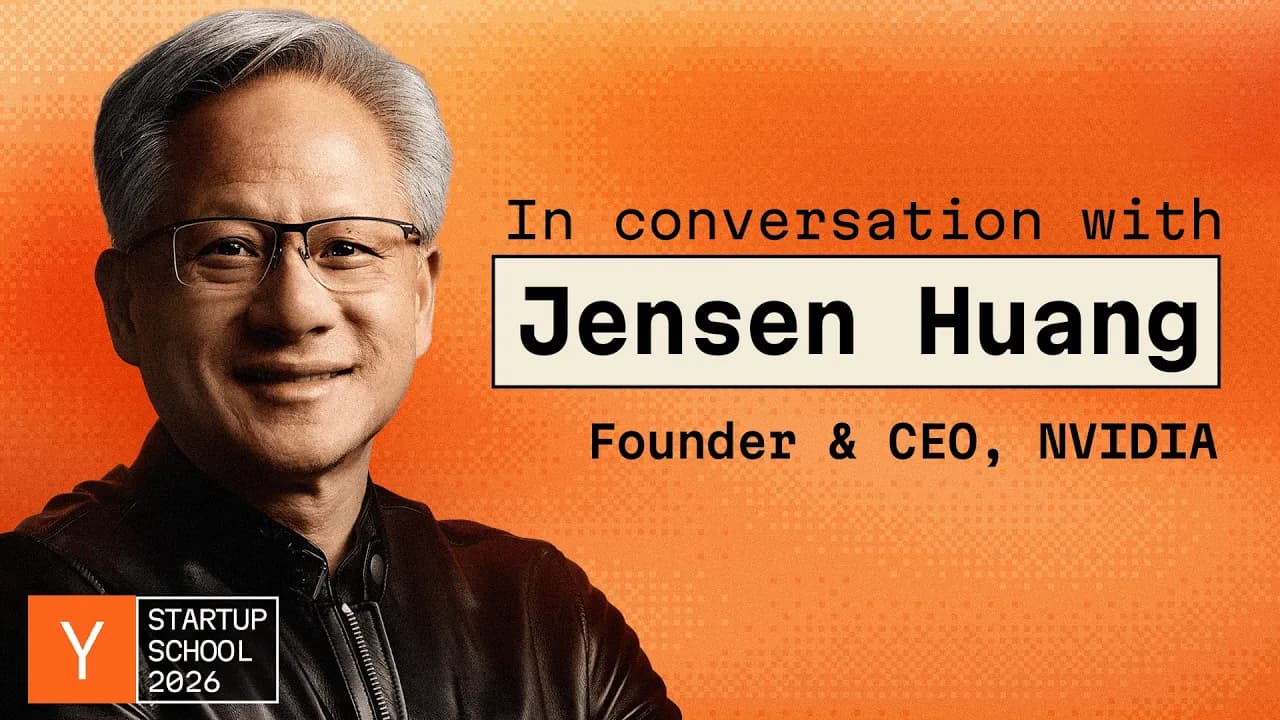
Tobi Lütke addresses the resignation of Jensen Huang, which occurred four days after allegations of an affair surfaced. The allegations quickly escalated to claims of an affair with a Chinese spy, followed by a TikTok video alleging up to three additional affairs. The conversation focuses not on the personal matters but on the fundamental question of why founders like Jensen Huang are irreplaceable.
Lütke's own words capture the core thesis: "There's no replacing a founder like Jensen. There never has been and there can never be a true succession for a founder like him. Nvidia ends today and it's replaced with a thing cosplaying Nvidia. It will be run by custodians trying and failing to preserve the flame he ignited." The discussion centers on why founders, particularly exceptional ones like Jensen, cannot be replaced.
Nvidia's current valuation exceeds four trillion dollars. The company's product transforms "rocks" into thinking machines, representing the closest thing to magic humanity has created. This achievement stems directly from Jensen's "unindominable vision." Lütke recounts his teenage experience saving money through a paper route and donating blood at three German hospitals to purchase a Riva TNT 3D accelerator, one of Jensen's early products.
Jensen has been integral to the industry, igniting its "magic and spark" through accelerating linear algebra, which enabled modern video games. His dogged pursuit of making products better and better led to CUDA, a programmable GPU architecture that investors questioned for ten years with "why are you doing this?" No one understood what CUDA would accomplish during its decade of development without clear use cases.
The breakthrough came with AlexNet, the first machine learning model trained on GPUs. These are no longer graphical processing units in the traditional sense since monitors cannot be plugged into them, yet they retain the name. Jensen has given the world the gift of graphical accelerators and machines that process so fast they enable synthetic intelligence and industrial applications. Nvidia represents a singular company built around a vision of taking something important and making it "unbelievably good" through "dogged pursuit of absolute excellence for its own sake."
Now that everyone needs Nvidia's products, they represent "the most valuable product on planet earth." Jensen has acted as a statesman, presiding over the responsibility of allocating these resources, bootstrapping industries, and supporting ecosystem development. Lütke argues that "Jensen is irreplaceable" and that Nvidia is essentially "Jensen's exoskeleton." While extramarital affairs are "not good things," only Jensen can run Nvidia. Administrative leave might be possible, but he built a company worth over four trillion dollars that creates value from nothing, generating trillions of dollars in economic activity.
Losing Nvidia's momentum due to board decisions in the face of scandal would represent a societal impact. Progress on planet Earth could be measured in charts ten or twenty years from now, potentially marking "a de-acceleration" after Jensen's departure. Running a high-functioning large company doing important work is "an unbelievably hard thing" with few people capable of doing it. The burden of proof needs to be much higher for claiming Jensen is not the right person to run the company.
Lütke references Michael Moritz's book "The Little Kingdom" about Steve Jobs, published when Jobs was 30 years old. The 2009 updated version "The Return to the Little Kingdom" contains a key distinction: "There's no greater distance known to a man than a single footfall that separates a CEO from a founder. CEOs are for the most part products of educational and institutional breeding. Founders, at least the very best of them, are unstoppable, irreplaceable forces of nature." Founders are forces of nature that cannot be repeated or replaced. There is no succession for a founder.
Succession plans transition founder-run companies into custodially-run managerial companies. Tim Cook represents a success story, extending Apple's runway and building on existing products while adding one or two new ones. However, market cap increases during Cook's tenure must be allocated to products developed under Steve Jobs. While transitions can create valuable companies, the original company under the founder ends the day the founder leaves. The betting odds of successful replacement are "really really low."
A friend reported an investor claiming Meta would be "the least different" if its founder left. Lütke calls this completely wrong. A year and a half ago, people criticized Meta for hiring researchers at high salaries, yet Meta has become a frontier-level AI lab. "Reinvention of your own company is an aspect of founder-run companies." John Burnham's book "The Managerial Revolution," written before World War II, addresses this topic using the term "bourgeois entrepreneur" instead of founder.
The distinction between builder billionaires and other billionaires is under-discussed. People building companies and products add value that "would simply not exist otherwise." Someone must start the company. Lütke founded Shopify through decisions made in 2004 and persistence for 22 years. He owns five to six percent of Shopify, with 95 percent owned by the public, employees, and early investors who took risks. This is how money is created.
Great societies, fair societies, healthcare, options, and safety nets are created from energy in the form of money generated by entrepreneurial sparks. This involves taking potentiality and converting it into products and services traded between people. Money comes into the world at the moment of product creation. Jensen and his teams take sand and rock and make it think, enabling AI to answer entrepreneurial questions. This is extremely valuable, demonstrated by willingness to pay for ChatGPT subscriptions.
Founders and entrepreneurs are accustomed to naysayers and overcoming objections. The moment safety becomes an issue, many will opt out. Recent CEO assassinations and polls showing up to 60 percent of people on one political spectrum agreeing that "occasional violence against CEOs can be justified" represent consequences of framing all problems as caused by someone else being rich.
Lütke's five to six percent ownership of Shopify represents real value created, but the other 95 percent belongs to others. During a three-hour conversation with Jeff Bezos (originally scheduled for 30 minutes), Bezos suggested the Forbes 400 list is detrimental to society because it focuses on personal wealth rather than wealth created for others. If Amazon was worth two trillion dollars and Bezos owned 200 billion, he helped create 1.8 trillion dollars for others. A list showing "how much wealth the entrepreneur has created" would be valuable.
Understanding where money comes from is the most important question. Only when understood does one recognize who supports human thriving. Redistribution is important but secondary to creation. Western societies increasingly focus on redistribution over creation. If growth stops, only redistribution remains, requiring taking from others. This mirrors the Middle Ages situation with no growth, where the only way to bring more kinetic energy was through birth, resulting in rivalrous competition for resources.
The rejected medieval system was replaced with one allowing people with vision to create goods and services, bringing more money into the economy through GDP growth. This system incentivizes behavior by allowing ownership of small fractions while sharing almost all value with civic society.
Many entrepreneurs give money quietly and anonymously. An organization helping rehabilitate gang members through tattoo removal, job placement, and education received a 50 million dollar anonymous donation from a wealth creator. However, anonymous giving lacks the signaling effect that encourages others to contribute. Carnegie built hundreds of libraries in communities where he sourced steel resources, making his contributions known. Michael Dell gives now rather than waiting until death, establishing kids' accounts as breakthrough infrastructure. Lütke's family made Canada's largest charitable donation to CAMH (mental health research hospital), initially anonymous but later publicized to create amplification effects and make such giving high-status.
The mainstream understanding of the robber baron era held that wealth accumulation involved labor exploitation, creating guilt that was then alleviated through charitable acts like building libraries. This represented a social compact that existed until recent times. Bill Gates was the last major figure to follow this template of wealth creation followed by large-scale philanthropy.
Tobi Lütke rejects the guilt framing entirely. He argues that creating products and services for fellow humans is inherently virtuous, and that this alone fulfills the core purpose of economic activity.
Markets represent the original form of superintelligence. They are vastly more intelligent than any individual participant, adjusting prices in real-time based on supply and demand. This allows people to access specialized services without needing personal competence in every domain. In Toronto, for example, one can call a plumber without understanding plumbing systems because the city's market superintelligence solves this problem on demand.
Markets have existed throughout human history. The oldest clay tablets discovered show people traveling between towns with goods, tracking ownership and profits. These were the entrepreneurs of 12,000 years ago. Free humans create markets among themselves, exchanging goods and compensation that enables further production.
Lütke identifies as not being a full laissez-faire capitalist. He believes monopolies must be avoided and every space of value requires competition. When competition stops, outcomes rarely go well. However, founder-run companies represent an exception where true mission-driven work can produce excellent results without relying on competitive pressure.
Nvidia had no true competition for an extended period, yet continued delivering annual card revisions with new features. Tensor cores were introduced without clear market demand at the time, initially seeming unnecessary for applications like Call of Duty. These cores later proved essential for AI acceleration. This development resulted from vision rather than competitive pressure.
When people follow a true mission, the best outcomes don't require market competition. In all other cases, competition becomes necessary. Once custodians take over, motivation becomes externally induced rather than stemming from an intrinsic burning flame that needs to be fanned.
Jensen Huang is viewed as the statesman of the entire AI industry. Since GPUs are required for AI training with no alternative suppliers, his allocation decisions carry enormous weight. When placing large orders, Huang personally reviews every allocation. Despite the ability to generate significantly more revenue, he has ensured availability for smaller companies and startups, recognizing their potential as future customers.
Huang has championed open source AI despite resistance from parties who prefer closed systems. Nvidia has invested heavily in open source AI initiatives.
The situation surrounding Jensen Huang appears orchestrated. The sequence of events resembles a scripted takedown narrative rather than organic developments. Multiple affairs and a Chinese spy component emerged in rapid succession, which Lütke finds suspicious given the timing and organization. The question becomes who benefits from removing someone who built a company over 33 years into the world's most valuable company while making critical decisions about locations, roadmaps, and the planet's most important products.
The best founders are relentless about saving time and focusing only on what matters most. Fred Smith, founder of FedEx, repeatedly stated: "You have to be absolutely brutal in the management of your time."
Lütke references his appearance with DHH (David Heinemeier Hansson), noting DHH's talk at the Rails build conference where he declared 2026 as the date programming ended for him. The audience, gathered to learn about upcoming technology developments, heard DHH state that programming as traditionally understood is no longer a job.
Web 2.0 represented a period when developers figured out how to transform the web browser from an academic document viewer into a platform for building software applications. This differed fundamentally from desktop software development due to client-server architecture constraints. DHH's Basecamp, released in 2004, marked a significant point when the browser became capable enough for sophisticated web applications.
This era involved building companies, creating open source gifts for each other, then transforming those into customer products with subscription models allowing cancellation at any time. This created honest value exchange relationships.
Computer programming as typing characters into terminals no longer exists in most contexts. Practitioners may remain in specific situations requiring precise control, but this represents a fleeting exception. Everyone who was a computer programmer has transitioned to a new role as creators of things and makers who communicate with computers through wishes rather than code.
This new work involves thinking harder about desired systems rather than incremental next steps. Ambition has increased substantially with more back-and-forth iteration possible.
Lütke has realized his life's ambition of becoming a full-time technologist and product creator at Shopify. He started the company because he couldn't find an existing kick-ass company and felt compelled to create one. He became CEO partly by hiring everyone under himself to preserve the flame of a great company.
He now contributes to Shopify core systems, builds products, tools, and technologies used by thousands within the company. His main advice for those struggling to extract value from AI-driven development is that their prompting is usually insufficiently ambitious.
Lütke conducts prompting history analysis by clustering prompts by type and examining examples from project beginnings, middles, and ends. This reveals that people often bring preconceived solution notions to AI rather than allowing it to explore potentially better approaches or identify whether the stated problem is actually the right problem to solve.
The majority of work now involves what he calls verification engineering - creating acceptance tests that definitively establish whether created systems are good. This represents a shift from productivity-focused development to correctness-focused development.
Formal verification, previously an academic discipline Lütke associated with mathematics proofs using tools like Lean, has become the most important field in engineering. This represents a rapid transformation he didn't anticipate.
Formal verification enables proving system correctness, which is essential for complex systems. When rebuilding systems with agents, the historical shortage of engineers relative to demand becomes addressable through new approaches.
Ruby on Rails exemplifies the framework approach that constrained possibility spaces by providing known-good ways of building web applications. Abstractions pretended certain complexities didn't exist, allowing engineers to work with databases through simple object interactions while hiding wire protocols, retry logic, and database complexities.
The industry built abstractions primarily for productivity gains, enabling one engineer to produce 10x or 100x the code of engineers without these tools. This productivity imperative led to wasteful use of computing advances, resulting in slower modern software compared to older systems.
Working with AI agents requires entirely different code-writing approaches. Agents require strict rules (linter rules) that human engineers historically resisted as oppressive. Agents thrive with explicit constraints but struggle with abstraction layers that require navigating through multiple files to understand consequences.
Since agents produce too much code for human review, formal verification becomes essential. This involves specifying system states and creating models that verify all possible states are considered and tested.
Using tools like Claude Code, developers can identify implicit state machines in codebases and make them explicit. This process reveals human limitations in code writing. TLA models can then verify all cases are specified, typically uncovering numerous issues in existing codebases.
Additional security analysis using tools like DeepSeek reveals vulnerabilities that suggest human-written code in production should be replaced within 6-12 months.
Software will become near bug-free and 100x faster in many instances. Instant startup times will return. Quality will improve dramatically, enabling sophisticated functionality on older hardware. Computers will adapt to user needs through direct instruction rather than requiring users to adapt to software limitations.
Software may become fully automated in cloud environments or accessible through conversational AI interfaces rather than traditional computer interactions.
History's greatest founders understand that recruiting the best talent is the most important priority. A players recognize other A players, which explains why companies like Ramp, Shopify, 11 Labs, Uber, and DoorDash use Deal for global hiring infrastructure.
Deal enables businesses to hire, pay, and manage workers anywhere in the world. The founder of 11 Labs noted that Deal enables hiring exceptional talent globally, accelerating innovation and bringing more voices and ideas to every corner of the world. Deal is trusted by over 40,000 companies.
Tobi Lütke explains that AI is best understood as an instrument rather than merely a task accelerator. He uses the guitar analogy: when first picking up a guitar, a person might figure out a melody on one string, but producing real music requires deeper understanding. Similarly, a small group of people in the world can "play AI" at an advanced level, understanding the tools despite the fast-moving base.
Instead of accelerating tasks, the approach is to learn the instrument by providing AI with problems to solve and showing up with openness for a wide variety of solutions. As tools become more sophisticated, it's not just the AI that improves - the harnesses using the AI are also becoming more sophisticated.
Almost all engineering at Shopify now happens through "factories" - constellations of AI agents with different jobs that loosely mirror organizational structures. These agents collaborate through chat or message boards to accomplish much longer horizon tasks.
It's better to be more ambitious with AI and have it do reps on solving problems than to accomplish tasks, because accomplishing just tasks keeps you in a smaller frame of reference. This is especially important given two factors: cybersecurity being the number one concern, and the resource crunch with compute that's likely to happen in the next year.
There are compelling reasons why software needs to be rewritten: it needs to run faster and use fewer resources. The supply chains are getting very tight, and human software isn't secure enough. If you want a laptop next year, everything is becoming constrained.
Tobi describes being extremely fortunate to have self-sustaining small groups within Shopify where everyone is at the same level. The implicit understanding is that you're part of this club because you can keep up, and to keep up you also have to contribute.
He hasn't had a weekend this year that he didn't work through entirely because he has zero ability to stay away from progress in computers. He feels made for this moment and believes every decision he's made in life pointed at this moment.
Tobi's philosophy: if you want to be successful in life, it's very simple - you have to be too good to ignore when opportunities arise. You need to be amongst the first people being called when something interesting happens, or the obvious choice when a promotion or position opens up.
Inside Shopify, he has groups of people who are way ahead of him on many things from whom he can learn. These groups exist in many companies, and people share what they know on X or in podcasts.
The productivity gap between people who understand these AI concepts and those who don't is the biggest gap that's ever existed in any industry, even invariant time. It's comparable to a modern factory versus a medieval blacksmith - there are so many zeros in terms of difference.
Time has almost stopped being a concern. The variable is just how much you're willing to invest in terms of cost.
Tobi explains the concept of building "factories" - if you have an agentic factory that works well in the problem domain you're solving, you can make a decision on Friday and show up on Monday with production code.
He completely rewrote Shopify's internal source repository system called Beta (loosely based on a tool he shared called Wargit) as a weekend project. This system hosts all the code in Shopify and needed to be updated because pull requests are now being merged at a rate 10 to 100 times higher than any other point in company history.
Five years ago, the Beta system rewrite would have been a multi-year project that might never have been attempted. The system is bounded by the amount of engineers you have, and it never gets that crazy because humans write code at a certain pace.
Now, if you decide you need to rewrite your entire database layer because you have an idea that could cause millions of lines of simplification in systems that then need to be rewritten in Rust, you can build all of that in a day. Previously, you'd have to find people with specialized skills, keep them as a really high-performing team for a year, and at the end check if your assumptions were right.
DHH, who is on Shopify's board, mentioned that some of Shopify's internal tools are better than anything he could buy. Shopify has always been an internal tooling company - they make tools for entrepreneurs, therefore they make tools for making tools for entrepreneurs.
This culture of internal tools is a two-sided coin. In every other company, internal tools are typically a hardship assignment where you get interns. At Shopify, it's the opposite - some of the best engineers work on internal tools, and they've found this to be easily worth it.
Because of their culture of internal tools and infrastructure for internal tool making, Shopify was extremely well prepared for the AI age. The AI can now autocomplete basically every internal tool.
Internal tools are wonderful to work on because you can deploy them and your colleagues can immediately say if they're any good. If they aren't, you make changes. If you need some downtime, who cares - unlike production software which requires four 9ths of uptime.
Tobi describes how Shopify feels internally right now as magic. Everyone is like wizards conjuring up beautiful new things from spells cast into factories, agents, and AIs. He's never seen anything like this and hopes people understand how amazing things are going to get.
There's been a limiting factor around software - there are so many creatives who will make things with computers, but there are incredible brains and minds that couldn't make things because they didn't have the skills. Learning how to work with these systems is getting easier every day and involves using language as the main tool, supporting any language.
Shopify wants to get their customers experiencing this first. They create products for themselves first because they need to understand the new tools to a degree that they can play them like an instrument. Only after figuring out what works and what doesn't does it make sense to productize into core products.
Software that doesn't come from a point of fantastic depth of insight is transient. Software will become fantastical, malleable, essentially bug-free, incredibly fast, and delightful in every way. People shouldn't have to care about software - it just has to work. But makers of software should love it and be proud of what they built.
Tobi believes people haven't fully priced in how amazing things are going to get because the shape is going to change. Initially, he thought the quality of all existing software would just go up - bug-free, fast, no splash screens anymore.
People love their computers when everything happens instantly and dislike computers when they're sluggish. When software is too verbose, too complex, or you can't find features, people internalize this as being bad at computers. Computers shouldn't make anyone feel bad about themselves.
Making things work the way people want will cause more people to accomplish their tasks at work. Due to much better experiences, they might be more ambitious with their own projects, potentially leading to entrepreneurship and making products they can sell and share with others.
Tobi's entire philosophy and bias is centered on these outcomes because they're most important to him.
Tobi agrees with Richard Branson's definition that all business is an idea that makes somebody else's life better. These tools allow people to make products that make other people's lives better.
Entrepreneurship is essentially saying you have something good enough to join the market with, making it available through the market system that shares it with everyone. Money is a form of energy directed backwards at the person who created it, causing more products to be created, more iteration, and better products.
Tobi distinguishes between capitalism and free markets. Free markets are the point - capitalism is a term usually offered when discussing small bits and pieces around the margins where markets stop being free, usually in the form of monopoly or regulations. Patents are monopolistic and disable free markets.
The quality of our lives is determined by how vibrant the market is and how many ideas, products, and services are shared through it. The project on planet earth is to cause the market to become more vibrant - to make more products, create value, and take it out of the potentiality of planet earth.
Tobi finds it troubling that the current narrative in media is so different about markets and entrepreneurship. People who are building and creating companies are maligned to the point of drumming up violence. If the destination of entrepreneurship comes with too many downsides, especially bodily harm, then we're going to lose the maximally distributed participatory potential and opportunities that the planet will ever see.
The good news is that new business formation is at an all-time high according to labor bureau numbers. However, there are troubling trends that need to be reversed.
It's unbelievably important to celebrate when anyone starts a company, small or big, and tell stories in a way that makes them relatable. Entrepreneurs are just people who decided to pick up skills and put themselves out there, trying to make goods and services for each other.
Keep David Senra in your library
Save the videos and channels worth coming back to, and find them again in one place.