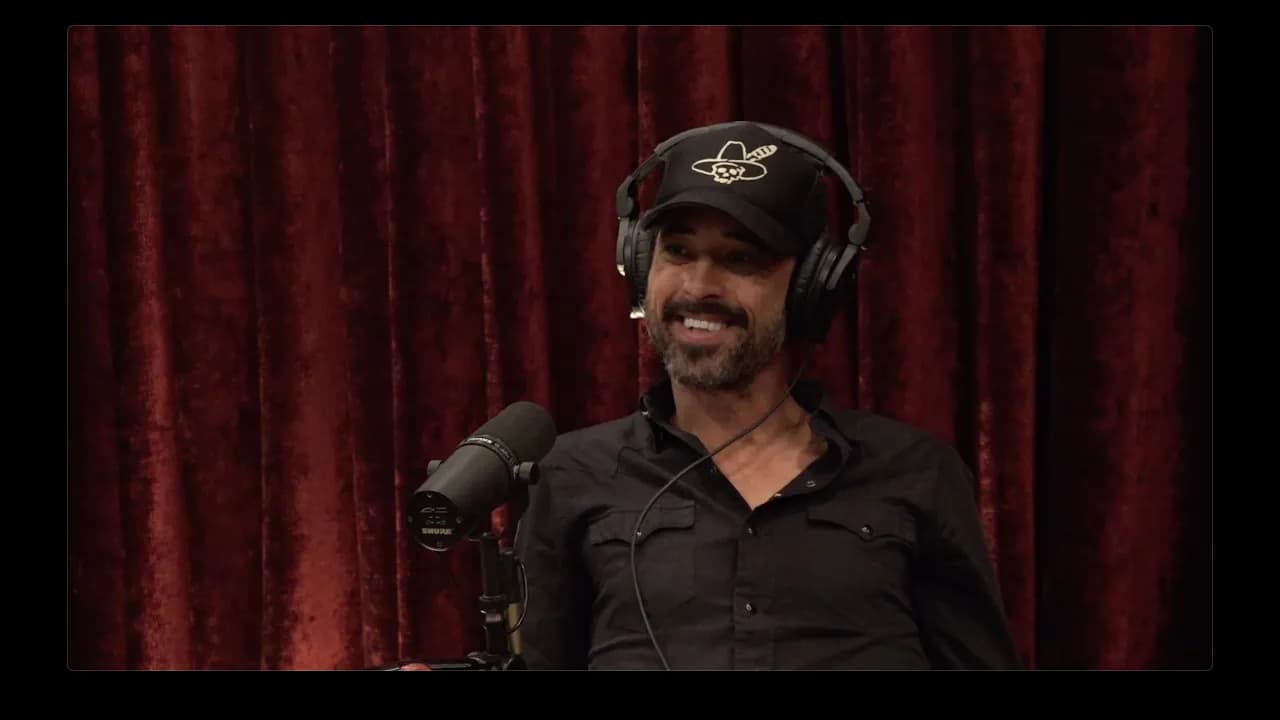
Joe Rogan Experience #2504 - Skylar Grey
In a Nutshell
Skylar Grey describes her path from a rural Wisconsin childhood performing with her mother to a solo career that took off after writing the Eminem hit "Love the Way You Lie." She explains how isolation in an Oregon cabin helped her rediscover her voice after early failures, while later moving to a Napa ranch provided the peace needed for sustained creativity. The conversation also covers her shift toward releasing music more frequently without perfectionism, her experiences with wildlife and farm life, and the value of real human-made art in an age of AI.
These notes were generated by AI and may contain inaccuracies.
Joe Rogan begins by sharing that his wife wants Skylar Grey's song "I'm Coming Home" played at her funeral. He listened to the solo piano version and was struck by its emotional depth. The conversation shifts to AI-generated music, where Skylar Grey sent Rogan a song and he replied that AI isn't yet capable of creating music with genuine emotion. They agree that AI can produce cool-sounding tracks, but real music carries a unique connection to the creator's spirit and creativity. Rogan acknowledges he likes AI music for how it sounds but recognizes it as artificial. Skylar Grey describes her own songwriting as therapeutic and rooted in authentic emotion.
Skylar Grey views technological advances, including AI, as tools that help creatives realize their vision, comparing current skepticism to past reactions against autotune and computer recording. She recalls recording her first albums with her mom on two-inch tape before computers were introduced. Rogan brings up Peter Frampton's talk box, noting how people once criticized it as not being his real voice. They discuss how tools evolve but that AI now can create entire songs in specific artists' styles, including convincing Skylar Grey imitations. Rogan mentions a full audio podcast conversation with Steve Jobs that never happened and fake conversations where people pretend they've been on the show.
The discussion turns to the increasingly blurry line between real and artificial content. Rogan describes this as "the first whispers of the fog of the Matrix" and notes that people are becoming more skeptical, questioning everything. He mentions prominent news figures reposting AI-generated videos that looked like they came from video games. Both express that while the situation is strange, it makes people appreciate real physical connections, real art, and human-made creations more deeply. Rogan shows a chimp skull artwork made from Zildjian cymbals by artist Shane Against the Machine and notes that knowing a person created it adds value. They agree that imperfections and nuance in real art make it more relatable.
Skylar Grey started performing at age six. Her mother was in folk bands and played Celtic harp, while her father sang in a barbershop quartet and her great-grandmother was an opera singer. At age two she spontaneously sang harmony during "Happy Birthday," which her mother noticed. She began joining her mother's band rehearsals and making guest appearances on stage. At six they performed a full hour-long Mother's Day show together at a library in Madison, Wisconsin. Skylar Grey is from Mazomanie, a small village of about 1,500 people. They toured the Midwest playing elementary schools, libraries, women's health conventions, and even a Boy Scouts event with 1,500 attendees.
At age 12 Skylar Grey decided to go solo, buying her first grand piano with money saved from performing. She began writing pop songs. Middle school kids mocked the silly songs she sang with her mom, such as "We Are the Colors of the Rainbow," "Never Smoke Tobacco," and "My Grandma Slid Down the Mountain." Her mother was disappointed because performing together had become her career. Skylar Grey felt driven to pursue her own path and knew she wouldn't sing with her mother forever. She hated school, felt she was wasting time, and begged to be homeschooled. At 16 she dropped out.
An algebra teacher told Skylar Grey that music isn't a career after she missed homework due to a show but still aced a test. The comment motivated her to prove the teacher wrong. Rogan criticizes teachers who discourage creative careers, noting that many enter teaching simply because they need a job rather than because they excel at educating. He argues that if society truly valued education, teachers would be paid significantly more. Skylar Grey reflects that she was a strong student with a 3.9 GPA but felt school didn't align with her music focus.
Rogan suggests the modern education system was designed to produce factory workers and functions as a form of early control, with children walking in lines, sitting straight, pledging allegiance, and raising hands. He notes that ADHD is often treated with medication when children can't focus on uninteresting material. Skylar Grey believes she has undiagnosed ADHD. Rogan views ADHD traits as a potential superpower, particularly the ability to hyperfocus on topics of genuine interest while ignoring boring ones. He mentions avoiding video games because he can lock in for hours. Skylar Grey describes struggling in high school with unengaging classes but becoming fully absorbed in subjects she loved.
At 17 Skylar Grey moved to Los Angeles by herself. She lived on the couch of Roy Hay, the guitarist from Culture Club, in Venice. The city presented major culture shock for a small-town Midwest girl. During her first month, a murder occurred next door; she watched police tape off the area and saw the coroner remove a body from a bloody mattress in the alley. The coroner then sat beside her and flirted, commenting on her beauty while having blood on his fingernails. Rogan notes that LA in 2003 was still relatively functional compared to its current state, with fewer vacant buildings and less visible decay.
Rogan references the documentary Roger and Me by Michael Moore, which details how the automobile industry moved manufacturing plants from Detroit to Mexico, causing massive job losses and economic collapse. He notes that Detroit was once considered the richest city in the U.S. with very high median household income around the 1950s due to Ford, Chevy, and Chrysler manufacturing. After the plants left, the city became largely abandoned, with trees growing through houses and industrial buildings left with broken windows. He compares this to current conditions in Los Angeles, where many buildings now display "for lease" signs.
Detroit was 20% above the US average in income due to the automotive industry. The city had one of the highest home ownership rates in the country. Many commentators and local histories describe Detroit as the wealthiest city in the US during that era, with some accounts claiming the highest standard of living in the world. Articles and tours about Detroit repeatedly refer to it as the wealthiest city in the world in the 1950s, not as the third wealthiest.
Tours about Detroit's history mention the wealthiest city in the world claim. The third richest city in the world line appears to come from memes and social posts that mix or exaggerate real facts. Detroit was exceptionally rich by US standards, but rankings like third in the world are not backed by clearly documented global per capita income comparisons from that period.
The top 1% of the world requires an annual income of $34,000. For the United States, the top 1% threshold is approximately $700,000 per year, with most analyses showing a range of $730,000 to $790,000 depending on the data source and year.
Globally, an annual income on the order of $60,000 to $70,000 places someone in the top 1%. One widely cited analysis found that in 2012, an annual income of $50,000 was enough to be in the global 1%. The $34,000 figure comes from rough older viral estimates and is not based on current rigorous global data. More careful tools and data sets suggest that $34,000 places someone well above the global median but closer to roughly the top 5% to 10% worldwide rather than the top 1%.
Companies take advantage of ultra-poor workers in other countries who are willing to work for low wages. Workers receive around a dollar a day with no healthcare, benefits, retirement, dental, or other protections. They simply receive the money and must figure everything out on their own. People then buy American-branded cars without realizing the manufacturing conditions.
Public school teachers now average $74,000 to $75,000 per year. State averages vary significantly, with the lowest paying states and the highest paying ones like California and New York reaching above $90,000. The national estimate for average starting teacher salary is about $48,000. It takes years of experience and often advanced degrees to reach or exceed the $74,000 average.
Making $50,000 in America means struggling unless someone is super young with no responsibilities. Starting at $48,000 a year is difficult after accounting for taxes, apartment costs, food, and transportation.
Large amounts of money flow through corporations and NGOs through various loans and programs. No politician runs on the platform of finding the best teachers and paying them the most money possible to attract the best and brightest talent.
The idea of checking boxes to direct where tax dollars go, such as to education, was discussed. The concept of voting individually on where taxes are allocated was considered.
Central Asian Shepherd dogs, including the Alabai breed, are used for protecting livestock. These dogs are also called wolf crushers. An Alabai named Nala weighs around 105 pounds and has a massive head. A Turkish Kangal is being considered as the next dog to acquire for outdoor livestock protection.
Twelve chickens and four sheep were lost to coyotes over the past few weeks. Coyotes that taste blood return every night. A previous experience involved a 140-pound mastiff named Johnny Cash that became accustomed to coyotes. The coyotes tricked the dog into destroying a small chicken coop, allowing them to kill and carry away chickens. One coyote killed 12 chickens in a single morning through surplus killing, leaving some bodies behind.
Chickens are treated as pets and not eaten. One favorite chicken named Big Cheeks was lost to a coyote. Chickens are free-ranged during the day and brought into the coop at night. Cows graze on the property through an arrangement with a cattle owner.
The property includes a biodynamic vineyard using cows for a few months each year to create a better ecosystem. Cow footprints create little puddles that help with water collection. The vineyard is dry-farmed without watering the grapes. This approach produces more concentrated flavor profiles because the vines struggle and reach deeper roots into the ground.
The property is called Glass Rock. Five different winemakers produce single estate wines from the property under brands including Pilcrow Glass Rock and Tansey Glass Rock. All wines are Cabernet made with an old world approach involving earlier picking for lower sugars and lower alcohol content. The resulting wines are described as delicate and beautiful rather than the powerful, high-alcohol style typical of traditional Napa cabs.
Skylar Grey got into wine in her 20s. She took a trip to Napa for a birthday and fell in love with the area. She met her partner Elliot at a grocery store while buying a watermelon. His pickup line was asking if he could carry her melon. She initially turned him down. Elliot is best friends with Carlo Mondavi, grandson of Robert Mondavi. They kept in touch and got together officially a year later. The relationship led to a dramatic divorce and five-year lawsuit.
After moving in together, they lived in a 400-square-foot cabin on a 400-acre ranch in St. Helena. Skylar kept acquiring cats and needed space for a music studio. They eventually bought a house in Napa that included a vineyard. The vineyard had been conventionally farmed with irrigation and pesticides up to that point.
They transformed the vineyard into a biodynamic, organically farmed operation. A farmer from France was hired initially because of his expertise in biodynamic methods. They do not use glyphosate or other pesticides. Elliot now runs tractors and manages much of the farming with additional help. The property has approximately nine acres planted with vineyard.
Living on a ranch provides a peaceful, serene balance to touring and performing in big cities. The lifestyle is described as the romantic ideal of being on a piece of land and growing something. Hiring help is recommended but comes with the challenge of managing interpersonal dynamics.
Living in LA negatively affected creativity due to giving too much power to so-called experts who offered opinions on writing, singing, and appearance. Removing herself from those influences allowed her to hear her own inner voice and gut instincts more clearly.
Skylar left LA at age 23 and moved to Oregon where she lived in a cabin by herself. She had received her first record deal at around age 18 under the name Holly Brook through Warner Brothers after being signed by Linkin Park. The album flopped and she went broke. Having spent all her college savings on demos and moving to LA, she had nothing left and needed to find non-performing jobs.
She worked at Barnes & Noble, taught gymnastics, and edited porn. The porn editing job was found through a Craigslist ad that did not mention adult content. During the interview she was asked if she knew it was adult content and if she was okay with it. She accepted because she needed the job.
The job involved taking feature-length adult films and cutting out highlight clips for search terms. She created short clips tagged with specific search terms such as particular acts. The work paid $30 per hour based on output volume and was the best paying job she had at the time. She experienced the Tetris effect from the work, hallucinating images of the content when trying to sleep, including seeing a gaping butthole in a light socket above her bed.
The porn editing job lasted two weeks. She simultaneously received an offer to be a keyboardist for singer Duncan Sheik, known for the 1990s song Barely Breathing. She joined his tour for about a year or two but wished she was making and singing her own music instead.
Skylar Grey journaled while on tour as a backup musician, writing that she wanted a cabin in the woods to set up a studio and escape people. Six months later, her mother called about a friend offering a cabin in Oregon for free in exchange for working twice a week in an art gallery. She accepted and moved to the southern coast near Bandon, living there for six months.
The cabin was a small one-room former fire lookout with one light bulb and no plumbing. A separate bathroom with flushing toilet and shower sat down a path. She had to hike a quarter mile up a sand dune from her parked car every day. There was no internet.
She used the time to rediscover her love for music after experiencing writer's block and depression, having recently broken up with her boyfriend. She was terrified of mountain lions and walked with a flashlight, wearing a mask on the back of her head to deter attacks from behind.
Joe Rogan explained the practice originates from the Sundarbans region in India, notorious for tiger attacks on humans. Historical reports indicate Sundarban tigers killed 50 to 60 people per year, with some estimates exceeding 100 including unreported cases. Recent expert estimates average 22 to 23 deaths annually.
Rogan shared a story from his 2009 comedy special about a tiger that swam to a boat, killed one man, dragged him to shore, returned, killed a second man, and attempted to attack the remaining passengers.
People in the Sundarbans, including honey collectors, wear masks on the back of their heads to prevent tiger attacks. The brackish water and typhoons contribute to dangerous conditions.
Skylar did not have a gun while living in the cabin, though she had an axe for chopping wood. She later developed an interest in firearms and now has a carry permit. Rogan stated he would never walk in such an area without a gun.
Rogan described seeing mountain lions in Colorado, where one killed one of his dogs, and in Santa Barbara/Montecito. One weighed approximately 70 pounds. In Utah, he observed a large tomcat estimated at 180-200 pounds under a tree at dusk using binoculars.
A friend killed a 200-pound mountain lion in Colorado under a depredation permit after it targeted a rancher's cows. The lion had gutted a cow and was eating its organs while the animal was still alive.
Skylar and her partner Elliot had a 400-acre property in Napa with sheep. On Valentine's Day, lambs were born, including one rejected by its mother that Skylar bottle-fed. The lamb, named Valentine, became attached and slept on the front porch. Skylar later got a tattoo of the lamb.
While driving to her studio one day, she spotted a mountain lion crossing a field and recorded a video. Neighbors and authorities suggested it might be a bobcat, but she insisted it was a mountain lion based on the long tail.
That night, a lamb was killed with deep fang marks in its throat and its stomach eaten. Fish and Wildlife confirmed it was a mountain lion kill and set traps. The lion killed additional lambs over subsequent nights, including Valentine.
The dogs used by trackers became confused because two mountain lions were hunting together. Mountain lions communicate using a whistling sound. After a week of unsuccessful tracking, one lion was shot by Elliot. Days later, another mother sheep was killed, revealing the second lion. Both were eventually eliminated, reducing the flock from 20 to 3 sheep.
Fish and Wildlife took the bodies of the mountain lions. Rogan noted that people eat mountain lion, describing the loin and roasts as tasting similar to pork. His friend Steve described it as superior pork.
Rogan discussed bear meat, noting quality depends on diet. Bears eating blueberries produce particularly delicious meat with purple fat from the berries. He referenced Steve Rinella of the MeatEater show.
Skylar stated elk is her favorite game meat. Rogan offered her some from his commercial freezer.
Rogan and Skylar discussed axis deer hunting on Lanai, Hawaii. With 30,000 deer and only 3,000 people, the island has an overpopulation problem requiring culling. Hunters can stay at the Four Seasons resort.
Axis deer evolved around tigers and are extremely fast, capable of jumping the string when bow hunting. They load muscles low to the ground and spring forward before arrows reach them. Most hunting on the island uses rifles, often with night vision and head shots.
Rogan mentioned hunting with a group of experienced bow hunters where only he and his companions succeeded, while later groups had poor success rates with bows.
Wild game meat cannot be sold in America due to historical overhunting that nearly caused species extinction around the turn of the century. Restaurants serving elk in the United States typically source it from New Zealand, where similar predator-free conditions exist and populations have exploded.
Skylar and Rogan noted that farm-raised elk may come from permitted sources, but truly wild hunted game cannot be commercially sold.
In the early 1800s to early 1900s, elk and white-tail deer were nearly hunted to extinction through market hunting, as people lacked refrigerators and needed constant access to meat. In contrast, Maui now has an abundance of axis deer. A company called Maui Nui processes and sells wild game products including bone broth, meat sticks, and actual venison that can be frozen and shipped. This provides one of the best sources for wild game, and axis deer is particularly delicious.
A typical hunt on Lanai guarantees success because the deer are easy to locate, unlike elk hunts that may require days of glassing, listening for bugles, and searching mountainous terrain. Hunters can kill multiple deer and have them processed on-site. Bob the Butcher handles butchering, packaging, and preparation. The Four Seasons has assisted by freezing meat in commercial freezers, allowing hunters to pack it in Yeti coolers for transport home. A few days of hunting can yield a year's supply of venison.
Skylar and her partner Elliot hunt deer annually in Napa. While Skylar does not hunt, she assists with cleaning and processing. Her father taught her these skills from childhood. He would send her on routes to flush deer toward him while he waited with a rifle. The family would gather around Thanksgiving in the basement to skin and cut the meat.
This hands-on process creates a completely different appreciation for food compared to purchasing meat from stores or restaurants. Knowing the animal lived a wild, organic life and experienced a quick, humane death provides peace of mind. A precise rifle shot results in instantaneous death, far preferable to being eaten by predators, starving in old age, or dying from harsh winter conditions.
Skylar left her isolated Oregon cabin after realizing she needed to make a living in music. At that point, she had lost her record deal, her lawyer, and her manager, though she remained signed to UMPG publishing. She contacted her publishing representative and expressed the need to figure out how to sustain herself through music, as she had no other viable career path.
Skylar had long admired the combination of female vocals with hip-hop, inspired by hearing "Stan" by Eminem at age 13. She proposed writing hooks for hip-hop songs. Her contact introduced her to producer Alex da Kid, whose style aligned with this vision. They connected via email, and Skylar began sending melody ideas from a café with internet access.
The first hook she sent became "Love the Way You Lie," which reached number one within a month. This success dramatically changed her circumstances. Suddenly, she received calls from major artists including Eminem, who brought her and Alex da Kid to work on Dr. Dre's Detox project, and Puff Daddy, who requested a song that became "Coming Home."
The transition from complete isolation to sudden fame was intense. Skylar went from having no one interested in her work to everyone wanting songs. The shift created significant pressure. Writing "Love the Way You Lie" in just 15 minutes led to imposter syndrome, as she feared it was a fluke and worried she would never replicate that success.
She accepted many songwriting sessions but struggled with the collaborative environment. Having primarily written alone, she found it difficult to create in front of strangers and often left sessions feeling inadequate. The pressure to deliver a hit every time stifled her creativity, as she could not force inspiration.
Joe Rogan noted that imposter syndrome is common among genuinely creative people. Most do not assume they deserve success and instead find major achievements surprising and disorienting. Skylar agreed that 99% of songs she writes do not work, and only a small percentage succeed. The challenge lies in continuing to produce work despite the low success rate.
Skylar's creative process requires solitude and being away from cities. She prefers working alone, focusing on how music makes her feel rather than trying to please others. Songs that flow naturally tend to be stronger than those she overthinks or slaves over.
Ideas often arrive spontaneously while standing outside a vet's office, cooking dinner, or during other daily activities. She records voice notes and lyric ideas but acknowledges needing to schedule dedicated creative time to avoid becoming lazy. There is a balance between not forcing creativity and not avoiding it entirely.
Rogan recommended The War of Art by Steven Pressfield, which frames creativity as something to summon through daily professional practice rather than waiting for inspiration. He described his own method of simply saying "here we go" and beginning to type, allowing ideas to shift organically rather than staying rigidly on topic. He treats writing as a numbers game, generating volume and then extracting usable material.
Both agreed that strong creative work often feels like it comes from outside oneself. Skylar focuses on emotional responses when evaluating ideas. Collaborative sessions with strangers rarely work for her, though she can create effectively with people she feels creatively connected to. Some artists, particularly rappers, thrive in group environments and feed off each other.
During album promotion, Skylar focuses on content creation and marketing rather than songwriting. She stores ideas that arise and returns to them later. She enjoys the creative aspects of promotion, including filming and content production, though she eventually feels the itch to write again.
Living in Napa provides a peaceful, natural environment that supports her creative process. She avoids cities because the rural setting feels like home, having grown up in the woods. She believes time in wilderness functions like a vitamin, allowing people to tune into the energy and life forms around them. The absence of cell phone service creates a noticeable difference in how the world feels, as electromagnetic signals may affect human perception similarly to how they impact bees.
Skylar's main goal is to release music more frequently. Self-imposed pressure has previously caused five-year gaps between albums, as she wants each release to represent a meaningful mark on the world.
Skylar Grey describes shifting away from putting excessive pressure on albums to represent her definitive mark on the world. Instead, she now focuses on capturing a specific moment in time and the current vibe she feels, then moving on to the next project without requiring everything to be cohesive or share a single sound.
She previously felt compelled to maintain consistency across her work but now embraces variety, viewing each album as an opportunity to explore different directions.
Her current album draws inspiration from 90s pop and grunge, which she describes as "bubble grunge." She plans to completely flip her approach for the next album, emphasizing that it's acceptable for her work to change over time.
Her new goal is to release an album every year rather than every five years. She has accumulated substantial unreleased music on hard drives and Dropbox folders because she previously made music and then repeatedly second-guessed it, restarting projects and deeming work not good enough.
Grey expresses regret that she should have released more material, including imperfect albums or songs. She acknowledges that a part of the creative process involves refining work, but believes she took this filtering process too far.
Joe Rogan suggests this self-critical tendency may stem from the pressure of having her first major hit reach number one at a young age, which could have made her especially hard on herself.
Grey states she wants to have more fun and take her work less seriously. She mentions that turning 40 has influenced this perspective, as she now sees the end and questions why she would continue torturing herself with pressure instead of simply enjoying creativity and releasing work.
She confirms she is already implementing this mindset shift and experiencing more enjoyment in her creative process.
Rogan notes that giving fewer fucks and accumulating experiences helps recognize flaws in past thinking. He describes this as gaining a better map of the territory, allowing someone to understand their patterns and make better choices.
Grey agrees that she now feels she gets it, particularly as an established artist who no longer needs to worry as much about certain pressures.
Grey discusses her upcoming album titled Wasted Potential, which explores the theme of her wasting her own potential. The record tells the story of her upbringing in small-town Wisconsin, discovering her sexuality, and serves as a coming-of-age narrative.
She notes that many people know her primarily from collaborations with Eminem and subsequent work, but this album reveals a part of her story she has not previously shared. Turning 40 prompted her to reflect on her childhood and realize she did not appreciate it enough at the time.
Grey reveals she was really depressed about turning 40. She attributes this partly to not feeling present during her childhood because she was working extensively. Releasing this album was important for getting that story off her chest so she could accept being 40 and actually enjoy this stage of life.
When asked whether she truly believes she wasted potential, Grey affirms this. She explains that making music with her mother growing up was a completely different lifestyle compared to the professional music world in LA. She did not initially realize how much work and grind the industry would require.
She admits being lazy about her career early on and that many decisions and failures were her own fault due to not putting in sufficient effort. She had significant opportunities in the music industry when younger but sometimes felt the work was too much.
Grey observes that her generation, the millennials, emphasized constant work, whereas she did not always operate that way. At 40, she felt she was not in the place she expected to be and had not accomplished everything she wanted by that age.
Rogan suggests that a degree of self-criticism is inherent to creative and ambitious people, and that this mindset may contribute to the quality of her music. He proposes finding a balance where one lets in a little self-criticism without fully believing it.
Grey emphasizes that life is not solely about leaving a legacy because ultimately it does not matter. She is focused on having more fun while continuing to create. Rogan affirms that her music is excellent and recalls attending an Eminem show where he saw her perform.
Grey thanks Rogan for the conversation and for enjoying her music. The episode concludes with mutual appreciation and well wishes for her upcoming album.
Keep PowerfulJRE in your library
Save the videos and channels worth coming back to, and find them again in one place.