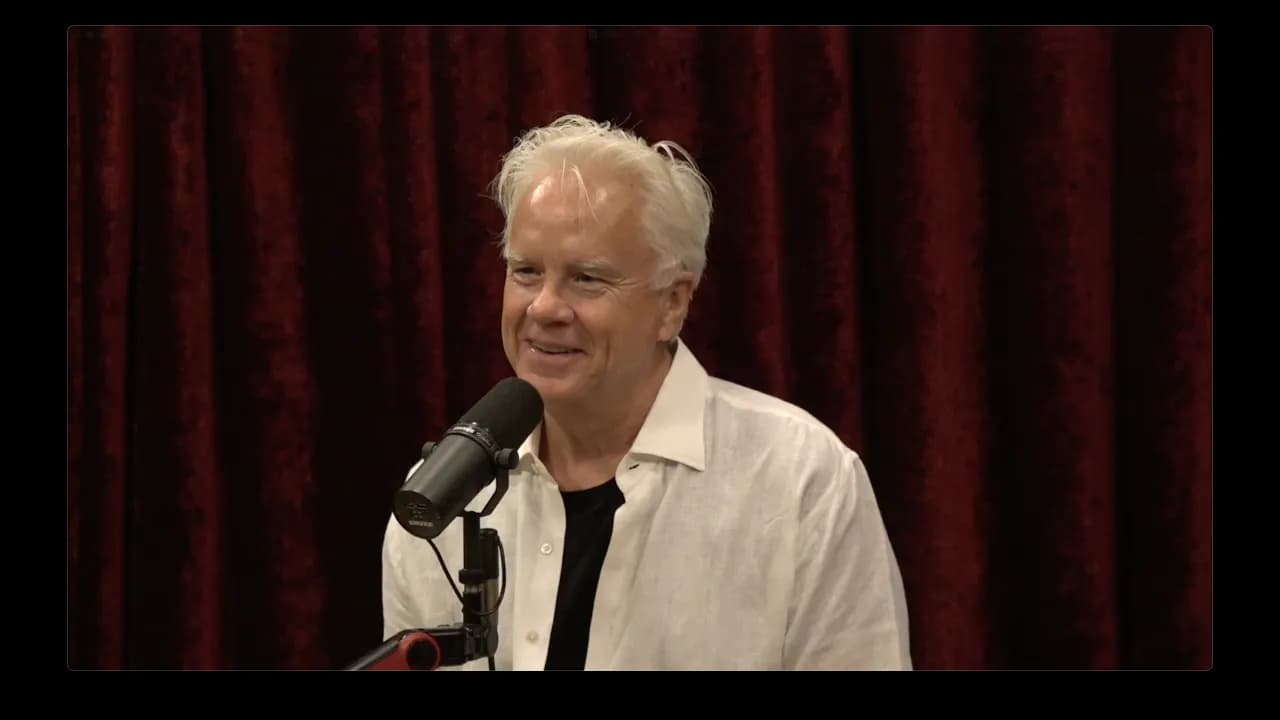
Joe Rogan Experience #2579 - Gary Sinise
In a Nutshell
Gary Sinise founded his foundation to ensure post-9/11 veterans and first responders never face the hostility Vietnam veterans endured, using his platform from films like Forrest Gump and CSI: New York to fund programs addressing mental health, suicide prevention, and family support. He argues that volunteer military service is essential to avoid a divisive draft, and that political disagreements over wars shouldn't punish those who serve. Key programs include Snowball Express for children of the fallen, proactive outreach to isolated veterans, and Soaring Valor trips pairing youth with WWII veterans to preserve institutional memory.
These notes were generated by AI and may contain inaccuracies.
Joe Rogan expresses surprise at meeting Gary Sinise in person after seeing him in movies since childhood. Sinise mentions he has watched Rogan's show and UFC fights.
Sinise appeared in both Forest Gump and The Green Mile. In 1994-1995, he did three movies with Tom Hanks in one year: Forest Gump, Apollo 13, and later The Green Mile. His role in The Green Mile was a small but good part.
Sinise wrote his first memoir Grateful American, released in 2019. The book documents his involvement with veterans and first responders, tracing his family's military service history from World War I, World War II, Korea, Vietnam, Cold War, Afghanistan, through to the creation of the Gary Sinise Foundation in 2011. A new memoir is forthcoming.
Sinise began connecting with Vietnam veterans in the 1980s through his wife's brothers who served in Vietnam and her sister's husband, a combat medic. He spent time learning about their experiences returning from Vietnam during a difficult period when veterans faced hostility.
Vietnam veterans returning home faced a divided nation where people were angry at them for serving. Veterans had to "crawl into the closet and hide in the shadows." Sinise felt compassion after meeting Vietnam veterans through his wife and wanted to help them.
Sinise played a wounded Vietnam veteran in Forest Gump. This led him to support wounded veterans through the Disabled American Veterans (DAV) organization. He was impacted by real-life "Lieutenant Dans" and wanted to help returning Iraq and Afghanistan veterans.
September 11th marked a "Turning Point" (chapter title in his book) that led to greater service. Sinise began raising his hand for USO tours, hospital visits, and supporting veterans returning from Iraq and Afghanistan. This work led to the creation of his foundation, now in its 16th year.
Rogan emphasizes that service members make the ultimate sacrifice and deserve support regardless of political views about wars or presidents. Sinise states he doesn't care about political divisions and wants veterans to return to a grateful nation.
Sinise was 18 years old in 1973 when combat operations ended in Vietnam. Meeting his wife's brothers and hearing their experiences of being abandoned by the nation motivated him to ensure Iraq and Afghanistan veterans wouldn't face similar treatment.
After September 11th, the nation initially united, but division grew over Iraq policy. Sinise wanted to prevent Iraq and Afghanistan veterans from being caught in political crossfire like Vietnam veterans were.
Sinise started visiting service members to show people care and appreciate them. This became a life mission to ensure volunteers who serve, go into harm's way, sacrifice limbs, and lose friends never feel uncared for.
Sinise argues that without volunteers willing to serve in the military, police, or as firefighters, society would need to reinstate the draft, which split the nation during Vietnam. He's grateful people volunteer for this work.
Rogan describes his high school history teacher, a Vietnam veteran with an extremely short fuse who once yanked a desk drawer full of pencils and slammed it on the ground when a student asked to borrow a pencil. The teacher was "READY TO POP AT ANY MOMENT."
Rogan learned from other teachers and classmates that his teacher was a Vietnam veteran. The school was Newton South High School in a peaceful Massachusetts suburb with no gang activity. The teacher's outbursts seemed disproportionate to normal teenage behavior.
Sinise grew up in Highland Park, a Chicago suburb, attending Highland Park High School. He never met a Vietnam veteran until his wife's brothers, wondering if any of his teachers had served.
Rogan is 59 years old and considers whether this incident occurred in 8th grade in Jamaica Plain rather than high school. The teacher was "really smart" and "tortured" - something had clearly happened to him.
As a child, Rogan viewed war through World War II imagery - the sailor kissing the woman in Times Square, fighting Nazis. Movies like Apocalypse Now changed this perception, showing tunnel rats and the reality of Vietnam War experiences.
Films from the 1970s and 1980s about Vietnam include Apocalypse Now, Platoon, Casualties of War, Coming Home, and The Deer Hunter. These films portrayed Vietnam veterans as unlikely to be okay at the end.
Forest Gump was the first story about a Vietnam veteran with a happy ending. Lieutenant Dan processes his anger, overcomes isolation and alcoholism, forgives himself, becomes successful in business, and stands again with prosthetic legs.
Many Vietnam veterans appreciate Forest Gump because it showed the story they wanted to see - someone processing war trauma and moving forward successfully, rather than remaining isolated.
Rogan notes how little help veterans receive transitioning from daily firefights and building breaches to sitting at insurance company desks. Veterans can get counseling that often doesn't help or medication to numb themselves, but no tools for processing the transition.
DraftKings Sports app promotion with code "Rogan" for new customers to spend $5 and get $200 in bonuses within 21 days.
Unlike Vietnam veterans who had "bags of crap thrown on them" when returning, today's veterans have access to thousands of nonprofits that emerged since September 11th, 2001, filling gaps where government support falls short.
Many service members don't seek help and instead isolate. The Gary Sinise Foundation tries to be proactive, calling veterans rather than waiting for them to reach out. Mental wellness is a major focus.
The foundation provides opportunities for veterans to tell their stories. The more they talk about experiences, the better chance of preventing self-harm. Website: garysinisefoundation.org.
Rogan notes many veterans find jiu-jitsu helpful for releasing pent-up anxiety through extreme physical exertion and finding camaraderie with others.
Sinise's wife had two brothers who served in Vietnam. The older brother, a West Pointer who did two tours, taught at West Point, and remained in the military community, adjusted better. The younger brother got out after one tour, tried college and various jobs including prison guard, but never adjusted properly without military community support.
Afghanistan veterans who lost buddies and went through difficult experiences question what their service was for after 20 years and withdrawal that left $80 billion in American military equipment to the Taliban.
The withdrawal involved people climbing onto airplane wheels and falling from the sky. Translators and cooperators who helped American troops were abandoned and many were killed or tortured by the Taliban. Equipment including tanks and helicopters was left behind, now used in Taliban parades.
Some speculate the withdrawal was designed to keep Afghanistan armed as justification for future return, though Sinise hopes this isn't true. The withdrawal was scheduled for September 11th regardless of conditions on the ground.
Gary Sinise discusses the difficult emotions surrounding the September 11th anniversary and the chaotic Afghanistan withdrawal. He mentions his special forces friend Lieutenant Colonel Scott Mann who, after leaving service, participated in Operation Pineapple Express to help evacuate Afghan allies. Despite their efforts, many could not be rescued, leaving veterans feeling their service may have been in vain. Sinise emphasizes that there were periods when people were free because of American presence, which represents a positive outcome despite the painful withdrawal.
Evan Hafer of Black Rifle Coffee employed Afghanis who had worked with him overseas, bringing them and their families to America before the full extraction occurred. The conversation highlights the trust issues created when Americans recruit local allies for a decade of service and then abandon them, leaving weapons behind in what Sinise describes as the most chaotic military withdrawal imaginable.
Sinise argues that even if withdrawal was the goal, maintaining some strong presence after twenty years of involvement would have been necessary rather than complete abandonment. He stresses that grateful Americans exist who want veterans to know their service is appreciated regardless of government decisions that may have gone wrong.
After September 11th, Sinise focused on providing support services to service members as the nation began splitting over the Iraq War. In 2003, he participated in Project Salute, a major USO entertainment tour including Kid Rock, Leon Mo, Paul Rodriguez, Dallas Cowboys cheerleaders, and athletes. Northwest Airlines provided a 747 for the tour, which split into three groups covering significant ground over one week.
During a November 2003 convoy trip with Wayne Newton, Chris Isaak, and Neil McCoy, Sinise visited the Abu Hastan school in Balad, Iraq, which soldiers had refurbished. The entire school of children ran out to hug the soldiers, creating a heartwarming scene that contrasted sharply with the predominantly negative news coverage. The entertainers sang "You Are My Sunshine" to a classroom of laughing children.
Witnessing children sharing one half-pencil among four students at long desks prompted Sinise to start a school supply program. Initially focused on that specific school, the program expanded to Operation International Children, shipping supplies to Afghanistan, Djibouti, Haiti, and other deployment locations. The motto was "helping soldiers help children," providing materials that allowed troops to engage positively with potentially hostile communities.
The program received letters from service members reporting that school supplies helped save lives. One convoy delivered supplies to an Iraqi village, and two days later children ran out waving, stopping the same convoy and pointing out bombs on the road. The children who received supplies just days earlier saved the convoy from destruction. The program operated from 2004 to approximately 2012.
A news crew documented a convoy delivering school supplies, capturing positive footage of children receiving materials. However, the convoy was attacked on the return journey, and only the gunfight made the nightly news while the purpose of the mission was eliminated from the story. A national news outlet representative told Sinise directly that "bad news sells."
Sinise describes using his entertainment industry profile to discuss firsthand experiences from war zones and hospitals. He notes that Lieutenant Dan's appearance on military bases uplifted troops, and he felt his role was to talk about courageous actions and good work he witnessed. This approach contrasts with typical perceptions of Hollywood celebrities as selfish and self-centered.
After wanting to support troops in Iraq, Sinise called the USO multiple times without response. When he identified himself as "the guy who played Lieutenant Dan in Forrest Gump," they called back immediately. This led to his participation in Project Salute, the first major USO tour to Iraq, sponsored by the Intrepid Foundation, Vanity Fair, and Tribeca Films.
The tour included football and basketball players, Dallas Cowboys cheerleaders, and entertainers. After performing in Kuwait, the group flew via C-130 to Baghdad where thousands of troops lined up from the airplane to a hangar holding 5,000 sweating soldiers in 140-degree June heat. An impromptu show featured Kid Rock on guitar, John Stamos on drums, and other musicians performing for the troops.
General Tommy Franks, who was running operations in Afghanistan and Iraq, requested a smaller group return to Baghdad proper. The group visited Saddam Hussein's palaces, which featured giant heads of the dictator on posts throughout the grounds. They traveled in heavily protected convoys with gunships flying alongside on both sides.
Sinise references horrific accounts of Uday and Qusay Hussein's crimes, including taking women from their husbands on their wedding days, killing the husbands, raping the women, and feeding them to dogs while watching ceremonies. He mentions being in a soccer stadium where people were tortured and discusses the intimidation tactics used to maintain population control through fear.
Saddam Hussein's sons acted completely normal in public, appearing polite, yet they committed horrific acts. Their behavior was compared to Joffrey from Game of Thrones on steroids. The palace contained a drained swimming pool with blood on the walls where people were tortured and killed. The sons had unlimited power and money with no accountability, engaging in acts of pure evil.
One of Saddam's palaces under construction during the invasion was called the Victory Over America Palace. French construction cranes stood outside the palace, which was ironic given that France opposed the invasion. The palace was bombed out during the conflict, with much of it destroyed.
Saddam diverted water to create a moat around his palace, leaving local farmers without water for their crops. Across from the palace, he built a Flintstones Village for his grandchildren to play in. The contrast between the extravagant palace and the suffering farmers caused some soldiers and locals to break down in tears of rage when seeing the inequality.
The experiences were documented in a film called Lieutenant Dan Band for the Common Good, which captured the band's concerts for troops and the work being done in Iraq.
Gary Sinise visited the border between North and South Korea multiple times with his band. A small cinder block wall separates the two sides. Republic of Korea soldiers stand behind visitors staring at North Korean soldiers across the border. The North Korean soldiers are described as slaves who have no concept of freedom and serve the supreme leader. A North Korean soldier once took pictures of Sinise through a window in a building that straddles the border.
A building straddles the border with a table in the middle where representatives from both sides can sit and conduct meetings. Sinise took his band to this location four or five times.
Yomi Park escaped from North Korea as a child. Her mother endured severe hardship to get her out, first going into China, then Europe, and eventually the United States. Park's story illustrates the dangers of concentrated power and the importance of protecting individual rights.
In North Korea, the government took control of all land with the promise that everyone would have food. Instead, the leader became rich while the population starved. The military receives food while farmers have their crops stolen. Citizens are required to report on each other, creating a culture of surveillance and fear. People were imprisoned for not crying hard enough when Kim Jong-il died.
Robert Sapolsky's work on determinism was discussed, which argues that human behavior is determined by genetics, environment, and experiences rather than free will. Sinise disagrees with pure determinism, noting that while environment plays a role, individuals still have agency. In oppressive systems like North Korea, people have zero free will because they know nothing else.
Sinise wrote his book Grateful American because he recognizes the privilege of living in a country where individuals can choose their own paths. The U.S. military protects this freedom, while other militaries exist to oppress their own people. America represents a rare exception in history where self-government allows individuals to determine their own destiny.
The question of whether Saddam Hussein's sons had any choice in their behavior was raised. Raised by a psychotic dictator with unlimited resources and exposed to evil from a young age, their actions may have been shaped by their environment. Children imitate their surroundings, and when raised by murderers who face no consequences, they may view killing as normal.
Saddam had a golden toilet in his palace, which had a gaudy, Las Vegas-like aesthetic. Dictators' obsession with gold was noted. A giant throne chair in one palace became a popular photo spot for visitors. The palace walls featured painted missiles pointed toward Israel.
The invasion of Iraq provided a unique historical opportunity to see inside a dictator's palace in detail, rather than relying on historical accounts. Saddam had multiple palaces across different cities in Iraq.
Saddam was captured on December 13, 2003, after Sinise's visit. The 4th Infantry Division from Fort Hood found him in a spider hole. Sinise visited Fort Hood in April 2004 after the division returned. Saddam had been hiding with help from an inner circle of supporters and had a million dollars in cash with him when captured, including $750,000 in US bank notes and a Glock 18C pistol.
The military created a deck of cards featuring Saddam and his top leaders to help troops identify targets. The operation to capture Saddam involved two targeted locations called Wolverine 1 and Wolverine 2. After 600 soldiers searched these locations without success, someone kicked aside flooring that revealed the spider hole where Saddam was hiding.
There are more slaves in the world today than before slavery was abolished in America. Libya became a failed state after Gaddafi's capture, with open-air slave markets documented on YouTube. People contacted Sinise from Libya to report that conditions have improved since then.
The idea that human beings are still willing to enslave people in 2026 remains insane. The world continues to be a very dangerous place, not much less dangerous than it was 100 years ago or 200 years ago. Young kids raise their hand right out of high school or right out of college to go defend the country. Support for the military and support for veterans should not be viewed as a right-wing idea, and Hollywood is recognized as a very left-wing place.
Gary Sinise was offered the lead role in CSI: New York right around the time he had done his first two trips to Iraq in 2003. In 2004, he was heading to Korea for his first trip there when offered the role. He decided to take the show, which ran for nine years, providing him a public platform to help the military. The chapter in his book Grateful American called "Perfect Timing" discusses how the timing was ideal for ramping up his military support work while having the weekly television series.
During his time on the show, Sinise would inform colleagues about upcoming trips, playing concerts on military bases around the country and overseas during hiatus periods. He never felt the community turned its back on him despite political divisions over George Bush's presidency at the time.
Sinise's character Detective M. Taylor was written as a Marine and Beirut veteran who was at the Beirut bombing in 1983 when 241 service members were lost. The character was also made a 9/11 family member who lost his wife at the World Trade Center. Episodes addressed these events to draw attention to Beirut and honor 9/11 families.
Most people in the country, especially young people, aren't aware of how many times the United States has been in conflict with Iran beyond current events. This includes the Carter administration kidnappings. The conflict has been ongoing for a long time, with many lives lost over proxies supported by Iran.
The Gary Sinise Foundation works to ensure that anybody who serves the country knows there are grateful people who don't take what service members go through for granted. The foundation aims to help service members through their challenges and ensure they are okay.
Sinise came from Chicago and started the Steppenwolf Theater Company at 18 years old with co-founders Jeff Perry and Terry Kinney. They began with nothing, didn't charge for tickets, and used a shoe box labeled "donations" in the lobby. The theater is now over 50 years old, occupying an entire city block on the north side of Chicago with three theaters, restaurants, bars, and classrooms.
The original nine members included John Malkovich, Laurie Metcalf, and Joan Allen (nominated for three Oscars). Sinise's wife Moira also became a member. Hundreds of plays have been done worldwide, with many great actors coming from Steppenwolf.
At 16, Sinise was playing in a rock band when the drama teacher at Highland Park High School spotted the band members looking scruffy and ragged. She told them they looked perfect for gang members in West Side Story and should audition. After initially laughing, Sinise went to the audition because he saw pretty girls going in. He got a small part, which changed everything.
During the final performance of West Side Story, Sinise was one of the gang members who carried Tony's body off stage after he was shot. The actor playing Tony was Sinise's best friend. During this moment, Sinise burst into tears. After the show, when taking curtain calls, the actor who played Bernardo reached back and pulled Sinise to the front to stand with the lead characters for a bow, recognizing the significant life change that had occurred for him.
Sinise stayed in touch with his drama teacher over the years. When his first book Grateful American came out, he took her to dinner in Nashville. During the meal, his publicist called to inform him the book had hit the New York Times bestseller list at number three. Sinise turned to his former teacher and told her he was a bestselling author, and she burst into tears remembering when he could barely read and write.
Sinise has played concerts at all military academies including West Point, Annapolis, Air Force Academy, Merchant Marine Academy, and Coast Guard Academy. He finds it heartening and hopeful to meet these young people who knew what they wanted to do coming out of high school and will owe the country four years of service upon graduation.
One program at the Gary Sinise Foundation is called Soaring Valor. The foundation has taken hundreds of World War II veterans to the National World War II Museum in New Orleans, sponsoring approximately 15,600 veterans with American Airlines providing travel. They conducted 33 charter airplane trips. High school kids were paired with veterans as travel buddies for three-day experiences.
The program now sends participants to Ground Zero and the Trade Center in New York, the Pentagon, Shanksville Pennsylvania, and the Medal of Honor Museum in Arlington, Texas. The goal is to teach young people about service, volunteerism, and what it takes to keep the country free, while showing them this is a good country with much to be thankful for.
The challenging environment of the military serves as an amazing vehicle for developing young people. Young people need to be challenged to understand their potential, and those who come out of military service can do things that other people can't do.
During Sinise's first Afghanistan trip in 2006, he landed on the USS Ronald Reagan aircraft carrier in the Persian Gulf via COD, a 20-person airplane that lands on the deck.
Sinise visited an aircraft carrier in the Persian Gulf and met a 19-year-old sailor entrusted with steering the massive vessel carrying 5,000 people. The young man impressed leaders enough to be given this responsibility, highlighting the caliber of personnel serving in the military.
Rogan noted the contrast between this 19-year-old's responsibilities and the average 19-year-old's activities. Steering a 5,000-person aircraft carrier represents an extraordinarily difficult task with incredible responsibility. Standing on the deck watching aircraft operations is impressive, with personnel performing dangerous jobs in high-stakes environments.
The work ethic required for aircraft carrier operations creates extraordinary people, and such challenges develop exceptional individuals. Veterans transitioning from 20-30 years in military service to civilian life face significant challenges. Programs exist to help navigate this transition. Evan from Black Rifle Coffee emphasizes hiring veterans and supporting veteran causes and first responders.
Without military service members, the country would be vulnerable. The military performs disaster relief and humanitarian operations beyond combat roles. Vietnam veterans faced harsh treatment upon returning home, creating a shift from the post-WWII reception. Post-9/11 nonprofits emerged to prevent similar mistreatment of current veterans.
Marcus Luttrell is involved in an ibogaine initiative with Rick Perry and Brian Hubert. Sinise discussed this program with President Trump at the White House. Ibogaine has helped veterans reenter society, deal with demons, and overcome alcoholism and addiction to pills.
An aggressive effort addresses the suicide problem in military and veteran communities. Many veterans won't reveal their struggles, viewing it as weakness. Battle buddies checking on each other provides lifesaving peer-to-peer support. Luttrell regularly checks in on Sinise via text.
Men often believe stoicism means keeping struggles to themselves rather than seeking help. Everyone has known someone who took their life without showing signs. The guilt of wondering if intervention could have helped is devastating. Proactive efforts to connect people with services are essential.
The foundation provides multiple mental wellness services and refers people to other organizations. Sinise uses media appearances to inform people about available services, emphasizing that veterans are not alone and are cared for.
The foundation runs Snowball Express for children who've lost parents in military service or first responder duty. The program takes over 1,000 kids to Disney World annually, all expenses paid. American Airlines serves as the presenting sponsor. The program moved from Orlando to Dallas in 2018 when it joined the Gary Sinise Foundation.
When children who've lost parents gather, they bond with others experiencing similar loss. The program includes families of fallen firefighters and police officers. Children may feel forgotten, particularly suicide survivors who may feel different from combat loss families. The foundation emphasizes that all children whose parents served are worthy of attention.
US troops and veterans experience suicide deaths at roughly four times the rate of combat deaths. A Costs of War study estimated 30,177 deaths by suicide among post-9/11 service members and veterans versus 7,057 US military deaths in post-9/11 war operations - 4.3 times as many. All these deaths are casualties of war.
Sinise's book Graceful Warrior tells the story of his son Mac, who was diagnosed with chordoma, a rare cancer, in 2018. Mac worked for the Gary Sinise Foundation and was a musician. He died January 5, 2024, after a five-and-a-half-year battle. Sinise discovered Mac's music after his death and produced three albums titled Resurrection and Revival from his son's compositions.
Mac had an orange-sized tumor on his tailbone discovered in August 2018. Surgery occurred in September 2018. The cancer returned and spread by May 2019. Chordoma affects only about 300 people per year in the US, with only 90 diagnosed with metastatic cases annually. Mac was disabled by cancer, unable to write or play music, but created an album in 2023 called Resurrection and Revival.
The book releases November 10, 2025, which would have been Mac's 36th birthday. It's not primarily about fighting cancer but about hope, courage, and persevering through challenge. Sinise describes Mac as "running through the bombs" - like the soldier in the film 1917 who keeps getting up despite being knocked down. Mac fought with grace and courage despite being paralyzed from the chest down.
Six weeks after Mac's death, Sinise posted a story on the foundation website that encouraged fathers to share their own grief. The book aims to help families going through challenges find strength and courage. Grief never goes away, but people can learn to manage it. Sharing stories provides healing for both the storyteller and listeners who may find inspiration.
Thank you, John. And everything else. Thanks for having me.
Keep PowerfulJRE in your library
Save the videos and channels worth coming back to, and find them again in one place.