Joe Rogan Experience #2582 - Greg Anderson
In a Nutshell
Greg Anderson rowed from Washington to Hawaii in 54 days with zero prior experience, demonstrating that regular people can achieve extreme physical challenges. His training evolved from traditional gym work to fascial isometrics, farmers carries, and natural movement patterns that dramatically improved grip strength and functional capacity. The conversation reveals how military service, jiu-jitsu training, and ocean rowing built his philosophy that government systems exploit citizens while individual excellence requires rejecting comfort and embracing calculated risk.
These notes were generated by AI and may contain inaccuracies.
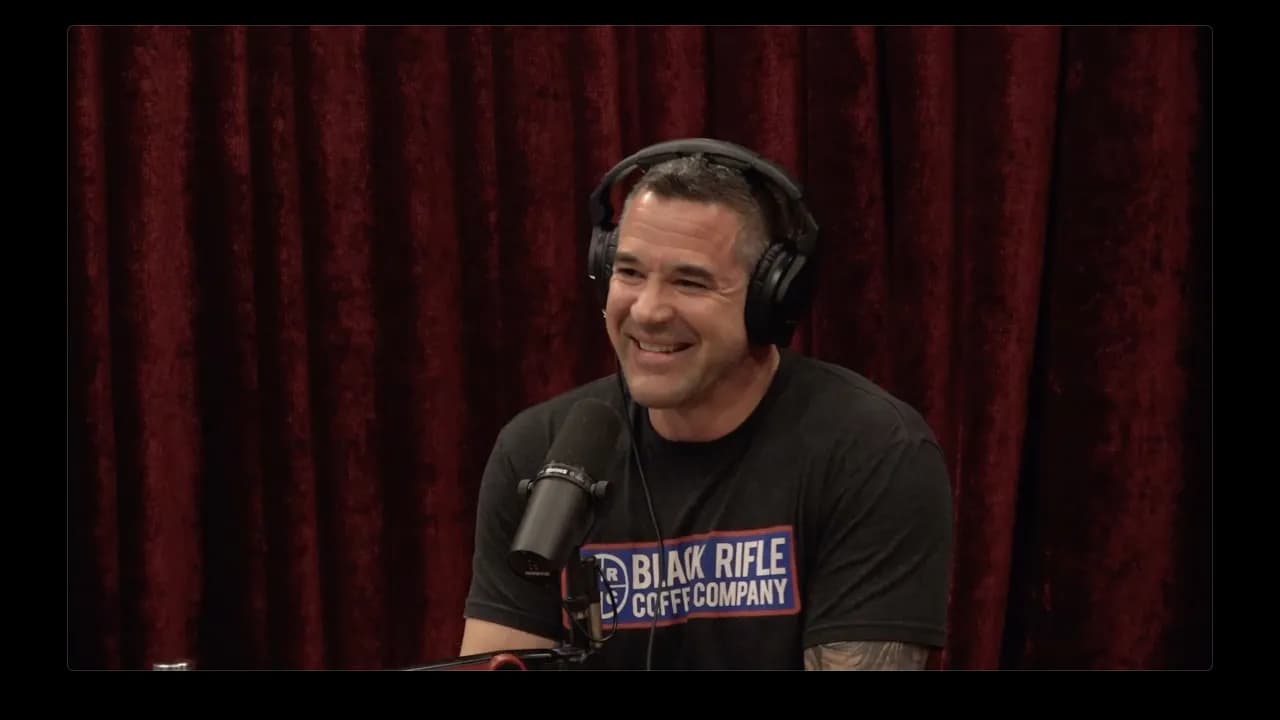
Joe Rogan discusses the podcast world and how people recognize him in public settings. Greg Anderson mentions his own smaller show and notes that people sometimes approach him at restaurants knowing Joe through his content.
Joe asks what possessed Greg to row to Hawaii. Greg explains he watched Jack Jarvis on Instagram who had a team rowing from New York to London the previous summer. Greg became fascinated by the journey and kept showing his wife the content. He told her he felt he was vicariously living through these guys and decided to message Jack that he was going to row the Pacific the next summer.
Greg assembled a team, bought a boat, and completed the journey despite having zero prior rowing experience. He is primarily a jiu-jitsu practitioner.
Greg has a bad left knee that's almost bone-on-bone but not yet requiring replacement. He never had surgery and never blew an ACL. The injury occurred after reading David Goggins' "Can't Hurt Me" and deciding to run every day, which worsened the condition until he could barely walk.
At age 37, an orthopedic surgeon recommended full knee replacement, stating the literature only supports that intervention. Greg refused, asking about alternatives like stem cells, physical therapy, or dietary changes. Years later, orthopedic surgeon Sean Baker joined his jiu-jitsu team and confirmed that Greg couldn't perform butterfly guard movements with a prosthetic knee, validating his decision to avoid surgery.
Joe mentions studies showing biologics can help reduce inflammation and potentially regrow cartilage. He references a recent study on eggshell membrane for cartilage damage where participants began growing new cartilage. The supplement is available on Amazon. Joe notes it makes sense because the building blocks of human tissue come from food sources like eggshell and collagen.
Greg discusses moving beyond traditional cardiovascular fitness and strength training to include fascial training. Fascia encompasses all connective tissue including ligaments, tendons, and layers that hold musculature together and run along bones. Traditional muscle isolation exercises don't strengthen connective tissue the same way.
The training involves putting the body in unusual positions and holding them for 5-10 seconds. When the body shakes, it indicates the nervous system isn't conditioned to those force applications. This is essentially isometric training.
Joe incorporates this into push-ups by counting slowly and holding mid-repetition for 10 seconds before continuing, finding he gets significantly more fatigue from fewer repetitions.
Greg references Instagram page Hyper Arch Fascial Training, noting the jaguar as the jungle's best athlete without lifting weights, simply by doing "jaguar shit." He advocates returning to natural human movements rather than constantly beating oneself up in the gym.
Joe discusses farmers carries as functional movement, performing them every other day for six months with noticeable improvements. He carries 70-pound kettlebells for approximately 150 yards uphill and 150 yards downhill every other day. The downhill portion is particularly challenging as it requires constant deceleration.
Joe introduces Tom Havlin, a 6'9", 400-pound man from Australia who posts workouts from behind the camera wearing outdoor clothes. Havlin carries heavy objects like axles and rusty weights, never showing his face. His Instagram content focuses on functional carrying movements rather than traditional gym exercises.
Havlin emphasizes that carrying weight while walking develops different strength than simply lifting and lowering weights. This connects to ancestral movements like carrying game from hunts.
Joe reports his grip strength increased dramatically from farmers carries. His fingers became larger, requiring him to increase his wedding ring size from 11.5 to 12. He notes that both uphill and downhill carrying provide different but important training stimuli.
Greg describes his first elk hunting trip in Shaeffer, Idaho at 8,000-9,000 feet elevation. The terrain featured shale rock that made footing difficult and dangerous. He hunted with bow alongside buddy Anthony who called, though Greg was new to elk calling and potentially scared animals away.
They did a drop camp where a guide took them in on horseback and left them to hunt independently. Despite finding abundant sign including tracks and scat every 50 feet, they saw no elk during the 10-day hunt, though Anthony spotted a bull and cows.
Joe discusses tree stand hunting in Wisconsin, noting that people criticize it as not real hunting. He defends it as genuinely difficult, requiring sitting in cold temperatures and testing mental fortitude. He describes how the forest comes alive approximately 20 minutes after settling in a tree stand, with wildlife resuming normal activity once they determine humans have settled.
Greg mentions ground blind hunting for bear in Alberta's dense forests, hunting over bait. He describes hearing movement and seeing various wildlife including wolves and a grizzly once.
Joe distinguishes between black bears, which can be scared away, and grizzlies that look at humans as potential prey. He grew up spending summers in Sitka, Alaska, and had his own boat for island hopping. At age 14, he encountered a grizzly despite his father's assurance they don't swim to islands. The bears swam out anyway.
Joe describes coastal brown bears as cannibals that eat cubs from dens and notes they're essentially giant wild dogs. He references Timothy Treadwell, the subject of Werner Herzog's documentary "Grizzly Man," who attempted to prove bears were friendly by living among them. Treadwell stayed past the hibernation period when bears were starving and desperate, resulting in his death.
Greg states he doesn't feel called to hunt predators, partly because he's never tried bear or mountain lion meat. Joe confirms bear meat is good when properly cooked, mentioning that black bear tastes good and can be prepared medium-rare using sous vide at 130 degrees for approximately 2 hours to eliminate trichinosis risk rather than cooking well-done.
Joe mentions friends John and Jen who run an outfitting company in Alberta and know how to properly cook bear through brining and smoking methods, creating dishes like bear pot roast.
Greg notes that axis deer meat ranks second only to elk in his preference. He has connections in Maui for axis hunting where the herd numbers approximately 100,000 with no season or bag limits, allowing hunters to harvest up to 10 deer per day.
Greg Anderson mentions his friend Joshua Dukes who rowed with him and they would visit Hawaii annually to hunt axis deer. They discuss a company called Maui Nui that sells wild game online including axis deer. The company ships frozen products including sticks, roasts, and steaks, and also makes bone broth. All products are USDA inspected. They harvest animals from their own land.
Greg explains the history of axis deer in Hawaii, noting that King Kamehameha was gifted axis deer from India in the 1800s, originally only four animals. Now there are approximately 30,000 deer on Lanai with only 3,000 people living there.
Greg describes a podcast recorded on Lanai with professional hunters including John Dudley, Cam Haynes, Adam Greenree, and Remy Warren. The island has a Four Seasons hotel where visitors stay while bow hunting. Lanai has significant public land unlike Maui, which has very little public land. The deer population has become a nuisance, digging up irrigation and breaking pipes, leading farmers and ranchers to encourage hunting.
Greg mentions that if he were to retire and check out of society, he would go to Maui for the jiu-jitsu, ocean, great food, nice people, and good weed.
Greg describes his ocean rowing experience where he expected to see marine life including dolphins and whales, but encountered very little during the actual row. They fished constantly but caught almost nothing, trolling for most of the trip. One day something large snapped their line, possibly a tuna or sailfish.
They had two fishing setups: a pole on a pole holder and hand lines. Greg notes that his friend explained ocean fish distribution, stating that fish are concentrated at the edges while the middle of the ocean is like the center of a swimming pool with little marine life.
The first four to five days leaving Washington from La Push, they encountered whales and sea lions that would play with them, biting the oars. Greg compares this playful behavior to his experience with his Malinois dog. A sea lion stayed with them for three shifts, approximately nine hours total.
They saw multiple whales and a couple of sunfish approximately 8 feet from fin to fin. Initially mistaking a sunfish for a shark at 20 meters away, they observed it approach the boat to investigate them. This encounter occurred around 300 miles offshore as they entered blue water.
Greg describes blue water as the open ocean where there is nothing. They saw two sunfish at the edge of this zone. They also had a shark, approximately 6-8 feet long identified as a blue shark, come up and bite an oar.
The early part of the journey felt like being in National Geographic. Greg describes their boat as having bedrooms approximately one-third the size of the podcast table.
Greg and Joshua served as navigators using a Raymarine GPS to plot their position and adjust course. They had to work with ocean conditions rather than fight against them. Training for ocean rowing is nearly impossible because conditions change daily with different current and wind directions.
When current and wind align, they achieved 100 miles per day down the California coast. When wind and current oppose each other, rowing felt like moving through molasses. Some days they made no progress or even went backwards.
They planned for 70 days with three meals daily but only needed 54 days. Peak Refuel provided freeze-dried meals, sending four meals per day for 70 days, ensuring they had more than enough food. Greg's favorite was the Buffalo Goulash meal.
For water, they used a desalinator unit connected to solar panels that pumps ocean water and converts it to fresh water. However, the unit removes minerals and electrolytes, requiring them to add electrolytes back using grapefruit-flavored Element and creatine.
The desalinator unit failed when life vests stored in its compartment hit the pressure release valve during a storm, flooding and frying the motor. This occurred approximately two to two and a half weeks from Maui.
They had brought a backup hand pump as a redundancy measure, following the military principle that two is one and one is none. The hand pump required approximately one hour to fill a container, producing only drops at a time.
The team made an agreement that they would either make it or die, refusing to call for help regardless of circumstances. They agreed that even if someone died from heart attack or aneurysm, they would continue the mission.
At 46 years old, Greg found the sleep schedule particularly challenging. The three-on, three-off rotation meant 12 hours of rowing daily plus additional time pumping water. By the end, they had to physically shake each other awake for shifts. At one point, they feared Will had died when they couldn't wake him.
Approximately 95% of people were supportive, but 5% expressed doubt about their survival. Nine days into the journey off the Oregon coast, they encountered a massive storm with waves the size of buildings, similar to conditions on Deadliest Catch.
Their boat, the Ironic 45, is a 24-foot rowboat built in London specifically for ocean crossings and designed to self-right after capsizing. The boat has enclosed cabins with air pockets positioned high for self-righting capability. They were knocked over multiple times but never beyond 90 degrees before snapping back upright.
Sponsors included Montana Knife Company, Vortex Optics, and Jeremy Nuome (the wealth alchemist) as the main sponsor. Nuome teaches stock market success using jiu-jitsu metaphors, describing the market as open mat where 98% are white belts and he trains people to purple belt level.
The boat's sleeping quarters are extremely small - approximately as wide as Greg's hand span and length from his hand to Joe Rogan. During storms, both occupants must squeeze into the space and button down hatches.
Despite wearing Merino wool base layers and Hely Hansen sailing gear including bibs and coats, everything eventually became soaked. There is no truly waterproof gear for extended ocean exposure, and with no way to dry items, they remained cold and wet for the first four to five weeks.
Once they reached warmer latitudes approximately three weeks out, conditions switched from freezing to being baked by Hawaiian sun.
When conditions became too dangerous to steer, they deployed a para anchor - a 12-foot diameter parachute deployed approximately 50 feet underwater. This holds the boat relatively stationary while surface water moves with wind, allowing them to ride out storms.
During the Oregon coast storm, weather forecasts predicted nine days of bad conditions. The closest city was Coos Bay, Oregon, approximately 400 miles away. They decided to ride out the storm rather than become the Coos Bay quitters.
The storm eventually worked in their favor, pushing them in the desired direction. After retrieving the para anchor, they surfed for hundreds of miles on waves the size of buildings.
They only went out on the ocean once for training before the expedition. Greg compares the journey to Ranger school - 60 days of suffering that cannot be adequately prepared for through shorter practice sessions.
They estimated 50-70 days for the journey based on watching the Talisker Whiskey Challenge (now called World's Toughest Row), an annual race from Spain to Antigua. Greg used his military background in route planning and map reading to estimate daily progress rates. The actual journey took 54 days, falling within their estimated range.
People have farmed off much of their thinking to technology. Rogan recalls remembering his high school phone number and others' numbers before smartphones, but now relies on his phone to call contacts like Jamie without knowing the actual numbers. He only knows his wife's number and one child's number because he recently had to change it and deliberately memorized it. Eddie Bravo's number is remembered from the pre-smartphone era.
Rogan received a cell phone in 1988, one of the earliest, which was large. His friend Bill Blumenright, a comedy club owner, would call him last-minute for gigs when others couldn't make it. Having a cell phone gave him an advantage as he could be reached while driving, leading to more work that paid for the phone itself. Early phones required punching in numbers manually since storage wasn't available initially.
The first game available on cell phones was Snake. Rogan never played games on his phone, preferring proper screens, mice, and keyboards for gaming.
After six years in Austin, Rogan only knows routes to the podcast studio, his comedy club, and the gym. Even when familiar with destinations, he uses navigation apps to check for faster routes and traffic updates. Waze sometimes routes through sketchy neighborhoods, prompting concern about the algorithm's choices.
In New Jersey, police stopped people from driving through residential neighborhoods because Waze directed drivers through them. Rogan questions why police can prevent use of public streets based on an app's routing, suggesting it was a wealthy neighborhood trying to avoid traffic.
During COVID, Anderson noticed all 20 cops in his lunchroom shared his skepticism while watching two police boats chase a paddleboarder in Malibu. The breaking point came when authorities conducted sting operations against salons and jiu-jitsu gyms. Anderson argued that law enforcement shouldn't violate constitutional rights regardless of whether COVID was dangerous, emphasizing that government actors can't suspend rights based on mayoral orders.
Chase Hughes, described as an expert in government psychological operations and reading liars, confirmed to Anderson that COVID involved an operation taking advantage of the situation to instill fear and impose controls. Hughes identified a massive transfer of wealth as a key unrecognized aspect.
Large corporations like grocery stores, Target, and Walgreens remained open while small mom-and-pop shops closed. Restaurants went under while fast food chains operated. Anderson notes 70% of Los Angeles restaurants closed permanently. The Comedy Store survived due to prior financial reserves from a golden era but faced enormous rent costs on Sunset Strip with all overhead continuing during the 18-month closure.
Government officials lack understanding of small business operations and don't care about their survival. Anderson proposed tying government pay to city GDP so officials would feel the economic impact of their decisions. A COVID task force member in Los Angeles admitted closing outdoor dining was done "for optics" rather than health reasons, despite knowing it wouldn't transfer the virus outdoors.
A restaurant in Snohomish, Washington added outdoor tents during COVID as required, then kept them after patrons enjoyed the seating. Years later, the county cited the tents as code violations, leading Anderson to question when such officials would face consequences.
Bigger government creates more jobs requiring justification through additional laws and restrictions. People in these positions often enjoy exercising power over others. Anderson describes such individuals as typically weak and cowardly. Real leaders avoid government work due to surrounding corruption, weakness, and lies.
Anderson argues against playing within corrupt systems, noting that entering government roles subjects individuals to attacks that destroy their reputations. He references being labeled negatively for not getting vaccinated and sharing use of ivermectin.
Anderson kept his academy open during lockdowns, refusing to operate covertly through back doors. He was emotionally prepared to face severe consequences, comparing the feeling to deploying to Ramadi. Washington state enforcement was aggressive, posting multiple closure notices on his door which he ignored.
Anderson noted the irony that DMV services remained open for expired vehicle registration renewals because they generated government revenue, while jiu-jitsu instruction was deemed non-essential. He questioned why a "little red sticker" was prioritized over activities that provide mental and physical benefits to people.
Jiu-jitsu serves as community, stress relief, and personal time for practitioners. Anderson compares it to religion, noting it cleanses the mind unlike most activities. Practitioners become nicer people because they release aggression on the mats.
Anderson identifies manufactured division as the foundational problem in society, with media and elites creating conflicts over issues affecting tiny percentages of the population to prevent unity and growth. On jiu-jitsu mats, none of these divisive topics matter.
Jiu-jitsu builds culture because participants can't maintain pretenses. Anderson rejects formal hierarchy, telling new students to call him Greg rather than sensei or professor. The environment eliminates intimidation and pecking orders, allowing authentic interaction. Everyone helps each other improve because individual progress depends on collective improvement.
Jiu-jitsu requires training partners and cannot be practiced alone effectively. Anderson briefly owned a grappling dummy but found it insufficient. Rogan received a sophisticated grappling robot from Uriah Faber that may eventually incorporate AI for position recognition.
Mario Sperry developed his triangle technique by repeatedly practicing on his girlfriend who eventually refused to participate. Anderson's academy operates from 6:00-7:30 PM with doors remaining open until 8:30 PM due to sauna and cold plunge usage. The facility sits on 4 acres with outdoor space functioning as a community center.
Anderson finds CrossFit practitioners develop muscles without functional application. He personally found combining CrossFit with jiu-jitsu detrimental due to excessive body breakdown without adequate recovery. His current routine focuses on lifting, carrying, yoga, mobility work, and jiu-jitsu training.
Anderson adopted Pavel Tsatsouline's kettlebell approach of performing 5 reps instead of 10, then resting 3-5 minutes before another set. Tsatsouline emphasizes treating strength as a skill rather than pursuing failure or soreness. Anderson notes that heavy squatting followed by jiu-jitsu training leaves practitioners without endurance or strength.
Steve Maxwell, an early American black belt from Philadelphia now in Washington state, opposes CrossFit-style strength competitions, arguing they create unnecessary injury risk through timed maximum lifts.
Anderson emphasizes not prescribing training methods to others, basing his approach solely on personal experience and body response. He references his recent ocean rowing expedition when discussing physical limits.
During the rowing expedition, Anderson received criticism claiming Polynesian ancestors had rowed oceans for thousands of years, questioning celebration of white participants. Anderson noted his Icelandic heritage involves similar maritime history and pointed out two team members were islanders.
Anderson identifies a current movement attempting to claim cultural appropriation for virtually everything.
Being proud of Icelandic heritage and connecting with Viking ancestry can be inspiring, but the focus should remain on what a person is actually doing in their own life. The people who criticize others for expressing pride in their background are typically not accomplishing anything themselves. If they were engaged in meaningful pursuits, they would demonstrate more humility, introspection, and self-reflection rather than commenting negatively on others.
Kelsey Fendler rowed solo from California to Hawaii and was on the water at the same time as Anderson's team. She personally contacted their team, expressed that she thought their expedition was wild, and offered assistance if they had questions about ocean crossings. The team communicated back and forth with her as a resource. Their inbox subsequently filled with messages from middle-aged women questioning why four men were needed when Kelsey was doing it alone.
Scrolling through social media and having negative thoughts about others' accomplishments is one thing, but actively reaching out to criticize people who are simply pursuing their goals represents a different level of engagement. Anderson notes that people who criticize others for doing things have always existed in society, but they previously lacked the ability to broadcast their negativity globally. The internet has revealed how many people among us are negative and unaccomplished, and encountering such criticism can serve as motivation to improve.
The woke movement demonstrates a pattern where participants eventually turn on each other because no one can meet increasingly stringent purity tests. This leads to constant excommunication within the group as standards keep being pushed further. The foundational reasoning behind this "crabs in a bucket" mentality stems from people recognizing that others are better at something and understanding the significant work required to reach that level. Rather than putting in the effort, they attempt to tear others down.
When witnessing someone excel at something significant, whether in sports or other achievements, it naturally makes observers feel inadequate because it highlights their own limitations. The unhealthy response is to decide the successful person is bad because they make others feel bad. The constructive response is to ask how that person achieved their level of performance. Jealousy itself is a normal feeling, but dwelling on it without understanding its source is problematic.
When people see someone with material success like a Ferrari and mansion, the normal reaction might be jealousy about why they don't have those things. The productive approach involves recognizing that the person likely worked extremely hard, possibly 16 hours a day, and that lifestyle might involve significant downsides like misery, lack of real relationships, or substance abuse. Achievements should inspire recognition that human potential has no bounds and incredible things are possible through dedicated effort.
Endurance training benefits hunting ability since legs and lungs are what ultimately kill elk. However, individuals should choose their training methods based on what works for them personally. If someone prefers running for hunting preparation, that's their choice. If another person doesn't see value in that approach, they shouldn't feel obligated to adopt it.
Anderson shared a video of an acrobat in China performing one-handed handstands on an angled board with peg platforms, jumping between positions with a single arm. The video prompted immediate thoughts about starting more handstand training. The group discussed whether the footage might be AI-generated, but concluded it was likely real, possibly from a Chinese acrobatic show.
When people see others succeeding, particularly in areas where they feel inadequate, some respond with anger directed at the successful person rather than recognizing their own negative self-comparison. This represents how less intelligent people react to others' success. The text format of online comments makes them appear legitimate, but the underlying motivation often stems from personal dissatisfaction rather than valid criticism.
One motivation for the ocean rowing expedition was demonstrating that ordinary people can accomplish extraordinary things. While the concept might seem clichéd, the underlying truth remains that anyone can pursue challenging, unconventional goals. People often have aspirations while lying in bed at night, and stepping outside comfort zones to pursue uncomfortable challenges represents valuable personal growth.
Anderson acknowledges that his expedition pushed boundaries but wasn't intended to result in death. The alternative to accepting some risk would be remaining inactive at home. Risk assessment involves distinguishing between possibility and probability - being willing to enter the realm of possibility for meaningful experiences while avoiding activities with high probability of death, particularly given family responsibilities.
Combat experience in Ramadi, Iraq at age 23 created a mindset of accepting potential death daily, which paradoxically felt freeing. This "fuck it" attitude developed from waking up each day thinking it might be the last. While this mindset was easier to maintain as a 23-year-old Ranger, the resistance to fear built during that period persists. Anderson notes having more to live for as a 46-year-old father of three but retaining the fear resistance developed through military service.
During a helicopter flight with Andy Stumpf, they flew above a lake and performed a free fall before pulling up just before impact. When Anderson questioned whether Stumpf was trying to kill them, Stumpf responded that it was a basic flight maneuver and called Anderson a "pussy." Stumpf's rapid achievement of a black belt in jiu-jitsu demonstrates his ability to focus intensely on developing skills.
Anderson has trained with Andy Stumpf approximately 10 times at Straight Blast Gym and describes his jiu-jitsu as phenomenal, particularly noting his guard retention as a guard player. Some people questioned how Stumpf could achieve black belt level after only five years of training, to which Anderson responds that complete dedication makes such rapid progress possible.
Jiu-jitsu uniquely allows hobbyists to train with world-class practitioners. Anderson trained nightly with Marcus "Bucha" Almeida while working as a police officer and holding a brown belt. This accessibility distinguishes jiu-jitsu from other sports where training with elite athletes like Tiger Woods or Michael Jordan would be impossible for average participants.
Anderson's introduction to jiu-jitsu occurred in 2004 during deployment in Ramadi, Iraq, when a SEAL teammate who was a purple belt offered to train. Despite Anderson's wrestling and boxing background, the experience demonstrated the gap between different skill levels. This motivated daily training throughout the deployment, leading to joining an MMA school and jiu-jitsu academy upon returning home.
Anderson progressed to brown belt at Gracie Baja in the Pacific Northwest before moving to Los Angeles and joining Checkmat, where he trained with Marcus Almeida. Despite being a brown belt, Almeida made him feel like he knew nothing about jiu-jitsu. When Anderson suggested starting over as a white belt, Almeida responded that no one could take away his rank and he simply needed to be the best brown belt possible.
Training at Checkmat provided opportunities to work with multiple world champions including Joao Miyao, Leo Vieira, Lucas Lepri, and Marcela Malanza. The key to benefiting from such elite company involves becoming integrated into the group rather than remaining an outsider. The experience, while initially humiliating, provides clear understanding of skill levels and accelerates improvement.
Steve Hesson emphasized that defense should be the absolute priority, with the fundamental principle being "I am always safe." Hesson would begin training sessions with black belts having fully locked rear naked chokes on his back, even with a gi, to practice defensive skills under pressure. This approach demonstrates the importance of never neglecting defensive capabilities in favor of offensive techniques.
After Marcus Almeida transitioned to full-time professional competition and stopped coaching evening classes, Anderson switched to training under Joao Miyao, another Checkmat black belt, and eventually received his black belt from Miyao. Miyao won the IBJJF World Championship while coaching Anderson and continues competing at an elite level while operating a gym in Huntington Beach.
Anderson began training with Jean Jacques Machado in 1998, the same period when Machado won Abu Dhabi. Machado taught classes while preparing for competition and demonstrated techniques like overhooks and underhooks. His birth defect of having no fingers on his left hand proved advantageous in no-gi competition since he never relied on gripping clothing, developing wrestling-based grips instead.
The Machado family includes multiple elite practitioners: Jean Jacques, his brother Rigan (described as a monster), and Carlos. A notable video exists of Rigan in his prime competing against Rickson Gracie in a jiu-jitsu match featuring elite-level scrambling between two black belts. Jean Jacques is considered the most accomplished competitor in the family, particularly regarding Abu Dhabi success.
The scarcity of proficient butterfly guard players in MMA relates to the extensive time required to develop such specialized skills. Practitioners who invest the necessary time typically focus exclusively on that discipline rather than transitioning to MMA. Similarly, fighters like Wonderboy Thompson who develop unique striking styles often stick with those approaches rather than diversifying.
Most jiu-jitsu athletes who attempt the transition to MMA never make it to the UFC, with fewer than one in ten succeeding. Many become skilled in jiu-jitsu and only decide to compete around age 33, which means they reach the UFC at 37 or 38 when their prime has already passed. This timeline issue affects fighters like Hadulo Vieira and Busha, who were past their peak when they entered the promotion.
People criticize Marcus Buchecha's jiu-jitsu after his UFC losses, despite him being a 13-time world champion. When Buchecha is on top of an opponent, they feel like they're dying. His UFC career has not met expectations, but competing against the best fighters in the world at the highest level is extremely difficult. The modern MMA landscape is not 1993 anymore, and success requires learning to strike, which takes years to develop.
Elite strikers like Alex Pereira learned their skills as children, giving them decades of development. A jiu-jitsu practitioner entering MMA faces the fundamental problem that jiu-jitsu training is not takedown-heavy or wrestling-focused. This represents one of the biggest flaws in traditional jiu-jitsu training methodology.
One academy implemented a rule that every round starts on the feet, even for guard pullers. The art involves offbalancing opponents, cutting angles, and securing advantageous grips before pulling guard. Practitioners should learn takedowns at 100% effectiveness and develop striking skills including distance management, covering up, and movement under pressure.
Untrained men overestimate their fighting capacity by 4,000%. Being humbled in a jiu-jitsu class provides real benefits by teaching practitioners their actual skill level. Even experienced athletes who were good kickboxers, taekwondo practitioners, and wrestlers discover they are useless beginners when facing skilled opponents.
No matter how skilled someone becomes, the lesson of being humbled gets relearned repeatedly. Three months prior, Rafael Lovado visited an academy and made a confident black belt feel like they knew nothing. Lovado pulled into a triangle effortlessly during what appeared to be drilling, then swept and applied mother's milk. Lovado has been training since childhood.
Mother's milk involves smothering someone with the chest until they cannot breathe, causing taps even from the mounted position. This technique has been winning in UFC competition and represents a viable finishing method. While it seems cheap to smother someone with body weight, it becomes particularly effective for larger practitioners.
Getting tapped by smothering is considered one of the most humiliating submission methods. Rafael Lovado requested a roll before appearing on a podcast, which the host recognized as inevitable. Lovado is described as one of the coolest people despite his intimidating skill level.
Even when Buchecha was in his prime or shortly after, Gordon Ryan defeated him with a shoulder crunch sweep that defied physics. Gordon represents the absolute peak of submission grappling skill. However, he developed serious stomach problems from taking antibiotics for approximately a year, which damaged his microbiome and prevented competition.
Gordon trained 365 days a year regardless of holidays, birthdays, Christmas, or vacations. He is described as a mad scientist and literal Marvel comic book character who gave his whole life to jiu-jitsu. He wears only fanny packs and sweatpants, owns minimal possessions including one plate, spoon, and fork, and spends all his time teaching and watching tape to formulate game plans.
John Danaher was a PhD student at Columbia in philosophy who worked as a bouncer and became obsessed with jiu-jitsu. He lives on the mats and trains constantly, giving up family and relationships. He knows an encyclopedic amount about the sport and constantly watches tape to break down positions. His coaching demands excellence and strict adherence to schedules, which causes many people to leave his program.
Helena Crevar represents John Danaher's new superstar who is mopping up competition. Anyone who survives his training program emerges as a world beater. Gordon gave away his formula through instructionals, stating that others would not do what he does and that it would take 20 years for competitors to catch up to his level.
During a "Who's Number One" event in Austin, Gordon wrote down a triangle submission on paper, sealed it in an envelope, and handed it to commentators before his match. He passed on every other submission opportunity until securing the predicted triangle against world champions, essentially playing with his food during competition.
Gordon is approximately 31 years old and could potentially return if healthy and offered significant money. He discussed stepping in for the last Abu Dhabi competition without training when someone dropped out. If he competed without proper training for years while dealing with stomach issues, his victory would have been particularly notable.
Rickson Gracie would conduct seminars in Rio with legitimate black belts, then tap each participant one after another without breaks. He would teach 20 black belts and then submit all 20, with the final person waiting becoming even more humiliated as Rickson remained fresh. These demonstrations showed levels upon levels of skill difference.
Rickson got into yoga and developed insane balance while focusing heavily on physical training, making him the most jacked of all the Gracies. When the UFC was conceived, the family chose to have Hoist compete instead of Rickson because Hoist appeared as a handsome, thin young man who looked like an accountant, while Rickson looked like he would kill opponents.
The UFC originated from Helio and Rickson Gracie's idea to fight everyone with no rules in a cage, originally planning a moat with crocodiles. Jiu-jitsu has gone full circle where people no longer appreciate it, evidenced by referees standing fighters up from body triangles. Mackenzie Dern is highlighted as exceptional, being a 10-time world jiu-jitsu champion who displays her skills effectively in MMA.
Mackenzie Dern is currently the best at displaying jiu-jitsu in MMA for both men and women, submitting everyone she faces. She defeated veteran Macy Chiasson, who had fought many great fighters, by taking her down and submitting her quickly. Dern possesses physical strength combined with beautiful technique and control.
Kayla Harrison may step down from 135 pounds due to difficulty making weight with her artificial disc replacement. Neck disc replacements are less problematic than lower back replacements because the head is not as heavy as total body weight. Strengthening neck muscles after disc replacement allows many competitors to continue.
Training consistently for 23 years still leaves uncertainty about the balance between pushing limits and tapping early. Not tapping to a kimura can result in inability to do chin-ups for three months even after escaping. Gary Tonon taps out 25 times per practice without concern for losing in training.
An academy has an iron neck device that nobody uses despite its availability. Preventative work including foam rollers, grip strengtheners, and joint strengthening should begin in practitioners' 20s rather than waiting until problems develop. Yoga has been promoted for a long time, and hanging from bars helps with decompression, sometimes using grip strength or hooks to isolate the back and shoulders.
A teeter inversion table decompresses the spine by hanging from the hips and serves as both an exercise and decompression tool. Back extensions can be performed on the device. The equipment is relatively inexpensive and recommended for back issues.
Many practitioners only train jiu-jitsu without additional strength work. Marcelo Garcia succeeded with this approach but started training as a child. More jiu-jitsu improves conditioning, but dedicated strength training two days per week helps prevent injuries to the lower back, neck, and knees by strengthening joints beyond normal levels.
The Gracies advocate keeping training playful, though going full intensity has benefits for learning how to go all-out. Knowing how to go full blast separates jiu-jitsu from other martial arts, though daily full-intensity training in striking arts leads to accumulated damage.
Thai fighters play spar to preserve their timing while fighting once a week to avoid injury. Full contact sparring every day in Muay Thai leads to brain damage. Jiu-jitsu training differs because street confrontations require controlling a fully resisting opponent, which feels familiar to practitioners who've drilled the scenario repeatedly. In contrast, karate practitioners aren't accustomed to full-force striking exchanges.
Grappling experience against skilled training partners makes controlling untrained individuals surprisingly easy, described as "feels like you're grabbing a baby." Anderson shared his personal experience using jiu-jitsu during a home invasion attempt at 2:30 AM. A drunken man who mistakenly believed he still lived at the property was attempting to enter the front door. Anderson, returning from Ramadi two weeks prior, initially confronted the man with his AR-15 before opting for a physical takedown.
Anderson executed an arm drag and rear naked choke on the intruder, rendering him unconscious in four to five seconds as a blue belt. He maintained control with hooks in while waiting for police arrival, putting the man out a second time when he attempted to escape. Anderson declined to press charges, stating "I just choked him out in my front lawn. What the fuck do I want to press charges on him for?" The police placed the man in the drunk tank instead.
Anderson joined the military in 1999 and was in Ranger school when 9/11 occurred. He graduated Ranger school days after the attacks and was deployed to Jordan two weeks later for a planned jump onto objective Rhino, an airstrip south of Kandahar. Alpha Company was ultimately removed from the mission. He deployed to Afghanistan multiple times, spending nine months in the mountains where his weapon never came off safe and no high-value targets were located.
Anderson described Afghan people as "awesome human beings" who fed and thanked American forces because they also lived under Taliban rule. He contrasted this with Ramadi, where "everybody hates you" and "everybody does want to see you die." The Sunni population had benefited under Saddam Hussein's regime, making them hostile to the American presence in the Sunni triangle of Baghdad, Fallujah, and Ramadi.
Anderson operated from a small base called Blue Diamond and conducted daily operations into the city. His unit was tasked with providing security for a State Department diplomat whose mission was teaching a U.S.-appointed governor how to rule in a Western democratic style. He was attacked almost daily with IEDs, indirect fire, and ambushes.
Anderson acknowledged that critiquing these operations can upset veterans who view their service as "spreading freedom." He questioned the logic of implementing Western-style government in neighborhoods where the population actively hated and tried to kill American forces. He drew parallels to how Americans would react to foreign military occupation attempting to impose different governance systems.
Anderson noted the irony of labeling fighters in Ramadi as "terrorists and foreign fighters" when many were from neighboring countries like Syria and Yemen, comparing it to Canadians coming to fight a foreign military invading Vancouver. He expressed pride in his service while acknowledging hindsight reveals they were "the bad guys" from the local perspective.
Anderson criticized the repetitive nature of war narratives, noting the same arguments used against Saddam are now being applied to Iran regarding weapons of mass destruction. He highlighted that Republicans lost midterms partly due to veteran fatigue with endless wars, stating special operations personnel are "tired of war."
Every American war except World War II has involved narratives that later proved partially propagandistic. Anderson referenced Lindsey Graham's comments about "flattening" targets and proposed a system where politicians voting for war would have their names drawn for front-line infantry service. He stated war should only be justified when American security or sovereignty is at risk.
Anderson discussed Benjamin Netanyahu's UN presentation with a cartoon bomb claiming Iran had enriched uranium, comparing it to "a Bugs Bunny bomb." He noted the pattern of politicians immediately visiting Israel upon election and questioned why this is their focal point, attributing it to financial influence. He referenced the pager operation as an example of sophisticated tactics.
Operation Susanna (also called the Lavon Affair) was a 1954 failed Israeli false flag operation in Egypt where military intelligence recruited Egyptian Jews to bomb civilian targets and frame the Muslim Brotherhood. Israel's Ministry of Defense archives describe it as a false flag operation. Anderson also referenced the USS Liberty incident.
In 1988, the U.S. Navy shot down Iran Air Flight 655, a civilian airliner traveling from Iran to Dubai. The flight carried families and included 66 children. Despite claims the aircraft deviated from its flight path, radar data showed it remained on course. Bush Senior stated "Mistake or not, Americans don't apologize to Iranians." Anderson connected this incident to Osama bin Laden's stated motivation for the USS Cole attack.
Anderson criticized the concept of "collateral damage" as acceptable in warfare, stating it should affect people as human beings. He rejected the notion that being "little brown kids on the other side of the world" makes their deaths acceptable. He referenced the hypothetical of foreign military shooting down a plane from SeaTac Airport carrying his daughters to illustrate how such actions create lasting enemies.
Anderson questioned why sensitive military equipment including Blackhawks, tanks, night vision, and scopes was left behind in Afghanistan rather than destroyed, suggesting it may have been intentional to maintain future threats. He noted that losing sensitive items during deployments results in being "kicked out of the Ranger Regiment."
Anderson stated he believes "the US government is the worldwide terrorist." He referenced glyphosate concerns from a recent podcast with Cali Means, noting data exists showing it causes Hodgkin's lymphoma in children. He argued politicians accepting money to protect substances killing children should face public execution. He defined political violence as the government's ability to legislate payment requirements and enforce them through armed enforcement and imprisonment.
The government imposes violence on people worldwide for any reason they want, including killing 150 girls at a school, while claiming they don't support violence. The real reason they discourage violence is because they fear the day when men decide they're sick of having their money stolen, having their young men sent to war, and being exploited by corruption that doesn't protect citizens or look out for their health and well-being.
The entire system is described as a racket where those at the top stay in control while ordinary people serve as nothing more than a bank to support what the elite want. Every Delta Force operator, Navy SEAL, Army Ranger, and Green Beret that Greg knows personally feels the same way about this corruption, yet the weakest and most corrupt group of men in American history have risen to control everything.
COVID-19 served as a test run where authorities could order businesses shut down, and the response should have been for every cop to refuse orders that contradict their oath to serve and protect citizens. The absence of consequences for corruption is what makes the situation particularly dark, with occasional prosecutions occurring only when individuals stray outside established lines or fail to protect each other.
Smedley Butler, after his military operations, realized he was clearing the way for bankers and oil interests rather than making the world safer. In 1933, he wrote "War is a Racket," recognizing this pattern nearly a hundred years ago. The same Butler was recruited in the 1920s to stage a military coup against the United States government but refused to participate.
Government corruption existed before the Constitution was written. Under the Articles of Confederation in 1787, Massachusetts attempted to tax Revolutionary War veterans who were farmers, leading to Shays' Rebellion. A government militia killed some of these veterans who refused to pay taxes for war reimbursement. The Constitution was drafted partly in response to this rebellion.
Article 1, Section 8, Clause 15 of the Constitution grants federal government power to quell insurrections, written directly in response to Shays' Rebellion. Thomas Jefferson stated in the Declaration of Independence that when government fails to serve the people, it should be abolished and replaced. However, the Declaration of Independence is not considered a legal document, unlike the Constitution, because it explicitly states the right to overthrow government when it fails.
With 350 million people under one president, continuity becomes impossible. The Revolutionary War was fought to escape control by a king, yet society finds itself in a similar position where one person can dictate terms to millions. The division between right and left creates an illusion of two distinct tribes, when most rational people are actually centrists.
Despite fundamental disagreements on issues like gay rights or trans issues, neighbors can agree on wanting 50% of their money back from taxes. The focus should be on addressing macro issues first rather than personal lifestyle choices. The proposed billionaire tax in California was framed as making rich people pay their fair share, but this ignores questions about where existing tax money has gone and why there's never enough despite corruption, waste, and fraud.
The Nick Shirley Act prevents investigation of corruption and fraud while simultaneously demanding more money from taxpayers. The Pentagon has never passed a single audit. If individuals fail audits, they face jail time with armed men abducting them and putting them in cages, yet government agencies face no consequences for repeated audit failures.
Richard Hatch, the first Survivor winner, won $1 million but refused to pay taxes on it. He went to jail and still owes $3 million in back taxes plus interest. Tax fraud results in mandatory jail time regardless of ability to repay, creating a system where government takes what it wants through force.
Socialism and Marxism require guns to enforce control over means of production and redistribute business ownership. When taxing billionaires proves insufficient, the next targets become those making $800,000, then $100,000, with taxes continuously moving down income brackets.
Washington state implemented a millionaire tax despite state law making income tax illegal, circumventing constitutional restrictions. When asked if the tax would ever drop below the millionaire threshold, officials gave no commitment. The tax was promoted as helping small guys while taxing the rich, but the mechanism allows future expansion to lower income levels.
California proposed taking 5% of everyone's savings accounts, including money already taxed when earned. This would target people saving for houses who have done the right thing their whole lives. The proposal came from politicians who can't balance budgets, ignore waste and fraud, while government size grows even as population decreases.
A 10% flat tax would have billionaires contributing far more than those making $75,000 annually. The narrative that wealthy people don't pay their fair share is false. With proper spending, schools would function optimally, streets would be safe, and infrastructure would be maintained, making the tax burden acceptable to everyone.
Compton represents areas where gangbangers arrested on RICO charges live in the same projects as their great-grandfathers, with generations trapped in the same cycle. Resources should go toward trade schools teaching electrical work and welding, and establishing jiu-jitsu academies in places like Compton rather than maintaining the status quo.
California Proposition 42, approved by voters in November 2026, changed the state constitution to block new state taxes on owning financial assets and personal property while restricting retroactive taxes. This prohibits wealth taxes based on ownership rather than earned income or investment profits, protecting retirement holdings, savings, and business interests from new taxation.
Idealistic young people see wealth inequality and assume successful people have too much, but the real issue is unequal starting positions. Capping success creates problems rather than fixing baseline inequality. Jensen Huang, CEO of Nvidia, works seven days a week and achieved success through intense effort rather than being gifted wealth.
Many criminals arrested in Los Angeles are actually decent kids lacking opportunity. Conservative approaches emphasizing bootstrapping ignore that some people don't know any better and lack exposure to alternatives. Greg acknowledges his upper-middle-class upbringing influenced his outcomes, making it disingenuous to claim environment has no bearing on success.
Funding jiu-jitsu academies in the most challenging neighborhoods would require more than just money - education systems need change, neighborhoods need to become safer, and drug trafficking must be restricted. Freeway Ricky Ross was arrested while the CIA helped him sell cocaine to fund the Contras war in Nicaragua, showing how profits from crime benefit powerful interests.
During operations in Iraq, stacks of $100 bills in $10,000 bundles were distributed to governors with claims they would build security forces. One million dollars deposited in the Ramadi Bank was stolen by insurgents within 24 hours. Military personnel considered burying cash in the desert with 10-digit grid coordinates to retrieve later, claiming IED losses.
Greg Anderson's jiu-jitsu academy is Electric North Jiu-Jitsu in Lake Stevens, Washington, approximately 45 minutes north of Seattle. His podcast is The Endless Endeavor, available on all platforms, and his website gregandersonofficial.com contains his book and other content.
The conversation concludes with an open invitation to come train and hop on the mat, which will change your life and connect you with the radest group of people in the Pacific Northwest.
Indeed. All right. Thanks, brother. That was fun. Bye, everybody.
Keep PowerfulJRE in your library
Save the videos and channels worth coming back to, and find them again in one place.