JPMorgan Just Revealed the Next 10 Years of Returns (7%–10%)
In a Nutshell
JPMorgan's latest long-term projections show Bitcoin at 10% annualized returns over 10-15 years, outperforming US large-cap stocks at 7.5%, REITs at 8.2%, and bonds at 5.6-6.6%. A $100,000 investment would grow to $259,000 in Bitcoin versus $206,000 in stocks and $220,000 in REITs, though Bitcoin's 55% volatility is triple that of stocks. Despite the high returns, JPMorgan excludes Bitcoin from main portfolios due to extreme volatility, emphasizing that individual risk tolerance matters more than chasing maximum returns.
These notes were generated by AI and may contain inaccuracies.
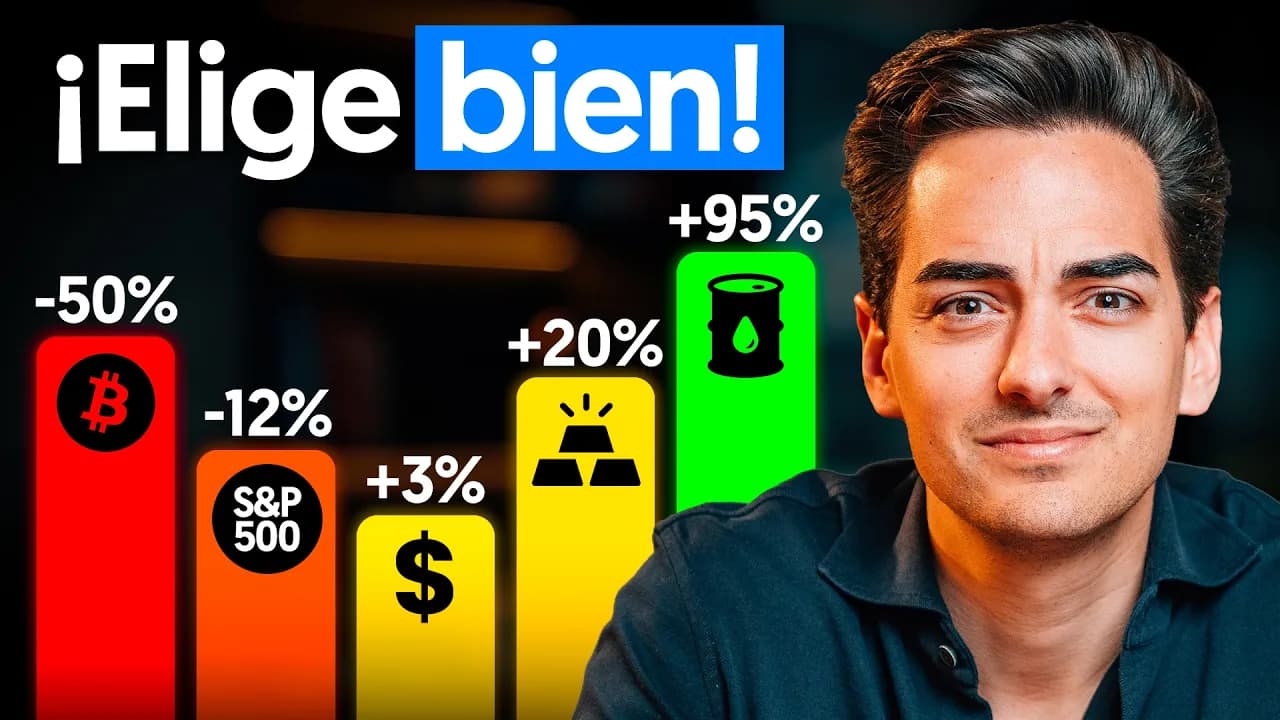
J.P. Morgan has released predictions for income potential from stocks, bonds, real estate, gold, and Bitcoin over the next 10 to 15 years. The report forecasts Bitcoin could return 10% per year, US large-cap stocks 7.5%, real estate investment trusts (REITs) 8.2%, and gold 5.5%. Bitcoin is predicted to outperform the stock market during this period.
The report contains a significant condition regarding Bitcoin that will be discussed later. JPMorgan has raised projections for US stocks and expects a conventional 60/40 portfolio to return about 7% per year. These are long-term projections covering the next 10 to 15 years, not just predictions for 2027.
J.P. Morgan predicts US large-cap stocks could return 7.5% per year over the next 10 to 15 years, increased from 6.7% in last year's report. The increased optimism stems from artificial intelligence and productivity improvements. US economic growth adjusted for inflation is forecasted to average around 2.1% due to these productivity gains.
Companies are investing billions in AI, data centers, and semiconductors. The core mechanism is that these investments enable businesses to produce more goods and services without proportional cost increases. A business example illustrates this: with 100 employees, technology can increase output by 20% without hiring additional staff, significantly impacting profit margins.
US stock valuations are already quite expensive, a trend since 2013. Strong optimism about AI is likely already reflected in share prices. Large company status does not guarantee shares are a good investment at any price. The 7.5% annual return forecast should not be treated as a guarantee, and retirement planning should not assume 10-12% returns.
An investment of $100,000 at 7.5% annual return becomes approximately $206,000 in 10 years when reinvesting all profits without adding new money. This represents a doubling of capital, but the figure is before taxes and inflation.
US small-cap stocks are projected to return 7.7% annually, while emerging markets are expected to return 7.1%. The differences are minimal, suggesting portfolio changes should not be based solely on these small percentage variations.
JPMorgan forecasts 5.6% annual returns for US aggregate bonds, 6.1% for investment-grade corporate bonds, and 6.6% for high-yield bonds. Expected global aggregate bond yields have risen to 5.3%, representing their highest forecast in two decades.
The reason for improved bond returns relates to interest rate changes since 2020-2021 when the Federal Reserve kept rates near zero. Treasury yields were extremely low during that period. Current higher yields mean investors receive better income from high-quality bonds. Bond yield and bond total return are not always equivalent, as bond prices can fluctuate and long-term bond values can decline if interest rates rise.
A $100,000 investment at 5.6% annual return grows to approximately $172,000 over 10 years. Compared to the $206,000 projected for US stocks, stocks offer higher expected returns but with greater volatility. Risk tolerance becomes more important than return potential for investors aged 60-65 preparing for retirement.
JPMorgan projects 3.2% annual returns for US cash over the next 10-15 years. Cash held in savings accounts or short-term Treasury bills carries long-term inflation risk. Inflation functions as an invisible tax that reduces purchasing power over time.
Emergency funds and money for short-term expenses should be maintained in cash, but keeping an entire retirement portfolio in cash for 20 years creates significant inflation risk.
JPMorgan forecasts US REITs could return 8.2% annually over the next 10-15 years, exceeding the 7.5% forecast for US large-cap stocks. US core real estate is projected to return approximately 8.1%. Publicly traded REITs represent companies accessible through stock markets, while core real estate refers to institutional investments in established assets.
REITs can own apartment buildings, warehouses, shopping centers, and data centers. Like rental property ownership, real estate investments generate income. However, publicly traded REITs experience significant share price volatility. The 8.2% expected gross return should not be confused with an 8.2% dividend yield.
A $100,000 REIT investment at 8.2% annualized return over 10 years yields approximately $220,000, representing a $14,000 advantage over the US large-cap stock projection.
Gold is projected to return 5.5% annually. Gold differs fundamentally from other investments as it generates no revenue like companies, pays no interest like bonds, and provides no rental income like real estate. Returns depend entirely on market price appreciation over time.
Gold serves as diversification and insurance against certain economic risks rather than an investment expected to outperform stocks long-term. JPMorgan's forecast aligns with this perspective, expecting positive but not exceptional returns compared to stocks, real estate, or Bitcoin.
This represents the first inclusion of Bitcoin in JPMorgan's 31-year history of long-term capital market projections. Bitcoin is forecasted to achieve a 10% compound annual return over the next 10-15 years, exceeding projections for stocks, REITs, gold, and bonds.
Bitcoin's larger current market size compared to 10-15 years ago provides context for the 10% projection. Bitcoin's expected annual volatility is 55%, compared to 18% for US large-cap stocks—nearly three times higher volatility.
A $100,000 Bitcoin investment at 10% annual return over 10 years yields approximately $259,000, representing a $53,000 advantage over the US stock projection. However, the potential for 50-60% price drops raises questions about investor ability to maintain positions during significant declines.
JPMorgan excludes Bitcoin from main strategic portfolio models despite high return potential, citing extreme volatility and unstable correlation with other assets. This demonstrates that highest-return investments do not necessarily warrant largest portfolio allocations, highlighting the distinction between maximizing returns and controlling risk.
Investment outcomes for $100,000 over 10 years based on JPMorgan projections:
- Bitcoin: $259,000
- REITs: $220,000
- US large-cap stocks: $206,000
- 60/40 portfolio: $197,000
- US bonds: $172,000
- Gold: $171,000
A 60/40 portfolio is projected to yield approximately 7% annually. The $197,000 outcome is only $9,000 less than the US large-cap stock projection, though actual risks and returns could differ substantially.
Investment decisions should consider individual risk tolerance and time horizons rather than focusing solely on which asset delivers the highest return. A 25-year-old investing for 40-year retirement has different requirements than a 65-year-old needing immediate retirement withdrawals.
These projections represent estimates, not certainties. Stock market valuations appear elevated based on S&P 500 and M2 money supply analysis. Under the current financial system, increased currency units entering the system drive inflation. Assets benefit from inflation while cash loses purchasing power.
Cash serves transactional purposes like blood circulation in the body, not as a storage mechanism. Emergency funds should be maintained in cash, but assets including stocks, bonds, gold, real estate, Bitcoin, and collectibles are necessary for wealth preservation.
The speaker has maintained long-term Bitcoin positions and emphasizes education about monetary systems. The 7-Day Money Roadmap spreadsheet is available as a free resource, along with Whiteboard Finance University community access and financial planning services limited to 30-40 families.
Keep Marko - WhiteBoard Finance in your library
Save the videos and channels worth coming back to, and find them again in one place.