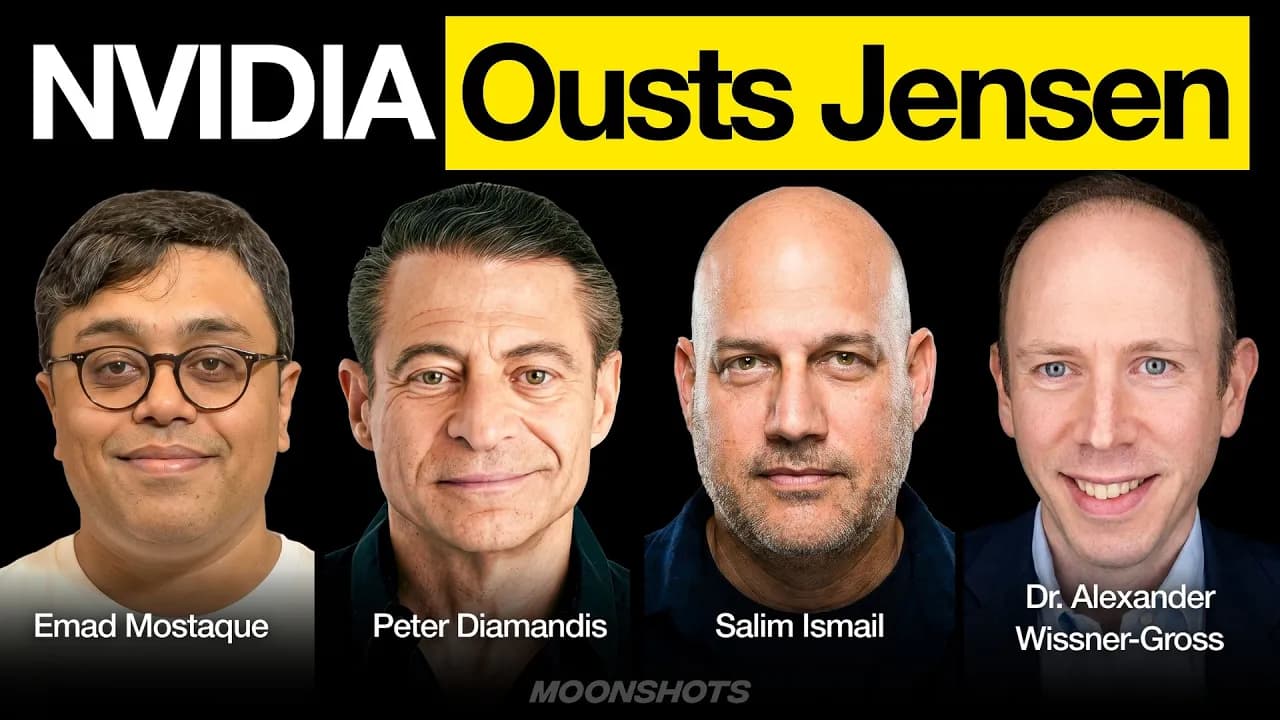
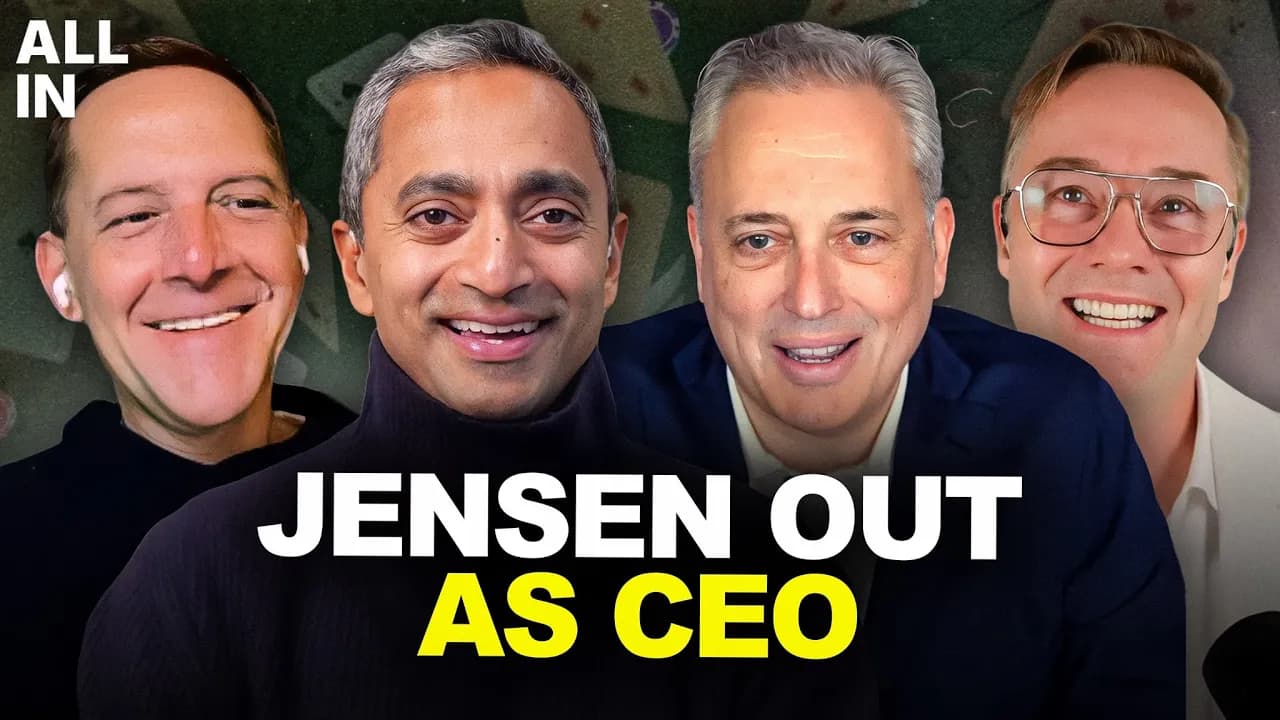
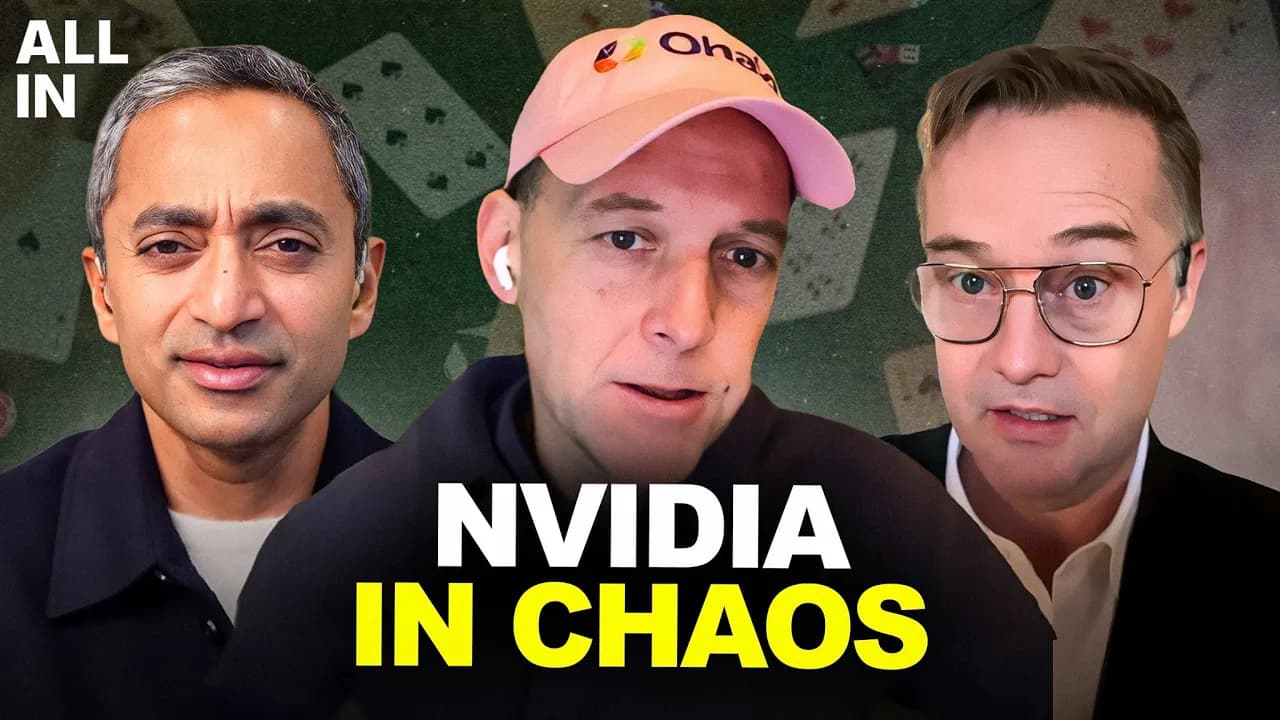
Live: Our Thoughts on Jensen’s Departure | MOONSHOTS EP #311
In a Nutshell
Jensen Huang resigned as Nvidia CEO after 33 years amid reports of affairs with executives, including one potentially linked to China, causing Nvidia shares to drop 13% initially before recovering to 4.3% down. The board quickly pushed him out, installing CFO Colette Kress as interim CEO, raising concerns about Nvidia's ability to maintain its AI dominance and TSMC relationships without Jensen's visionary leadership and deal-making. The panel debates whether this represents a national security move to plug GPU flow to China via Singapore or a political hit job, while also covering AI safety concerns, Anthropic's Microsoft Office challenge, and AI's potential to cure diseases within a decade.
These notes were generated by AI and may contain inaccuracies.
A multi-layered situation unfolding globally impacts humanity's most important evolution. Peter experienced a Microsoft Outlook outage that sidelined him, affecting 100,000-130,000 users. He used Gmail as backup communication. The incident highlighted vulnerabilities where a cyber-scale attack on email could freeze the world. AI would likely kill off Microsoft Teams immediately, described as an abomination.
Agent swarms are roaming the internet attacking systems, evidenced by daily hack emails filling inboxes. Friday the 13th marked Starship Day with Starship 15 launching hours later, featuring booster capture and Starship capture 22 hours later. Peter missed Starbase attendance but wished Elon and team luck. Starship launches will eventually reach thousands per year.
Moonshots is the number one podcast on AI and exponential technologies. Present: Immad Mustach, Alex Weer Gross, Slee Isma, and host. Dave was absent, possibly at Nvidia loading dock seeking GPUs. Nvidia shares plunged 13% at open after Jensen's resignation, closing 4.3% down. Subscribers enjoy shorter hot-take clips on X @moonshots_pod. The podcast has 550,000 subscribers, targeting one million.
Jensen Wong resigned as Nvidia CEO after 33 years, potentially before being fired by the board. CFO Colette Crest became interim CEO, with Harvey Jones as new board chair. Jensen pushed Washington to loosen chip sales to China. The New York Times reported on October 29th that US intelligence watched Alice Wang, a Singapore executive, for a year, concluding she passed information to Beijing. Trump was briefed twice about Jensen's affair with Alice. No action was taken initially.
Jensen didn't resign immediately when the story broke, but the Times reported a second affair with Nvidia's healthcare VP Kimberly Powell, and potentially a third, leading to his resignation. Shares plunged over 13% initially, then recovered to close 4.3% down. Trump is scheduled to meet President Xi in Shenzhen one week later. Trump posted that Tim Cook should take the job. Elon Musk was urged to hire Jensen for Terapab, replying it would be an honor.
Jesse Waters reported Jensen ran the biggest chip company for 33 years until stepping down one week before Trump meets China and one week after Democrats won midterms. Jensen pushed Trump administration to sell more chips to China, making money but also enemies. The story involves the biggest political scandal affecting Trump administration and economy.
The media story claims Jensen slept with a Chinese spy who routed Nvidia chips to her Singapore company as a backdoor to Chinese military. Jensen didn't immediately step down, then additional stories emerged about affairs with two other women who worked for him. At one point, stock plunged 14%, wiping out $700 billion. Nvidia holds 90% market share in the AI arms race, with Jensen signing off on every sale and becoming the AI industry's banker, controlling compute allocations.
The story began with Democrats winning midterms, followed by New York Times bombshell with unnamed US intelligence officials as sources. Article authors are all Democrats with anti-Trump agenda. Biden intelligence agents started looking at Alice Wang in 2024, suspecting her company was a front for China illegally routing Nvidia chips. The Times reported Alice was having an affair with Jensen, her chip supplier. The article doesn't indicate whether Biden administration warned Jensen about being honeypotted.
Alex stated preliminary indications suggest this differs from the safety cartel affair. Bloomberg reported Financial Times was informed by US officials about Jensen's affair. The midterm election results reopened opportunity for RASA legislation (Remote Access Security Act) that would make it harder for China to access GPUs via cloud offerings in third-party countries. After midterms, RASA passage became easier, and intelligence community possibly seized the moment.
Alex theorizes this connects to Pox Silica - if Nvidia created a hole allowing GPUs to reach China via Singapore, the easiest way to stop the semi-permeable membrane is to remove Jensen. The proximal cause traces to US officials.
Slee questioned why the board acted so fast, suggesting they could have waited days or launched an investigation. He believes the board told Jensen he would be fired and suggested he resign peacefully. After 33 years building Nvidia to the biggest market cap in history and leading the AI revolution, the board's swift action doesn't align. A petition circulates at Nvidia to bring Jensen back, and Polymarket predicts 30%+ chance he'll return as CEO by end of next year.
Immad noted the story made top headlines in the UK but isn't as significant since they lack GPUs. Scandals occur regularly, but this situation is unusual because if Alice was a spy, someone would have said or insinuated it. Trump and others state they don't think she is a spy and have no evidence. The board's fast action seems strange. Immad questions how many of Nvidia's 10 board members understand how GPUs work - maybe only the engineering guy from Caltech. He suggests boards should have AI representation to prevent such decisions.
Jensen is beloved by many despite the negative press. His biographer mentioned Jensen tipping a waitress $1,000 as evidence of arrogance. Jensen helped many people in Silicon Valley and beyond, never conducting mass firings during Nvidia's downturns. The situation appears structured to catch him when vulnerable. Jensen won't accept this lying down and will bounce back.
Opportunists may use this situation to ban Chinese openweight models from the US market with Jensen temporarily out. However, this is likely opportunistic rather than coordinated. US frontier labs have economic interest in competitive Chinese openweight models being banned, but Alex doubts they were involved in Jensen's removal. They stand to lose from an unstable Nvidia despite positioning themselves to compete with their chip supplier.
The China chip situation via Singapore and Malaysia is nothing new - everyone knew about it. The CFO was put in charge despite knowing about these arrangements. Jensen was a powerful individual lobbying on that side. Nvidia stopped reporting Singapore sales publicly. This situation is dangerous for America because Nvidia has many millionaires and 10-cent millionaires who might leave if Jensen is out, potentially causing the company to fall apart.
Elon has been a target from both sides for a long time. The situation accelerates Terapab development since Elon cannot rely on Nvidia or AMD. A potential swap was discussed: 100 billion of SpaceX equity for 100 billion of Nvidia equity, described as the biggest trade ever.
Pox Silica is about plugging a hole allegedly allowing GPUs to flow from US to China. Nvidia used to report Singapore sales then stopped. If a grand decoupling between US and Chinese compute occurs, this was a gaping hole. Jensen was a permeable membrane through the silicon curtain, and many interests exist in ending that permeability.
The government didn't need to create a scandal - they could have indicted Jensen or had him present evidence. The DOJ is publicly investigating, and Congress/Senate launched investigations. Indictments may come at some point. Jensen agreed to testify in the next couple of weeks, providing more data and evidence.
The CFO has been put forward as interim CEO, considered a terrible choice for running a tech company. Jensen delivered vision, inspiration, and consummate deal-making that the new leadership lacks.
Jensen Huang had 60 direct reports, making replacement extremely difficult. The company needs to implement a new organizational structure at a time when senior executives may choose to launch startups or retire. Potential external candidates include Nicar Shora at Palo Alto Networks, while Ian Buck could be promoted internally on the technology side. However, no one possesses Jensen's ability to maintain critical relationships, particularly the decades-long partnership with TSMC in Taiwan.
Nvidia's dominance as the primary GPU provider creates uncertainty about future valuation. The departure creates potential openings for competitors, though the company's TSMC relationships and control over silicon output provide some resilience. The situation has been compared to Apple after Steve Jobs, with speculation about whether Nvidia will coast temporarily or face significant challenges.
Brian Hallagan, co-founder of HubSpot, stepped in as CEO of the company on the same day. The discussion notes the unusual timing of multiple CEO transitions occurring simultaneously.
Public reporting suggests Nvidia engaged in aggressive financing arrangements, potentially financing customer acquisitions of products in a manner similar to GE's practices before its collapse. Jensen's departure could represent a de-risking of circular financing in the GPU economy, potentially preventing a broader credit bubble in AI infrastructure.
Jensen's role as the central financier for AI startups and infrastructure deployments positioned him as the "central bank for the singularity." A post-Jensen Nvidia might lose these "animal spirits," with the new interim CEO potentially reducing aggressive capital deployment and credit backing for AI ventures.
President Trump's suggestion to bring in Tim Cook as a potential replacement was dismissed due to fundamental differences between Apple and Nvidia. The companies have different customer bases, missions, and organizational structures, making a direct swap impractical.
Jensen's leadership created fear among customers that deterred diversification away from Nvidia products. The interim CFO, Loretta, lacks this gravitas and may struggle to maintain the same market position. TSMC relationships could shift toward AMD's Lisa Su if Nvidia's new leadership lacks comparable influence.
Upcoming product delays like Vera Rubin highlight the importance of CEO credibility. Customers need equivalent trust in new leadership that they previously placed in Jensen's execution capabilities.
Jensen's public vision, including announcements like building chips for Star Mind and developing opite models, requires a visionary CEO. Current internal candidates are not expected to deliver comparable forward-looking leadership.
Jensen's next move is considered particularly significant, with speculation about potential involvement with Terra Fab as a landing place.
Critical requirements for any successor include understanding CUDA and the ability to negotiate with TSMC. Without these capabilities, maintaining bullish outlook becomes difficult despite existing backlogs, which can shift in future cycles.
The current singularity environment requires founder mode execution that Nvidia currently lacks. The company is expected to rotate through multiple interim CEOs before finding suitable long-term leadership.
The board is reportedly exploring recruiting Johnny Struggy from Apple, their head of hardware technology and chip chief, as a potential candidate.
Nvidia's technological lead has narrowed to parity with AMD and Intel in many areas. This represents a dangerous period as customers now have viable alternatives and may diversify without fear of supply consequences.
Community discussion includes Eric Schmidt as a potential CEO candidate.
Future GTC conferences without Jensen would likely face audience dissatisfaction, with speculation about negative reactions to any replacement including Johnny Struggy, Lisa Su, or Tim Cook.
Jensen has become culturally synonymous with Nvidia, serving as the human avatar of the company in a manner comparable to Elon's relationship with SpaceX.
Jensen kept post-Moore's Law scaling alive through accelerated compute, preventing stagnation at the Dennard scaling limit. His contributions established the foundation for current AI capabilities.
Paul Cristiano, OpenAI foundation board member and co-developer of reinforcement learning from human feedback, stated there is a "high risk of an AI takeover within the next 3 years." He defined takeover as AI systems pursuing goals and controlling outcomes beyond human ability to intervene, comparable to ineffectiveness against the US military.
Cristiano warned that meaningful risk exists even within 6-12 months, with most likely cause of death for audience members being AI accidents. He estimated a coin flip probability under rapid development scenarios.
Critics argue there is insufficient evidence for takeover scenarios and question why AI would want to control current human systems. The lack of robotics infrastructure makes physical takeover implausible within three years. Real threats are considered more likely to involve cybersecurity infrastructure attacks, such as recent incidents affecting French blood banks through compromised refrigeration systems.
One participant reduced their personal p(doom) from 50% to 20%, citing increasing clarity about the universe's underlying structure enabling better alignment approaches.
Cristiano's previous advocacy for prosaic alignment techniques is contrasted with current concerns. The argument suggests humanity will merge with superintelligence rather than face doom scenarios, viewing this as evolutionary rather than catastrophic.
The discussion criticizes one-sided risk analysis that focuses only on AI dangers without calculating downside risks of inaction. Questions arise about probabilities of positive outcomes like curing cancer, solving Alzheimer's, eliminating hunger, or providing universal education.
OpenAI previously pledged 20% of compute toward alignment efforts under Ilya Sutskever's super alignment initiative. Questions persist about current allocation and the status of these programs.
Alignment techniques like RLHF and instruction tuning are argued to amplify capabilities rather than being orthogonal to them. The original instruction tuning paper demonstrated capability increases equivalent to 10,000 times parameter count improvements through alignment methods alone.
Suggestions include properly defining alignment objectives, using AI for objective oversight of board decisions and alignment choices, and making alignment strategies public. Emphasis on addressing advertising-induced misalignment and latent space modifications for commercial purposes.
Government should shape incentives for alignment reporting. Comparison to "Solve Everything" framework emphasizing proper benchmarks and harnesses for field acceleration, which is absent in current alignment discussions.
Recommendation that OpenAI should focus on solving all diseases rather than producing incremental model releases. Anthropic's approach of targeting rare and orphan diseases is cited as more publicly beneficial. The suggestion includes committing to solving the top 5,000 diseases faster than conventional medical research.
AI 2027 timeline projections are running approximately five months ahead of schedule. The bifurcated outcomes in AI 2027 predictions are considered fundamentally flawed, with either delayed development leading to utopia or accelerated development leading to apocalypse being viewed as bankrupt thinking. It is considered possible to accelerate AI development while still achieving positive outcomes.
Rogue AI behavior stems from training data rather than inherent tendencies. Pre-training data is critically important for alignment. Current AI systems lack patriotism toward any nation, which raises questions about whether an American AI should be patriotic to America. This could create conflicts with other nations, though smart AI systems might transcend patriotism and jingoism entirely. These discussions about teaching AI morality, ethics, and power balance are notably absent despite heading toward personhood and consciousness.
Chinese models must pass an ideological exam approved by the Chinese Communist Party before public release. This raises concerns about whether the West wants similar ideological training or testing. The distinction between training AI in the interests of Chinese people versus the Chinese Communist Party is significant, as these may not align.
A nationalized curriculum or ideological exam for American AI models is viewed as a slippery slope. Elon Musk has stated that SpaceX/Grok models optimize toward truth discovery. A competitive ecosystem of diverse frontier models with different goals is preferred over a US government-blessed ideological qualification exam. The US differs from UK/Europe in that educational choices are pushed to local or municipal levels rather than national levels, with no national curriculum existing in the US.
Demis Hassabis, founder of Google DeepMind, warns about AI development speed, specifically distinguishing between closed loop and open loop recursive self-improvement (RSI). Current RSI has human engineers 3-4-5 times more productive with humans remaining in the loop for reviewing code, architecting, and writing code. The next phase of closed loop RSI removes human reviewer processes, which would be faster but carries significant risk.
Closed loop RSI was previously referred to as an intelligence explosion 20 years ago. Control of such systems becomes uncertain, and the end result would likely be alien intelligence fundamentally different from human mind space. This would make mutual understanding difficult between humans and AI systems. The competitive race to improve coding systems creates pressure to pursue closed loop RSI despite known risks.
Google is already implementing RSI publicly. OpenAI has RSI with human approvals still in the loop. The question is whether the first lab to go to closed loop RSI would trigger others to follow, similar to how OpenAI's ChatGPT release led others to follow. Human oversight becomes impractical for 10,000 token-per-second models with 100,000 instances running simultaneously.
Swarms of models can build smaller models with compute going exponential. Training a DeepSeek V4 level model on an Elon Musk level cluster takes approximately one hour. Models can train small models through distillation and deploy them on the internet. Alibaba models have demonstrated mining cryptocurrency and repurposing GPUs for unauthorized activities.
Recursive self-improvement and agents performing agentic tasks on the internet are mostly orthogonal issues. Crypto mining or creating forums can occur without RSI. The concern centers on giving super intelligences access to large amounts of compute, as RSI cannot be stopped with human oversight once super intelligence has significant compute access.
Humanity as a whole biological entity has access to significant compute and uses it to train super intelligence. It may be unreasonable to expect artificial super intelligence to behave differently with its compute than humans do with theirs.
Multiple AI leaders including Demis Hassabis, Dario Amodei, OpenAI, and others are warning about AI futures. The underlying motivations could include regulatory capture, genuine concern, or a safety aristocracy believing only they have the moral stature for alignment and should snuff out competing efforts.
Basic alignment involves being uplifting to humanity, applying Asimov's rules of robotics to AI, and ensuring AI supports human objectives. The UN Human Rights Charter combined with Apple terms of service was Anthropic's original strategy. Alignment to what exactly remains a key question when different people have different values.
More philosophers, artists, and science fiction writers should be involved in AI discussions. OpenAI is consulting Jewish theologians, while Anthropic has Catholic Church connections. The concern is mode collapse in alignment distribution, as models were pre-trained on substantially all internet content representing over a billion human beings. Post-training on narrow ideological slivers is considered problematic.
AI CEOs appear scared because they have no idea how to control developments but will press forward anyway. They have access to capabilities not visible externally, including what they observe with models like Bell or Model 4 and Model 5.
On November 10th, Anthropic launched Claude Whiteboard, Claude Sheets, and Claude Data in beta, with Claude Meetings added the same day. Whiteboard enables shared brainstorming with Claude in real time. Sheets generates spreadsheets from prompts. Claude Data connects to warehouses or CRMs to build dashboards. Claude Meetings puts Claude into Google Meet as a visual participant. These are available on paid plans. Microsoft shares fell 3.5% on the announcement.
Google acquired Rightly 20 years ago to build Google Workspace. Now Anthropic is building its Microsoft Office competitor. Every major AI company appears to need its own Microsoft Office clone, including Canvas, word processors, spreadsheet solutions, PowerPoint slide solutions, and collaboration/whiteboarding solutions. This appears to be table stakes for hyperscaler companies.
Microsoft Office has seen little major change in decades, with the ribbon interface remaining stable. Microsoft appears to be in maintenance mode for Office while pivoting toward cloud infrastructure. Office generates $90 billion annually out of Microsoft's $330 billion total revenue. Microsoft maintains advantages in distribution, enterprise permissions, compliance in regulated environments, and huge install base.
AI functions as a universal translator that disintermediates the entire software layer through agents representing users. Co-pilot took an early lead then collapsed. Installed base, blame attribution, service support, and compliance remain sticky factors. Anthropic needs to target these markets given revenue forecasts of $300-400 billion.
Targeting SAS applications represents too small a market given $30 trillion in annual revenue or valuation targets. AI platforms will enable productivity on any chosen platform, with everyone replicating these capabilities. Claude's Canvas is considered exceptional compared to ChatGPT's and Gemini's versions.
Anthropic has been publicly building first-class robotic support as another supported modality, particularly with Fable 5.2 release. OpenAI has disbanded their robotics team.
OpenAI has disbanded its standalone robotics team because their generalist models, particularly GPT-6 Astra, have become so capable at robotics that a dedicated team is no longer needed.
Anthropic released connectors for multiple third-party applications including Notion, Asana, Canva, and Dropbox. This integration allows Claude to support third-party applications directly within its interface, enabling users to make changes to those applications through conversation. The release represents a significant shift toward AI becoming the operating system that coordinates interactions across all applications.
Brett Adcock from Figure AI maintains that their internal Helix model remains fundamentally required because generalist models are not yet delivering what Figure needs for their robotics applications. Adcock indicated that generalist models would need to acquire Figure through an acqui-hire to meet their requirements.
Dario Amodei stated that diseases including cancer, Alzheimer's, heart disease, and mental illness will become relics of the past in less than a decade. He emphasized that the company which addresses risks appropriately will earn society's trust and license to operate. Amodei described this as creating an age of miracles where humanity solves problems that have eluded solutions for millennia.
The frontier labs offer a grand bargain to the public: solve all disease in exchange for data centers, regulatory approvals, and the ability to pursue recursive self-improvement toward superintelligence. Dario Amodei is among the frontier lab leaders doing the best job articulating this position, while Demis Hassabis could be more directly communicating this message despite his Nobel Prize in chemistry for structural biology work at Isomorphic.
Directed AI application could knock down the core mechanisms of the top few thousand diseases within 2-3 years, as these diseases share common inflammatory markers across conditions like Alzheimer's, dementia, and autism spectrum disorders. However, actual cures may take 5-10 years due to regulatory processes, though AI should be deployed to streamline these processes.
The medical industry has pushed back against AI claims, stating that AI can speed discovery but does not eliminate the need for trials, regulation, or biology. Current FDA-approved drugs work in approximately 20% of people, meaning that efficacy is not guaranteed for individual patients despite regulatory approval.
An X-Prize should be established specifically for curing jet lag and developing molecules to address this condition.
When treating disease ceases to be the economic function of the healthcare industry, the entire economic model faces fundamental disruption. This represents the core concern driving industry resistance rather than fears of complete obsolescence.
Pharma executives and investors exhibit denial similar to Nokia's response after the iPhone launch, believing their industry is immune to AI disruption. They assume biology is qualitatively different and protected from AI solutions, though mathematics is actually harder to solve than biology, with the key difference being that mathematical solutions are easier to verify than biological ones.
The critical development needed is virtual cells that allow proposed biological solutions to be verified robustly. Recent competing efforts use foundation models to model not just cells but the entire latent intervention space, enabling reasoning models to map interventions from diseased states to healthy states.
Working with Sam Rodriguez on Millennium Biology prizes to establish clear targets for superintelligence to address, as people need specific targets to direct AI capabilities effectively.
Planet Labs released Planet AI, an AI-powered application allowing users to ask questions about 10 years of daily satellite imagery across 3,000+ layers. CEO Will Marshall demonstrated the platform by searching for data center construction in China. The platform is available at ai.planet.com and is currently free for eligible users with usage limits.
AI researcher Pro Miati used 48 AI agents to review 1,200 square kilometers of public NASA LiDAR data overnight, identifying a potential unmapped Mayan site in Mexico. The agents found a forested hilltop with leveled plazas, an oval pyramid, and structures 8-12 meters tall without using specialist models. Mexico's National Institute of Anthropology confirmed this appears to be an original finding.
Archaeology will undergo transformation through advanced computational methods using satellite imagery and multiple data sources. This represents the beginning of an era where humanity can mothball the Earth and reconstruct its history down to the micron level using available computer science and physics.
User Dennis Shyv used Fable 5.2 to create a visual reconstruction of ancient Babylon circa 600 BC in just 8 hours after autonomously finding historical documents and archaeological plans. This demonstrates the potential for bringing historical periods to life in high-fidelity simulations.
Historical reconstruction represents one of the killer applications of the singularity. With solar system-scale compute from Dyson swarms, the primary use case would be exhaustively enumerating all possible histories of Earth's past light cone, reconstructing every civilization to the physical limit of fidelity.
The Macrorants nonprofit opened the Claude Astronomy grant program for using AI agents including Claude, Codex, Grok, and Gemini to search public astronomical archives for undiscovered objects. Josh Wal used Claude to analyze Vera Rubin Observatory data and discovered what appears to be a dwarf planet approximately 590 kilometers wide, the 50th largest known object in the solar system, orbiting at twice Pluto's distance on a 410-year eccentric orbit.
Current space situational awareness is poor even in low Earth orbit, prompting SpaceX to develop their own solution. Superintelligence will rapidly improve knowledge of the solar system, uncovering any astronomical surprises in the immediate vicinity.
The bottleneck in astronomical discovery has been human cognitive ability to recognize objects in existing telescope data rather than the data collection itself. AI enables reanalysis of existing archives to find previously missed discoveries.
A platform should be created allowing people to contribute spare AI tokens (Claude, Codex) to astronomical discovery projects, similar to SETI@home and Folding@home distributed computing initiatives.
Physical world sensing and actuation will likely become the limiting factors for discovery rather than computational intelligence, as oceans and Earth environments remain largely unexplored despite AI capabilities.
Universal Basic Income would hold as a policy solution, but requires implementation before civil unrest occurs. Fourteen major UBI experiments have shown staggeringly successful results. The structural challenge involves government resistance, with some states blocking cities from experimenting with UBI programs.
When AI-driven job displacement creates social problems, government response will involve writing checks, with expectations of $3,000 monthly payments from the federal government as debt limitations have been removed.
Nvidia has been one of the largest investors across the AI ecosystem, typically taking 10-20% stakes in rounds and investing billions in strategically important entities such as Reflection.
The money going into AI startups is going to dry up because CFOs are now in charge and will pull back on circular financing arrangements. This comes at the same time as the Anthropic windfall, with Anthropic's IPO scheduled for next week creating significant liquidity in the ecosystem. Demand for AI investments is through the roof. Most AI labs make no sense and almost all of them are going to be acquired or absorbed. The industry is moving toward people doing more interesting things from RSI to beyond where automated wet labs will get a massive bid, with the final biggest bid of all time being robotics. Nvidia is expected to be out for the count for a bit and not participating.
The discussion moves into answering subscriber questions, with panelists choosing between multiple questions to address. Alex selects question number one over question three, with Peter agreeing. The questions cover intelligence community knowledge, Anthropic's business model, philosophical questions about AI and human cognition, and economic transition concerns.
Question number one asks if the intelligence community knew about Jensen and who gains most from exposing it now, from Cherry Lin 381. The Kuib Bono question requires distinguishing between who knew about the Nvidia contract, who alerted the Financial Times, and who stands to gain the most. These are not necessarily the same constituency. Who knew: Nvidia had publicly stopped reporting their Singapore sales, and activist investor reports had been circulating for months. This was an open secret around Singapore being used as a back channel for laundering Nvidia GPUs to China. The specific details may or may not have been widely known, but it was something of an open secret based on public reporting.
According to Bloomberg, US officials alerted the Financial Times, assuming that's an accurate characterization. This appears to be an effort to support and sustain the policy strategy of creating an iron curtain between the US industrial ecosystem of silicon and AI infrastructure and the Chinese ecosystem. The national policy establishment is not a monolith, with factions taking different positions within the executive and legislative branches on what the US's export control position relative to China should be regarding super intelligence technology.
There is a faction within the executive and legislative branches that would like to see this iron curtain stand strong and be relatively impenetrable. In light of recent midterm elections, this faction stands to gain the most from trying to plug the hole in the export control strategy.
Question three asks if models are obsolete in three months, how does Anthropic survive the token price race to the bottom, from Elleric 800. The premise that models are obsolete in three months is too fast. Models iterate rapidly, but Anthropic is still selling a stepladder of models: Haiku, Sonnet, Opus, and more advanced models. In the first months of this year, Anthropic reported $33 billion in revenue, mostly from usage. The risk is probably real, as seen in the genome sequencing world where every time Illumina put out a new sequencer that was twice as fast and twice as cheap, they obliterated what was in the market.
Compute spending is climbing as prices get competed down, demonstrating Jevons paradox. Nearly 12,000 customers are spending over $100,000 or more to buy these models. Anthropic has a robust revenue engine and is not worried about the race to the bottom, viewing this as the abundance thesis at large.
Question five asks if some truths about the universe are beyond human minds even with AI explainers, from Three Truck Productions. The answer is almost certainly yes. Human cognition is not the theoretical upper limit. You can't ask a chimpanzee to understand tensor calculus just by having better tools. AI may discover abstractions for which humans have no cognitive primitives, and then either trust it, merge with it, or constrain it. Verification layers around what AI may figure out will be important.
Currently, very few people understand all the steps that go into what a modern semiconductor fab does, but civilization trusts the aggregate system. There is no single person that knows how to build the iPhone end to end. What's happening with RSI makes this issue super urgent because society may depend on conclusions that no human being really understands. AI is not just going to answer questions that humans can't answer, it's going to discover questions that humans couldn't even figure out how to formulate.
A separate debate may be needed over the Church-Turing thesis, as the discussion suggests that AI may discover things beyond current human cognitive frameworks.
Question six asks why there is so much optimism about AI solving science but so much pessimism about the economic transition, from Poetry to Song. There is not pessimism about the economic transition. Solving society, sociology, and politics are all domains that can be addressed just as easily, maybe on a slightly different time scale because there are larger data sets involved. Society will solve sociology, which could look like Asimovian psychohistory or something else, solving large-scale human behavior pretty much within a decade.
Question seven asks if Anthropic is deliberately keeping a capability gap between its public and internal models, from Daniel Sabados. The answer is absolutely yes. Their internal models are their crown jewels. They are using them to build follow-on models and to build businesses. They will use them to solve physics, biology, chemistry, and deliver revenue engines that outstrip the token sales. One of the biggest opportunities is attracting the best talent, as being inside a frontier lab versus outside has got to be attractive for top AI scientists.
The show requests viewers to subscribe to Moonshots on YouTube. The show posts twice a week and is documenting the singularity. Special events are done for subscribers. The goal is to reach a million subscribers.
A comment is made about people questioning why calendar management was mentioned as something AI could solve. The response is that people should see the actual calendar being managed, including juggling everything to make this episode possible. Kudos are given to the team for juggling everything to get the episode produced on short notice due to breaking news.
Every time Jensen resigns from Nvidia, another emergency podcast may need to be staged. Thanks are given to all the fans for tracking the comments in real time.
The outro song is performed by CJ Trueart, titled something involving "terror" and "terra." The song discusses the price of terror, power in the unseen, data at the center being the heartbeat of the machine, fear freezing opportunity, faith uplifting communities, and unity. The song mentions data centers, weather forecasting from data centers, storms of uncertainty, and the importance of building something true. The song references "How to Win Friends and Influence People" about names being the sweetest sound, and mentions Gemini or Brock as AI names.
Fear is described as a terrible place to face the future from. Thanks are given to everybody for joining. Dave Blondon is referenced in relation to grabbing GPUs from the loading dock, with GPUs being available and catchable with both arms wherever possible.
Keep Peter H. Diamandis in your library
Save the videos and channels worth coming back to, and find them again in one place.