More Trillion Dollar IPOs, Anthropic $3T, Zuck's Price War, China Ends Open Source?, Trump Accounts
In a Nutshell
SpaceX IPOed at $1.75T and is trading at $2T, while Anthropic confidentially filed and is projected to hit $3T valuation if public today, with both Anthropic and OpenAI expected to IPO in 6-9 months. Token costs are doubling every 45 days with minimal ROI, prompting companies to seek cost-cutting through open-source routing and cheaper models, though frontier labs maintain revenue dominance as the intelligence gap persists. Meta launched a price war with 100x cheaper tokens, China is restricting overseas access to top models, and the Trump Accounts program is creating millions of investment accounts for children with $1,000 seed money and major philanthropic commitments.
These notes were generated by AI and may contain inaccuracies.
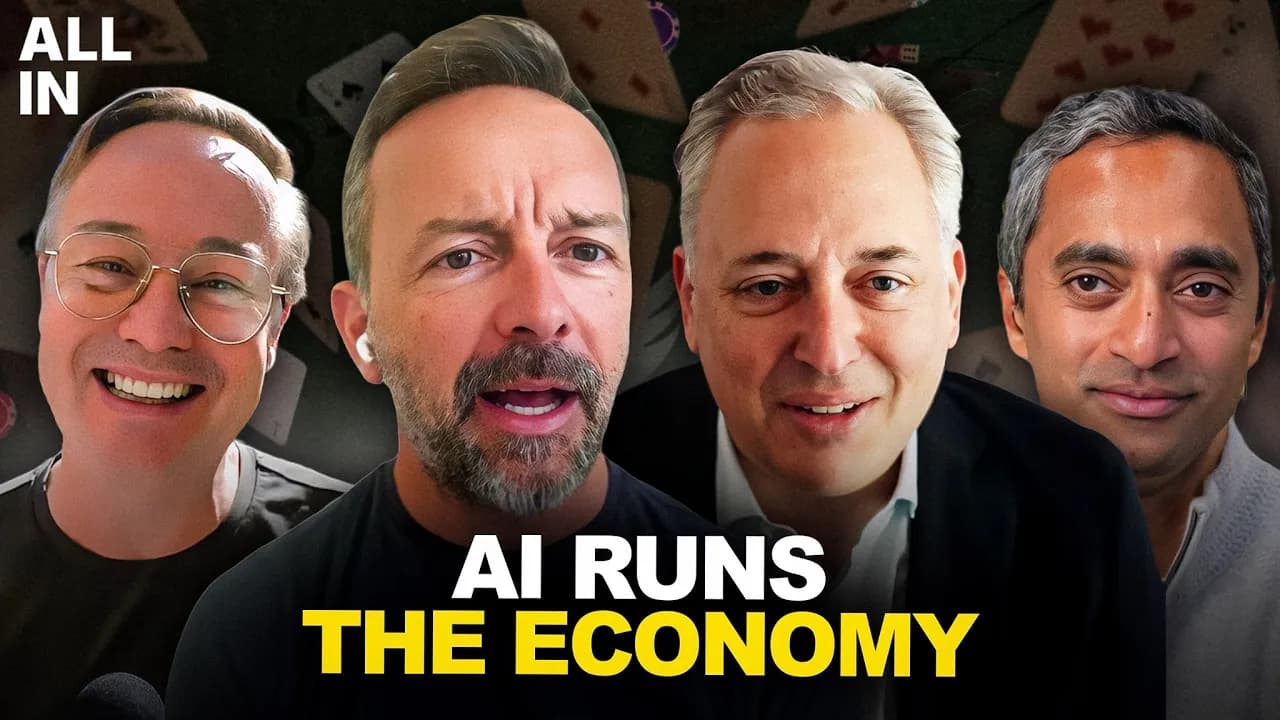
Episode 280 of the All-In podcast features Jason, Brad, and Chamath while Freeberg is on vacation. Brad mentions he has been in DC celebrating America 250 and will be out from August 10th through the 30th. Jason is in Paris conducting eight interviews at the Rays conference.
Chamath attended a dinner in Geneva with Jensen, Brad Smith, Anthony Tan from Grab, and others as part of a United Nations Commission for AI where Mark is the co-chairman. He describes Mark as "the empasario of empisarios" and notes how impressive his ability to build such a large business is.
The UN Commission for AI focuses on open source. Tom Brown from Anthropic was present and was described as "very awesome" rather than alarmist about existential risks. Anthropic believes the future is open source for all countries.
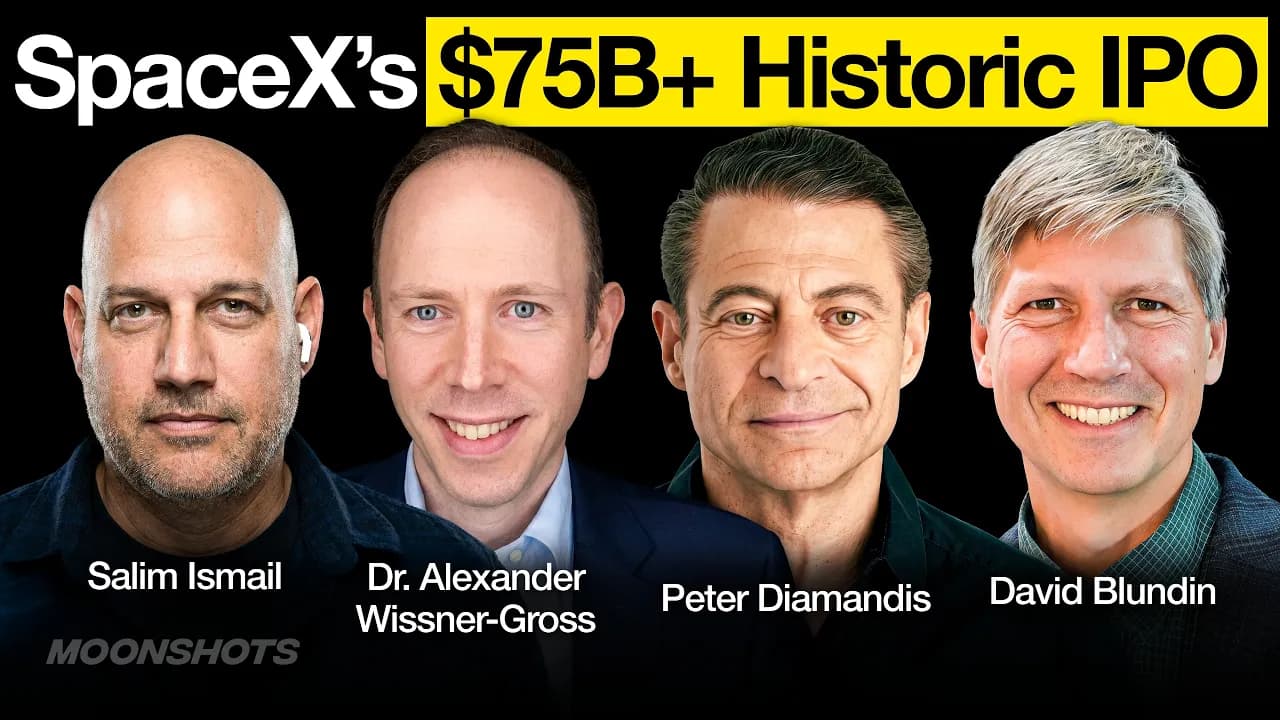
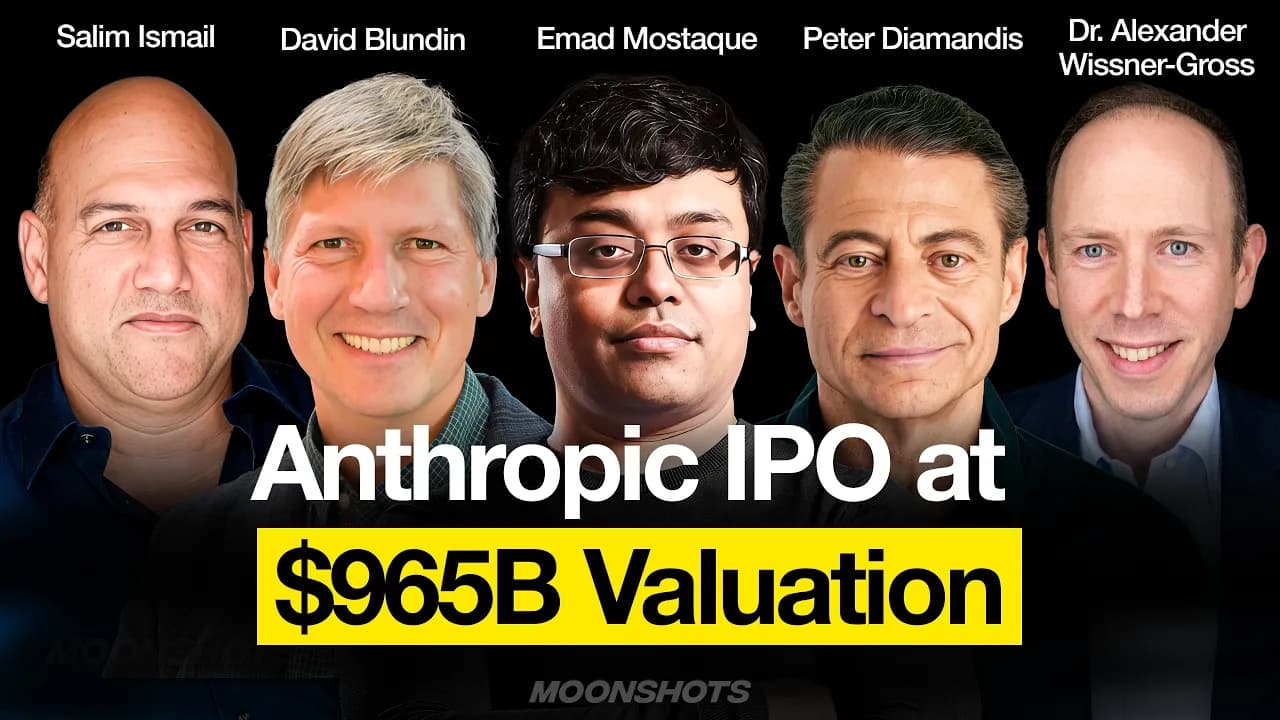
SpaceX went public at a $1.75 trillion valuation and is currently trading at $150 per share, down from $200, maintaining the $2 trillion market cap and ranking as the seventh largest company in the world. Anthropic confidentially filed on June 1st with a 65% chance on Polymarket of IPO happening this year. Gavin Baker believes Anthropic will end 2026 with over $100 billion in revenue and be very profitable, suggesting it would trade at $3 trillion if public today.
Chamath's CTO reported that their token costs are doubling every 45 days while downstream productivity gains are at most 5%. The CTO indicated they've "effectively already asymptoted" and need to use more tokens for incremental improvements. Chamath suggests companies should exit at current valuations before these ROI concerns "seep into the water table."
SpaceX raised $75 billion at $1.75 trillion valuation and is up 25% since IPO, trading at roughly 35 billion of forward revenue. The IPO was described as "textbook" and successful. Key innovations included staged release from lockup tied to milestones, early index inclusion, and raising $75 billion. The 4-5% float creates volatility concerns, with 50% peak-to-trough drawdowns typical in the 6 months post-IPO.
Exchanges and indexes modified rules for SpaceX because previous rules were designed for younger, less-tested companies with lower revenues. The concern was that forcing index inclusion at the peak could lead to 30% drawdowns affecting investors, but the company's size and importance justified inclusion.
Brad believes both Anthropic and OpenAI have very high probability of going public in the next 6-9 months barring black swan events like a Taiwan blockade. Anthropic is rumored to be trending toward over $100 billion in revenue, potentially achieving well over $100 billion GAAP revenue next year. OpenAI's revenue is rumored around $70 billion this year, still twice SpaceX's revenue level.
OpenAI faces additional complexity from corporate restructuring requirements. Brad suggests Anthropic will likely go public before OpenAI. Altimeter would be a buyer at scale in both IPOs, though Brad notes that at over $1 trillion valuation, "get-rich quick schemes are over" and 50-100% durable bounces are unlikely.
ChatGPT serves as the consumer brand for large language models, while Claude positioned itself as the enterprise solution. OpenAI became distracted with Sora and Disney relationships, potentially giving Anthropic the high-growth enterprise position. Chamath questions whether enterprise revenue can sustain without clear ROI.
Chamath tested Anthropic's model on S&P 500 EPS growth since 2024, initially receiving 50% attributed to AI. After correcting for Nvidia chip sales to Amazon, the answer became 9% for S&P 493, with the majority from pricing power on inflation and 3% from buybacks. Actual ROI from AI appears between 0-2% based on publicly available data.
Enterprise revenue faces challenges because buyers demand ROI justification, creating brittleness with fewer, more demanding buyers. Consumer revenue provides safety through tens of millions of buyers at smaller price points, avoiding ROI discussions. Companies spending $1 million annually on tokens face pressure to show returns above risk-free rates.
Uber CTO Pine reported 99% of engineers use AI tools, over 70% of pull requests attributed to local or cloud agents, and 200 agentic skills built by engineers. Uber is deploying "agentic pods" with forward-deployed engineers working with department heads on systems thinking and process optimization across legal, operations, marketing, customer support, HR, and procurement.
Brad argues the current experimental spending lacks direct ROI but the market is so early that nobody cares yet. The total addressable market includes every small, medium, and large company globally. Revenue distribution is not concentrated with few customers but spread across millions making independent economic decisions.
Brad predicts companies going from $100 billion to $300 billion in revenue, representing $200 billion in incremental revenue unprecedented in world history. Intelligence represents the largest TAM ever seen. Jensen Huang uses AI for all Nvidia chip design work, with the machine building the machine. Tiny intelligence advantages at the frontier are required.
Unlike previous technologies that accrued to specific departments, AI tools apply to every person in every organization simultaneously. At $20/month per person in a 1,000-person organization, incremental cost is only 3-4% on top of salaries averaging $100-150k. The question becomes whether this makes each person 3-5 times more effective, explaining the revenue ramp that challenges conventional understanding.
Regulators and other oversight bodies often won't permit organizations to use AI in the ways they want to deploy it. Finance and HIPAA-regulated environments create particular restrictions, with HR data also falling under compliance constraints that prevent putting certain data to work with AI systems.
Once organizations begin using AI and experiencing productivity gains, the technology becomes highly addictive. Early experimentation in January led to testing the Hermes agent, an open-source software project developed by Nuvo Research, which uses French naming conventions despite not being a French company.
Using Open Router to obtain API keys and accessing GLM models through BitSensor on the TAO subnet (a crypto project) resulted in a 95% reduction in token costs. This dramatic cost reduction enabled shifting from daily to hourly agent runs, and breaking single tasks into three separate agents operating on an hourly schedule.
An agent processes all-in episodes and This Week in Startups episodes hourly to identify the top three or four technology trends, fundamentally changing thinking patterns. When costs decrease by 95%, the question becomes how much further token prices will fall, with 90% price reductions observed in each of the last two and a half years.
Jevons Paradox suggests that cheaper tokens will lead to dramatically increased usage. The central debate since the DeepSeek moment 18 months ago involves whether frontier models are being undermined by open-source alternatives closing the intelligence gap, with model routing making it easier to direct tasks to cheaper tokens.
Despite arguments that cheaper, good-enough models would eliminate demand for frontier labs like Anthropic and OpenAI, the share of economic value and wallet share has actually increased for frontier labs while commodity token share has grown for other providers. Jesse Zang's tweet highlighted this divergence between economic value concentration and token volume distribution.
The comparison to iPhone adoption suggests there may come a moment when organizations decide existing models are good enough, similar to how phone upgrades stopped being automatic. Fable 5 demonstrates limitations when it refuses to answer certain health-related queries that would normally be researched.
No country is not developing its own sovereign AI strategy, and many nations reject reliance on closed-source American models. Geographic penetration remains a significant opportunity, with many people worldwide still not using AI technology.
Three major trends are emerging: geographic human penetration representing upside opportunity, experimentation transitioning to ongoing repeatable usage, and integration with existing regulatory infrastructure. Countries are willing to spend money on sovereign stacks to avoid technical risk rather than subjugate themselves to foreign dependencies.
Companies lacking earnings growth to justify AI costs will seek cost displacement rather than addressing underlying problems. Most organizations lack the nerve or capability to implement necessary changes, preferring to let problems compound rather than pursue difficult solutions.
Open source proves significantly harder to implement than simply using approved systems like Claude. Configuration of setups involving BitSensor networks and Open Router required hours of technical work even for experienced users, with dynamic routing between models like GLM 5.2 and fallback options to Claude.
Andy Fang, CTO of DoorDash, reported that internal coding benchmarks enabled confident introduction of open-weight models into AI code review without degrading code quality. Frontier models handle the hardest work while delegating lower-level tasks to models like Kimmy 2.6, with benchmarks being released to demonstrate ROI.
In earnings miss scenarios, organizations find laying off people much more difficult than cutting other costs. The risk increases when companies achieve rapid success without proving clear ROI, making cost displacement through alternative solutions more likely.
Enterprise CTOs are getting smarter about AI implementation, but the spirit is willing while the flesh is weak. Coinbase and DoorDash have built token routing systems with middleware layers, but average enterprises lack the technical capability to implement such diversification strategies.
Mark Zuckerberg announced Meta would create a price war by offering the same quality at 1/100th the cost through Spark 1.1, a strong agentic coding model available through Meta's model API and Meta AI. The company is entering the token provision space beyond just hosting.
Document summarization may require 20,000 cheap tokens suitable for lagging or open-source models, but replacing a software engineer for two hours may require 2 million expensive tokens. The consequences of using 95% solutions become significant when tasks break early, in the middle, or at completion.
For AI agents replacing $200/hour consultants, the difference between spending $3 on cheap models versus $15 on expensive models becomes irrelevant if the expensive option provides bulletproof results. Revenue growth from Anthropic and OpenAI customers demonstrates continued preference for frontier models despite cheaper alternatives.
Open source companies are growing but selling extremely cheap products, with room in every market for premium, mid-tier, and commodity products. There is no current evidence that the intelligence gap between commodity and frontier models is collapsing to the point where people won't pay for frontier capabilities.
The UAE's Abu Dhabi Technology Innovation Institute ships Falcon models. Saudi Arabia's Humane develops Arabic LLMs. Japan is investing $6 billion in the Neoterra consortium focused on physical AI and robotics.
Enterprise CTOs want to shift token consumption to cheaper models due to skyrocketing compute costs and AI sovereignty concerns about giving up competitive advantages to frontier labs. However, most lack the technical ability to build the necessary middleware routing systems.
Open source share of enterprise spending decreased from 19% last year to 11% this year, though usage may be increasing in both categories. The difficulty in measuring open source usage stems from paying only compute costs without lab fees.
The most technically capable 1% of enterprises are implementing hybrid architectures, but convenience drives most organizations to frontier labs. Decagon's founder noted that open models work well for mature use cases with known requirements, but frontier models are needed for immature use cases where workflows are still being discovered.
Nesh Aurora identified that enterprises want model fungibility to hot-swap between models, but memory, context, and history remain tied to specific models. Creating middleware that makes context portable across models requires significant technical expertise.
Ali from Databricks found that harness choice can reduce costs by approximately 2x using the same model. GLM 5.2 performed particularly well, with optimization reducing token usage by 80% for trend-spotting agents running hourly.
Inference clouds including Base 10, Fireworks, and all major hyperscalers will provide tools for achieving model fungibility. The market will remain heterogeneous with substantial room for both open-source and frontier lab solutions.
Current benchmarks suggest model intelligence is converging, but revenue distribution shows no convergence. The question remains whether model routers can overcome inherent intelligence advantages of frontier labs, or whether superintelligence will become fully recursive, extending leads as smarter models generate more revenue for additional compute investment.
The distance between frontier models and others may actually extend over the next 2-3 years as more complex agentic tasks emerge, rather than converging. Evidence comes from interviews with Anton, CEO of Lovable, which grew from $100M to $600M in revenue over two years and hit zero to $350M in the first two years of the company after roughly 30 months of product availability. Matti, CEO of 11 Labs, was also interviewed. Both companies are major customers of frontier models, spending tens of millions of dollars. Both are working on their own proprietary models to escape dependence on frontier labs, indicating a trend toward verticalized models for specific use cases like voice and code generation.
A counterpoint raised: 11 Labs needs the best voice agent in the world, and if frontier labs provide superior quality, it may not make competitive sense to switch to inferior self-built models. The question is whether these companies can build better versions than frontier offerings. The ability to create verticalized models is getting easier every six months, but whether this leads to convergence or divergence remains uncertain.
Decagon, a customer support AI company, sends 90% of usage to open models that have been post-trained and customized based on their learnings and data. This suggests a pattern where immature use cases use the most powerful frontier models, while well-defined workloads move to post-trained open or purpose-built models. The tip-of-the-spear companies are working on job routing and harnesses to achieve AI sovereignty.
Based on token revenue, the market has become a duopoly with Anthropic at approximately $60 billion ARR and OpenAI at approximately $40 billion ARR. No other companies register meaningful revenue by this metric. Every token served represents a use case that the labs learn from, potentially widening the gap. A year ago there appeared to be five major labs; now there appears to be a top two with everyone else trailing.
Revenue metrics miss utilization of open source models, which are "dark tokens" not captured in revenue figures. Companies like DoorDash using open source models on their own hardware or NeoClouds don't show up in frontier lab revenue. The only visible cost is hosting, which appears on Nvidia's balance sheet rather than frontier lab revenue.
Reuters reported that CCP officials are considering restricting overseas access to China's top models. Two Chinese regulators met with Alibaba, ByteDance, and Zhipu AI (GLM 5.2) to discuss limiting access to top open and closed models outside China. AI research theft or leaks would become national security offenses, and authorities want to control who can fund Chinese AI labs. The Manis case demonstrated this, where the CCP pulled employees back from Singapore.
Chinese authorities are worried about Mythos potentially exploiting software vulnerabilities and Washington deploying models against Chinese interests. GLM 5.2 reportedly contains watermarks from Mythos, indicating distillation activity.
When behind, China goes open to catch up and gain developer community support and utilization for reinforcement learning. Once catching the frontier, the incentive shifts to closing models to capture value. ByteDance's model has always been closed. Alibaba's Qwen went from open to closed. Zhipu AI's GLM 5.2 is also moving closed after being open. This mirrors Sam Altman's strategy at OpenAI, moving from nonprofit to for-profit and from open to closed models.
There is absolute agreement in Washington, from the president down, on staying ahead of China. The US will take steps against distillation. The US can spin up open source models through Reflection and Nvidia. Frontier labs report insufficient demand for open source models to justify development. China's restrictions may represent chess playing more than actual threats, as they would hurt China more than the US.
The best outcome for America in the AI race would be if China developed its own doomer community that cracks down on their labs similarly to doomer-driven restrictions in the US.
While the administration wants to win the AI race, the risk lies at lower bureaucratic levels where people might make hamfisted decisions thinking they're helping the China race. Congress is more responsive to the doomer community creating political pressure.
Energy may be the gating factor rather than software or chips. An analysis shows the US will be three entire California's worth of energy short by 2050 just for regular consumption growth. Taiwan has only 2-3 weeks of LNG reserves, meaning a China blockade would immediately cause energy shortages. Nuclear, solar, batteries, and all energy sources need expansion, representing a regulatory challenge.
The program provides $1,000 for every child at birth in a privately-owned investment account that compounds over their lifetime. With $10 weekly savings matched, this grows to $50,000 by age 18 when invested in the S&P 500. The Invest America Act passed into law a year ago as part of the reconciliation bill. The app went live July 4th, creating millions of accounts. The Trump Accounts app reached number one in top downloads.
A joint NYSE and NASDAQ bell ringing occurred from the Oval Office with hundreds of CEOs, kids, and families present. The president suggested auto-creating accounts for all 50-70 million kids under 18. Over 1.5 million accounts were created in the first 24 hours with over $1 billion in deposits. Each account has a QR code enabling instant Apple Pay contributions.
Michael and Susan Dell anchored with over $6 billion ($250 for each of 25 million children, primarily lower and middle-income). Gwen Shotwell of SpaceX contributed $350 million in SpaceX shares for lower-income communities. Micron put in $250 million up to $1,000 per employee. Brad Gerstner committed $100 million for all kids in Indiana. The goal is raising $100 billion in the first 12 months, creating the largest direct philanthropic platform in US history without charitable middlemen.
Some opposition exists on BlueSky and elsewhere due to the "Trump account" name, with some refusing participation due to political objections. The president himself is pushing hardest for universal enrollment, wanting every child included regardless of parental political views. The administration is working through Treasury, White House, and Social Security to auto-create all 50-70 million accounts over the next 90 days using existing data.
The discussion addresses concerns about political opposition to the Trump accounts program. Credit is given to Democrats including Cy Booker, Gavin Newsome, Governor Wes Moore, and Senator John Federman from Pennsylvania who have supported the initiative. The broader political divide is framed as two competing worldviews: one where Bernie and Mandami want to tax corporations and centralize wealth distribution in Washington, versus the administration's approach of setting up private accounts for every child to build independence and wealth.
If successful, the program aims to increase equity ownership in America from 50% to 70-75% of the population. Sachs describes this as both a philanthropic platform and an important antidote to growing populism and anger against billionaires, addressing whether the system is rigged against average Americans.
Accountants on CPA Twitter highlighted the program as an exceptional estate planning and wealth management strategy. The key insight is that this ranks among the top three financial moves people should make, comparable to taking advantage of employer 401k matches, health savings accounts, and maxing Roth IRAs. The program offers both free money opportunities and significant tax advantages.
Parents can donate up to $5,000 annually per child under 18, with friends, family, and others also able to contribute. Employers can contribute up to $2,500 tax-free. The approach is to have employers reduce taxable income by $2,500 from salary to fund children's accounts. The accounts function like IRAs with tax-free compounding until age 18, then rollover options into traditional or Roth IRAs.
A clever tax strategy involves waiting until children are no longer dependents, potentially during college or right after graduation when they're in the 0% tax bracket, to convert Trump accounts to Roth IRAs at minimal tax cost. This could result in accounts worth $200,000-$300,000 that enable tax-free investing for life or business startup capital.
IRA rules allow penalty-free distributions for first home purchases or health emergencies. The compounding power is significant: starting with $200,000-$300,000 at age 18 could grow to $10 million+ by age 60 at standard market returns.
The discussion explores how companies like OpenAI and Anthropic could contribute equity to these accounts at massive scale. With 50 million accounts opened, large equity donations become feasible while respecting per-child limits. A pooled account system would distribute donations over time across current children and future births.
The program projects over 100 million accounts within the decade, starting with 70 million today and adding 3.7 million annually from new births. Beyond wealthy families contributing $5,000, the focus is on the 50% of Americans who would otherwise have zero equity ownership, potentially adding $2-4 trillion to family accounts over 15 years.
Philanthropists like Gwen Shotwell can contribute SpaceX shares directly to children's accounts, with each share counting against the $5,000 annual limit. This direct giving model is positioned as more efficient than traditional NGOs, avoiding overhead costs for offices and salaries.
At standard market returns over 30 years, a maxed-out Trump account could make a child a millionaire by age 28. Current projections of $50,000-$200,000 assume conservative monthly contributions of $50 rather than maximum funding, focusing on families without current saving capacity.
The initiative targets families feeling left out and left behind rather than the top 10% already served by 529 accounts. The president explicitly directed focus on the main street agenda, positioning this as the largest change to the social contract since Social Security in 1935.
Every employer should participate because the tax savings benefit both employees and employers. Even if employer contributions substitute rather than add to existing benefits, the tax advantages make participation a no-brainer for profitable companies.
Critics are urged to set aside Trump Derangement Syndrome and valid criticisms of the administration, recognizing this as addressing America's K-shaped recovery and tension between haves and have-nots. The program is framed as the most American response to socialism and communism appeals among younger generations.
Australia is cited as one of the world's happiest countries due to mandatory superannuation funds requiring 12-14% of income directed to retirement accounts. The program could similarly address American anxiety about children's futures, potentially changing birth rate decisions among those who currently feel the system is too difficult.
Brad is praised for threading the needle between polarized parties and creating something unifying. The initiative is described as potentially bigger than Social Security, representing retirement savings, philanthropy, and dynamic platform development with potential future features.
The decision to allow access at 18 rather than 30 reflects political consensus that voting age and military service age should align with financial independence. However, only 25% can be withdrawn for home purchases, business startups, or college, with the remainder rolling into IRAs that have built-in early withdrawal penalties.
The program creates natural engagement opportunities since children with actual money become motivated to learn about investing, compounding, and financial concepts. 37 states currently require financial literacy education, with plans to integrate account management into curricula nationwide.
25 states are planning to contribute to children's accounts, redirecting funds from ineffective existing programs through block grants. States mentioned include Oklahoma, West Virginia, and Indiana, with the philosophy that direct money to kids produces better outcomes in graduation rates, homeownership, and business formation.
The concept originated at Brad's kitchen table in fall 2020 with his two sons as co-founders. The journey through meetings with congressmen, senators, presidents, and former presidents has been described as extraordinary payback, with Lincoln participating in every meeting.
Joe Jebia, co-founder of Airbnb, joined the administration and created exceptional government software completed within Trump's first 18 months. The platform achieves consumer-grade ratings and engagement metrics that would satisfy Silicon Valley companies.
The implementation team included Michael Dell, Vlad Tenev from Robinhood, Joe Gabia, Treasury Secretary involvement, and Luke Pettit at Treasury. The objective was creating one of the best consumer products ever launched, not just the best government program.
Governor Wes Moore stated that Republicans and Democrats have attempted similar initiatives for 40 years. The program is positioned as essential on America's 250th anniversary, standing against those wanting to abandon the 250-year experiment of democracy plus capitalism in favor of socialism.
The tech industry needs to win for capitalists, creators, and makers who build things. The Trump accounts represent an example of something that helps people at the bottom. With a $7 minimum wage, addressing this issue alongside giving people a path to believe in the American dream means they will take that path. The approach provides a better alternative than socialist policies, allowing everyone in the country to have equity in great companies.
Whether it's AI companies, Intel shares, or TikTok fees, wins achieved by the administration can go directly to citizens' accounts to compound for a lifetime. For people over 18, there's discussion about supplemental accounts beyond Social Security, which is a sacred promise by both parties that nobody will change.
Social Security takes 12.4% of W2 income and puts it into something akin to a government black hole where contributors don't own or control their money. People have no idea how much they've contributed, and if they die, it doesn't pass to heirs. In contrast, Trump accounts function like a supplemental IRA that doesn't require new legislation, just expanding the age range. People could start building supplemental wealth and participate in gains.
The Trump accounts serve as an amazing philanthropic platform and an incredible platform for middle class family planning. CPAs are calling this one of the greatest things ever, and if they could only tell clients to do one thing, this would be it. This represents something finally for the middle class.
The market gap exists because you can't get an IRA until you have your first job and earnings, which for most people is age 22 plus. For the first 22 years, kids can't have an IRA. Trump accounts give every child an IRA at birth, and the accounts have rules that make them better than traditional IRAs.
Trump accounts are better than IRAs because employers can contribute $2,500 tax-free, philanthropists can contribute, and moms and dads can contribute. The key insight is that the easiest compounding occurs between ages zero and five, when children are still dependent on mom and dad. This approach picks up the first third of life in compounding, which had been cut off since nobody traditionally saves until age 25.
The conversation concludes with appreciation for the milestone achieved on America's 250th birthday, watching kids get their accounts activated in the Oval Office.
Keep All-In Podcast in your library
Save the videos and channels worth coming back to, and find them again in one place.