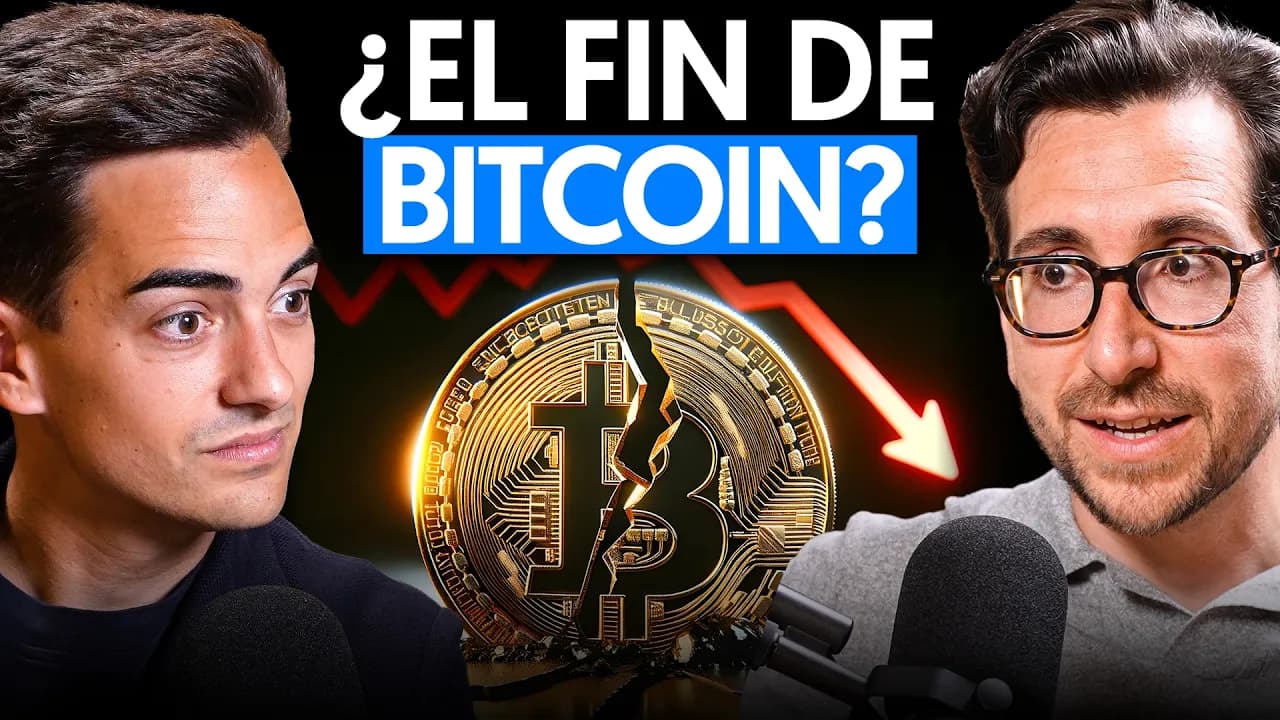
Michael Saylor Is Officially Down $14 Billion As Bitcoin Crashes (WHAT'S NEXT?)
In a Nutshell
Bitcoin has crashed to $55,300-$61,000, wiping out $14 billion from Michael Saylor's holdings and $10 billion from Tom Lee's, representing the largest Bitcoin loss ever recorded. Unlike fundamentally sound companies that generate revenue and provide real value, Bitcoin produces nothing and fails to serve as an inflation hedge or secure currency as originally intended. The speaker advocates treating Bitcoin as high-risk speculation only—trading small amounts without leverage during oversold conditions while prioritizing long-term investments in companies with strong fundamentals over speculative assets.
These notes were generated by AI and may contain inaccuracies.
Bitcoin is trading at just under 61,000 after reaching low levels of 55,300 a few hours ago. Michael Saylor was at one point effectively losing $16 billion in unrealized losses, now down to $14 billion in losses. Tom Lee is down $10 billion in unrealized losses. According to the latest figures, $12.6 billion represents the largest loss ever for any individual or company in any Bitcoin investment.
Michael Saylor was using a dollar-cost middle-in-the-money strategy in Bitcoin and has previously sold a portion of his Bitcoin, with speculation about whether this will happen again. These extreme losses have not occurred with some of the greatest investors in the stock market because they invest in good companies that are well managed over a long period of time, without experiencing this extreme volatility.
The fundamental difference between Bitcoin and traditional investments is that you don't see this extreme volatility with fundamentally sound companies. Bitcoin can be a good deal like buying AMC or GameStop shares during the meme stock market movement, where you could have made a lot of money, but fundamentally it never deserved that valuation and was characterized by extreme volatility.
For those seeking high risk and high return, there is a favorable risk-to-reward ratio with Bitcoin now sufficiently oversold, and even for MSTR. This doesn't mean this is the bottom - no one can predict the bottom. Things could certainly get worse before they get better because the current times are still uncertain.
Bitcoin does nothing and is not used for anything. It started with a good idea to become a solution to a problem and overcome inflation, but every time inflation rises, Bitcoin falls. It was supposed to be secure, but it's still being hacked with billions of dollars lost in some of the biggest hacks recently.
Bitcoin at 60,000 is tough at the moment. A trading approach would be to take $10,000 to trade with without using any leverage or margin, buying $1,000 worth of Bitcoin right now because it's still in its early stages. There is no confirmation of a reversal, and if Bitcoin starts to build momentum, averaging down the dollar cost as the trend improves, then taking profits when it reaches overbought levels. This is a trading deal, not an investment.
Bitcoin started with a really good idea to become a solution to a problem and overcome inflation, but after nearly 20 years, it's still unrealistic for the average person. The average American citizen, and certainly grandparents or parents, would not be able to use this. It's difficult with the keys and the need to move them off the internet for security. If you forget your keys and password, you lose your digital currency, and if you lose your hard drive, you're done for.
The argument that Bitcoin has outperformed all markets since creation is flawed, similar to saying an investment of $1,000 in Nvidia's IPO would be worth $10 million today and repeating that as if it's coming in the future. Past performance is not indicative of future results, especially from an initial public offering or since inception. In the early stages, there's always acceleration, but Bitcoin has been stable over the past five years.
Nvidia generates more than $300 billion in revenue annually and more than $200 billion in net income annually. It's a real asset that provides real value in solutions for lives and how beneficial it is to everyone. Bitcoin started with a good idea as a rare currency and hedge against inflation, but it doesn't represent anything fundamental, doesn't do anything, and doesn't generate anything.
Even with the recent decline, Bitcoin is still up 317% even after falling by nearly 50%. If going back to previous record levels, the ratio is 700%, but even at current levels, 300% represents an investment in a fundamentally strong company that grows in the long term. Even indices like QQQ and SPY have all outperformed Bitcoin over the past five years.
Bitcoin was supposed to be secure but is still being hacked with billions of dollars lost. After nearly 20 years, it's still unrealistic for the average person. The complexity with keys, moving them off the internet, and extreme security requirements makes it difficult for average users. Forgetting keys and passwords results in lost digital currency.
You can make money trading Bitcoin or cryptocurrencies, just as you can make money trading meme coins. This should not be taken as evidence that there is any real value behind it - it's just an opportunity. If the risk-to-reward ratio is favorable and the risks are understood, it's possible to take advantage of speculative assets.
With Bitcoin and MSTR, they may be oversold enough to be in a position where things could get worse, but if positioned appropriately without margin or leverage, the account won't be liquidated. One of the biggest problems for leveraged traders in cryptocurrencies is buying too much too early, exposing themselves to high risks, and being unable to withstand the downturn, forcing them to sell.
Pure speculation carries greater risk than investments with fundamentals. The higher the risk, the less exposure there should be in terms of leverage. When deals appear or oversold levels are reached, position yourself so you won't have to get out. It's better to buy just one share rather than 100 shares if that means using margin or leverage.
Warren Buffett's saying "Be greedy when others are afraid, and fearful when others are greedy" was referring to fundamentally sound investments, not purely speculative assets. The more speculative something is - meaning it doesn't amount to anything fundamental, doesn't do anything, and doesn't generate anything - the greater the risk.
Don't spoil deals by overexposing yourself. When deals appear or oversold levels are reached technically, position yourself so you won't have to get out. It's better to buy just one share rather than 100 shares if that means using margin or leverage.
Seeking Alpha offers huge discounts and is geared more towards investors who want to invest over a long period of time. Alpha Picks performance since inception in 2022 shows 241% returns compared to 82% for the S&P 500, even with the recent downturn. They choose two different stocks each month and provide complete fundamental analysis and webinars. Current Black Friday discounts include Premium and Alpha Picks subscription for the whole year at $500 total, saving $298, with a 7-day free trial period.
For long-term investors, take time to understand what you choose to invest in during market downturns in high-quality companies. Seeking Alpha was designed to support investors who rely on strong, long-term fundamentals.
Live trading sessions are available every morning as soon as markets open with a 40% discount currently valid until the end of November.
Keep Ricky Gutierrez in your library
Save the videos and channels worth coming back to, and find them again in one place.