Nate Silver Predicts: Democrats Take the House, Newsom Is Fading & AOC Might Win It All in 2028
In a Nutshell
Nate Silver predicts Democrats have an 85-90% chance of taking the House in 2026 due to Trump's unpopularity, economic anxiety, and midterm backlash, though the Senate remains near 50/50. Gavin Newsom is fading in 2028 Democratic primary polls as voters shift toward younger candidates like AOC, whom Silver sees as the likely nominee due to anti-establishment sentiment and generational divides. American elections are dominated by structural partisanship, with 43 states predictable at 97% confidence, and neither fraud nor procedural issues meaningfully alter outcomes.
These notes were generated by AI and may contain inaccuracies.
Partisanship functions as the dominant force in US elections. Forty-three of fifty states can be predicted with 97% confidence for the 2028 presidential election based on current polarization patterns. This predictability stems from structural political divisions rather than election interference.
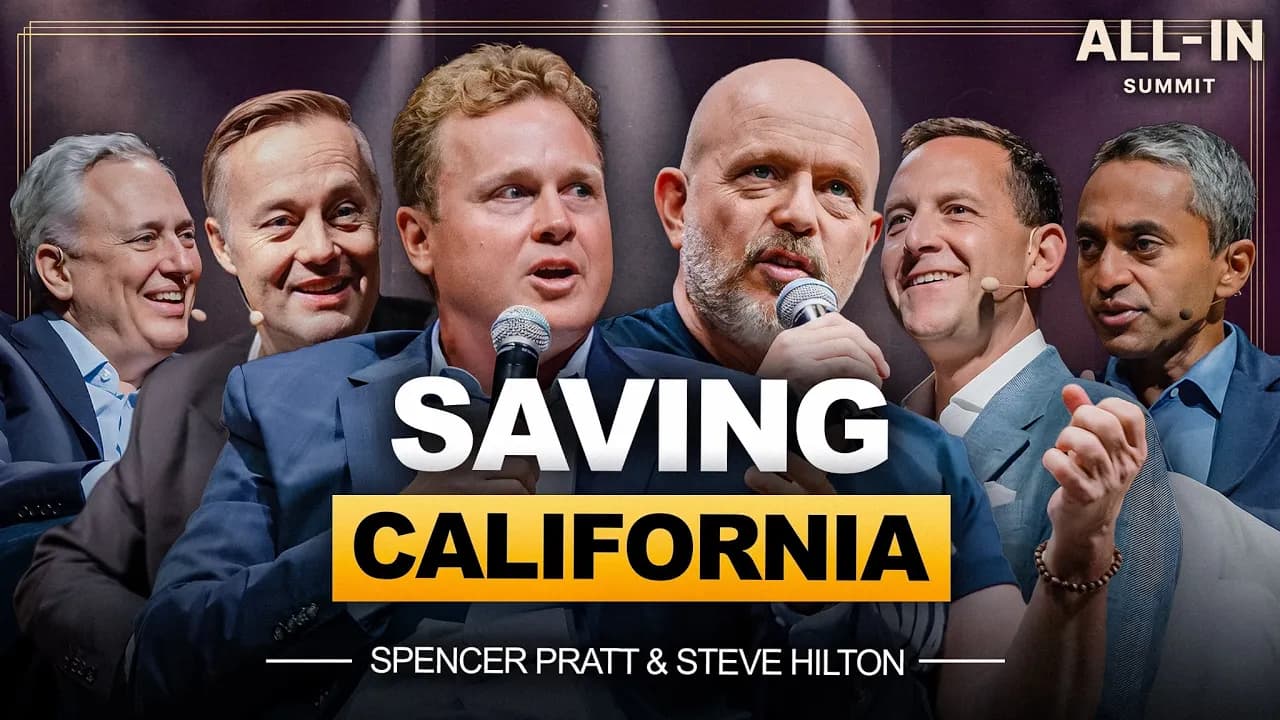
Nate Silver addressed questions regarding the Los Angeles mayoral election involving Spencer Pratt and the counting patterns of mail-in ballots. The analysis examined differences between in-person returns, early mail-in data, and late mail-in ballots that showed a surge for one candidate.
Silver stated there is no evidence of fraud. Systematic differences exist in when demographic groups cast ballots, with Democrats encouraged to vote by mail under recent political dynamics. California's extended vote counting process was described as unacceptable compared to other systems.
California Governance Context
California is characterized as a capital-D Democratic machine state with limited heterodoxy compared to states like New York. The state has produced candidates including Kamala Harris and Gavin Newsom. A 2025 redistricting referendum tracked closely with Democratic presidential margins despite the party's historical opposition to gerrymandering.
Silver noted that California has not recovered from the pandemic in the same manner as other areas, particularly Los Angeles, while maintaining strong partisan alignment.
Voter ID and Mail Voting Analysis
Voter ID laws are viewed as reasonable requirements. The historical assumption that Democrats benefit from maximum turnout has shifted, with Democratic overperformance now concentrated in special elections and midterms rather than high-turnout presidential races.
Mail-in voting creates verification challenges but does not inherently explain the California results. The state's slow counting process and multiple voting mechanisms contribute to predictable blue shifts as later-counted ballots tend to come from younger, more progressive demographics.
The Heritage Foundation has documented thousands of fraud cases. Even extrapolated by factors of 10x or 20x, these numbers would not swing major elections. Documented fraud cases that altered outcomes have been limited to very small local elections with vote totals in the thousands.
The American election system is highly decentralized. Recounts with a 0.5% threshold rarely overturn margins larger than 0.05%. Errors tend to cancel out across large counts. Most countries count votes within hours, while the United States' extended timelines reflect its electoral college structure and decentralized administration.
The structural advantages of California's voting system create significant barriers for Republican statewide candidates. Partisanship remains the dominant predictor of outcomes rather than procedural manipulation. Silver expressed concern that extreme polarization reduces governance quality and has been worsened by gerrymandering conflicts between parties.
Democratic nomination processes in deep-blue states favor triangulation strategies that produce weaker general election candidates. Recent Democratic presidential wins were limited to the 2020 pandemic election and Obama's 2008 and 2012 victories, which featured explicit cross-partisan messaging.
"Partisanship is the gravity that dictates every election in the US"
"43 of the 50 states, we could probably predict right now with 97% confidence who they'll vote for in 2028"
Biden currently polls at 20% among independents. Many Democrats and especially Republicans under Trump have adopted the view that elections are purely a numbers game rather than requiring persuasion or turning out the opposing side.
The Republican Party has shifted from a country club group of elites, rich people, and business owners to a populist party. The Democratic Party has moved from being the working man's and working woman's party to a liberal, socialist-leaning party. Inside each party there are sub-factions creating a 2x2 or 4x4 matrix of groups.
Democrats have three main factions. The left faction includes avatars such as Zoran (likely Zohran Mamdani), AOC, and Bernie Sanders, all described as effective politicians in their own ways. Zoran understood how to be a Knicks cheerleader with an almost perfect speech. AOC has become a more effective tactical politician. Bernie built an impressive movement as an old guy from Vermont and the socialist mayor of Burlington, coming close to beating Clinton and winning many states in 2016. However, the left historically has not had many big wins outside of the bluest states.
The abundance libs faction, named after Ezra Klein, are more pro-free market and sometimes deny being centrist though Silver considers them pretty centrist. They are concerned with California as a case study of poor governance. They favor states where things are more functional, where there is more housing, better airport experiences without convoluted shuttle systems like LAX, and where there is population growth. These are purple or red states where people have moved to. The abundance libs are critical of Democratic governance and critical of culture war issues on policing and trans rights.
The resistance lib faction fits up with the Democratic establishment but remains very partisan and cheerleading for the blue team. They believed Joe Biden was railroaded out of the 2024 race. Gavin Newsom's constituency is primarily resistance libs. Newsom goes out of his way to support and endorse the Bidens because it signals to resistance libs that he has their back and is a fighter. The message is that Democrats lost in 2024 because the media was unfair to Biden and/or because Kamala Harris was a black woman, so the solution is to pick a white guy who will fight and tweet in all caps.
Newsom's approach mirrors the Trump playbook of never apologizing and always going on the attack. He had proof of concept with the redistricting move which was a genuinely smart tactical decision. Democrats will lose seats but without California they would lose even more.
The triangulating spirit of picking the least unacceptable candidate like Kamala Harris, Hillary, or John Kerry in 2004 represents a failed strategy. Almost every election now is a change election with Obama in 2012 being the exception. Democrats are slight favorites to win in 2028. It would not be shocking if AOC, Newsom, Shapiro, or others win, but they could be underdogs again in 2032. The UK is the closest comparison with six prime ministers in nine years. It is not a good time to be a defender of the status quo.
No GOP nominees look particularly strong. Trump's approval rating is down to 38%. People are upset about Iran, gas prices, and fatigue from having a singular center of politics for so long. Trump is fatiguing. It is an uphill battle for the GOP, though Democrats might give Republicans a fighting chance.
Socialists are getting elected as mayor and rising at the state level. Self-declared socialists are appearing at the national level. There is discussion of whether a Democratic socialist could become president in 2028. The question is whether populist movements will drive the left further left and whether Democrats will become a full-throated socialist party.
Silver notes huge generational divides. At 48, he remembers the Cold War and the Berlin Wall falling, so socialism carries connotations adjacent to communism and a long history of economic failure. Younger Democrats view the socialism brand more favorably. America remains a supremely capitalist country that attracts the best and brightest young talent globally. The AI capital boom is keeping the stock market in relatively good shape.
Democrats have lost support among Hispanic and Asian-American voters. These groups are the most likely to own small businesses. Recent immigrant groups are very entrepreneurial, which Silver believes makes the United States great and makes him pro-immigration. Shifts away from Democrats have occurred among the most entrepreneurial groups.
Silver describes himself as an elite who is socially liberal and economically moderate, using liberal in the European sense meaning some role for the state but pro-market in general. He is unsure if this view is an electoral winner. The most neglected voters are those who are culturally more conservative but economically more progressive. They support small business and are wary of conglomerations of power.
When there is a world's first trillionaire and anxiety about AI displacing white collar jobs, combining anti-oligarch rhetoric with moderation on woke issues could be effective. Young men still want to feel they control their own destiny and do not necessarily want handholding. The US is not alone in having resistance and dissatisfaction with the status quo.
Silver has been defending Zoran Mamdani in New York because he is getting the ins and outs of the city. New York has nice new airports and relatively low crime compared to California. Silver used to live near Penn Station and Madison Square Garden and never felt unsafe, unlike visiting San Francisco. Combining functional performance in government with a message is important. Having more optimism is valuable, similar to Obama's optimistic take on the American spirit.
The generational issue is significant. It was insane to have candidates trying to be president until 86 and 82. The most electable Democrat might be someone like John Oaf who is younger and pretty progressive based on his voting record but is not a brawler like Newsom.
Mamdani is pretty popular in New York so far. New York is a capitalist city and a pragmatic place where people from all around the world migrate. There is a lot of wealth. Despite seeming chaotic at times, New York is a success story in a way California has become less of one.
The cut point for views on capitalism is around age 40. Before the New York mayoral race, people made accurate block-by-block projections of where Zoran would perform based on where younger, more progressive people live. Part of the shift may relate to economic anxiety and exactly when people came of age. Silver grew up with the first election he could vote in being Clinton in 1996 during the triumph of the West and capitalism, with a robust economy in the 1990s. People born around when September 11th happened represent a cut point.
People in their 40s through early 50s, particularly the second half of Gen X, are the only sane people in the US because they grew up, worked hard, and felt the American system worked for them. Younger people do not have that experience. Media consumption has changed dramatically. There used to be centralized news delivery under TV and radio with three or four major networks having huge editorial control. At the New York Times, there used to be page one meetings where editors decided what was news. Now it is very decentralized. Social media plays a role. Evidence shows phones and social media affect youth satisfaction significantly.
Social media, particularly Twitter, is an effective mechanism for squishing complicated political issues into one blue versus red dimension. Partisanship is a powerful force. Silver gets yelled at for heterodoxy such as saying Biden was too old. The algorithmic feed predates Elon but was improved or worsened by the current regime. Silver dislikes that choosing to follow an account does not guarantee seeing their tweets without giving the algorithm an additional signal.
Silver told the Twitter team they should have a button on follow to show every post from a person. The for you algorithm is pretty decent but requires training. It is responsive when users click do not show me this anymore. Silver wants to see tweets from accounts he follows without the algorithm presuming it is smarter than the user. Breaking the chronological feed is annoying, especially when watching the World Cup and seeing tweets about matches from six hours ago.
Nate Silver's model for the midterms will be released within a few weeks, delayed by the World Cup and redistricting developments. Prediction markets currently show Democrats at 80-85% probability to take the House and 40-45% probability to take the Senate. Silver believes the House odds may be understated and could be closer to 85-90%.
The House race has multiple factors pointing in the same direction: an unpopular president, voter anxiety about the economy, no new Middle Eastern wars initiated by Trump, the historical pattern of the president's party performing poorly in midterms, recent incumbent backlash domestically and internationally, and strong Democratic results in New Jersey and Virginia in the previous year. Redistricting provides some benefit to Republicans, but these structural advantages may not be enough to overcome broader headwinds.
The Senate presents a different challenge as a numbers game. Even in a favorable environment for Democrats, they must win seats in red states. The Maine race is highlighted as a concern, where despite the state being a D+8 or D+10 environment, Graham Platner leads Susan Collins by only two points. Silver assesses this as a 50/50 race and views the nomination as an unnecessary risk for Democrats.
In Texas, Republicans face challenges with candidates like Ted Cruz in what appears to be a toss-up race, and Ken Paxton as a less-than-ideal nominee. Despite criticism of Cruz on personal matters including his sexuality, partisanship remains a powerful force in the state's deeply red electorate.
Gas prices represent a visible indicator that could potentially shift voter sentiment toward Republicans if lowered significantly. Forecasts suggest some abatement, but this remains contingent on the duration of conflict with Iran. Trump's unfavorable ratings appear entrenched, while Democrats maintain high enthusiasm despite internal misgivings about their party. The generic Democrat versus generic Republican matchup remains favorable for Democrats who view democracy as at stake.
Silver notes that models always carry uncertainty, with roughly a 10% chance that unexpected outcomes prevail, but the fundamentals appear strong for Democrats in the House. The Senate race could shift to a slight GOP edge depending on gas prices and developments in Iran, potentially moving from 50/50 to 60% GOP probability.
The House and Senate races are almost perfectly correlated. The probability of Democrats winning the Senate without the House is approximately 1%. If Democrats win the Senate, they will almost certainly win the House and governorships as well. Winning the Senate in a blue year requires overcoming structural disadvantages in states like Ohio, Iowa, and Alaska, which would indicate broader Democratic success across the ballot.
State-level races matter significantly because governors exercise executive power and shape policy for the next generation. State legislatures also hold substantial importance for policy outcomes.
Gavin Newsom has declined in Democratic primary polls from approximately 25% to 15%, and on Polymarket from 33% to 22%. He benefited initially from name recognition, but Democrats are now considering alternatives like Jon Ossoff of Georgia, a younger candidate with the credential of winning election in a purple state.
Newsom's strategy of arguing for continuity with Kamala Harris and Joe Biden has failed electorally. His embrace of Biden represents a defensive position. Newsom has had Hunter Biden on his podcast as part of this approach.
Democrats are showing preference for younger candidates. Alexandria Ocasio-Cortez, now 36 years old, qualifies as a potential 2028 candidate. Silver identifies her as his bet for the nomination. AOC represents the possibility of an outsider, anti-establishment candidate who channels dissatisfaction with the Democratic Party brand.
Chuck Schumer may be vulnerable in the 2028 primary. Voters express fatigue with the Democratic establishment and seek either a more centrist or more left-wing alternative rather than maintaining the status quo.
The Republican primary historically saw establishment candidates prevail over challengers like Rick Santorum, Sarah Palin, and Herman Cain who captured significant vote shares but ultimately lost. Growing generational dissatisfaction and younger voters' skepticism toward party brands could create openings for outsider candidates.
Barack Obama in 2008 positioned himself to the left of Hillary Clinton on issues like Iraq while employing post-partisan rhetoric about shared experiences across political divides. Effective candidates combine substantive positioning with broad appeal.
Gavin Newsom has made efforts to moderate, including having Charlie Kirk on his podcast and opposing the billionaire tax. He has attempted moderation on culture war issues. However, Kamala Harris, positioned as an institutional California candidate, lost all swing states by two to five points in 2024, suggesting that demographic characteristics alone do not determine electoral success.
Keep All-In Podcast in your library
Save the videos and channels worth coming back to, and find them again in one place.