Sam Altman: NO RAM FOR YOU!!!
In a Nutshell
Sam Altman called personal computers’ DRAM a “terrible” use of scarce memory and argued it should be redirected to data centers, sparking backlash from Musk, tech press, and users. The rant coincides with OpenAI’s massive HBM purchases that helped double DRAM prices and underscores his preference for centralized AI over local, open-weight models. The episode’s core takeaway is that markets, not Altman, should allocate memory via price signals that spur new supply, rather than top-down directives.
These notes were generated by AI and may contain inaccuracies.
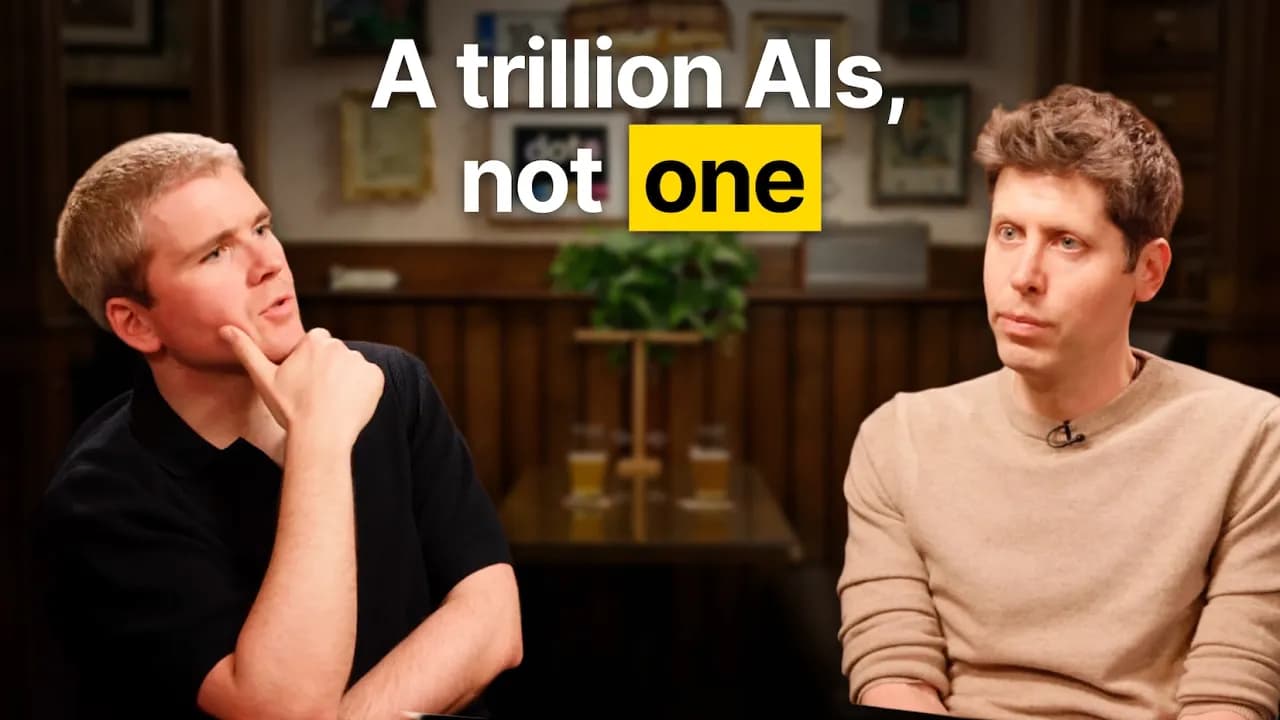
On October 29, Sam Altman appeared on the "Cheeky Paint" podcast hosted by John Collison, co-founder of Stripe. The discussion centered on the memory crisis. Altman stated that many people want to run artificial intelligence on their computers using open-source models. He said verbatim: "From the perspective of global allocation, in fact, it is terrible that everyone has a large amount of the world's limited supply of DRAM memory inside their own devices." DRAM refers to dynamic random access memory, the main memory in computers commonly called RAM.
According to Altman's estimates, personal computers use that memory only 5% of the time, while data centers use it almost continuously. In the absence of a shortage, he argued that memory should be allocated to the cloud. He referred to "their computers" in the context of running artificial intelligence at home, which the internet interpreted as targeting laptops and gaming consoles.
Elon Musk responded by posting a meme from the movie "Inglourious Basterds" with the caption "People deserve to have their own RAM too." An editor at The Verge wrote: "These people don't want you to own powerful computers anymore. They want you to rent it." A writer at Tom's Guide compared the statement to "the CEO of Chili's telling you that supermarkets and home cooking is a terrible allocation of food." A satirical post read: "Tell Sam Altman I'm using 64GB of RAM to play Roller Coaster Tycoon." The phrase "You will own nothing and you will be happy" was recirculated, and one publication was titled "The Myth of Building Conformative Computers."
The reaction was driven by the memory crisis. For more than a year, memory has been one of the scarcest resources in technology. Major memory manufacturers converted their factories to produce HBM (high-bandwidth memory) for artificial intelligence chips, leaving little for other uses. In the first quarter of this year, prices of regular DRAM memory contracts nearly doubled. A 32GB DDR5 memory kit that previously cost around $100 now costs between $400 and $600. Micron shut down its consumer-oriented Crucial brand. Sony raised the price of the PlayStation 5 to $650.
OpenAI contributed to this pressure. In October 2025, OpenAI signed letters of intent with Samsung and SK Hynix covering up to 900,000 DRAM chips per month, estimated at about 40% of global supply. The person who called RAM in personal computers a waste is simultaneously one of its largest buyers.
From an economic perspective, the memory crisis represents normal market function. When a resource becomes scarce, its price increases. This price signal tells consumers to reduce consumption, wait, or find alternatives, while telling producers to make more. Currently, the signal comes from data centers. The expansion of artificial intelligence is draining power converters, electrical equipment, memory chips, and graphics processors. The largest transformers may take up to 4 years to connect. Renting a high-performance graphics processor has become about 40% more expensive in the last six months.
In the long run, high prices attract more supply. When memory and graphics processors remain expensive, profit margins rise for manufacturers. Micron's gross profit margin reached approximately 87% in its last quarter. Micron, Samsung, and SK Hynix are all building new factories. However, building factories takes years. Micron's next factory in Idaho is scheduled to begin production in mid-2027. The president of SK Hynix stated that 2027 will be the worst year for supply in the history of the industry.
During the podcast, Collison reiterated that the solution to high prices is high prices themselves. When asked how this solution worked for memory, Altman replied with a single word: "Bad." He claimed the invisible hand was failing because memory manufacturers had not forgotten previous recessionary periods when they built excessive factories and nearly went bankrupt. However, he also stated these companies are on track to generate nearly $100 billion in free cash flow next year.
This example illustrates why money and markets persist even in a post-work economy. Supply can grow but not instantly. At any moment, there is a limit to what can be produced. Even with super-intelligent robots numbering in the tens or hundreds of billions, creating 10 million new data centers would be impossible. Scarcity will always require management. The question of who gets scarce resources first remains an allocation problem.
Altman is responding to a short-term allocation problem without clearly understanding economics. He also wants more power for himself. His solution is authoritarian: if he had a magic wand, he would order everyone to stop putting RAM in their MacBooks and Xboxes and allocate it all to data centers instead. He is building some of the world's largest data centers and has spoken of $1.4 trillion in commitments to computing power. More memory in the cloud means more memory for OpenAI.
A potential defense of Altman's position uses expected value. Placing every graphics processing unit and memory chip in data centers dedicated to cutting-edge medicine like cancer research might have higher expected value than placing them in gaming consoles or laptops used for watching YouTube. However, this argument assumes ordinary people using these resources are not doing anything productive, and that placing devices in data centers automatically makes them more useful. Neither assumption is necessarily true.
People use their own computers to write code, edit video, run small businesses, conduct research, and run their own artificial intelligence models. Massive decentralized computing serves purposes beyond entertainment. Data centers also operate porn sites, YouTube, and other non-medical applications.
The question of who decides what is valuable lies at the heart of the debate. In a planned economy, someone at the top makes decisions. This was the system in the Soviet Union and pre-reform Communist China. The intuitive appeal is simplicity: one person makes decisions without discussion or complication. However, simplicity is not necessarily fair or effective.
By the mid-1980s, the Soviet planning agency could only balance supply and demand for about 2,000 products per year. Adding other agencies and ministries, the state monitored approximately 200,000 products, while the Soviet economy produced about 24 million products. No single authority could know all of that.
The genius of the free market is that no genius at the top is needed. The market consists of supply and demand for goods and services. Price stabilizes where the quantity people want to buy matches the quantity offered for sale. In 1945, economist Friedrich Hayek described the price system as a miracle. His example was the number 10. If the number 10 suddenly became rare, most users would not understand why, but the price would rise and tens of thousands of people would reduce their use. No central order would be required. If the price remained high, people would find alternatives. This allows market economies to correct themselves without central planning.
Markets are not automatically perfect or always 100% fair. They can be manipulated through monopolies, holding companies, price fixing, and corruption. The memory industry itself provides an example. Between 1999 and 2002, the largest memory manufacturers secretly set prices for chips sold to companies including Dell, Apple, and HP. The Justice Department collected more than $731 million in fines, and some executives went to jail.
However, the market is fairer than a central plan. It is amoral rather than immoral. Immorality means doing wrong, while amorality means making no moral judgments. The market functions as a sorting algorithm using money and price as signals. This amorality is actually its strength. Money is scarce, so willingness to spend demonstrates desire. The market's amorality is better than authoritarian ethics where one person decides what is valuable, useful, right, or wrong.
OpenAI wants AI to be centralized, with people paying for subscriptions indefinitely. However, some serious AI users are moving in the opposite direction. Banks, defense contractors, militaries, and governments are choosing local open weight models. Open weight models allow users to download and run weights themselves, enabling air-gapped operation on networks without internet connections. Users can run models in their own data centers or computers with complete control.
Examples include the US military running Camo GPT on its secret network, hosting open weight models from Meta, Google, and Mistral. Defense contractor Booz Allen placed a Llama model on the International Space Station without internet connection. French bank BNP Paribas operates open weight models in its own data centers. The Dutch Ministry of Defence operates an internal chatbot on its own servers without internet connection, using GPT-OSS, an open weight model from OpenAI itself.
The decision of who gets RAM should not be left to Sam Altman or anyone else. It should be determined by price. Current prices signal the entire industry that more memory needs to be built. While this will take several years, that is how markets function.
Keep David Shapiro in your library
Save the videos and channels worth coming back to, and find them again in one place.