Secret Service developing offensive, defensive drone capabilities to confront threats | 60 Minutes
In a Nutshell
The Secret Service is confronting a 40% surge in threats, with 10,000 cases this year alone, driven by mental health crises, social media, and foreign adversaries like Iran. Director Curran, who shielded Trump during the Butler assassination attempt, is overhauling the agency with new armored vehicles, a trauma response truck, and a multi-million-dollar drone program featuring AI-powered drone hunters and fixed-wing surveillance platforms. Despite these advances, the agency admits swarm drone attacks remain unsolved and has resorted to elaborate decoy operations, including a $400 million Qatar-donated plane, to counter missile threats.
These notes were generated by AI and may contain inaccuracies.
The United States Secret Service was created 161 years ago when Abraham Lincoln signed it into law. That same day, he was fatally wounded by an assassin. Since then, the service's mission has evolved from catching counterfeits to protecting the lives of presidents, their families, and other top officials. Today, in the age of AI, the threats are not just from a lone assassin's bullet, but autonomous attack drones.
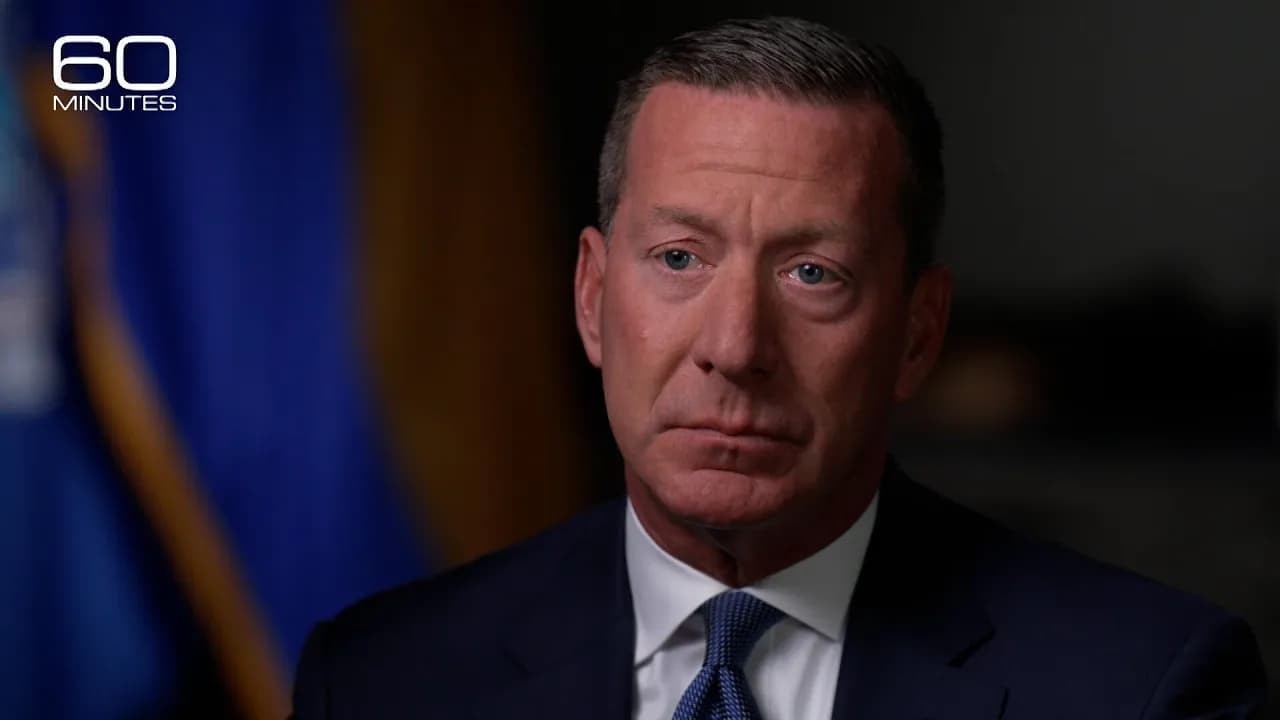
The US is a country that feels on edge. The Secret Service told 60 Minutes the number of threats is way up against its protectees, especially President Trump. He has been the target of more assassination attempts than any other president. Director Shawn Curran has been an agent for 25 years and is now leading the Secret Service.
Director Curran stated: "It's like we've never seen before. The threats on our full-time protectees are up just over 40% since they were last year. That's a massive increase." Since January, there have been 10,000 threats on the people they protect. "10,000 threat cases just this year and the year's not over."
Deputy Director Matthew Quinn explained: "Look, I think a lot of it has to do with the internet. You know, people are more accessible. Information is more accessible. It's definitely new to us." In the last 2 and a half years, there have been three known attempts on President Trump's life: at a campaign rally in Butler, Pennsylvania; his Florida golf course; and the White House correspondents dinner, where a shooter breached the security perimeter.
When asked if President Trump's polarizing nature is leading to the increase in threats, Director Curran responded: "We are an a-political organization. We're here to protect who we're sworn to protect." He added: "Look, I would say there's people on both sides of the aisle that either love or hate any president. I think the biggest factor we're dealing with today is mental health issues for sure. And more people are being pushed over the edge in either direction." Deputy Director Quinn noted: "The world is different than what it was 20 years ago. Social media changes people."
When asked whether more threats come from the left or right, Director Curran stated: "We don't weigh it that way. We just look at who is making the threat. We investigate it and we run it down each and every threat." Research by the Center for Strategic and International Studies showed a spike in incidents at the local and national level from the left in 2025. It was the first time left-wing attacks have been higher than right-wing attacks in 30 years. This year that trend has reversed with more attacks coming from the right so far.
Eight months into a war with Iran, the threats from outside the country are also growing. Iran has vowed revenge. When asked how to deal with that when protecting the president, Director Curran stated: "Turn on the TV and you can see the funeral where there are massive banners saying kill President Trump. So, do we recognize the threat environment is increased? Absolutely. How we do it and how we change, that's where we prefer to stay in the background."
Few people know the risks more than Director Curran, who just two years ago was the lead agent protecting President Trump when he was campaigning on July 13th in Butler, Pennsylvania. Curran was among the agents who shielded President Trump when Thomas Krooks fired eight rounds at the stage from a rooftop 155 yards away.
Director Curran stated: "I haven't really reflected on it. I've kept myself busy. I've just worked and worked. I've gone from assignment to assignment so that I've probably taken my mind off of it. It's what we train to do. It's what you never want to do." When asked what goes through his mind as the lead agent, he said: "I mean, we were face to face and then I have to think about the next move. You don't have time to think about anything else. I am his vest. You know, I wear my vest for him. It's not for me."
When asked if it was true that he had requested additional resources and were denied, Director Curran stated: "I'd rather not get into the past. I will tell you that I did request additional resources and I'll leave it at that." A congressional hearing led then director Kimberly Cheetel to resign over the breakdown of security that day.
The newly reelected Donald Trump put his lead agent in charge of the Secret Service. This past June, the final government report on Butler was released. The Inspector General report found, quote: "The Secret Service missed multiple opportunities to detect, prevent, and disrupt the assassination attempt. This was a massive failure by many accounts." When asked if he could assure the American people that something like this won't happen again, Director Curran stated: "Yes." When asked if he was convinced, he replied: "I am convinced."
The agency at every level has been dangerously understaffed for years. Director Curran stated they have 942 people in training today. If you looked back last year, there was maybe 200 in training.
Since Butler, the Secret Service has expanded the formidable security footprint that surrounds the president. With the president back on the campaign trail ahead of the midterm elections, Director Curran has added new training to avoid the mistakes of Butler.
The president's limousine, known as "the Beast," is getting regular updates, most of them classified. The vehicle weighs up to 10 tons with bulletproof glass and defensive countermeasures. When asked if the Beast can protect against a chemical weapons attack, Director Curran stated: "I don't want to get into its capabilities but it's it can do a lot."
Director Curran added a medical response truck because of what he saw in Butler. It houses a trauma unit and a field surgeon ready to treat gunshot wounds. An armored personnel carrier is new to the president's motorcade. When asked why they need a vehicle this big, he explained: "When you look at some of the significant civil disturbance events we've had, how do you move people? You look at getting teams to the capital during the January 6th event. This provides us the ability to get people where they need to be and take care of them, keep them safe." The Secret Service did not have this vehicle for January 6th.
The Secret Service is preparing for a new threat, unlike any seen in its history. Last week, the director left headquarters to personally test counter drone ammunition. Deputy Director Quinn is leading the agency's new multi-million dollar program to develop offensive and defensive drone capabilities.
Deputy Director Quinn stated: "What you're seeing right now is one of our fixed wing platforms. This has capability to stay up for a significant period of time, provide realtime situational awareness for everybody on the ground." The war in Ukraine has become a testing ground for the weaponization of drones, and that hasn't gone unnoticed by the Secret Service.
When asked what they're learning from the battlefield in Ukraine, Deputy Director Quinn stated: "Everything. We just had teams come back about two weeks ago. They are on the front. They're on the battlefield with this. We know that technology is going to hit the homeland at some point. So, we're using lessons learned there to build our program and make sure we're ahead of it before it gets here." When asked if he thinks drone attacks will happen in the United States, he replied: "We have to plan for it. We have to assume that it's possible. The second we're not, we're going to get caught flatfooted."
The Secret Service showed 60 Minutes the drone hunter, a weapon which uses AI and radar to disable enemy drones and capture them with a net. The operator says "locked" when the drone hunter has locked onto the offending drone. The drone hunter then hunts down the bad drone and captures it. The drone is then taken to a predetermined safe area.
The concern is that a small rudimentary drone could be weaponized with explosives and do serious damage to a large concert, sporting event, or campaign rally. Just a small amount of C4 is plenty enough to do a lot of damage. 60 Minutes has learned the Secret Service took down a drone using electronic jamming equipment at the Army Navy game in Baltimore last December, where the president and members of Congress were in attendance.
Despite all the new technology, the threat of an attack by a swarm of drones on a place like the White House is still an issue. Deputy Director Quinn stated: "Swarms are a huge problem and a big threat. I'd love to tell you the swarm problem solved. It's not." He also stated: "I will tell you that at the White House, White House is the safest place on Earth."
When asked about the future of drone defense, Deputy Director Quinn stated: "Yes. We're deploying equipment everywhere that makes the most sense to ensure that the White House remains the safest place in the world." When asked if they need to militarize all of Washington DC in order to protect the president, he replied: "No. The whole goal of our job is to provide maximum resources without the appearance of overwhelming overt militaristic sight. There's ways to do it and still let Americans maintain their freedoms and still provide protection at the highest level."
The protection extends to the new Air Force One, a 747 donated by the Middle Eastern country of Qatar. Adding security enhancements to that plane cost the US nearly $400 million, according to the US Air Force. When asked if the Secret Service fully trusts a plane that was given by a foreign government, Director Curran stated: "We trust that plane because you checked it all out." He declined to elaborate further.
Despite his confidence, the Secret Service would not let the president fly home on the Qatari plane from Turkey in July after intelligence reports of an Iranian plot to fire a missile at the presidential jet. Instead, the Secret Service pulled off a complicated scheme using the old Air Force One. They snuck President Trump into a catering truck. Cabinet members, White House staff, the press, and Secret Service agents were left on the decoy plane.
When asked why the Secret Service made the decision to use a decoy plane when leaving the NATO summit in Turkey, Director Curran stated: "Look, that's not the first time we've done that. We wish that wasn't reported because that takes some of our tactics away from being able to do something similar again. Certainly wasn't the first time we did something like that." When asked if the president's been on a decoy plane before, he replied: "I didn't say that. I'm just saying that's not the first time we did something like that before."
When asked if he was okay with agents being left behind with other staffers on the decoy Air Force One in Turkey, Director Curran stated: "When you're operating in any protective detail with the president of the United States for any president, the priority is the president. Everyone else, staff, agents, media, personnel involved are not the priority, including our own personnel. As hard as that may be for some to understand, the mission is to protect the president of the United States."
Keep 60 Minutes in your library
Save the videos and channels worth coming back to, and find them again in one place.