Should You Pay Off Your Mortgage Early or Invest? (Here's The Math)
In a Nutshell
At low mortgage rates (2.75%), investing the extra $500/month in the stock market nets over six times more wealth ($422K) than the $64K interest saved by paying down the loan. At today's higher rates (6.75%), paying off the mortgage early saves $217K in interest, but investing still comes out ahead—though by a narrower margin. Before making extra payments, prioritize an emergency fund, max out 401(k) matches, and only pay off the mortgage early if the rate is high enough that the guaranteed return beats expected market gains.
These notes were generated by AI and may contain inaccuracies.
If your mortgage interest rate starts with a two or a three, paying extra on it every single month could cost you over a million dollars on a $400,000 loan at 2.75%. Sending an extra $500 a month straight to your mortgage saves you about $64,000 in interest over the life of the loan. If you take that same $500 and put it in the stock market instead, and over 30 years, it grows into more than $1.1 million. The video breaks down exactly when paying off your mortgage early actually makes sense, when it doesn't, and the four ways to do it if it does.
Everybody loves the idea of a paid-off house and not having a mortgage payment. The bank doesn't own a piece of it, and it's a true weight off of your financial shoulders. Peace of mind definitely counts for something, but you also have to look at the math, not just the emotion. That same $400,000 mortgage costs you $187,867 in interest at 2.75%. Bump up the rate to 6.75% and you're paying roughly $533,981 in interest on the exact same loan. It's the same house with the same amount borrowed, but almost three times as much the interest. Every dollar you throw at the principal also builds equity faster, which matters if you ever need a home equity loan for a renovation or a real emergency. Paying it off early isn't a bad instinct or bad idea, it's just not always the right move. There's an opportunity cost associated with that decision.
The top three reasons people want to pay off their mortgage early are peace of mind, interest saved over the long term, and faster/more equity, and ultimately just not having that bill over your head. The video gets into the interest saved portion and the math between paying off versus investing.
Every dollar you send to your mortgage early is a dollar that can't do anything else. It's literally locked in the walls of your house, aka known as the equity of the home. This is the whole opportunity cost argument, and it's the biggest one against paying off your house early. If you're locked into a low rate, that money could be earning a lot somewhere else. The bigger issue, though, is liquidity. Once that money is inside your house, it's not liquid anymore. You can't pull $5,000 back out of your drywall when the transmission of your car dies, for example. This is why step one before any of this is a fully funded emergency fund of 3 to 6 months. This could be in something like a money market, a high yield savings account. If paying extra on your mortgage means draining that cushion, you're not getting ahead because you're one bad month away from a credit card balance sitting at 20 plus percent interest, which is about the national average right now according to the Federal Reserve. Before talking strategy and math, make sure that the emergency fund is already taken care of because you don't want something to happen to where you've already put money into your house, you can't get it out unless you cash out refi, use a HELOC, or something along those lines, and then next thing you know, you're putting it on a credit card when it should have been in cash.
Once your cash cushion is solid, everything else comes down to these three simple questions. Question one: do you have that emergency fund? If not, stop here. That should be your first priority. Question two is the most important one that dictates the rest of your decision-making, and that is what is your interest rate? This is what boils down the math versus the emotion, and this is going to be probably your number one guideline here. A high rate makes paying down more attractive. A low rate makes investing the extra dollars more attractive. Your rate is basically telling you the guaranteed return you'd get by paying it off early. A 6.75% mortgage means every extra dollar towards principal is guaranteed 6.75% return, and that's tax-free, risk-free. A 2.75% mortgage means that the same dollar is only guaranteed 2.75%. The stock market has historically done a lot better than that over long periods. Even the 10-year Treasury is yielding close to 5% at the time of this recording, it's somewhere around 4.75. The third question is taxes and penalties. If you itemize and you're actually using the mortgage interest deduction, paying off the loan early means losing most of that write-off, or losing the entire write-off. Most people take the standard deduction now, so this affects far fewer households than you'd actually think. But check before you assume it doesn't apply to you or your situation. Ask your lender directly whether there's a prepayment penalty because some loans still have them buried in the closing paperwork. Though this isn't usually the case, but again, just double check.
The host shares that he got his own policy through Policy Genius, and it was way easier than expected. Policy Genius is a marketplace that lets you compare life insurance quotes from America's top insurers in just a few clicks. They lay out your options clearly: coverage amounts, prices, terms. Their licensed agents walk you through the whole thing and handle all the paperwork. They've got thousands of five-star reviews on Google and Trust Pilot. With Policy Genius, you can find 20-year life insurance policies starting at just $276 a year for $1 million in coverage, less than a dollar a day.
Let's drive this point home with the same loan at two different rates because the rate changes everything. It's the entire point of the video. Say you've got a $400,000 mortgage at 2.75%, the kind a lot of people locked in back in 2020 and 2021. You add an extra $500 a month to your payment, that pays the loan off nine and a half years early and it saves you roughly $64,466 in interest. That sounds great until you look at the alternative. Take that same $500 a month and invest it instead using the stock market's long-term historical average of about 10% a year. And over that same stretch of time, it grows to $422,000. That's more than six times what you saved in interest. Now, flip the scenario. Same $400,000 loan, but this time at 6.75%, right around today's national average. That same extra $500 a month saves you $217,522 in interest and pays the loan off in 10 years and 8 months early. So, invest that money instead and it grows to $351,000. Investing still wins, but just not by much obviously because the interest rate is significantly higher and it's closer to that 10% number that was assumed. This makes it about 60% more instead of six times more like in the first scenario. In one scenario, it's not even close. The other scenario actually is. This is where you need to make a decision. Are you going for all the intangibles that were talked about or are you going for pure math and mathematics? Whichever way you choose, it's not wrong.
If you've run the numbers and paying it off early actually is your move, here are four different ways you can do it. Option one: pay it off in full if you've got the cash sitting there and the rate justifies it. This isn't common, but it happens especially for someone who's close to retirement who inherited money or sold a business or sold a house in California and is now moving elsewhere. Option two: make one extra full payment a year. This is applied straight to principal. If you've ever looked at an amortization table, you can see how much in a 30-year mortgage actually goes to interest and how much actually goes to principal. Most of it goes towards interest. So, you barely feel it in your monthly cash flow, but it shortens the loan meaningfully over time. Option three: switch to bi-weekly payments where you pay half your monthly amount every 2 weeks. You'll notice you end up making 13 payments instead of 12 without really even trying to. It's very effortless. It's kind of like paying yourself first. Some lenders won't set this up directly. You might need a third party service or just do it manually. Option four: refinance from a 30-year to a 15-year term. Your payment goes up obviously, but your rate usually drops and your total interest goes down significantly. These are four viable options for trying to pay off your mortgage early.
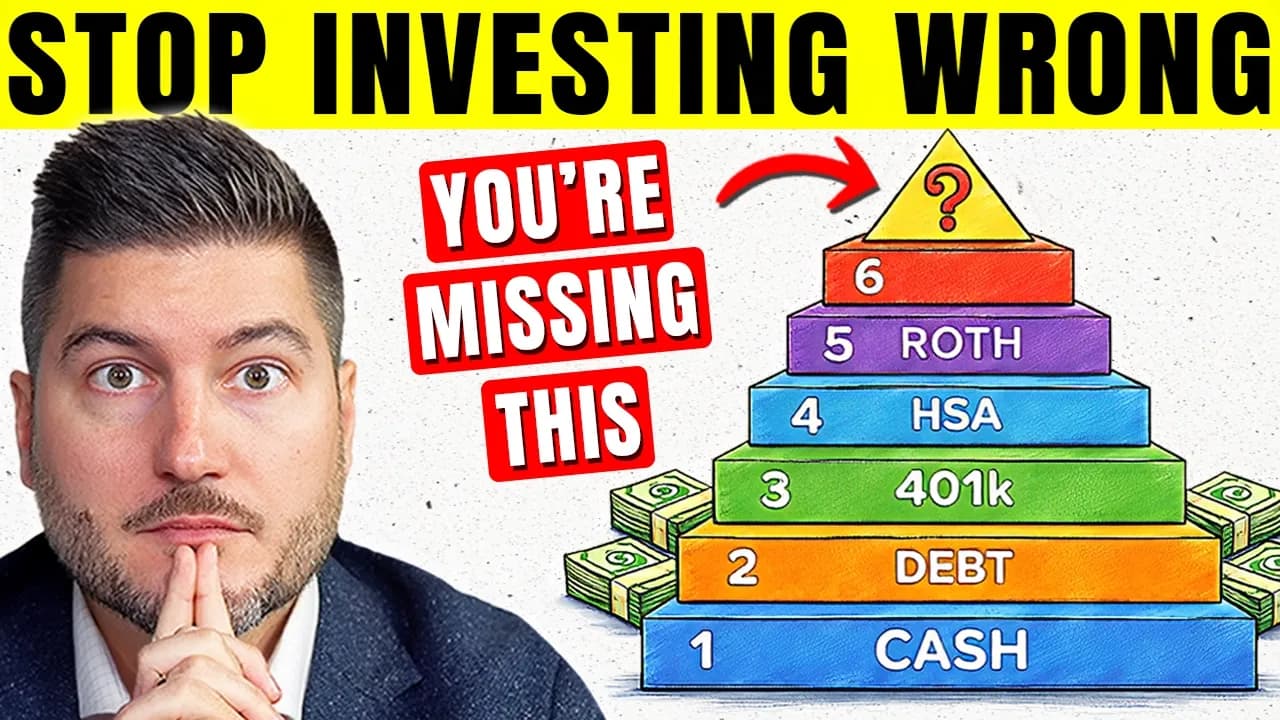
If your rate is low and the math says invest, here's the order to do it in. First, make sure you're getting your full employer 401k match before adding a single extra dollar going anywhere else. That match is an immediate guaranteed return that no mortgage payoff can compete with. After that's maxed out, a regular brokerage account is where extra dollars go to work. And unlike your 401k, you can access that money at any time without penalties, which matters if life happens before retirement. And if you've got specific goals, this could be kids college, it could be another house down payment on a rental property or just a bigger house, maybe real estate investing, whatever. This route keeps this money working without tying it up in the walls of your house. Free money and flexible money come before the guaranteed but often lower return of an extra mortgage payment. Again, depending on your rate: if your rate is 7, 8, 9, 10% it may start to make sense based on the math. But if you're in the twos or threes, this is probably the order you want to go in first.
The host paid off his house and doesn't have any debt at all, and doesn't have a mortgage. The problem was he paid off a 2.49% 30-year mortgage. He did this when high yield savings accounts were earning nothing, and you were basically just praying and hoping that the stock market goes up. His first daughter was born and he went into psycho dad mode and just said, "Hey, I want to build a strong foundation for my family." He paid it off. He says Dave Ramsey's wrong. The grass doesn't feel different. You're still going to have maintenance. You still have taxes. Your house could be paid off, but stop paying your property taxes and see who actually owns your house. The government and the municipality that you're just renting from in the form of property taxes. You never really own your house in this country. Yes, it's nice not having a mortgage payment every month. Yes, it allows us to travel. Yes, it allows us to save. Yes, it allows us to be super aggressive on the investing and cash side of things, which is great, but in hindsight, he wishes he never did it because inflation would have paid his house off for him. If you just kept that loan for 30 years, inflation does what it does. He probably should have just kept it. However, he was a new dad. He didn't panic. He had the money, but completely paid off. He had no mortgage. He will say this again, the grass doesn't feel different under your feet. It's the dumbest thing he's ever heard in his life. You still have everything and all the headaches in terms of overhead that come with owning a home. Did it help him get through periods of time where his business income was kind of all over the place? Absolutely. Is there a peace of mind factor? Absolutely. Do you want to have a mortgage into your 60s? Absolutely not. But he was in his early mid-30s at the time when he did that. So, in hindsight, he probably should have just left it alone for a little bit.
The host offers a free Google Drive spreadsheet for a 7-day roadmap. Just hit file, make a copy. It's absolutely free. Whiteboardfinanceuniversity.com is his private community. They have live streams every Thursday. He shares everything. They have full courses on real estate investing, stock market investing, and budgeting. He will be making the transition to financial planning. YouTube is a never-ending hamster wheel. The algorithm is a black box. His videos aren't shown by the algorithm which forces him to take on sponsorships. And then everyone hates him for taking on sponsorships. Instead of working one to many, he's just going to do what he went to school for when he was 18 years old and getting his finance degree. And that's becoming a holistic financial planner, except he's going to work for himself and launch his own registered investment advisory. That is not done yet. But if you want to work with him, you can figure out how to do that down below. He has a little form. He's only going to be working with 40 households max, period. This is ongoing planning. This is not just a one-off plan or whatever. Yes, he can help with that. But this is going to be an ongoing relationship probably until you or he dies, or if he's not doing a great job, which he will be because he's been doing this for 20 years.
The grass doesn't feel different. Does it help alleviate pressure and mental stress? Of course. Does it give you options? Yes. But the math has to make sense.
Keep Marko - WhiteBoard Finance in your library
Save the videos and channels worth coming back to, and find them again in one place.