Stories about service members and veterans | 60 Minutes Full Episodes
In a Nutshell
Three U.S. service members recount harrowing experiences from recent conflicts: an F-15E crew shot down over Iran who survived a massive rescue operation, Delta Force commander Dalton Fury's failed attempt to kill Osama bin Laden at Tora Bora due to rejected tactical plans and unreliable Afghan allies, and Marine veterans from Golf Company 2/8 grappling with PTSD, lost comrades, and the difficulty of transitioning to civilian life after Afghanistan. The episodes also detail Task Force Paladin's dangerous IED-hunting missions, where roadside bombs costing $10 each killed more Americans than any other weapon. The overarching message emphasizes the extraordinary lengths the military goes to rescue its own, the persistent psychological toll of war on veterans, and the often futile nature of counter-IED operations against an enemy that remains largely unpunished.
These notes were generated by AI and may contain inaccuracies.
When an American fighter jet was shot down over Iran on April 2nd, two US Air Force officers were left stranded alone in a rugged mountain range being pursued by Iranian forces. To prevent their capture, five weeks into a costly and unpopular war that had taken the lives of 18 US service members, the US military launched one of the largest search and rescue operations in its history. Newly declassified footage shows how the mission unfolded.
When the US went to war with Iran in February, it was by sea, by land, and mostly from the air. Admiral Brad Cooper, the American commander in charge of the war, stated that approximately 13,000 missions had been flown up to that point, establishing air superiority. The fighter jet was brought down in a mountainous area south of the city of Isvahan, close to where Iran had been keeping much of its highly enriched nuclear material.
The plane's mission that evening was to conduct a strike on industrial facilities related to both the drone and missile program, not related to the Isvahan nuclear facility. The aircraft's mission call sign was Duded 44. It was an F-15E, a two-seat fighter that has been a workhorse of US Air combat operations for decades. The $30 million jet was brought down by a shoulder-fired missile that can cost around $100,000.
Defense Secretary Pete Hegath was woken up Thursday night with the news. When he heard that an American fighter jet was down behind enemy lines in Iran, his immediate thoughts were to the next steps: whether the crew was okay, whether Iran knew, and the commitment that regardless of their condition, they would be retrieved.
The two officers shot down over Iran were identified as Alpha (the pilot) and Bravo (the weapon systems officer). Neither had spoken publicly until now. Bravo described the moment of impact as "getting hit by a freight train." The crew agreed to call the weapon systems officer by his mission call sign "Bravo" due to security threats from Iran.
The crew attempted to save the aircraft but determined it was not possible. They ejected and found themselves floating over the heart of Iran. Alpha and Bravo landed approximately five miles apart, separated and alone on the ground in the rugged Iranian desert.
Alpha landed safely. Bravo's parachute was damaged in the initial attack. At one point, he looked up and saw no parachute, which he described as the most terrifying thing he had ever seen. He prayed, "Lord, your will be done," and asked for help if he was to survive.
Bravo described his descent as freefalling. Military professionals estimated he hit the ground at between 70 and 100 miles per hour. He survived what he called a "modern-day miracle," sustaining a broken back, broken arm, broken shoulder, sprained ankle, and bleeding from cuts and scrapes to his head and face.
Iran is the size of Alaska. In the heart of Iran where Bravo landed, there are high desert valleys and craggly cliffs. He found himself in one of those valleys with cliffs on either side. Despite his injuries, he moved as quickly as he could away from his landing site.
Bravo determined the safest place for him was up. He made the decision, despite his broken bones, to hike and climb up a 7,000-foot ridgeline. When asked how he found the strength given his injuries, he stated, "Never let a lack of motivation put you on Iranian TV."
Soon after the crash, an Iranian news anchor announced a bounty for the capture of the Americans. Videos emerged on the internet of armed groups hunting for the downed crew. According to US military sources, Iranian forces got to within a few hundred meters of Bravo. General Dan Kaine, Chairman of the Joint Chiefs of Staff and a former fighter pilot, noted there were about 1,500 Iranian forces within a 10-mile radius.
Six hours after the crash, the US had its eye on Alpha. Declassified video shows the risky daytime raid to pick him up, involving two helicopters of the 21 aircraft deployed. Videos posted on social media showed American helicopters taking fire. Alpha was successfully rescued, but Bravo remained missing.
As night fell on the first day, a message came from Bravo. When he found a spot that provided some concealment, he started working toward communication. His message stated: "I'm hurt. I'm moving. God is good." This confirmed he was alive and moving.
The initial plan was potentially to attempt rescue on Friday night, but conditions did not align. A decision was made in the situation room to wait an additional 24 hours. Bravo would have to survive with almost no water and no food in the wind and cold of the high mountain desert for another full day.
The CIA played a pivotal role, launching a multi-pronged campaign that included deception to confuse Iranian forces and top-secret technology to pinpoint Bravo's exact location. American bombers and drones hit Iran's Revolutionary Guard forces nearby to clear the way for the rescue.
Nearly two days after Duded 44 went down, the rescue operation for Bravo commenced. The second operation involved about 92 people on the ground. This was the first US boots on the ground in 46 years in Iran. Several hundred were in the air, with approximately 3,000 to 5,000 supporting overall.
The force came in on two large search and rescue planes and landed on a makeshift desert airstrip. They unloaded small Little Bird helicopters capable of reaching Bravo on the ridgeline several miles away. The Pentagon declassified video of the rescue showing Bravo on the ridgeline waiting to be picked up.
The two service members on either side of Bravo were elite Air Force Pararescue operators known as PJs. When asked what his rescuer said upon reaching him, Bravo stated he would leave that specific conversation for another time. When asked what he said to them, he replied, "Let's go."
Bravo was in American hands but not out of danger. Back at the makeshift airstrip, the rescue plane's landing gear was stuck in the desert sand, and the planes could not take off. More than 90 of America's most elite service members were on the ground and needed to be rescued.
A clandestine unit of the US Air Force got Bravo and the 90-plus special operators out of Iran. The US then bombed its own marooned aircraft so no technology fell into Iranian hands. Fifty hours after being shot down, Bravo was safe, rescued as the sun rose on Easter Sunday.
When asked what he wanted the American people to know about this rescue mission, Bravo stated: "This is not a story about what I went through. Instead, it's a story of the teamwork, of the training, of the faith, of the decisions and leadership to do something that will live in history as an example of what America is willing to do in order to uphold our promise and leave no man behind."
Shortly after 9/11, the Pentagon ordered a top-secret team of American commandos into Afghanistan with orders to kill Osama bin Laden. The man leading the mission was a 37-year-old Army major from the US Army's Delta Force. He cannot be identified by name or shown without disguise due to security concerns. He calls himself Dalton Fury and is the author of "Kill Bin Laden."
In 2001, just 10 weeks after 9/11, Fury led a team of America's most elite commandos. The team's mission was to find, capture, or kill bin Laden. Fury stated that the writing on the wall was really to kill him, as no one wanted to bring Osama bin Laden back to stand trial in the United States.
Fury's Delta team joined the CIA and Afghan fighters. Their orders were to kill bin Laden and leave the body with the Afghans. The strategy was to let Afghans do most of the fighting. Using radio intercepts and other intelligence, the CIA pinpointed bin Laden in the mountains near the border of Pakistan at a place called Tora Bora.
The ridgeline where bin Laden was located was at about 14,000 feet, with Pakistan behind it. Fury rated the position as a 10 out of 10 in terms of difficulty to attack.
Delta developed an audacious plan to come at bin Laden from the one direction he would never expect: over the tops of the peaks from the Pakistan side. This plan was disapproved at some level above Delta, possibly at Central Command or all the way up to the President of the United States.
The next option Delta wanted to employ was to drop hundreds of landmines in the mountain passes that led to Pakistan, bin Laden's escape route. The first person to trigger a mine would allow aircraft overhead to find the group and engage. This plan was also disapproved.
Fury pressed on with the only option left: a frontal assault on bin Laden's dug-in al-Qaeda fighters. The Delta team had only about 50 men, so the mission would depend on Afghan militia as guides and muscle. Their leader was a warlord named Ali.
Ali told Fury after about 30 seconds of discussion that he did not think the Americans could handle al-Qaeda in these mountains. Ali accepted millions of dollars in cash from the CIA. In short order, his Mujahedin fighters were escorting Delta Force into the mountains.
The Afghan Mujahedin troops ranged in age from about 14 to 80. They wore what Fury described as rags. Video recorded by the Delta commandos themselves shows the Americans, dressed like Afghans, maneuvering up the mountains and calling in airstrikes on al-Qaeda.
By day, the force would advance, but at night, the Afghan allies went home. The Mujahedin would get into a skirmish, lose a guy or two, kill an al-Qaeda fighter or two, and then leave. It was almost like an agreement and understanding between the two forces.
Four days after arriving in Tora Bora, Fury faced a fateful command decision. Three of his men were in trouble behind enemy lines, and at the same time, the CIA had a breakthrough location for bin Laden. It was night, so Fury was without his Afghan allies.
Fury managed to rescue his men and found himself approaching bin Laden's doorstep, about 2,000 meters away from where they thought bin Laden was located. Fury had two choices: advance his small team with no Afghan support or return to camp and assault in the morning.
Fury was under orders to make the Afghans take the lead. Intelligence said there were more than 1,000 hardened fighters protecting bin Laden. Fury wrote in his book: "My decision to abort that effort to kill or capture Bin Laden when we might have been within 2,000 meters of him, about 2,000 yards, still bothers me. It leaves me with a feeling of somehow letting down our nation at a critical time."
Fury explained that had they gone up that ridgeline, bin Laden might have been 500 meters away. They might have run right into him, or they might have found nothing. It was not worth the risk to go up and play cowboy. It was better to be cautious, refit, and go up with the entire force the next day.
In the morning, bin Laden was on the radio. The radio intercepts gave Delta a fix on bin Laden's location. Fury's Afghan allies announced that they had negotiated a ceasefire with al-Qaeda, something the Americans had no interest in. When Fury's team advanced anyway, his Afghan partners drew their weapons on Delta. It took 12 hours to end the bogus ceasefire.
Bin Laden had changed direction and the tone of his radio calls. He was clearly under duress and hurting. Bin Laden stated on the radio: "Our prayers were not answered. Times are dire and bad. We did not get support from the apostates who are our brothers. I'm sorry for bringing you here. It is okay to surrender."
A Delta team called Jackal observed 50 men moving into a cave. The Mujahedin said they saw an individual, a taller fellow wearing a camouflaged jacket. They called up every available bomb in the air, took control of the airspace, and dropped several hours of bombs on the cave. Fury believed bin Laden died inside that cave.
Bin Laden's radio went silent. Fury believed the bombs had killed him. Six months later, American and Canadian forces returned for proof. They checked al-Qaeda fighting holes and used explosives to try to open up collapsed caves. They dug up bodies and removed fingers for forensic analysis, but found no evidence.
In October 2004, bin Laden released a message, and Fury knew his team had failed. Based on intelligence, Fury believes bin Laden was wounded in the shoulder by shrapnel from an American bomb and was hidden in a town next to the al-Qaeda cemetery. A gentleman supporting al-Qaeda during the battle brought him in, provided him food, ammo, and water, and gave him medical attention for a few days before moving him back across the pass into Pakistan.
Two and a half million Americans served in Iraq and Afghanistan. An annual reunion was held for Golf Company, Second Battalion of the Eighth Marines, who were first met five years prior. In 2009, Golf Company was taking the highest casualties on Afghanistan's most lethal battlefield.
The Marines gathered in Washington for their reunion. They were mostly civilians now. They fell in without uniforms, weapons, or the passing of years. They gathered in one place where they could be together and say things that had been left unsaid or deliver news of the last five years.
Golf Company's Lance Corporal Burrow and Lieutenant Bajgeois were enlisted in the ranks of Arlington National Cemetery. Each stone arch is a gateway through time. Names read included Lance Corporal Jonathan F. Straoud and Lance Corporal Gregory A. Posey. This was September 2009, when Golf Company stood rigid in a mud-walled memorial service for seven battlefield crosses.
The seven Marines died fighting to clear and hold the Taliban heartland after exhausting months negotiating around landmines and skeptical elders. Their orders were to use restraint. Corporal Jonathan Kisseno expressed his frustration: "It sucks. I don't know another word to say. It sucks because all you want to do is get that guy. You just want to get them, you know, for everything, you know. For revenge, if you know, to say the least."
Kisseno sought revenge for the death of his friend Nick Exaros, who was killed in 2009 by a roadside bomb. Five years later, Kisseno had used his veterans benefits for college and now sells retirement plans for Lincoln Financial outside Philadelphia. He moved on but never let go of Exaros. "It's because of people like him that I want to continue to push harder in life and succeed because it's the good ones that pass and I can't let that be in vain. It drives me. It motivates me."
When asked what he missed about Afghanistan and the Marine Corps, Kisseno replied: "Absolutely. The brotherhood. There's no question about that. You missed the sense of purpose, right? You had a mission. You felt accomplished with everything that you do even at a young age. And I think when you transition into the real world, you have to find out what your mission is."
Kisseno emphasized that he doesn't want to forget Afghanistan: "I don't want to put it behind me. I want it to be real in everything that I do because it gives me something to live for. It gives me something to stand for." He added: "I love the camaraderie and everything that came along with it. There's nothing like it. Nothing. I haven't found anything like it."
Golf Company's Rory Hamill was so dedicated to the camaraderie that he went back to Afghanistan for another tour in 2011. "I suppose it was to try and get back at the guys that killed my brothers."
Hamill described the day he was wounded: "Came across a local national who gave us some intelligence on the ground that there was an IED in a compound next to his house. I took the mine sweeper off my point man's back and I jokingly said, 'See you on the other side.' I got about three-quarters of the compound swept. And then I stepped on a low metallic pressure plate and my leg was instantly sheared off. I remember it seemed very surreal. My vision went gray. There was a lot of ringing, dust everywhere."
When the dust settled, his right leg was gone halfway up the thigh. At Walter Reed Medical Center, President Obama presented him with a Purple Heart. "It was amazing. It was an amazing experience."
Hamill admitted the first two weeks were dark: "A lot of the thoughts going through my head were, 'Why didn't I die? What am I going to do now with my life?'" He contemplated taking his own life but realized he had children who depended on him. Urged onto a different course by his father, Hamill pressed through counseling and physical therapy. He now manages logistics in a Navy program for wounded warriors.
When asked if he would do it again, Hamill replied: "In a heartbeat. You made me the man I am today. Whether they like it or not, I still feel responsible, you know, for them. They're still your Marines. They always will be."
G Company's battalion commander was Lieutenant Colonel Christian Cabinos, now Colonel Cabinos. "In this summer of decision in Afghanistan in 2009, you are going to change history."
When asked why some Marines still struggle after coming home after five years, Cabinos replied: "I think in some ways we all do when we come back is because we're trying to put that experience into perspective. I joked I'm never more popular coming home from a deployment than right before the bus door opens. Superman's coming. Superman's coming. Superman's coming. The door opens. Oh, it's just him. And they expect you to fall back into those roles. Husband, father, brother, nephew, cousin, uncle, as if nothing changed."
Five years ago, Dan O'Hara was a fresh second lieutenant leading his first combat platoon. "What's the biggest threat to your Marines? The biggest threat would be the improvised explosive devices." He joined the Marines because he didn't want to regret not serving.
On his worst day, the mission was to diffuse a landmine and it went according to plan. But on the way back, Lance Corporal David Hall detonated a second bomb. The next day, O'Hara tried to give meaning to Hall's death: "So, just understand we're doing the right things. We're doing good work. We're making a difference here. You know, we're here fighting for the people of Afghanistan. We're here ultimately fighting for our country."
O'Hara now questions whether they should have been in Afghanistan: "I don't know. Maybe the answer is yes. Maybe it's no." After two tours and many questions, O'Hara was recruited into General Electric's program for returning vets and is now a project manager for GE Oil and Gas. He sometimes thinks about running for office.
"Those images are burning your head, man. They never go away. They never go away." Afghanistan did not leave Golf Company's Devon Jones. Like many others, Jones brought the war home. "I mean, it was rough. I didn't do anything during the day. I moved at night. That was it."
The anxiety of post-traumatic stress left him isolated and jobless. "You're getting closer and closer to being on the streets. You're getting eviction notices and you're getting those and you're just like, man, this is bad." He lost his apartment and stayed in his storage unit. "I felt like a complete idiot, like a complete failure. I went from being a very proud combat veteran that just to another, you know, percentage of the homeless vets. It's so much easier to give up. You go from having a job, a stable job, having everyone that cares about you around you 24/7 to being alone, broke, eating saltine crackers, living in a storage unit. Who wouldn't want to die?"
What torments Jones is the persistent presence of his friend Dennis Burrow. After Burrow was killed by a landmine, Golf Company put his name on a combat outpost so he wouldn't be forgotten. Jones was there when Burrow died but doesn't want to go into detail: "I'm not sure if I really want to go into detail on that too much, you know. I'm not the person that the family hears that from if they don't already know. It's not easy to think about that day because that was a pretty rough day."
Jones has nightmares where he's just sitting there staring at Burrow. When asked if he sometimes thought he'd like to trade places, Jones replied: "Every day. Every single day. How do I deserve to be here? It's been a long time, buddy. Miss you, dude. Nothing else to really say. Just look after us, look after everybody else, man. So, I'm thinking about you, bud."
The men look after one another with phone calls at 3:00 a.m. to be reminded that what got them through combat will get them through whatever they're fighting now. There is a bond that only a vet can know, that does not loosen with time.
Colonel Cabinos hopes that five years from now, the Marines will still be coming together to see each other, talk to each other, and talk about their kids and the things going on in their lives. "So that they've been able to put that experience in perspective and use it as a foundation because I said that these kids are our next greatest generation, but not necessarily because of what they did on the battlefield. It's going to be because of what they did when they got home."
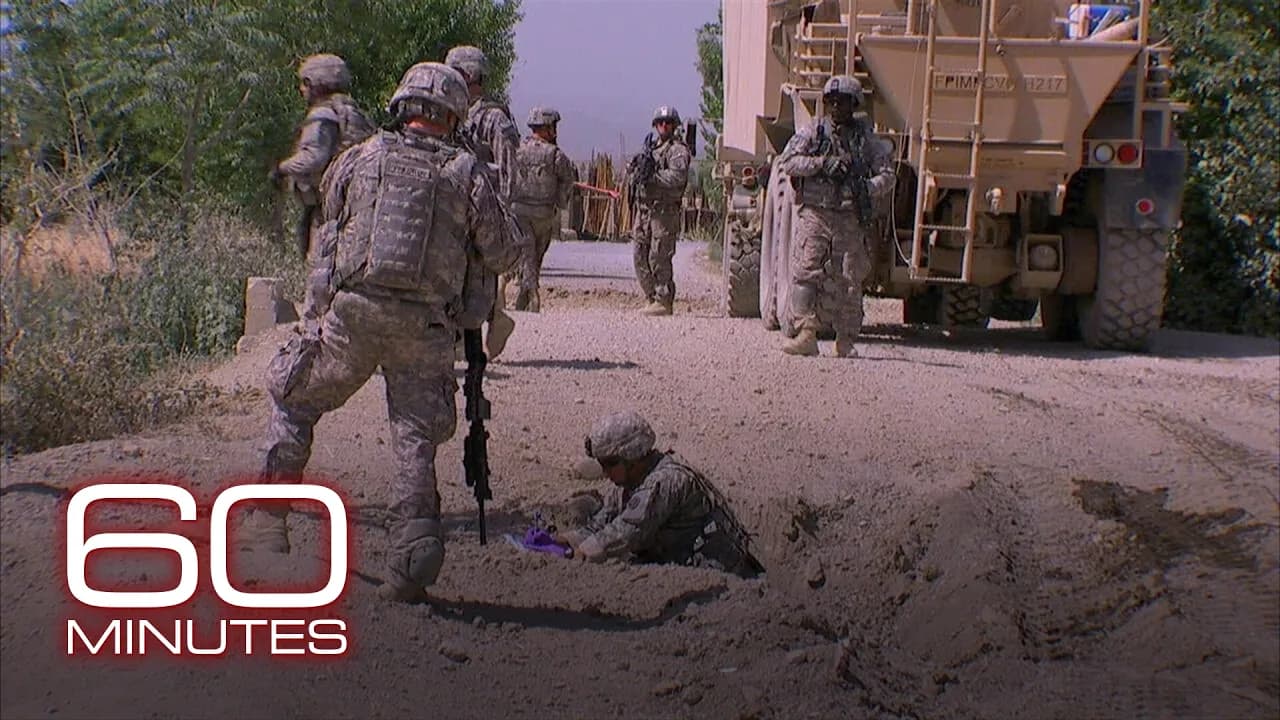
Last month was the most lethal yet for American forces in Afghanistan. Most Americans were killed by roadside bombs or IEDs. IEDs killed more than 40 American and coalition forces in October alone, up from five two years ago. In response, the US military launched offensive search and destroy missions by Task Force Paladin. Only volunteers serve on Paladin teams because the mission is so dangerous.
Colonel Jeffrey Jarowski was in charge of Task Force Paladin. "It's been a terrorist tool of choice for many, many years."
The Paladin teams are having more success finding bombs. Army Captain Dave Foster and his Paladin team discovered their first bomb within an hour of patrol. "The IED that we found had a 107mm rocket connected to a command wire. As the team was doing dismount and ops, they found the command wire. 107 millimeter rocket has approximately about 8 pounds of explosives in the warhead."
Staff Sergeant Max Cabrera found and disconnected the command wire, disabling the bomb. Cabrera picked up the bomb and carried it behind an abandoned building to blow it up, avoiding civilian casualties. "You get scared, but when you got so many things going through your mind, you just don't even know what to concentrate on sometimes."
Sergeant Cerra is 26 and from the island of Saipan in the West Pacific. When asked what it takes to do the job, he replied: "A belief that you're making a difference and a little bit of craziness." A little bit of crazy goes a long way in Afghanistan.
In World War II and Korea, artillery and shrapnel killed more American troops than any other weapon. In Vietnam, it was small arms fire. In Afghanistan, the roadside bomb caused more than 75% of American and coalition force deaths. In eastern Afghanistan's Paktia province, near the Pakistan border where many bomb makers are trained, the Paladin squad worked with a Michigan National Guard unit to clear bombs from roads.
Specialist Christopher Parsons has been a Guardsman for 3 years. "I love the pressure and it puts a lot of pressure on me to make sure I do my job correctly." His skill set from hunting deer in Michigan helps with hunting IEDs in Afghanistan. One of his commanding officers noted that deer hunters like Parsons make the best bomb hunters.
The devices can be triggered by clothes pins, but the blasts are often massive. Paladin teams travel in specialized, highly armored vehicles. Each one costs nearly a million dollars. The Buffalo has a large claw-like arm that can dig for bombs in the road. Another can snag trip wires lying across the road.
Captain Thomas Lefay of the National Guard unit says the vehicles are targets every time they leave base. "They know what my purpose is when I roll out with that buffalo, and they've watched it enough to know exactly what that vehicle does."
The convoy's mission was to clear a road so the base commander could drive safely to a meeting with a local official 12 miles away. Outside a village, the Buffalo stopped to dig for a bomb because the squad was attacked there the week before. Six minutes later, the Buffalo filled with smoke as two powerful bombs buried in the dirt road exploded. Despite their training and experience, the squad never saw it coming.
The Buffalo collapsed in a huge hole, lost its wheel and drive shaft, but all three soldiers inside survived. Sergeant Daniel D. Roach was relieved but frustrated: "Same goddamn spot that happens every time we roll up here. This is my second hit. Cat got the mouse this time, I guess you could say."
Sergeant Cabrera found the detonation wires buried in the road. The first bomb hit its target, but the second one 30 yards away missed. "Trigger man made a mistake. And we were lucky. And we're lucky he made a mistake." Lucky because it's usually the second bomb that causes the most casualties. After the first explosion, men like Sergeant Cerra go to investigate and that's when insurgents often set off the second bomb.
Roadside bombs are meant to prove to Afghans that the United States with its superior military still cannot protect its own troops or them. It costs about $10 to make an IED in Afghanistan. "You could lose your life over $10." One soldier had been hit by IEDs on the same road within a half kilometer three times.
"The enemy is relentless in the way he employs these. And so you can't stop. Ours is a fight of constant consistent pressure where we have to be relentless just as that enemy is. This is not a fast fight. It's warfare at a snail pace. We stopped so often we averaged just 2 miles an hour."
Captain Foster thought there might be a bomb hidden in a field. A bomb wire was found on local farmers' land. Sergeant Cabrera put on his 80 lb bombsuit and took what soldiers call the long, lonely walk. The road appeared safe, but to be sure, he set off two explosive charges. There wasn't a bomb connected to the command wire, but another bomb exploded behind them as the convoy moved on.
Captain Foster reflected on their 17-hour day: "Strapped to mortars, IEDs. This was a good day. Everybody came home safe." When asked if he was somber or exhausted, he replied: "No. It's at the end of the day knowing that all my soldiers are safe. That's when I sit down in a quiet time and thank God for watching over them."
Hours later, near the end of their mission, Captain Foster's men were attacked again. Around a bend in the road, smoke in the distance meant a massive bomb had exploded under the lead vehicle just two miles from the base. The vehicle appeared to be total loss. All three men on board were injured.
In two days on the road, the bomb squad encountered five bombs. Three soldiers were injured, two others shaken up. One US vehicle was damaged, another wrecked. Not a single bomber was captured or killed.
Colonel Jarowski assessed the mission: "Overall, yes. It was successful in that that force was able to find IEDs. Some of both. Some were found and rendered safe and I think we destroyed them and at least one of them. Others we found the hard way." When asked if America got its butt kicked that day, he replied: "Not at all. A vehicle getting blown up, doing what it was designed to do to absorb that blast is not us getting our butts kicked. It's us removing that threat."
When asked if this is a fight they can't win, Jarowski replied: "I try not to think about it too much because it doesn't really help anybody, you know." Captain Foster measured success differently: "Winning to me is going home really after our deployment's done is going home."
Keep 60 Minutes in your library
Save the videos and channels worth coming back to, and find them again in one place.