The First Sign Your Arteries Are Clogging (90% Miss This)
In a Nutshell
Erectile dysfunction is an early warning of arterial plaque because penile arteries are smaller than coronary arteries and lack collateral circulation, appearing 3–5 years before heart or brain symptoms. Measuring plaque with CIMT, coronary calcium scoring, or CTA confirms disease severity; fixing insulin resistance, visceral fat, and blood pressure through weight loss, aerobic and resistance exercise, and blood-pressure control is the only way to reverse the underlying vascular damage.
These notes were generated by AI and may contain inaccuracies.
There's an important sign that your arteries are getting clogged that happens well before a heart attack. Most people dismiss it as a psychological or aging problem until it's too late to reverse. By the end of this discussion, you'll know how to identify this sign, measure how severely clogged your arteries are, and learn the exact steps to clean your arteries to avoid a sudden heart attack or stroke.
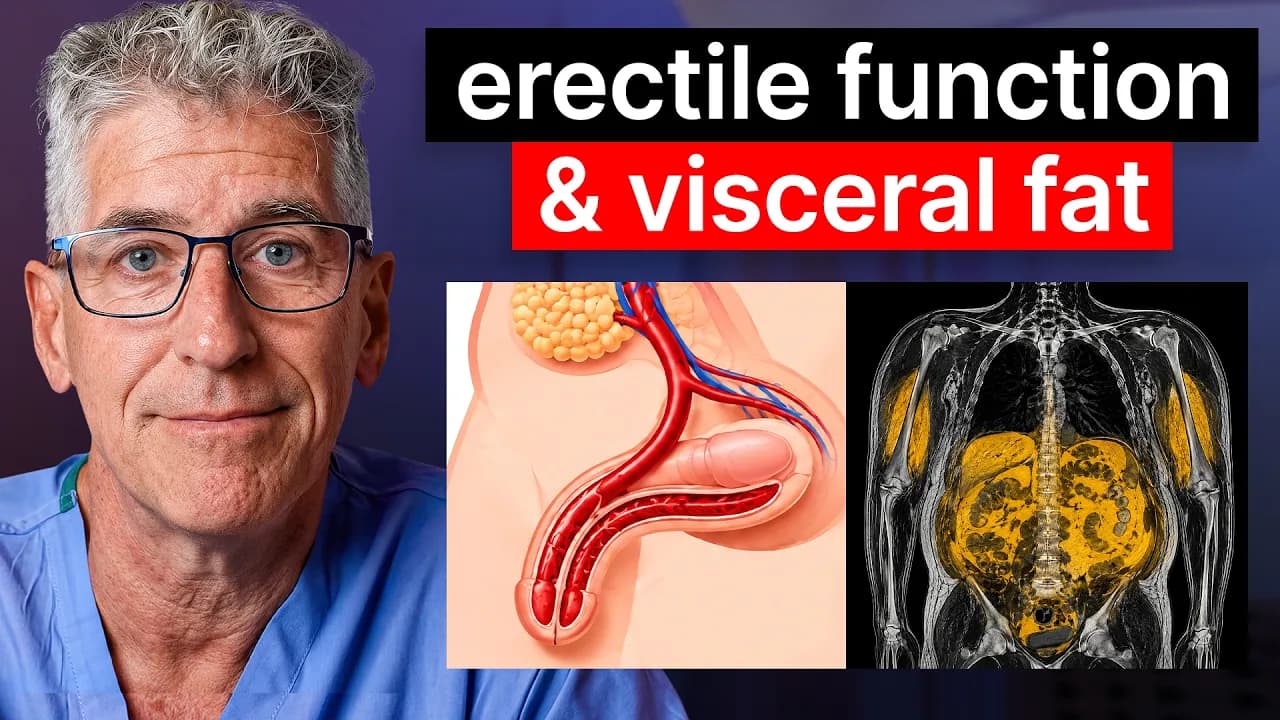
The major sign is ED (erectile dysfunction). Most men who develop ED assume it's stress, age, mood, or a testosterone problem. After 40 years of treating patients, the deeper explanation is arterial health, and this gets missed far more than other reasons.
When arteries start getting clogged with plaque, a smaller artery suffers first. Penile arteries measure roughly 1 to 2 mm in diameter. Coronary arteries (arteries in the heart) measure 3 to 4 mm, making them two to four times bigger. The same degree of plaque barely affects a coronary artery but can severely restrict blood flow in a vessel half that size or less.
The heart has collateral circulation (backup routes and reserve capacity that go around blockages), allowing it to tolerate early disease quietly without symptoms. The penis has no such buffer and depends on peak flow and rapid response. Small changes produce big performance differences in erections.
ED typically shows up 3 to 5 years, sometimes longer, before heart symptoms (angina), brain symptoms, stroke, heart attack, or transient ischemic attacks (mini strokes). This occurs because the smallest pipes feel the pressure first. Nerves have even smaller arteries than those supplying the penis. Reduced flow blocks stimulation and stops erections in two ways: through arteries directly to the penis and through arteries supplying the nerves to the penis.
The same mechanism applies to women, though it looks different and gets dismissed more often. In women, reduced blood flow to the genital area causes decreased arousal, loss of sensation, difficulty with orgasm, and pain during sex. It also causes dryness. This is the direct female parallel to ED. Women also develop unexplained fatigue and reduced exercise tolerance as early warning signs for heart disease, often written off as hormones, stress, or aging.
ED and female sexual dysfunction are not bedroom problems. They are vascular warnings and early warnings of vascular problems.
Three imaging tools provide a concrete picture of what's happening inside arteries:
-
CIMT (carotid intima-media thickness): An ultrasound of neck arteries using information technology to measure how much plaque exists rather than flow impact. The vast majority of heart attacks occur in people without flow impact yet, which explains why many people have heart attacks after normal stress tests. CIMT finds soft plaque, the most dangerous and unstable type that can rupture and cause a heart attack even without impacting flow. This test is non-invasive and involves no radiation. Quality testing locations can be difficult to find. Annual CIMT testing tracks progress.
-
Coronary calcium score: A low-dose CT scan timed to the heartbeat that detects calcium in heart artery plaque. It is accessible, inexpensive, and involves minimal radiation. It only detects calcified plaque and misses soft plaque, the real danger.
-
Coronary CTA (CT angiography): A test timed to the heartbeat that uses x-ray dye to map both calcified and soft plaque and estimates artery narrowing. It is more invasive due to dye injection and more expensive. CTA with AI maps both plaque types and estimates narrowing.
These tests move the conversation from "I might have a problem" to "here's exactly how much disease I have" and indicate how urgently action is needed.
Drugs like Cialis and Viagra usually help with symptoms and have evidence supporting arterial health more broadly, including in the heart. To fix the problem permanently, address the root cause. The root drivers are insulin resistance, visceral fat, chronic blood sugar elevation, and high blood pressure, not cholesterol alone.
High cholesterol is often a marker for metabolic disease rather than the sole cause. Typical treatment with cholesterol drugs addresses a symptom, not the root cause. Cholesterol's impact is multiplied by the metabolic environment. Fix the environment first.
Every pound of visceral fat lost takes pressure off arteries, improves insulin sensitivity, reduces systemic inflammation, reduces oxidative byproducts, and directly restores arterial function. Visceral fat creates the hormone resistin, which decreases insulin receptor sensitivity throughout the body (liver, muscle, other fat cells), not just in the fat cells themselves.
Blood pressure control is equally important. Metabolic disease causes increased insulin, increased IGF-1, and similar hormones that cause the kidneys to retain salt. Metabolic disease also decreases nitric oxide, making arteries squeeze tighter. Each uncontrolled year of arterial stiffening and microvascular damage in the penis, kidneys, brain, and eyes brings more damage and earlier heart attack. Bringing blood pressure down is one of the fastest ways to protect vessels.
Regular aerobic exercise (walking, cycling, swimming) improves arterial function directly, especially with intensity focused on large muscle groups in the legs. Resistance training is also essential. Intensity matters, and muscle health (measured by strength) is more important than mass. Resistance training improves glucose disposal and body composition dramatically. Arteries respond to use; regular work makes them more flexible, responsive, and healthy.
ED functions as a warning light on the dashboard. Fixing metabolism, blood pressure, and lifestyle turns it off at the source. Decades of patient work reversing plaque began with similar videos. Growing old is hard, but it's a lot easier with healthy arteries.
Keep Thomas Fordham Brewer MD MPH in your library
Save the videos and channels worth coming back to, and find them again in one place.