The Longevity Revolution Is Here | Lifespan with Dr. David Sinclair - Season 2, Episode 1
In a Nutshell
The Longevity Revolution centers on the claim that aging is driven by loss of epigenetic information rather than accumulated damage, and that partial cellular reprogramming using OSK genes can reset this “software” to restore youthful function. Evidence includes the ICE mouse model, optic-nerve regeneration, and vision restoration in aged or glaucomatous mice, culminating in the January 2026 FDA clearance of ER-100—the first epigenetic reprogramming therapy—for human glaucoma trials. The episode underscores that these milestones mark the shift from merely slowing aging to actively reversing it in living mammals and, soon, in people.
These notes were generated by AI and may contain inaccuracies.
We are living through the most revolutionary period in the history of humanity. You could be one of the last people to live a normal lifespan or one of the first to break the maximum limit of 122. The technology is coming. OSK alone could reset the epigenetic clock of human cells. One of the most exciting milestones happened recently. ER 100 became the world's first epigenetic reprogramming therapy to be cleared for human clinical trials. It's the same tech that cures blindness in mice. People that have been treated, if all goes well, will be able to see again.
Welcome to Lifespan, a show where we discuss the cutting-edge science of aging and how to live healthier at any stage of life. I'm David Sinclair, a scientist and professor working on understanding why we age and discovering new ways to slow and even reverse the aging process. On this show, I share an insider look at the latest from my lab, the field, and what's just around the corner.
Hey everyone, it's great to be back after the pilot episodes, which went to number one. This new lifespan show is bigger and better now. Matt will be coming back for some shows and I'm also going to be interviewing scientists from the longevity field and from my lab. We'll hear what it's like to make these discoveries and where humanity is heading. These folks have more than a 5-year view on the future because they're actually inventing it. Normally, this would be hidden behind closed lab doors, but we're going to gain special access. To join our community, visit lifespan.com.
My life's mission is to extend healthy lifespan for all. And that's why I founded Lifespan, which exists to help you and your loved ones live your longest, healthiest lives. We're building the world's largest longevity community and supporting medical research through the nonprofit Lifespan Foundation. Of the 150,000 people around the world that die every day, approximately two-thirds of those are due to age-related diseases and conditions with aging at the root cause of those. Hence, we can dramatically improve human health by targeting aging itself. We are in a new era and lifespan covers what you need to know about the exciting world of aging and longevity science.
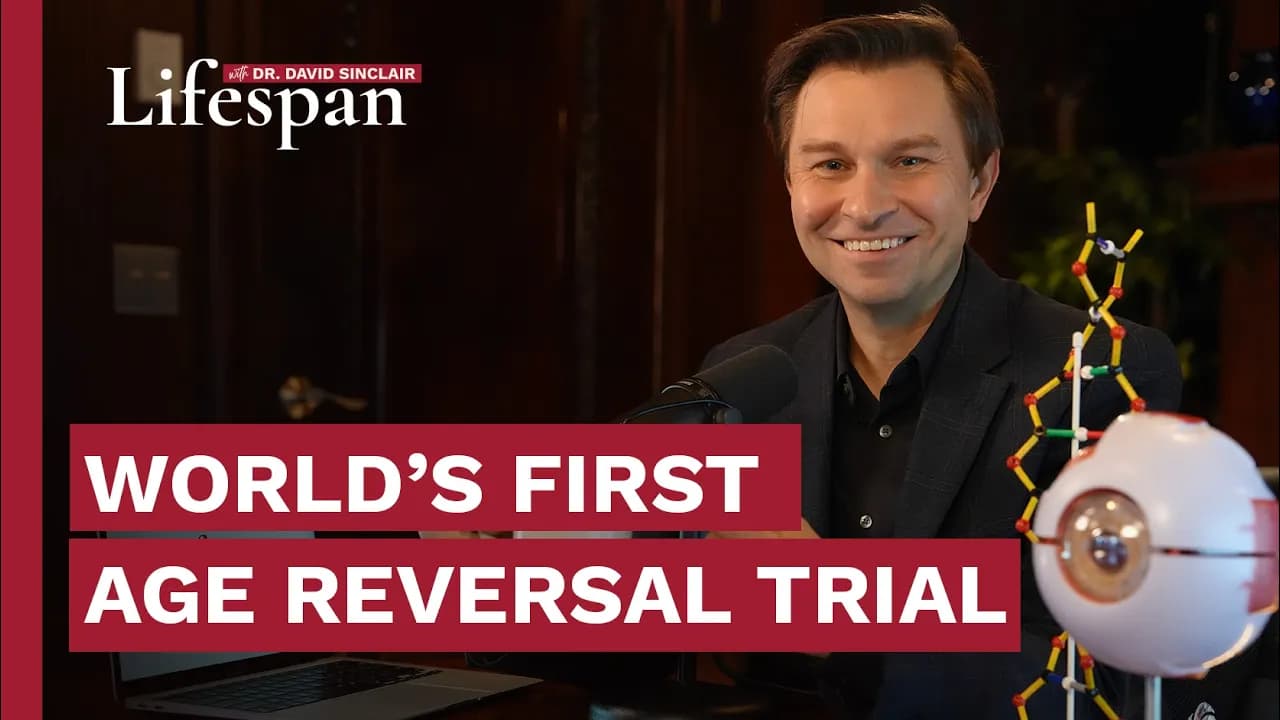
In making this episode, I used everything from tennis balls to DNA models to show you how cellular software might be rebooted. I recorded this over many weeks because it was really hard to make. We looked at thousands of papers and double and triple checked every fact and even re-recorded parts for accuracy. And with that, let's go to my left here. I'm excited to introduce the Lifespan Smartboard. This board here. I can go up, I can touch it. We can zoom in on figures from papers. And every show will be examining the science on that whiteboard and also bringing up video chats and other things. To my right here, we have a glass cabinet as part of this beautiful old library that I've filled with objects of interest that I'm going to bring out throughout the shows going forward. And they will illustrate what I'm talking about from DNA molecules to the Wright brothers plane.
Even Arthur C. Clarke, the science fiction writer who features in my book Lifespan, famously said, "Any sufficiently advanced technology is indistinguishable from magic." And if you've not yet heard the news, I'm excited to inform you. The technology is coming. One of the most exciting milestones happened recently in January 2026 when Life Biosciences drug candidate called ER 100 became the world's first epigenetic reprogramming therapy to be cleared for human clinical trials by the FDA. The tech is essentially a gene therapy that came straight out of my lab from my student Wanglu. It's the same tech that we published on the cover of Nature in 2020 that we showed reverses aging and cures blindness in mice. Professor Bruce Cassander, Sharon Rosen Wy Gibson, and her team at Life Bio have since shown that this tech also works in monkeys to restore visual function. And we're about to learn if it works in humans to reverse vision loss. And from there, just pick your organ of interest. Ear, kidney, heart, liver, skin. The possibilities are just too numerous to list. I'll talk much more about all of that later and give updates on how the trial goes in later episodes.
What used to be science fiction just 10 years ago is now coming to reality. And the science that used to live on the pages of journals and in academic conferences like the ones I typically attend, it's now coming to the market. No science show would be complete these days without mentioning AI. Artificial intelligence isn't here just to solve problems faster. It's here to rethink them. AI systems today are helping uncover previously invisible aging biomarkers, revealing drug targets tied to biological aging, and even suggesting repurposed compounds that could rewind the age of cells and address multiple hallmarks of aging at once. I know this because my lab is doing this and I'm excited to bring you the latest findings of my lab and the field. Insights you can find nowhere else. In the next wave, adaptive agentic AI systems could partner with human biology to optimize interventions, essentially acting like an ever-learning personal longevity scientist for you. Sequencing just one genome used to be reserved for elite research labs at a cost of about a billion dollars per genome. In early 2026, the $100 genome has been announced, which is going to pave the way for personalized longevity guidance, cancer detection, and decades before it actually happens, as well as drug personalization and age estimation, at least your epigenetic age, which we also call your biological age. And this is quite different than the one-size-fits-all advice that represents the 20th century. This means you have a choice. Be a bystander or be literate in what comes next.
The longevity space is moving really rapidly and its progress is only accelerating. The sheer amount of information and updates happening make it extremely difficult for any non-expert to make any sense of what's going on. It's hard to get a good grasp on what's real and exciting versus speculation and science fiction. You've probably noticed that people who are really passionate about wellness and longevity have some very strong opinions that often conflict with each other. It's hard to know who's right. Influencers are even worse. Trying to gain attention by saying outrageous things or hyping up a new study. I see it all the time. Eat only meat. Seed oils will kill you. You can't take metformin or berberine if you want to gain muscle. Detox teas will cleanse you. Even cold plunges will melt fat away. What about you must eat every 2 to 3 hours to stoke the metabolism? A lot of these couldn't be further from the truth. And we're going to dissect the real science here on this podcast.
Given the opportunity, virtually everyone that I talk to would like to become a centenarian, someone that lives over a hundred, especially if they would spend the vast majority of that time free of disease. My father, for example, who I talk about a lot and he's in my book, is now 86. And by following the practices we will be discussing on this podcast, he remains in perfect health, as energetic and as busy, and even happier than he was in his 30s. With everything we now know and science I know of that's coming down the line, this is not a crazy goal at all and is something that's quite achievable for you and your family.
Okay, let's begin by talking about extraordinary feats of longevity and performance that are already possible today. These are verified achievements by real people living under current or even past conditions. They establish the current outer boundaries of human biological potential. Each case shows what the human body and mind can already accomplish. I believe that if something is biologically possible for one person, it represents a capacity that could in time extend to many.
First, let's talk about the longest verified human lifespan on record. That's Jean Calment of France, who lived to 122 years and 164 days. Andrew, let's call up that video of Jean Calment on her 117th birthday. She was a great woman. She was very funny and said numerous jokes. One of which was, "I only have one wrinkle and I'm sitting on it." There's also the story of her talking to a reporter, young reporter, and he said, "Wow, this has been great. I hope I see you next year." And she says, "I don't see why not. You look pretty healthy to me." Jean was born in France in 1875 and she passed away in 1997. I remember the day clearly. She watched the Eiffel Tower being built as a teenager and lived through two world wars plus the invention of airplanes, the rise of the internet and much more. The number 122 in Lifespan's logo recognizes her great achievement and this extraordinary milestone. Just consider this. 122 is over 40 years beyond age 80. The same span of time as from age 40 to 80. So think about that. What if at 80 you had another 40 years of healthy life ahead? Calment's record stands as proof of our human biological potential. The question is not whether such longevity can occur. It already has. The question is how to make it more common in even better health and ultimately even longer.
This human lifespan record alone is powerful, but what about physical performance in older age? At age 22 in 2009, Usain Bolt set the 100 meter world record of 9.58 seconds. But in 2024, 80-year-old Kenton Brown ran 100 meters in only 14.21 seconds, setting a world record for his age group. The times of course differ meaningfully, but Kenton's achievement is nonetheless incredible. Usain Bolt 9.58, Kenton Brown 14.21 at age 80. For those watching on video, we found a video of men in their 80s doing a 100 meter final. Andrew, let's pull up that video. It's really remarkable actually how fast they run. It looks like it's on twice speed. Looks like there's two Australians in there. The green and gold. Go Aussie. Oi. Oi. Oi. We say I think the red guy is going to win. Yes. So, just notice the energy, the speed, and explosive power of those guys. And remember, they're over 80. And importantly, it's not just a single outlier performing this way. All seven of the runners accelerate hard, maintain form, and drive through the finish line with force. At their age, they're sprinting. They're also demonstrating exceptional muscle power, coordination, and athleticism. This is likely not something you've ever seen before. I know I haven't. And yet, it is indeed what the human body can achieve, even at 80 and beyond.
Speed, of course, is just one dimension of fitness. Endurance is another. In 2021, at age 80, Joseé Lopez ran a mile or about 1.6 km in 5 minutes and 56 seconds. I mean, most of us can't even approach that. He set a world record for his age group. Anyone who's run a mile knows that a time below 6 minutes is a difficult and remarkable accomplishment at any age, and especially so at 80. Jose's feat proves that exceptional aerobic function and cardiovascular health can be achieved even at older ages.
Physical vitality is not limited to speed or endurance. It extends to fertility as well. So in 1997, it was amazing to learn that Dawn Brook naturally conceived a healthy son at age 59, making her the oldest verified mother to conceive without fertility treatment. Female fertility typically declines significantly after the mid-30s and natural conception beyond age 50 is extremely rare. Yet Dawn demonstrates that fertility can persist far beyond typical norms. Dawn set the record and through technology my lab and others are striving to preserve fertility for as long as possible for as many women as possible.
So let's talk about mental performance. Is a loss of memory and creativity inexorable with age. The mini mental state examination or MMSE partly developed by my friend Sharon Inouye at Harvard. It's a widely used screening tool for cognitive impairment. It assesses memory, attention, language, and other skills. Scores range from 0 to 30 with 25 or above considered within the normal range. In 2008, den Dunnen and colleagues in the Netherlands published a case report in the journal Neurobiology of Aging titled "No Disease in the Brain of a 115-year-old Woman." They asked the question, are there limits to healthy life for a human brain? In the paper, they reported a woman who had chosen to donate her body to science. And at the age of 115, the same year of her death, she scored 26 out of 30 on this exam. At age 115, her performance was stated to be above the typical average of healthy adults aged 60 to 75. While not a verified world record, this must be pretty close to one. After she passed away, scientists found almost no evidence of heart disease in her body and her brain had almost no beta amyloid plaques or vascular changes. She had around the same number of locus coeruleus neurons as those of the brains of healthy 60 to 80 year olds. Locus coeruleus neurons are among the first neurons to change with age and one of the earliest sites of phospho-tau protein accumulation in aging brains and often accumulates decades before clinical Alzheimer's disease appears. These findings show that the boundaries of human cognition can extend well beyond what most people currently experience and that cognitive impairment need not be inevitable even among super centenarians. We know that a 115-year-old woman had the same cognitive performance as 60 year olds. So that is possible. That also means it should be possible to figure out what made her special and design medicines that could be used by all of us to give us what she had.
To help keep this show freely available, Lifespan partners with a select group of companies that I truly believe in and who also share our commitment to evidence-based science and supporting medical research. One of those partners is Ketone IQ. Researchers are increasingly interested in metabolic flexibility, including how the body can tap into alternative energy sources like ketones, especially during fasting. I've been increasingly interested in ketones as I go longer and longer with my fasting. Last month, for example, I managed to essentially go for 3 weeks without a full meal. And I know that sounds crazy, but I really wanted to see what would happen during that time. My body survived on ketones. The remarkable part is that I felt better than ever. My strength and my energy improved and my brain was really active. I even slept better. There's a lot of great science about the potential benefits of fasting and of ketones. But the problem is, how can you get the benefits of fasting without having to reduce your food like I did? You've likely heard of ketones before in the context of the ketogenic diet or in fasting literature. By cutting back on carbohydrates, especially, what you're actually doing is flipping a metabolic switch that tells your body to start producing these molecules as an alternative energy source besides glucose. Ketone IQ is a little drink whose active ingredient is a ketone precursor, and it's called R-1,3-butanediol. Now, you don't have to remember that, of course, but what's interesting is that your liver converts that drink into beta-hydroxybutyrate, which is a main ketone fuel that your brain and your muscle can use for energy. There's a growing amount of research into the effects of ketones on the body. In 2012, for example, the first study of its kind showed that consuming an exogenous ketone raised blood beta-hydroxybutyrate levels to that typically seen during a long fast like the one that I did or if you're having a really strict ketogenic diet. Then in 2018, a study asked, "What fuel does the aging brain still use?" As cognition declined in their patients over time, the researchers found that the brain became less able to use its normal fuel, glucose. And what actually happened was that the ketone uptake remain relatively preserved. That's really important and interesting because it suggests that even when the aging brain struggles to use sugar for energy, it can probably still use ketones as the alternative fuel. And finally, I briefly want to mention a study that I really love from 2022 where researchers gave soccer players some ketones and found actually that their reaction time in their cognition improved. They didn't get as much fatigue. And actually, that's one of the reasons that I take Ketone IQ often, especially before I do this show. We're offering our audience a 30% off discount for your first monthly order at ketone.com/lifespan or at the checkout. Just use the code lifespan.
Beyond general brain health, what about maintaining specific mental skills at an elite level in older ages? Chess is an extraordinarily complex game. To play at a high level, players must calculate multiple moves ahead every turn, anticipate opponents responses, recognize hundreds of board patterns, and adapt in real time under pressure. Mastery demands working memory, pattern recognition, and long-term planning. The title chess master is given to only elite players recognized by the national chess federation and reflects sustained competitive success. In 1984, Oscar Shapiro became the oldest person in US history to earn the title of chess master at the age of 74. Achieving this in his 70s demonstrates that complex skill acquisition can occur even at old age. Sure, it was years of practice, but his lifestyle or his genes might have had something to do with his success. And if so, we can mimic that, too.
These are rare examples, but they aren't always. Take my father, Andrew, for example, a regular guy who read the science and took control of his health around the age of 50. Let's show a picture of dad. He's been doing many of the right things that longevity science says to do. Exercise regularly. He does a lot of walking. He takes supplements. And now at 86, he's in perfect health, stronger and fitter than average 30-year-olds. He's certainly fitter and stronger than me. I'm super proud of dad. In later episodes, we're going to talk about what he and I do on a daily basis to maintain our youth and vigor. Wherever my dad goes, people underestimate him for his age. We climbed the Sydney Harbor Bridge, and people weren't sure he could do that, and it was no problem. He'd already walked 20,000 steps before we went up there. He's climbed mountains. He's abseiled. And most recently on a big stage in Sydney, he joined me up on stage and he was a natural. Taken together, these examples show what incredible feats of longevity and performance have already been achieved by athletes and by chess champions and even my father. And that is before the benefits of the kind of technologies we're going to talk about on this show and those that will undoubtedly arrive in our lifetimes. With the exception of my father, these feats are extremely rare, but nonetheless possible and achieved. Imagine you or your loved one being 80 years old and knowing that more than 40 healthy high performance years are still lying ahead. I believe we can make these outcomes more common and hopefully one day possible for all of us. But to make that leap from rare outliers to widespread reality, we must understand what determines the true limits of human biological potential. Why do some people preserve function so far beyond the norm while most experience steady decline? To answer that, we need a framework for what aging actually is at the biological level. And that brings us to my information theory of aging.
The information theory of aging or ITA is a totally new way to view aging. From the 1950s to the 1990s, the prevailing view about aging was that it was due to DNA damage or some type of damage caused by free radicals that could be mopped up by antioxidants. And this is why you still see food and drinks in the supermarket tout the wonderful benefits of antioxidants. But we've moved on from there. What was once a minority view has moved closer to the mainstream. Increasingly, aging is no longer described as the buildup of cellular damage, but as a loss of biological information. According to the theory, the precise patterns of gene expression that maintain cellular identity gradually erode, leaving cells less able to function properly and more vulnerable to disease. ITA proposes that aging is not fundamentally caused by mutations or some other type of damage or disrepair. It is a loss of information.
So what kind of information are we talking about here? There are two types of information in all of our cells. The first is the genome, a highly stable digital repository of information that's encoded in a chemical we call DNA, which can last for hundreds of thousands of years. In fact, some of my colleagues at Harvard have pulled these out of fossils, even of Neanderthals and species older than that. The other type of information that we need to talk about here which is so important for aging is epigenetic information. These are the instructions that tell cells how to use the genome. The software of our cells you could think of it. ITA posits that what fails with age is our cells' ability to read and interpret genetic information correctly. And over time, cells begin to read the wrong genes at the wrong time, and they lose their identity. Nerve cells begin to take on the properties of skin cells. Liver cells drift towards kidney cells. We start to lose our hearing, our eyesight, and our muscles shrink, our bones weaken, and then diseases take hold. What's so important for any scientific theory and for ITA is that it's testable. And what's so exciting is that there's growing evidence that it might actually be true. For it to make any sense, you have to accept a strange premise that cells carry memories. So rather than viewing the body simply as a collection of mechanical parts that wear out over time, we can see it as a dynamic system for storing, preserving, and interpreting biological information. Aging in this framework is not just damage accumulation. It is the progressive loss of the cell's ability to maintain its identity. This eventually causes the organ or the tissue to forget how to function and stave off what we affectionately call diseases.
Of course, we all started out life as a single fertilized cell. Then during embryo development, each of our cells, which contain the same DNA, they quickly specialized by remembering which genes to turn on and off. The system that carries this out is called the epigenome. This cellular memory maintained through epigenetic marks and folding of the genome is what allows a neuron to remain a neuron and a liver cell to remain a liver cell. As we get older though, that breaks down. I have a little model here of what chromatin actually looks like. I threw this together recently with some tennis balls and some Velcro. So, if you're just listening to this, you can imagine blue velcro wrapped twice around each tennis ball in a string of balls. So, the blue velcro represents DNA. It's a little bit tangled, but that's good because the DNA naturally looks like this. And bundles of these proteins form chromosomes. You can actually see with the microscope. So during embryonic development, what happens is that these balls and DNA wrap in certain ways that are slightly different between nerve cells and liver cells and skin cells. But during aging, what we found is that this starts to unravel and that the DNA becomes more open and now genes that should not be turned on get turned on and a nerve cell starts turning on genes that liver cells normally have on. That's a problem. We don't want our brain expressing liver specific genes. Ultimately what we see is that that causes dysfunction of all organs including the brain and that leads to disease. And this is why we think we get old. Your DNA sequence is essentially the same in a skin cell as it is in a neuron in childhood and in old age. The difference lies not in the letters of the code but in how that code is read. By changing where chemical tags are added to the DNA and to the proteins that spool the DNA. You can see here that there would be little chemicals like this bit of Velcro on the proteins that wrap the DNA. And actually, we get chemicals like this one on the DNA itself. These little chemicals, one of which is called methyl, a very important one. They dictate how this is all folded. And those little tags change over time. Unlike the digital genome which is very robust, the epigenome is mostly analog information and hence highly dynamic. In fact, if you could see these balls under the microscope in a real cell, they wouldn't be sitting here. They'd be flying around like it was a hurricane. It's actually quite a miracle that we last 80 years. That flexibility is what allows cells to adapt to the environment. So when you eat a meal, some of these balls open and you get genes for insulin, for example, switched on. But it also is our Achilles
Epigenetic patterns drift over decades, causing tags to end up in the wrong places. Instructions become eroded and cells forget how to function. The chemical tags on DNA determine how cells function. A model shows DNA as a spiral staircase with letter C positions marked in red. When methyl chemicals are abundant on the C's, the gene shuts down, which is how a liver gene in a nerve cell is prevented from being expressed.
Over time, methyls are removed and can relocate to incorrect positions. This process is not merely an indicator of aging but is believed to literally cause aging. The chemicals form the basis of the information theory of aging. Gene expression patterns become disregulated, cellular identity weakens, and function declines.
A metaphorical diagram called the Waddington landscape illustrates cellular changes during development and aging. A ball at the top represents a pluripotent stem cell that can roll into any valley. During development, balls roll into specific valleys such as the neuron valley or kidney valley. Cells acquire an identity and maintain it. During aging, valleys and hills erode, allowing balls to roll into adjacent valleys. Neurons become more like kidney cells and kidney cells become more like neurons. This suggests a potential method to push balls back to their original positions and rebuild the hills and valleys.
The modern story of the information theory of aging began with baker's yeast. Old yeast cells live about 20 to 25 divisions, taking about 10 days to die. They become big, slow, ugly, and sterile. In the mid-1990s at MIT in Professor Lenny Guarente's lab, researchers investigated why baker's yeast cells age and whether the process could be slowed. At the time, aging theories centered on cumulative damage including free radicals, telomere shortening, and molecular wear and tear. The idea that aging might be genetically regulated was not widely accepted.
The team discovered longevity genes in yeast called sirtuins that regulate the epigenome. One key experiment involved Brian analyzing a mutant yeast strain that had survived in the fridge for months. Using a micromanipulator, he measured lifespan by removing and counting each daughter cell. Wild type yeast produced about 24 daughters while the mutant produced roughly 30% more daughters. The mutation was called SIR2. This gene maintains gene silencing at specific loci. Its partner protein Sir2 is an enzyme that removes chemical tags from histone proteins, tightening chromatin and altering gene expression. Sir2 requires NAD as a cofactor to function. This links cellular metabolism directly to epigenetic regulation and explains the current NAD booster industry.
Mammalian homologues of Sir2 became known as sirtuins. The findings showed that aging in yeast involves changes in chromatin structure and gene regulation rather than solely random damage. The redistribution of sirtuins during aging leads to loss of silencing at some genes and inappropriate expression at others.
Notes from October 1996 represent the first documentation of the information theory of aging. The theory proposes that aging results from information loss rather than just damage. Evidence accumulated over two decades in worms, flies, and mice. Sirtuins regulate stress resistance, metabolism, and DNA repair. NAD levels are critical. Chemical tags on the letter C change in predictable ways that correlate with biological age and now form the basis of biological clocks.
Double-stranded breaks that occur daily in every cell can accelerate sirtuin movement and epigenetic alterations, accelerating aging. This suggests the response to DNA damage, rather than the damage itself or mutations, may be the major driver of aging. Aging is due to progressive loss of biological information, particularly epigenetic information.
The ICE mouse model stands for inducible changes to the epigenome. Targeted, easily repairable DNA breaks were introduced and could be turned on and off. At about 5 months of age, double-stranded DNA breaks were induced for about 3 weeks, approximately three times the normal number. The goal was to test whether creating breaks accelerates aging. The ICE mouse on the left appeared significantly older than its untreated sibling at 18 months. The treated animals had an advanced epigenetic age of about 50% and showed functional signs of aging earlier than expected. Skin, kidneys, livers, and brains appeared older. They exhibited loss of cognition and frailty. The underlying DNA sequence remained essentially intact.
A 2023 paper published in the journal Cell involved 46 scientists and took 13 years. It provided the first clear evidence that disrupting epigenetic information could drive aging in an animal, showing a loss of epigenetic information as a cause of mammalian aging.
In 2013, thinking turned to information preservation. A 1948 paper by Claude Shannon titled A Mathematical Theory of Communication proved transformational. Shannon showed that building redundancy into a message and comparing incoming signals against a clean reference allows the receiver to reconstruct the original signal. He called this backup copy the observer. This concept suggested biology might have an original embryonic signal and a receiver representing future bodies, with aging as informational noise in between. If a backup or observer exists in biology, epigenetic information could be corrected and youth restored.
Diagrams drawn in Fiji explored epigenetic drift, showing young cells expressing genes correctly while drifted cells express wrong genes. Additional diagrams illustrated sirtuin proteins responding to DNA breaks and compared the epigenome as an analog system to digital DNA, using a compact disc with scratches causing noise and jumping music as an aging metaphor. A record player analogy was also used. These early concepts contributed to the fully developed information theory of aging.
If epigenetic instructions are corrupted, nudging them back toward youth might help damaged tissue recover. This led to the question of whether epigenetic information could be safely accessed and restored in cells or living tissues. Embryos reset their age and reprogramming can push adult cells toward youth, suggesting biology knows how to recover the information. The challenge is understanding how embryos accomplish this and how animals like fish and lizards regrow limbs and tails.
John Gurdon in the UK took nuclei from adult tadpole cells in the 1950s and replaced egg DNA, producing a young tadpole. This showed old DNA could make a new organism. In 2006, Shinya Yamanaka showed that turning on four genes OCT4, KLF4, SOX2, and c-MYC, now called the Yamanaka factors, could turn mature skin cells back to induced pluripotent stem cells. This work and Gurdon's earned the Nobel Prize in 2012. However, fully reprogrammed cells lose identity and can become anything. In animals, turning on these four genes drives lethal tumors and can kill mice within two days.
In 2016, Alejandro Ocampo and Juan Carlos Izpisua Belmonte turned on OSKM in prematurely aged mice. The mice became much healthier and lived about 30% longer. In 2009, the lab began seeking a way to reset the epigenome. By 2014, the current version of the information theory of aging was taking shape. A PhD student was assigned the problem of safely resetting the epigenome in old human cells like embryos do. Dozens of gene combinations and culture conditions were tested over three years. In 2017, the experiment using only OSK factors without c-MYC succeeded. OSK alone reset the epigenetic clock of human cells without causing cancer. Using just OSK could rewind epigenetic age in human cells by up to 75% and then stop.
The retina was chosen as an ideal testing ground for gene therapy because it is an enclosed space and safer than systemic delivery. Retinal nerve cells connect the eye to the brain via the optic nerve and do not naturally regenerate in adults, though they do in young mice. Injury to the optic nerve, such as in glaucoma, leads to irreversible vision loss and blindness.
A hypothesis was formed that if aging could be reversed at the cellular level, regenerative ability and vision might also be restored. On Thursday, June 28th, 2018, around 10:00 p.m., a student sent a series of texts that led to a cover article in Nature in 2020. A student named Chang was shown at a machine cutting tissue for microscopic examination, with his watch displaying 10:06. The student texted that his hands were shaking and expressed a mix of preparing for the worst while hoping for the best. The response given was that any result is the best result.
Minutes later, a picture of regenerating optic nerves was sent. Questions were raised about whether the image showed an AAV infection, viral infection, or optic nerve. Upon scrolling up, three pictures were revealed showing nerves so long they reached out of the visual field. The nerves were noted to be from 12-month-old mice, and additional samples also showed good regeneration. This was described as the best result in the lab in years.
In adult animals, including humans, damaged optic nerve fibers typically do not grow back very far, if at all. The remarkable length of the regenerated nerves indicated that damaged nerves were regaining a youthful capacity to regenerate—a phenomenon rarely observed in the adult central nervous system. This moment was recorded in the book Lifespan, and the findings were later published on the cover of Nature magazine.
In aged mice experiencing natural decline in visual acuity, OSK treatment restored visual function, measured by eye and head tracking movements and electrophysiological tests. In mice with glaucoma characterized by elevated pressure in the eye and failing retinal nerve cells, OSK not only promoted survival of those nerves but also improved visual performance, effectively restoring vision. This marked the first time a gene therapy reversed aging and vision loss associated with both disease and aging.
Later experiments demonstrated that OSK gene therapy also reversed age-related molecular signatures in other tissues such as muscle and kidney, including in ICE mice whose epigenome had been artificially aged by repeated DNA breaks. Without the enzymes that remove methyl chemical tags from DNA, the treatment no longer cured blindness. These results suggested that Waddington's landscape, eroded over time, can be at least partially rebuilt by temporarily re-engaging the cell's own youthful program using only three genes: OSK.
Analysis focused on the epigenome, specifically DNA methylation patterns that change predictably with age and serve as biomarkers of biological aging. After OSK treatment, methyl marks on DNA were more youthful, indicating that the biological clock could be reset alongside improved vision. Importantly, this reversal did not involve loss of cellular identity. The study suggested that mammalian cells retain a backup copy of youthful epigenetic information, which reprogramming accesses and restores, reestablishing youthful patterns of gene expression. These findings provided experimental evidence for the information theory of aging in a living mammal.
Safety was critical, as full reprogramming is known to cause tumors and other problems. OSK expression was carefully induced, resulting in no tumor formation, no loss of retinal structure, and no evidence of uncontrolled cell proliferation. This demonstrated for the first time that age reversal and oncogenesis are separable processes when reprogramming is performed in a controlled manner.
The retina is part of the central nervous system. Demonstrating regeneration and functional recovery in the CNS suggests potential applications for neurological conditions, including Alzheimer's disease, as well as hearing loss and spinal injuries. The principle that aged tissues can be epigenetically rejuvenated likely applies to muscles, heart, liver, skin, and other tissues. The eye served as a proof of concept for many other possibilities.
These results, along with subsequent studies in non-human primates, set the stage for Life Bioscience's development of the drug candidate ER-100, which stands for Epigenetic Reprogramming 100. ER-100 is a gene therapy containing the OSK genes designed for human use. In January 2026, it became the world's first epigenetic reprogramming therapy to receive clearance from the FDA to begin human clinical trials. This milestone marked the first time a therapy specifically designed to reset epigenetic age was authorized for testing in patients.
ER-100 is delivered as an injection of gene therapy through the front of the eye via a quick, painless procedure. The genes move through the liquid in the eye and reach the nerves at the back in the retina. The retinal nerves form the optic nerve that transmits electrical signals to the brain. In glaucoma, elevated pressure causes optic nerves to age rapidly and become defective rather than dead. If effective, the gene therapy causes these nerves to become younger over approximately six weeks and resume functioning, potentially restoring vision.
The first clinical trial is running at three sites across the United States and is primarily designed to test safety. Dr. Joe Rizzo at Harvard is running one of the sites in Boston. Phase 1 trials are testing ER-100's effects on patients with glaucoma, the same pressure-related condition tested in mice. Glaucoma is the largest cause of blindness across the planet. Another condition being tested is NAION (non-arteritic anterior ischemic optic neuropathy), essentially a stroke in the eye. The prevalence of NAION has increased among patients using weight loss injections as these drugs have become more widely used. The trial can be found at clinicaltrials.gov.
Current treatments for glaucoma primarily aim to slow disease progression by lowering eye pressure or managing risk factors such as obesity, but they do not restore vision already lost. ER-100 seeks to rejuvenate damaged retinal nerve cells so they function more like they did when younger. Early-stage trials typically enroll a small number of patients and use gradual dose escalation. In this case, 18 patients will be tested, with doctors monitoring closely for side effects. Although safety is the main focus, doctors will also look for signs of vision improvement. If ER-100 proves safe and shows benefit, it will advance to larger trials. Given that no alternative medicine exists to fix blindness, there is potential for more rapid FDA advancement to reach patients sooner.
The broader significance extends beyond the eye. If restoring useful epigenetic information can repair damaged nerve cells in optic nerves, similar strategies could work in other tissues. Over the coming months, doctors will learn how safe and effective the approach may be. Regardless of specific outcomes, a path from laboratory science to patients and clinics has now been established. For the first time, epigenetic reprogramming is no longer confined to the lab and is being evaluated as a potential therapy in people, representing a new chapter in treating age-related disease at its root cause: aging.
In this episode, a turning point in the history of medicine was highlighted. For decades, aging has been viewed as inevitable—something to slow or manage, but never truly change. That perspective is now shifting. Examples were explored of what the human body is already capable of, including Jeanne Calment living to 122, 80-year-olds sprinting, and people maintaining cognitive function well over 100. These are not anomalies but clues to what the future might hold.
The information theory of aging was discussed: aging is driven by a loss of biological information, not just accumulated damage and wear and tear. This led to epigenetic reprogramming as a method to restore the instructions cells need to be young again. All of this is no longer theoretical—it is happening now. FDA-cleared clinical trials are in progress, with many more trials coming not only from Life Biosciences but also from companies associated with Jeff Bezos and Sam Altman. Humanity is moving beyond slowing aging and learning how to reverse it.
The show emphasizes that science and evidence come first, with the team working hundreds of hours to present only the facts. Additional resources are available at lifespan.com, including early access to future episodes, the Lifespan magazine, detailed episode show notes, transcripts, and links to referenced papers. Membership helps support medical research to extend healthy lives. Viewers are encouraged to subscribe, turn on notifications, and share the episode. The show can also be followed on Instagram at Lifespan and on X at joinlifespan.
The episode concludes with thanks to the production team, including Andrew the Wonderman, Ying, Rajie, Geek Me Out, Romesh, Marissa, Vulgore, Kathleen, TLDR Fitzgerald, researchers Shivani, Sethi, Adiv Johnson, new producer Daniel Salazar, and Serena. Thanks were also given to Inspirro Studio and Create Ape, as well as partners supporting longevity research. The show is for informational purposes only and is not medical advice. A qualified healthcare provider should be consulted, as individual results may vary. Views expressed are the speaker's own and not those of Harvard University or Harvard Medical School.
Keep David Sinclair in your library
Save the videos and channels worth coming back to, and find them again in one place.