The Internet is Clueless About Relationships - Dr Max Butterfield
In a Nutshell
Dr. Max Butterfield critiques viral relationship mishaps like a biathlete's Olympic cheating confession, emphasizing emotional self-regulation over grand gestures, which fail due to dysregulation and chase people away—opt for calm, simple outreach like "Want to grab coffee?" after breakups. Key advice includes healthy distractions for recovery, self-compassion to curb rumination fueled by uncertainty aversion, direct communication to avoid shadow sentences and passive aggression, and prioritizing partners with emotional stability, conscientiousness, and cognitive flexibility. Internet discourse oversimplifies with universal rules; true compatibility demands sitting with uncertainty, gracious interpretations, and behavioral consistency over words.
These notes were generated by AI and may contain inaccuracies.
Dr. Max Butterfield introduced. PhD in experimental psychology, masters in clinical psych, masters in experimental psych, bachelor's in psych, additional work in religion, law, and languages. Decided in first grade to like school and never leave; still in academia 30 years later. Few people provide evidence-based relationship advice, especially in short-form social media.
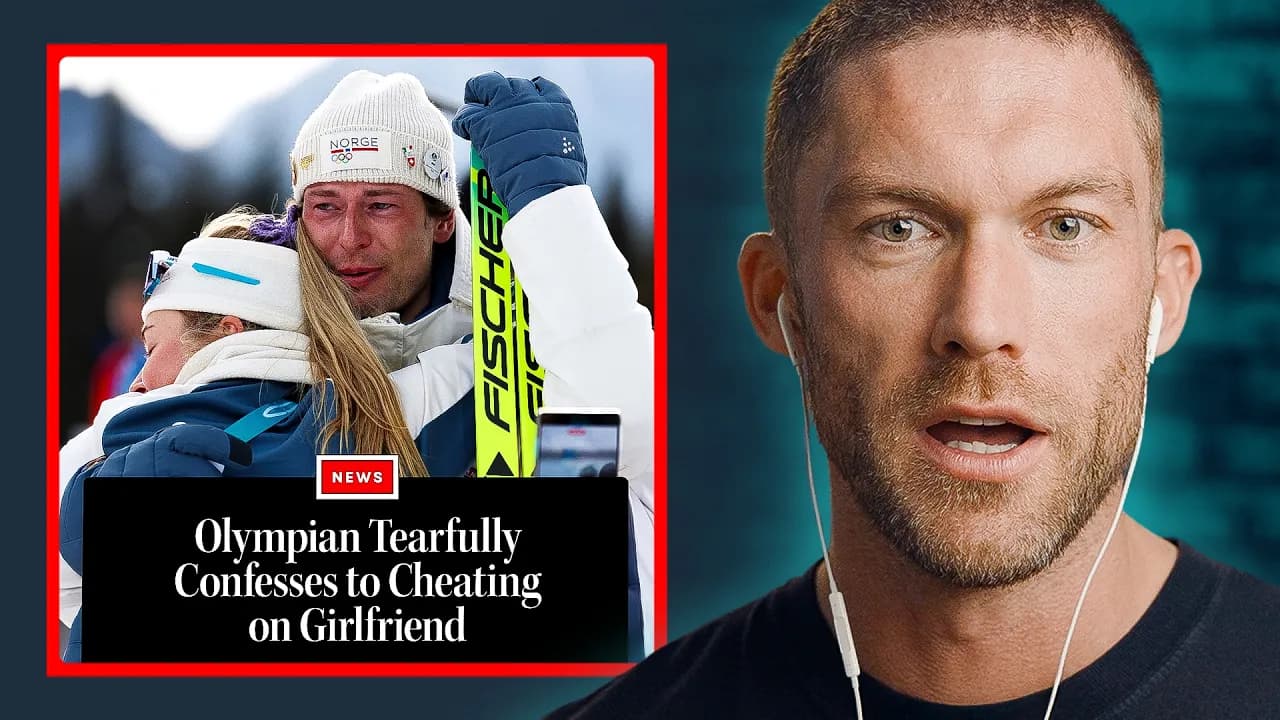
Norwegian biathlete Sterne Home Leggrade (28-year-old) won bronze in men's 20km biathlon at Olympics. In viral post-race interview, confessed to cheating on 'love of his life' 3 months into 6-month relationship; she dumped him after he came clean a week ago. Attempted public apology to win her back, but ex (anonymous) told Norwegian tabloid VG it's hard to forgive even after declaration of love in front of the world.
6 months ago, I met the love of my life, the world's most beautiful, wonderful person in the world. And 3 months ago, I made the biggest mistake of my life and cheated on her.
Used crowning career moment (biathlon: rifle shooting with skiing) for confession instead of thanking mom, God, or hard work.
Key question: Was this planned or impulsive? Different feedback depending.
If impulsive (excited, unregulated in front of camera):
- Blew up his life; every woman now sees him as cheater.
- Use humor to diffuse: 'stick to your 50m shots.'
- Repair damage; learn to regulate and think through actions.
If planned:
- Ask: What were you thinking?
- Possible motives: Show he's good guy, repair after shame/guilt from cheating motivates extreme actions.
- Might be good guy who made mistake or idiot; need more questions.
Potential romcom setup with clumsy protagonist laying accomplishment at her feet, but admitting cheating undermines credibility.
Not manipulation of her; he's manipulating himself via dysregulation, clamoring for connection.
- Olympic athlete should control impulses for 6 months after years of training.
- Post-breakup: People try anything (allocate effort wrong); need to try better, not harder.
- Trying harder chases people away.
Romantic mind pushes grand gestures; rational mind averse. Approach-avoidance: Scary things desirable (pursue relationship but fear hurt) causes steps forward/backward. Same in breakups: Hard truths scary.
Grand gestures fail like diving under car to grab scared cat by tail—you never see it again.
- Instead: Slowly approach over days (offer food/water, show safety). Requires investment, delayed gratification (lacking in adult society).
Dysregulation drives grand gestures to quickly fix attachment wound; ex sees it as spewing unsafety.
Advice for winning back:
- Pump brakes.
- Simple text: 'I've been thinking a lot. I'd love to speak if you'd care to.' Or 'Hey, do you want to grab coffee? Been thinking about you.'
- Fake it till you regulate: Project chill confidence.
Dysregulation = fight/flight; like doing stand-up chased by bear—look like maniac.
Primary: Regulate own emotions (teachable skills; should be taught from second grade).
Breakup Recovery Prescription:
- Healthy distraction: Work/school, friends, rec league (kickball), video games, lift heavy, run long, soccer—tire out to sleep well.
- Avoid alcohol excess.
Guilt correlates with likelihood of being caught (evolutionary).
- Low visibility act (wrapper blows away at night): Low guilt.
- High visibility (busy neighborhood): High guilt.
Applied to biathlete (announced cheating himself) and Epstein files witnesses (slow breathing under pressure: goat meditator, innocent/no fear of accusation, or uncaught; possibly beta blockers).
Beta blockers: Prescription; block anxiety detection (lower heart rate, respiration, blood pressure); used for steady hands (billiards) or presentations. Possible for courtroom calm.
Neurologically similar: Blunt regulatory instruments (fight/flight same for bear chase or mom fight; grief on/off for dog, grandma, or partner loss).
Theories:
- Evolutionary: Prevents future mistakes (ruminate on smashed finger → less likely to repeat; survive better).
- Serves present function: Rewarding (dopamine stimulation); punishing yet reinforcing (like class clown yelled at but laughed at).
Assess: What function does it serve? Provides insight to break cycle.
Rick Hanson podcast (Being Well with son Forest): Ask 'What are you getting out of your rumination?'
Mind abhors uncertainty/ambiguity (germinates anxiety); prefers imagined catastrophe to close open loops (negativity bias → collapse to worst-case).
Humans abhor ambiguity and uncertainty, preferring to imagine catastrophe rather than deal with not knowing. Brains are cognitive misers, taking the path of least resistance. Worn neural paths from rumination become self-reinforcing: ruminating once makes it more likely again, creating a loop. With evolved tendency to ruminate that serves a function and cognitive architecture reinforcing it, intervention is needed once it starts. Interventions include therapy, breaking routine, going somewhere else, or doing something else—not always requiring costly therapy.
Content of thoughts after difficult periods matters; fresh territory disrupts patterns. Example: Worrying about partner's night out or lack of text upon waking—change routine like going straight to a coffee shop instead of checking phone or getting breakfast at home to disrupt thought patterns. Put phone in garage or car before bed. Switch things up simply; people overcomplicate, ruminating about rumination.
Arguing with yourself chips away at rumination without fully disproving it. Example: Guy worried ex was living her best life; suggest "How do you know she didn't step in gum today?" Introducing possibility disrupts the loop. Be intentional: put phone in car, go out for breakfast, chip away—adds up over time.
Rumination as teacher addresses first-order emotions (sadness) vs. second/third-order (frustration at sadness, bitterness at frustration). Infinite regress of self-flagellation. Ask how it's serving: evolved to keep safe, marshall defenses post-painful situation. Thank ancient programming for safety attempt; dissolves judgment.
Self-judgment prevalent; envy those who turn it off for run or TV. Harsh judgment on what done or not done, alternatives. Research on compassion vs. self-compassion: easier to forgive friend's cheating ("everybody makes mistakes, move on, don't mention at Olympics") than self. Disparity creates downstream problems.
Cutting-edge research lacks strong interventions. Kristen Neff (guru) shows writing letter to self as to friend helps; or letter advising friend in same situation. Self-reflection on treating self differently than others. Labs researching as prevalent, recently identified problem.
Rejection sensitivity: normal dislike of rejection, but high sensitivity sees signs even when not rejected (e.g., delayed text → "he hates me, never talk again"). Creates turbulent social environments, lens seeing rejection in ambiguity. Associated with neurodivergence (autism, ADHD), personality disorders—not causing, but part of constellation.
Men taught no means no, anything short of obvious "hell yeah" means back off—fear discomfort, boundaries, MeToo; good people. Videos: women in NYC stealing finance bros' salads; topless in Central Park, no guys approach; maxi dress at bar, no approaches.
Simplest signaling: "Hey, you're cute," "Hey, I like you," "Killer boots." Avoid tricks, body comments (dangerous); clothes body-adjacent, risky (e.g., "that top is pretty tight"). Flirting ambiguous by nature—good, but overdid in workplace/schools pre-MeToo. Forthright hard (puts self out there) vs. flirting deniability.
Text/social media hard: no back-and-forth. In-person teasing/joke obvious; text ambiguous (sarcasm?). Class anecdote (8 years ago, dating apps rising): student unsure how to text girl back, 15 classmates advising—overthinking basics, no chance.
Shopify ad: powers 10% US e-commerce (Gymshark, Skims, Allbirds, Newtonic); 36% better checkout, Shop Pay +50% conversions; $1/month trial at shopify.com/modernwisdom.
Crowdsourcing texts; South Park episode: guys outsource to ChatGPT, girlfriends chat pleasantly.
Science inconclusive (evolutionary, cultural psych, personality); depends on context. Often to impress other women (social hierarchy, deter mate poaching: "don't mess with me"). Counterintuitive but persuasive.
Study: woman in revealing vs. conservative clothes asks directions pre-study; vocal analysis/micro-expressions: conservative = kind; revealing = judgmental looks, whispers. Women notice/judge more; men less attuned to clothes.
Armani suits study ('90s, replicated): same man in Armani vs. Burger King uniform—women rate Armani attractive/powerful/dateable, uniform not. Reverse: men rate woman hot regardless of attire. Women "pigs" like men, different domains.
Tragic: women effort under male panopticon illusion; call from inside house. Women could coordinate lower beauty standards (less long hair/nails/heels/tan), men wouldn't notice (e.g., guys ignore nails, $50 vs. $10k bags, shoe brands). Women ignore men's car details (Ricaro seats, twin-tip exhaust, Alcantara, iDrive). Allocation: direction over speed—talk to women, not tweak car.
Not red flag blanket; context-dependent (could be humility, green flag). No shortcuts/magic spells; relationships built over time, knowing people. Few true red flags (e.g., "I'm going to murder you").
Meta-theme: short out-of-context clips + universal rules = trouble. "You're too good for me" from high-status/self-assured man = cute flirty compliment ("How have I ended up with a girl like you?" third date: "Dude, so out of my league. Holy shit." romcom gold).
Behavior > words (behavior-intention gap): nice intentions without action = red flag; pattern of follow-through matters. Inability to regulate emotions (outbursts, punch wall). What done secretly (say vs. do mismatch). Core: consistency (actions match intentions), regulation (calm person, can become calm when dysregulated). We all dysregulate.
Everyone gets dysregulated. Not everybody is always calm; it's cool to be excitable, and there's a useful time for anger, especially on your behalf. If you're late for the flight and just make it, does that ruin the entire holiday? Or by the time the flight lands, has everyone burbed their emotions back down?
David Buss identifies emotional stability as the number one trait to look for in a partner: how long after emotional perturbment does it take to return to baseline? Shorter window is better.
Dr. Max studied under Sarah Hill, who was David Buss's student—"research grandpa." Spoke at Sarah's HB symposium in Palm Springs (pre-John Tooby's passing); least credentialed there (master's level among PhDs), with Don Tubi in front row.
Sarah mentioned ovulatory shift hypothesis study (possibly Christina Duranti): same guy presented as "cool" (leather jacket, smoking, motorbike) or "nerdy" (sweater vest, Big Bang Theory caricature), told as twins. Women converse about dating scenarios. Cool guy is detached ("maybe we'd go out, maybe not"). Tracked hormone cycles—ovulating women prefer cool guy signaling masculine traits. Even lesbians rate him better father/invested.
Ovulatory shifts: replication crisis says no, friends say yes—will come out in wash.
Another: women more likely to vote Obama over Romney when ovulating (Obama chattier).
Evolutionary approach drives interesting hypotheses, even if not all replicate. Focus on mechanisms: what would work and how to target via research. Max's degrees in experimental psych, but social psych is core—theory loose, like butterfly collection without unifying theory. Evolutionary psych aims to unify why people relate as they do; does some things well, eclectic approach like Swiss Army knife.
Men prefer bigger women when economy bad (know where food is), thinner when good. Study: students in mess hall prefer bigger before eating, thinner after. Tracks with economy state and era's pinup women.
Conscientiousness (thoughtfulness): pay attention, reliable, get things done, agency, care for partner and make it happen.
Agreeableness: yes-and, not no-but; supportive, not conflictual.
Moderate openness: not too much (wandering eye, unpredictable, polyamorous later) or none (no adventure).
Max: Sounds great for his current life, but college students want higher openness, less conscientiousness (fun over school focus). Big Five traits vary over lifespan and situation-specific. Class demo: few admit to lying, all do—personality varies, hard to assess/predict. Use as lens for current compatibility, not partner selection.
Cognitive flexibility important: open to growing? Trajectory matters. Much online discourse reverse-engineers incompatibility into universal rules (e.g., sensitive guy opens up to wrong woman, concludes "men shouldn't open up"—cheese with chalk). Right match: women who melt for emotional openness, still find him hot; stoic guys for others. People want rules for certainty in inherently uncertain relationships—no magic spell.
Adulthood increases uncertainty (e.g., Max applied to 12 top PhD programs, rejected despite strong undergrad; later had baby, more unknowns). Tolerance key to better life.
Practice: Running 16,000 miles in 10 years—slowed down post-shoulder injury/basketball. Thoughts arise, distract (bird, car), return if important; meditative despite hating meditation. Others: housemate's 60-min daily meditation; Alex O'Connor/Douglas Murray prefer jiu-jitsu over Sam Harris meditation.
No universal rules—trial/error to find what works. Biggest mistake: try once, fails, quit forever. Max quit therapy (master's in clinical psych), seminary, football (7th grade)—freed for better fits.
People who make changes happier than non-changers. Openness to experience dips with age. Praise "stick with it," but try new: LinkedIn job peek, journal relationship, Zillow city move, new coffee shop. Psychological spring clean to interrupt patterns, counter closing tendencies, escape local maxima for global.
Invest in high-return things/people: those investing in you, not forcing entry.
Jonah Hill texts leaked: therapy language ("If I tell you to leave me alone and you leave, you're dead to me"). Not fun game of guessing ("don't talk to me" means talk?). Straightforwardness developable skill; younger people indirect (e.g., hint sadness to prompt digging). More effort to obfuscate than state wants.
Playing emotional games is self-protective, like flirting with emotions—making others prove they care enough to dig deeper without putting oneself out there. It's hard to say directly, e.g., "Hey, Chris, I'm feeling sad today. I don't know how this interview is going to go." Starting that way might elicit an unhelpful response like "Oh, okay." Pick spots carefully, but if feeling sad, reveal it in a socially appropriate way. This skill is learnable.
Women saying "leave me alone" but meaning the opposite can stem from cultural penalties for open sharing historically more for women than men, transmitted across time. Today, it could go either way. Social media teaches it: "Never tell a guy X, instead do ABC." Learned from childhood, e.g., pretending to be sad in fifth grade gets extra attention from boys, persisting into adulthood on apps like Hinge.
Anecdote: Joe Hudson's Daughter
Joe Hudson's 7-year-old daughter cried regularly in the bathtub, sounding angry. He asked if she was sad or pissed off. She said when angry, everyone runs away, but when crying, her sister hugs her.
Not speaking in shadow sentences—pointing toward what you mean without stating it directly, denying the other the chance to give what you want. Like telling someone to hit a bullseye with eyes closed or moving the target. Passive aggression (also called indirect aggression) misunderstood; used to be thought men direct, women indirect, but recent research shows men more aggressive overall, including indirect. Women use it more as socially appropriate and safer—physically dangerous for women to be directly aggressive toward men due to strength imbalance. Evidence suggests women more directly aggressive toward other women, less repercussion.
Female intrasexual competition least popular on internet, huge disparity between fascination and discussability. Researchers: Joyce Benenson, Candace Blake, Corry Clark, Christina Duranti, Tracy Vaillancourt (Mean Girls). Rob Henderson story: Woman kidnapped by Amazonian tribe given food parcel by boy that smelled bad; she set it aside. Later, child fell ill claiming she put it near her and ate it; tribe chased her. Other women gave parcel via child as trap—either she eats and sickens or discards and accused of poisoning.
Male equivalent simpler: "Man take rock. Man throw rock." Female version multi-layered. Glad not to navigate that.
Posts on intrasexual competition draw shots despite being well-accepted principle in grad school. Hidden third rails. Birth rate decline discussion also controversial—accused of feminist lies on Tucker Carlson, then right-wing misogynist elsewhere. Same statements vilified oppositely.
Denying female intrasexual competition implies women non-agentic, passive recipients—disempowering. Women coerce, cajole, manipulate via competition, mate guarding, status seeking. Denying agency says they're blown by wind. Subtle misogyny in assuming women passive victims or derogating motherhood as second-class.
Vilified from both sides: called cuck and red pill incel. Calling balls and strikes—people don't like their favorite thing called wrong, gets personal. Many hidden rails. Uncomfortable truths win over comforting lies given time; being right early uncomfortable but redeemed with persistence.
Develop skills: be open, honest, but know oversharing limits—don't say everything in head. Takes practice and feedback. Social media fear of cancellation inhibits; everyday people avoid posting due to risk vs. low benefit (15 likes vs. 3 million gang-up).
People disconnected IRL, no feedback on communication. Opposite of echo chamber: say nothing, no learning. Never test assumptions; curate personal algorithm hearing same stuff. Fear entrenches opinions more than spewing wrong ideas.
Study: Erroneous beliefs—right-wing think left wants no borders; left think right opposes all birth control. Venn diagram mostly overlaps: most right want some gun control, left strong military.
Internet pattern matching: "Who are these men to talk about women's issues?" Issue is disagreement, not men speaking. Cohort of women agree. Identity-based silencing: only group members speak? Gay rights invalid (not gay), Ukraine (not Ukrainian), Palestine, RSPCA (not dog), NSPCC (not child), Save the Whales (not whale).
Reasonable people don't comment; angry/supporters do, creating polarity. Causes digging heels in, e.g., climate activists shout louder when ignored, escalate to gluing to M25.
Call out ideas, not people—ideas debatable, personal attacks end conversation. "We know what you mean" assumes bad faith, loses credibility.
Passive aggression, sardonic language Twitter norm. "lol" means "fuck you" without showing got to them. Cooler-than-cool facade; true colors hidden. Direct statement interpreted as shadow of worse private intent. Heat-of-moment regrets screenshotted forever.
Inhibits playfulness, free speaking; pigeonholes people. Daily fear: "Is today the day this post cancels me?" Less crossover, creativity. External pressure prevents crazy statements—not all bad, but not all good. Least gracious interpretation of anything said. And I have to I have to convince
Apply the most gracious interpretation to others' communications, even when receiving an unpleasant email. Ask: what is the most possible gracious interpretation? Often, they might be having a bad day and didn't mean to phrase it that way. Extend the same possibility to others that you give yourself, since you have bad days and send wrong wording. It takes extra effort, which is why people often don't do it. The mind leaps to 'they hate me,' 'they're a bad person'—a reductive two-dimensional view.
Host praises Dr. Max Butterfield: "Dr. Max Butterfield, ladies and gentlemen. Max, you rule, dude." Offers help: intros, signal boosts, whatever needed within reason.
Dr. Butterfield appreciates it. Currently growing email list at drmaxbutterfield.com—put email in there. Has big plans in the works he can't talk about publicly yet; sign up to find out the secret.
Host wants to fly him to Austin once new studio is done to sit down and talk more. Recommends everyone follow on Instagram: Dr. Max Butterfield.
Dr. Butterfield: "Awesome. Thank you so much. It was a blast. This was a great conversation."
Keep Chris Williamson in your library
Save the videos and channels worth coming back to, and find them again in one place.