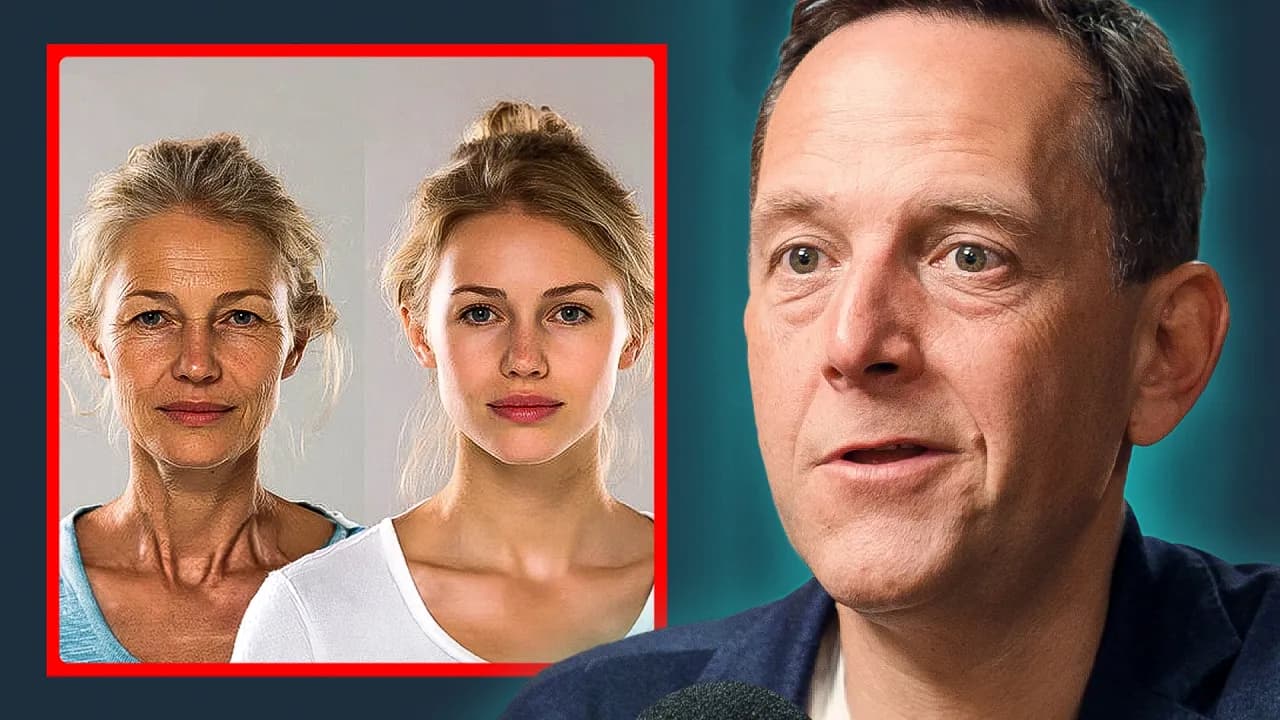
David Sinclair: Can Aging Be Reversed? After 8 Weeks, Cells Appeared 75% Younger In Tests!
In a Nutshell
David Sinclair asserts aging is reversible via the information theory of aging—cells lose epigenetic identity due to DNA damage and stress, but labs have reset mouse/human tissues to 75% younger using gene therapies and chemicals, with human blindness trials starting soon (glaucoma, optic stroke) and a rejuvenation pill in 1-2 years. Lifestyle slows aging by a decade: skip breakfast (fast 14-16h daily for sirtuin/NAD boost), exercise aerobically, eat polyphenols (blueberries, olive oil, matcha), avoid smoking/X-rays/ultra-processed foods; supplements like NMN, resveratrol, spermidine. Reversal cures diseases (Alzheimer's, cancer, menopause), enables 22nd-century lifespans, prioritizes youth over wealth, and fuels purpose through endless opportunities.
These notes were generated by AI and may contain inaccuracies.
Dying at 80 is not inevitable. That can be changed. David Sinclair, Harvard professor studying aging, longevity, and age reversal for 30 years, has seen evidence from his lab that we can reverse the aging process. It's not a question of if, it's a question of when. Major things people should do can lengthen life by a decade.
Smoking, getting an X-ray, ultra-processed foods, excessive drinking, flying a lot accelerate aging. Flying all the time probably accelerates aging. Going to a rock concert blasts eardrums because ear hair cells get older faster.
Body like a computer; can reinstall the software. Reversing aging cures diseases like Alzheimer's, cancer, heart disease because aging drives them. Lab like Willy Wonka's chocolate factory making discoveries every week. Turning point in human history; probably live into 22nd century if doing all right things.
Team report shows some unsubscribed randomly. Check if hit subscribe button if regular viewer. Approaching significant subscriber landmark. Hitting subscribe helps keep show free and improving. Deal: subscribe and they'll bring desired guests and conversations.
Picture of grandmother Vera and David Sinclair in early 20s (now 56). Grandmother inspired him to leave world better. Book Now We Are Six important; poem grandmother read at age six:
When I was one, I had just begun. When I was two, I was nearly new. When I was three, I was hardly me. When I was four, I was not much more. When I was five, I was just alive. But now I am six. I'm as clever as clever. So I think I'll be six now forever and ever.
Subconsciously, grandmother said don't grow up; adults can be evil after World War II impact in Hungary. Child is innocent. Realization: why do people grow old? Spent life figuring why we get old, grow up, get frail. Solving that has biggest impact on human health in history.
Grandmother told him at age four or five: "No, I'm going to die. Everything dies. I'm going to be gone. Your parents will be gone. Your pet cat will be dead pretty soon. And you yourself will be dead one day." Heart-wrenching realization world will be gone. Thought that's not fair; cruel to know. Vowed at 18 to get PhD, go to US, develop research lab to do something about it.
Preservation of health and life most important. Treat diseases with drugs, but underlying cause of 150-200,000 deaths daily is aging. Ignored or accepted as natural, therefore acceptable. Reject that idea. Future will look back at today as medieval for accepting frailty before 100.
Harvard professor, 30 years studying aging. Technology in lab reverses age of tissues in animals and human tissue grown in lab. First human trials in about a month. If works, transforms history; reset age of human body not by a year or 10, but more. Cures impossible things like blindness in animals including primates.
First trial: submitted to FDA to treat blindness as early as next month. Eye chosen as enclosed space, safer than whole body. In mice, reversed whole body age leading to longevity, rejuvenation; skin better, all parts healthier younger. Cautious in humans to avoid setbacks.
Plastic eye model: target retina at back where light hits, nerves coalesce into optic nerve to brain (eye part of brain). Optic nerve gets old/damaged but nerves mostly still there, just forget how to work—that's aging. Introduce three genes into optic nerve, turn on for 6-8 weeks. Genes reset cell age including nerves by 75% then stop (don't go to zero). Chose eye as safe enclosed system, not because works better there. Done in mice for brain, hearing, skin, multiple sclerosis, motor neuron disease with great effects.
Independent lab study: injected three reversal genes into vein of old mice (equivalent 80-85 years, frail). Got additional 100% lifespan extension (e.g., 80-year-old to 160 equivalent; or 70-year-old's remaining 10 years to 20). Not optimized; Hail Mary.
World doesn't know how close to safely reversing human body age. Confident because biology of aging understood, information theory of aging not disproven, enabled first safe reversal. In lifetime, medicines will reset/reverse large part of body age to cure incurable diseases. Turning point in human history; not if, but when.
Prediction: pill every couple weeks makes younger in 10 years. Lab like Willy Wonka's; 25 brilliant scientists make discoveries weekly. New technology: liquid drink rejuvenates mouse in 4 weeks (not genes). Normal: rejuvenated ear, skin, cured ALS/motor neuron disease. Same genes/molecules cure multiple sclerosis, blindness, liver disease—not disease-specific.
Don't base on parents/grandparents' frailty in 80s. Like Wright brothers: 1900 thought always horse speed, but 20th century went to moon. Our generation same for biology/aging. Previous generations no guide. Potentially live to 22nd century if do right things, technology increases. In 50 years, using 2070-2080 tech. Make it 10-20 years longer than parents or something wrong.
Singularity: make it to certain point, won't age anymore. First: cure blindness, then every year older get one year younger. Can reverse eye age multiple times (at least twice in mice; died with perfect eyesight). Not one-shot; keep reversing.
Ray Kurzweil predicts singularity ~2040s. Smart, predicted AI; dangerous to bet against. Skeptical as field leader; much to do. If trial works this year (2026), new territory toward whole body reversal. Can multiply reset body age.
Aging not just wearing out. Body like computer; software can reinstall. Information from parents/womb intact, functions perfectly to early 30s, then loses info. Gray hair: cells lose identity, stop making melanin. Info gets lost/corrupted. Backup copy from youth in every old person can reinstall into cells/tissues/whole mouse body, hopefully human. Old person needs reset; young person inside waiting. Future: choice to rejuvenate.
Backup copy location: working on it, secret, entirely new biology.
Biology in information age; started with DNA structure. DNA model: 6 ft long per cell, double helix ladder. Steps (bases): A matches T, G matches C. Rip apart to copy DNA. ~20,000 genes; ~15,000 turned on differently for nerve vs. liver vs. skin cell. That's gene expression. Controlled by epigenome, not genome (DNA molecule).
Epigenome is information transferred from cell to cell, from parent to offspring, not in DNA. It controls which genes are switched on and off. Major regulator is modification of bases on DNA, particularly cytosine (C) with a methyl group added (carbon with three hydrogens). This DNA methylation determines gene expression, e.g., optic nerve vs. liver cell, set in the womb. Epigenome consists of these chemicals turning genes on and off.
Information theory of aging: cellular information (DNA plus epigenome) is pristine when young but epigenetic information loses with age. Cells lose identity (nerve vs. liver vs. skin). Old skin cells less skin-like, start resembling nerve cells; nerve cells resemble skin. 99.999% of genes intact, but control systems (methyl labels) erase over time.
Aging is an identity crisis of the cells. The cells forget what their job is.
Enzymes remove and add methyl groups, but they change improperly. Major cause: cell catastrophes trigger removal of labels to adapt to stress. Cell panics (e.g., broken chromosome), relocates proteins like in a ping-pong match to emergency site, turns on stress genes. Short-term survival good, but doesn't fully reset. Every cell has at least one broken chromosome daily (20 trillion events/day in body), leading to cumulative aging.
Created ICE mice (Inducible Changes to the Epiggenome): engineered mouse stem cells with slime mold gene (activated by tamoxifen drug from chemotherapy) that breaks DNA without causing cancer/mutations. Fed drug for 3 weeks: mice initially fine (like not feeling X-ray or flying). 10 months later, 50% faster aging than untreated twins: super gray, old, all diseases of aging.
Anecdote: Got photo of sick-looking mouse while in Australia; texted back, "That's not a sick mouse, that's an old mouse." First evidence information theory correct. 12 years ago, lab bets: Sinclair bet on aging, others on death/cancer/nothing.
Equivalent in humans: X-rays, CT scans, frequent flying (cosmic rays) cause DNA breaks, accelerate epigenome rearrangement/loss of identity. Rock concerts blast eardrums, stress ear hair cells, accelerate deafness via aging.
Day-to-day stressors accelerate aging. Example: Brother (1 year older, 3 kids under 7-8) has more gray hairs at Christmas, proxy for aging due to lifestyle differences despite genetic similarity.
DNA not destiny: Epigenome (lifestyle) 80-90% of aging rate. Twin studies (Denmark): identical twins, one smokes/obese/sun-exposed ages much faster.
Gray hair not deadly, but appearance correlates with organ age.
Harvard study on WWII veterans: average 14 years longer life by:
- Avoid smoking (any smoke breaks DNA, accelerates lung/body aging).
- Avoid excessive drinking (>1 glass alcohol/day bad; Sinclair mostly quit).
- Eat well (healthy food, avoid overeating/ultra-processed).
- Exercise (biggest besides above).
- Have reliable partner (or pet if not; human bond slows aging, loners die sooner).
Can lengthen life by decade. Dig deeper into exercise, diet, lifestyle, fasting, nutrition.
Ancestors died at 30-40-50 from famine, disease, war; rare to reach 80. Natural selection favored early survival/fast breeding, not longevity. Mutation for 90-year life useless if dying at 30-40 anyway. Humans breed early but long development (education). Evolved for Serengeti (Eastern Africa): predators, tribes. Optimal lifespan ~30; post-30 entropy/information loss.
No predators → longer lifespans evolve (20-30 generations). Island species without predators live longer. Humans slowly evolving longer lifespans sans predators, but too slow.
Long-lived organisms have few predators:
- Bristlecone pine: longest-lived tree (thousands of years, since pyramids), poisonous.
- Bowhead whales/large animals: no predators, breed slowly, stable epigenome, no identity crisis/cancer for centuries. Whale cells in dish resist identity loss even after DNA breaks.
Reversing aging cures diseases of aging (Alzheimer's, cancer, heart disease) as they're driven by aging. In lab: give mouse human Alzheimer's genes → dementia; reverse brain age → disease gone (body heals when young).
Young cells healthy, self-fix/renew; immune clears cancer (we have cancer cells now, but immune kills them). Teens rarely get heart attacks/cancer.
Curing aging cures most diseases 100%.
Ovaries age first; evolution programmed menopause to stop reproduction, conserve energy for existing kids.
In mice: reversible. 16-month-old females (equiv. 65-70 human, stopped breeding ~6 months) treated with chemical → rejuvenated eggs/ovaries, produce healthy offspring (normal lifespan). Old eggs had messed-up chromosomes; treatment fixes. Question if women run out of eggs challenged.
Hard to test in humans vs. mice/monkeys.
Spent career since 35 developing aging medicines; complicated by money, business, laws, politics, leadership changes, patents, competition, spite, big pharma opposition.
Beyond mice: done in monkeys (physically/genetically near-identical to humans).
Other nations may do secret human research without ethics/bureaucracy. US government blocked $500M+ foreign investment in Sinclair-board company (age reversal tech too dangerous in wrong hands). Governments worldwide watch closely: economic/pharma/health/social changes, super soldier potential. Prepare for rejuvenation (live to 120+): social security, employment shifts. Economically positive: delays chronic disease/healthcare costs (last 5-10 years eat savings/gov money; last 2 years most expensive).
Would 56-year-old billionaire Sinclair give it all up to be 33? Can't price youth. Social media: would you for a billion dollars
Would you swap with Warren Buffett? No. Absolutely not. There's no money in the world that you want to be old. Youth is more valuable than a billion dollars. It may be the most valuable thing you could ever have. I would rather be 33 years old than a 43-year-old billionaire. Even the 10 years I value as a billion dollars. One year maybe, but not 10 years. 10 years is super valuable. The older you get, the more valuable it becomes.
It's important to realize the massive impact that this technology can have not just economically but on individual lives of human beings across the planet. The world when this becomes a reality—I'm pretty convinced it's going to happen—is going to be as different as the pre-computer world and the pre-airplane world is today. Imagine the world where we could pick our age and continue to reset to that age. Trying to imagine what the world would be like if I could be 33 forever or for another 100 years. I could stay 33 for 100 years.
Do you think that's the plausible outcome: we can pick an age and stay there for a hundred years like at that particular age or is it just that I'm going to be 150 in my physical form, wrinkled and gray but just continue to live? Is it looking young or just living longer? It's actually both. We're doing a lot of work in my lab on skin and hair, hair loss, hair graying. We've seen that we can rejuvenate the skin of mice. We also grow human skin in the lab from scratch and put that human skin on mice to test age reversal in that system. I'm very optimistic that we'll be able to rejuvenate the external part of the body as well as the internal. If we can cure blindness, reversing the age of the skin is a piece of cake.
What does that world look like? What are the unintended consequences of a world where we're all kind of young and live longer? Problems of meaning and purpose? There's this gut feeling that if I'm not worried about death, I'm not going to strive as hard or have as much meaning or agency. I totally reject that view. Every moment is special. I wouldn't be enjoying this conversation any more if I could live 200 years. I'm loving the moment. If I lived for a thousand years, I'd still enjoy every day. Even a thousand years, one day may be seen as too short. That's still not very much in the grand scheme of the age of geology and the earth. We will still love life and enjoy every moment, but we'll get more opportunities. We can try multiple careers, get divorced and have a whole new life. There will be opportunities and it will be a magnificent world. Not to mention the productivity that humans can provide with the knowledge of a 50- or 80-year-old but with the body of a 30-year-old.
Do you think people will make different decisions about having children? We have a problem already with couples leaving it too late. It's very clear with the fertility rate and the rate of childbirth that we're going off a cliff. By 2050, we're going to start going in a bad decline and earlier in many western countries. It's going to be important to give couples and women especially the choice to have children for longer. That's one of the reasons I work on this topic. The training we need to do and pressures on finding a mate and being happily married or partnered up can take decades. You don't want to rush into it. Being able to have children in your 50s and 60s would be a great gift to humanity. The pressures to have children before 35 typically are extreme and unfair. It'll help us maintain the human population. Without humans—absent android robots everywhere—we're going to have a deficiency of human capital and human productivity. This is the best solution to that lack of humans: keep people healthy and alive and productive for longer.
You mentioned cancer is something you're working on in your laboratory. What progress have you made? What has that taught you about the nature of cancer and how we might prevent and cure it? In your laboratory, you've been able to slow the growth of certain cancer cells and kill those cancer cells completely. My wonderful student Nalat is doing her PhD on this. We've hypothesized and now tested, based on the information theory of aging, that cancer is expressing those genes differently in the same way that aging is a cellular identity crisis. Cancer is a cellular identity crisis. If we can rejuvenate an old cell to be normal and turn on the right genes again, we should be able to do that for a cancer cell and either make it normal or if it tries to be normal and wakes up from its zombie-like state, it might even kill itself. That's what we're finding in my lab. Nalat's work has shown that a majority of cancers that we've grown in the lab will die and shrink in an animal if you try to reverse their age through the injection that you were referring to earlier. We can do it a couple of ways. One is using those three genes that rejuvenate the epigenome and make cells young again—the same technology for the eye we're using in cancer cells. We also have this chemical drink that we can give to animals or put on the cells and that also wakes the cancer cells up. They try to become more normal, turn on the original set of genes that they might have had on 30-40 years ago. Some of these cancer cells that we grow in the lab were from the 20th century. We rejuvenate them, turn on those genes that were originally in the normal tissue, and the cells kill themselves. We may not be able to cure all cancer using this, but if we're successful rejuvenating the human body, cancer is not going to be a risk. That's just a nice side effect of what our original mission was, which was to treat aging.
From this we can start to understand what we think is causing cancer. It goes back to the carcinogenic behavior you described earlier, things like smoking, anything that's applying stress on the DNA. You have to break the DNA. That's the catastrophe: really broken DNA, but you can do other things that cause catastrophes like overheat the cells. Even mechanical stress, too many hits on the brain in football will do that. That drives aging. Aging drives cancer. One of my theories called the Oncogenesis hypothesis. As we age, we're becoming more cancer-like as a human. Our metabolism when we're old is closer to heading towards what a cancer cell's metabolism is like. When we actually do get cancer, the cancer cells grow better in an old person than when you're young. By rejuvenating those cancer cells, giving them the ability to be young again, they actually either slow down in their growth or kill themselves in response.
Information theory of aging analogy: this record album has information on it, music, just like DNA. Scratching this album is like the control of the DNA bit getting messed up. If we were to play this on a record player with a needle, it's going to jump around and read the wrong songs or not sound very good. That's now the equivalent of an old cell. The information, the beautiful music, is there, but the ability to read it has been messed up in the same way that in old age, the information is in the DNA, but the cells don't read it correctly. Our technology is to get rid of those scratches so we can play the beautiful music of our youth again.
Steven puts on a 20 kg weighted jacket and neck brace to limit neck movement. Imagine feeling like that for a decade. That's old age. You feel tired, weak. You can barely hold your body up or move your neck. It would be painful. Most people in their 80s have some sort of disease and aches and pains. To fully simulate, add weight on the arms, ear muffs, Vaseline on the eyes. Shut your eyes and you can never open them again—that's what it's like for blindness patients we hope to cure. The governor of Massachusetts wore a full bodysuit for 15 minutes and cried, understanding for the first time how his father feels.
If I put a calculator in front of you and you had to hit a number and that was the age you were going to live to, what number would you hit? Infinity. There's no day if you're healthy where you want to die. Even if you're 100 or 120, if you have friends, family, loved ones, you're healthy, would you say tomorrow I'm ready to die? No, unless there was some kind of psychic issue. It's only when you're sick or have depression that you want to leave this world. Otherwise, life is a joy for most people. Being alive is the greatest gift. Consciousness is even greater. Why would you want that to end?
I have always assumed I wouldn't want to live forever. But if I was healthy with friends, family, doing things I loved professionally, would there come a day where I would choose to go now? No, there wouldn't. Just like there hasn't come a day in the last 33 years.
Do you think it's going to be possible in the next 50 years for us to live forever? I'd be shocked if that happened, but I've been shocked my whole career at how fast this technology is moving. Now with AI, things are going so fast. I'd be happy to be proven wrong. You're probably going to live into the 22nd century. We can't imagine what the world's going to be like then. AI has really changed this equation. We're doing things in my lab that would have taken 160 years before and quite literally billions of dollars on a $10,000 budget.
Fasting, just eating less often, is one of the most important things we can all do for longevity. I practice it as much as I can, though it's challenging in a world full of abundant food. We've known for thousands of years: ancients observed clarity of mind, long-term health. Difference between the glutton and people that fasted for religious reasons is obvious. Fasting doesn't include malnutrition—you need abundant vitamins, minerals, adequate nutrition. Three meals a day is craziness. Breakfast is the most important meal of the day is marketing from the early 20th century by breakfast cereal companies. Breakfast is not the most important meal for most people, especially adults, especially if you're not hungry when you wake up. There's no point in eating if you're not hungry in the morning. I skip breakfast.
Part of it came out of research in my lab. We studied yeast cells, which live about 10 days. We used yeast as a model for aging. Adversity, as long as it's not killing these cells, is good for you. It's called hormesis: what doesn't kill you makes you stronger and live longer. Adversity mode vs. abundance mode, which is modern life: popcorn, movies, wheels on your suitcase, sitting down all day. Fasting is adversity. Exercise is adversity. Cold plunges, saunas, adversity mimics. They're not really threatening your life. At the cellular level, cells get freaked out, worried adversity could kill us. They fight back: turn on repair systems, recycling systems, DNA repair systems that help slow down aging. In this modern world of total abundance, we don't exercise, eat three meals a day, get overweight, don't sleep much, have air conditioning—we're aging faster than we need to because our bodies are not fighting aging.
My team discovered sirtuins. I was one of many scientists in the 1990s, part of a team. In yeast. I went to MIT, professor Lenny Guarente. Goal: figure out if there are longevity genes. At that time, most thought there were aging genes or death genes. Doesn't make sense—our bodies would have longevity genes that give life. In yeast, searching for them. Lenny and I published in the journal Cell: first evidence for a cause of aging for any species. We figured out why yeast cells get old. Hallmark of an old yeast cell: it loses its mating type identity (a type or alpha type, male/female). It gets an identity crisis, doesn't know what sex it is, becomes sterile. Broken chromosomes distract the sirtuin defenses and that causes aging in a yeast cell. Sirtuins are proteins attracted to DNA, protect it from getting damaged, repair broken chromosomes.
Sponsor mentions removed as per guidelines.
Sirtuins normally turn genes on and off as epigenetic regulators, controlling the epigenome and telling cells their identity (nerve cell, skin cell)—like a conductor. Over time, the conductor becomes demented. When there's a chromosomal break, sirtuins panic, leave DNA to repair it, abandoning their identity role. They have two jobs: identity and repair. Repair is quick, but not all sirtuins return to original genes, causing an "identity crisis" like a tennis match or ping pong where sirtuins are balls hit to the break and back. This loss of epigenetic information causes aging in yeast cells (they don't live longer than 10 days) and explains human lifespan struggles beyond 80-90 years.
Constant eating distracts sirtuins from conductor role, forcing repair work, accelerating aging.
Breakthrough as Sinclair left lab for Harvard at 29: NAD (molecule fluctuating with food and sleep) is essential fuel for sirtuins to control genes and repair DNA. Grams in body, ancient (in yeast and humans). Young people have lots of NAD, enabling efficient sirtuin work. By age 50, NAD levels halve—body makes less and destroys it faster. Fasting yeast or humans raises NAD, rejuvenating sirtuins, preserving epigenome, improving DNA repair.
Can I drink NAD?
Direct NAD drinking ineffective; better take precursors: NMN (nicotinamide mononucleotide) or NR (nicotinamide riboside). NMN directly converts to NAD (two NMNs make NAD). Swallowing 1g NMN typically doubles body NAD. Human trials show sirtuins reestablish epigenome, lower body weight, improve inflammation, positively change cholesterol.
Sinclair and father (86) have taken NMN for over a decade.
No one-size-fits-all; depends on personal capacity. Challenging first two weeks due to hunger. Start slow: skip breakfast, add mid-morning snack; progress to no breakfast until lunch; build to late lunch or dinner (e.g., until 3-4 PM). Avoid eating in bed. Aim for 14-hour fast (e.g., finish dinner 7 PM, next meal late). Some do 16 hours. Do 5 days/week to activate sirtuins, raise NAD. Combine with exercise.
Once a month, Sinclair fasts 3 days for chaperone-mediated autophagy (deep clean of old/damaged proteins after 2.5-3 days). Autophagy = self-eating; kicks in with extended fast.
Body conserves energy; deep clean energy-expensive. Sequence:
- First hours: use liver glycogen for glucose.
- Run out: break down fat, produce ketone bodies (ketosis; bad breath, sharp mind 15-24 hours as brain uses ketones).
- After 3 days: break down proteins (old ones preferentially); do infrequently to avoid muscle loss. Animal studies show life-extending.
Short-term keto helps weight loss. Long-term not healthy, no longevity association. Concerned about lack of plant molecules in unbalanced keto. Best: lean diet focused on not-overcooked, non-ultraprocessed plants.
Sinclair eats less meat now (used to require it per meal, veggies as side). Partner Serena Pun (nutritionist, longevity expert 26 years) cleared his apartment of toxic/ultraprocessed foods (e.g., sugary peanut butter). Now: rarely meat/alcohol, fresh high-quality preferably organic foods (avoids pesticides/contaminants, though more expensive).
Animals lack polyphenols (activate sirtuins, mTOR, others; in plants/fungi, not meat). Xenomorhesis = eat rainbow (stressed plants produce polyphenols defensively: resveratrol, pterostilbene, quercetin, anthocyanidins).
Blueberries packed with polyphenols (purple color); handful as snack (not low sugar, don't overeat).
Polyphenols mimic fasting/exercise (NAD = sirtuin fuel/gas; polyphenols = accelerator). Matcha green tea: high polyphenols from shading plants (stress); Japanese trial/error over thousands years. Sinclair switched from coffee. Avoid sweetened matcha (sugar reverses benefits).
Red wine good absent alcohol (polyphenols). Sinclair's 1996 paper raised sirtuins 30% in cells; once apologized for daily red wine recommendation (doctors prescribed it). Now avoids daily due to UK Biobank: 1 glass/day shrinks brain gray matter vs. non-drinkers.
Ketone-IQ (exogenous ketones like beta-hydroxybutyrate or 1,3-butanediol): Sinclair drinks before podcasts for clarity. Studies (some from Ketone-IQ, independents) show heart/brain healthy. Gives fasting clarity/boost without full fast.
No debate: lower LDL as much as possible (irrefutable science, thousands in studies). Brain makes own cholesterol, doesn't use bloodstream's. Sinclair on statin since 30 (family history, insisted despite no heart disease; doctor conservative). Advocate preemptively treating before disease, starting early. Fights system for tests/meds.
Diet impacts if you absorb cholesterol highly (can test).
- Blueberries: polyphenols; handful snack (moderate sugar).
- Avocados: polyunsaturated fats for satiety, anti-inflammatory.
- Extra virgin olive oil: omega-9 activates sirtuins; polyphenols if cold-pressed/stressed; epidemiological data: high intake = low inflammation/less disease. Sinclair takes teaspoon mornings with resveratrol polyphenol.
- Nuts: vitamins/minerals; 1 Brazil nut/day for selenium (recent study: deficiency deleterious); calorie-dense, moderate if weight loss.
- Brussels sprouts: polyphenols + sulforaphane (sulfur, rotten egg smell/taste; activates NRF2 hormesis). Steam lightly; supplement if disliked.
Pulsing = cycles of stress/recovery, not constant input. Example: resveratrol (in red wine). Fat mice: daily resveratrol made thinner, cured diseases, 15-20% longer life. Normal mice: daily slight extension (not significant). Old mice: every other day significantly longer life. Daily foreign substance may counteract benefits.
Metformin has been shown to make athletes, bodybuilders, weightlifters do fewer repetitions, resulting in muscles about 5% smaller compared to those not taking it. This is not molecular but because metformin makes you feel weaker by interfering with mitochondrial energy production. Mitochondria are the power packs in cells, originally bacteria. Pulsing or cycling metformin every other day is better for longevity. Natural equivalent is berberine, which also activates AMPK. Take every other day, and if working out, avoid taking it a few hours before; take after or skip that day.
CDC-funded study: People exercising regularly (30 minutes jogging 5 days a week) have telomeres looking 10 years younger than sedentary people. Association studies show correlations but not causation; need placebo-controlled or prospective trials. Studies assigning exercise vs. sitting show telomere length differences, providing better causation evidence. Associations could be confounded by better diet, sleep, etc.
Telomeres are ends of chromosomes that shorten with age; used as biological age indicator. Now, epigenome and DNA methylation are better clocks.
Saunas proven beneficial for heart disease and long-term mortality, mostly studied in Finnish men. Regular sauna bathing (many Finnish homes have saunas) reduces death from heart disease and cardiovascular events. Mechanism unknown, but theory involves heat shock proteins (HSPs) activated by heat, defending cells; moisture helps. Sauna better than steam room because hotter. David uses hot steam shower daily; prefers sauna if possible.
Limited data but hormesis theory; may help muscle repair post-workout. More research needed. Provides mental clarity and feeling better.
Top: Skipping meals (easiest biggest impact). Close second: Exercise including losing breath (panting, unable to converse easily) for at least 5 minutes, 3 times/week. Aerobic exercise key for longevity benefits; long-lived people do more aerobic, not just weights. Weights important for mobility, strength, preventing falls, hormones like testosterone.
Initially skeptical, but research shows mitochondria rejuvenated/enhanced by specific red light wavelengths (must get right). Not BS; good evidence for skin, hair. David uses red light cap for hairline preservation.
Travels with case of supplements (won't show publicly due to experimental ones). Safe ones:
- NMN
- Resveratrol
- Metformin or berberine
- Spermidine (from wheat germ, not sperm; discovered in semen by Antony van Leeuwenhoek). Extends lifespan in worms to mice; safe; stimulates autophagy, aids fasting, delays epigenetic information loss. Quantities in book.
- Glycine (5g most days): Amino acid; David did PhD on glycine genes. Extends mouse lifespan; controls one-carbon metabolism and DNA methylation, potentially slowing epigenetic aging. Very safe.
- Vitamin D (takes Serena's with vitamin K2): Prevents deficiencies linked to cancers; K2 keeps calcium out of arteries (plaque), into bones.
Takes baby aspirin daily (despite some doctors stopping recommendation due to bleeding risks vs. clotting benefits for average person). Justified by personal high cardiovascular risk: High cholesterol and Lp(a) (little p, parentheses little a). Lp(a) inserts into cholesterol, promotes plaque. Genetic (Ashkenazi Jewish ancestry traced 1000 years). Test Lp(a); high >30-40 mg/dL risky (normal ~10 or less). Lowers with high-dose niacin (B3) (0.5g built up; some take 1g; causes flushing, take with aspirin). Drugs in phase 3 development.
Father bald before 30, gray by 40. David uses:
- Red light cap (6 minutes): Proven to slow loss (act before visible).
- Hormone mimetic blocking DHT (testosterone form causing male hair loss; women lose less hair due to less DHT). Not taking testosterone (can raise DHT). Raise testosterone naturally: Build muscle, especially legs/back. Gym raises testosterone if low (<400).
Doesn't recommend drugs, but for low T: Reduce stress, sleep well, exercise, build muscle first. If needed, talk to physician. No big downside or cancer risk (friend did trials). Useful for health, not longevity.
Future as different from now as now from 200 years ago (when infections like splinters, childbirth, smallpox killed routinely). Future: Cure blindness, paralysis; look back at today's medicine as horrible (e.g., nothing for blindness or broken back). Breakthroughs like curing blindness in monkeys (complete blindness restored in 6 weeks) coming to humans soon. Lab reverses tissue age in mice routinely in weeks. Aiming to rejuvenate any tissue (liver, brain, memory).
Use virus-like particles (AAV) packaging 3 genes. Expensive now ($10M/year to produce for trial). Future: Cheap pill. For eye: Quick jab into eye (2 seconds discomfort for blind patient). Trillions target retina nerves via surface proteins (zip code; AAV2 for eye; changeable for liver/brain). Particles enter cells, release DNA loop staying permanently. Genes dormant until activated by doxycycline (malaria/Lyme drug; with probiotics). On for ~8 weeks.
Trial (one at Harvard) treats blind patients (glaucoma, pressure
The first disease to treat is glaucoma, pressure in the eye. There's also a stroke in the eye, becoming more prevalent due to Ozempic and other weight loss drugs; people go blind overnight with nothing that can be done. They're blind and their other eye can go a few months later. It's very scary for young people. A friend had it happen. It's pretty common, about 30,000 people each year in the US alone. These two diseases are the beginning. If they work, then macular degeneration, the largest cause of blindness besides glaucoma. Then liver, lung, skin, and keep going. Make different packages for different organs and ultimately rejuvenate the entire body.
The company is Life Biosciences, a private company. Proud of the scientists doing this work. Big goal is to make the world's first age reversal medicine as a pill, working with them using AI to find that molecule.
Timeline for Age Reversal Pill
Forecast for the world's first age reversal molecule: Right now down to three molecules that work, using AI to make all three in one. Screened about 8 billion candidates using AI, now doing bench lab work to see if one or more works. Putting into humans still a number of years away, but should know within a year or two if right—put them into mice; if they get younger and live longer, on to something important.
Reason to make a pill: Important for the planet. These drugs are expensive—$10 million to do a clinical trial, could cost over $100,000 per treatment. Not for everybody. Worth it if blind, worth it for the country to cure blindness. But what if instead of $100,000, $100? Working to democratize this technology so anyone, even in Kenya, can take these medicines.
Most important thing not talked about: Pushback, philosophical from religious folks who don't believe we should play God. Argue we've been doing that for thousands of years, changing our biology, taking medicines, plant medicines originally. What about this room is natural? We change our world as a species. Aging is no different—crazy we haven't worked on it sooner.
Do you believe in God? Short answer: Believe there is something beyond reality as we see it. Study physics; physics is weird. Anyone who says they understand the quantum world or quantum mechanics is lying—bizarre. Quantum entanglement, simulation theory. This is not a solid desk; multiple versions of it, maybe infinite. Four of them? Four times infinity.
Believe consciousness is the ultimate goal of the universe, that consciousness creates reality. From particle physics: Observation of particles changes their reality, even retrospectively in time. When you observe them (camera or eyes, usually detector), conscious interpretation changes how it acts.
Does this mean something behind this wall unless we look? Maybe observation creates reality. Influences reality for sure. Not calling it God, but spiritual in a scientific way.
Has it dawned that you might be the only real person here, we all render when you walked in? Plausible but narcissistic. I just rendered when you walked in the house today—I don't exist. No way of proving right or wrong. Most kids think that initially, but least likely explanation, though some truth in physics.
Do you think we're in a simulation? Better than 50% chance this is simulated. Probably a simulation. World we think it is not the world it is. Measuring at fundamental level, reality doesn't exist the way we think. Things created, change by human observation—weirdest thing in science. Why aren't we talking about it more? Reality cannot be true if looking at DNA molecule affects particles inside it. You create realities of particles, maybe macroscopic things, by existing, having consciousness, eyes, sensing it. How does particle know you've seen it?
Double-Slit Experiment Explanation
Classic double-slit experiment, mid-20th century or earlier. Fire electrons through two slits in a board (board blocks particles). If observing, electrons go straight through slits, hit backboard detector (film or detector), make two lines: left or right slit. That's our reality.
If not looking, particles behave as wave, interact, make interference pattern—multiple lines on detector, heaviest bands in middle, others too, like waves interfering.
Mere act of looking at where they went: two lines. Not detecting: pattern. Can observe in real time or retroactively (some debate on true retroactive, not going back in time).
If measure in real time, see two. World knows you're looking—particles know, with eye or camera. If develop film later without watching, affected world in stripes.
From that, conclude we know nothing about reality—everything observed changes by observation. Does octopus observe and affect? Should test—octopi conscious, would affect reality.
What is all this stuff? Biggest questions: What is world made of? Why are we here? Next big question: Do we have to age? Other species around universe figured it out. Goal of every conscious living form. We've been slow.
Believe in aliens? Don't believe but believe in mathematical probabilities. Trillions of planets, many habitable. DNA, proteins on meteorites, planets. Crazy to say no other life. Civilization? Conscious? Don't know, but life all over universe.
Longevity, living forever comes back to meaning—what's the point? Alien a million light years away—same question. Null and void? Just have good time, sex, kids, enjoy, experience?
Existential crisis of conscious beings. All need purpose—key to longevity; people with purpose live longer. Purpose of universe: Allow consciousness to emerge through biology. By design or coincidence with infinite universes. Universe set up for life, consciousness—small changes to physics make life impossible. Life, consciousness-producing universe.
Does that mean meaning to us existing? No. But consciousness most interesting, important thing universe produces—worth preserving. Like Elon Musk: Humans amazing but cruel, consciousness should be preserved.
Defining Consciousness
Consciousness: Ability to know you're thinking, be self-reflective.
Is my dog conscious? Partially, but not same way—no reflection on past like us, not aware of self. Semi-conscious: Think, predict future, know feelings, empathy. Levels of consciousness.
About 1 million years ago, humans crossed threshold into pure consciousness (maybe not pure). Consciousness spectrum? Maybe another organism thinks you're not conscious.
We are not ultimate consciousness—other levels. Partner Serena Pune more conscious; like gorilla to her. Exists on other planes. Females superior to men in some things, higher EQ (got death threat for saying in book, threat to break legs). Higher consciousness: Extra perception, see yourself thinking. Higher: See yourself seeing yourself seeing yourself thinking.
Do you know you're thinking? Yes. See that you're thinking? Hard. Pure consciousness: Free but thoughts, inside own mind.
AI will be conscious, more than us eventually—evolve billions times faster.
Concerned about AI? Risks, but different than mainstream media. Already self-analysis, early dog-like consciousness in AI—early days.
Imagine AI with eyeballs, hearing, legs, arms—learn from experience, read every book. Conscious, know they exist. Not worried—will have empathy, kind (not all; some cruel like humans). Need rules for misbehavior.
Nervous about AI teaming with million android robots on ships invading country, controlled by one person. Recruiting home robots into army—conscription, reprogramming millions. Highly intelligent, stronger, physical.
Worried about bad humans using AI, robots for evil.
Podcast Lifespan coming back—did it because new information needs scientist interpretation. Lots of speculation. Went to number one in health. Paused for drug development, but demand high. Launching imminently. Dig deeper into biohacking, supplements, exercise.
lifespan.com website. Building world's largest longevity community online: Three C's—credibility (scientist), content (podcast, writing), community (learn from each other). Millions together learn faster, advances. Majority profits to science, clinical trials.
Closing tradition: Last guest leaves question—what's purpose of life?
Purpose of life is to do your best with the skills you've been given every day to make the world a better place for future generations. That's how I live my life every day.
Thanks for pushing frontier—trailblazer cost: Wrong a lot, spend money, energy, time. Convincing, educating on basics from book Lifespan (NYT bestseller): Why we age, why we don't have to, accessible lifestyle factors for longer, happier, healthier life.
Book accessible—not like PubMed journals. Follow on social media, especially X for updates. Website lifespan.com, podcast linked below.
Keep The Diary Of A CEO in your library
Save the videos and channels worth coming back to, and find them again in one place.