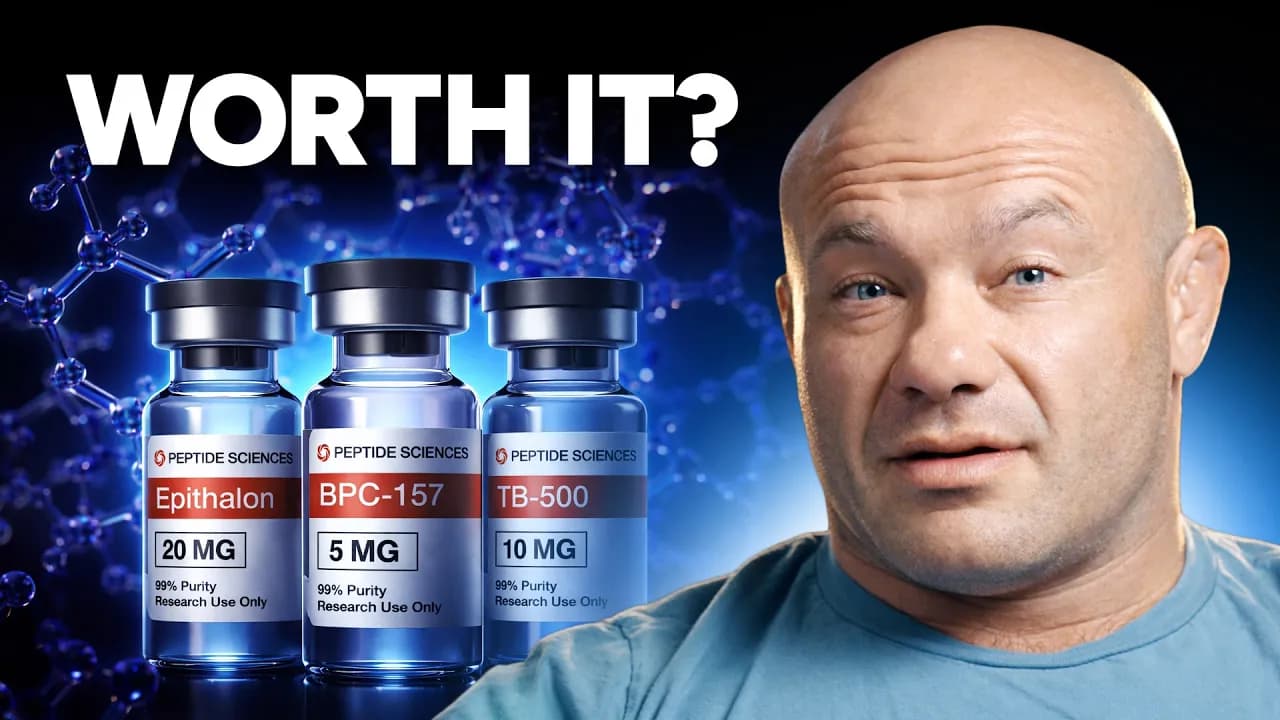
The New Peptide Craze: Is Any of This Safe?
In a Nutshell
RFK's plan could soon legalize 12 peptides for prescription use. Only two—MK-677 and Melanotan II—have strong human data, delivering large GH/IGF-1 boosts or tanning/libido effects, but both carry clear trade-offs such as ravenous hunger or nausea. The other ten show promise mainly in animal or cell studies, with small-to-moderate benefits and unknown long-term safety; none are game-changing for muscle growth.
These notes were generated by AI and may contain inaccuracies.
RFK just pushed through a plan for a panel of experts to formally vet 12 specific peptides to see if they can get put on a fast track to regulatory approval. Some of these peptides are very cool and are likely to have small to moderate beneficial effects in the real world for real people just like you. Many need way more human trials for even me to take them. And that's saying something cuz I take a lot of weird gray market stuff.
This means that potentially for these 12 peptides or at least some of them in the very near future, you'll be able to acquire them legally through a doctor's prescription. There won't be any gray markets or any of that weird stuff. Now, this is really, really cool. This is a great direction for government, in my opinion, to take the industry. But it does beg the question of these 12 peptides that RFK highlighted, how excited should we be about potentially using them more? Are these legit tools or some of these fluff or what's going on?
BPC-157 stands for body protection compound because it's been found in animal studies especially and in preclinical studies to be amazing for injury repair. It signals tissue repair in tendons, ligaments, muscles, guts, nerves and in vascular injury models in animals. It seems to have anti-inflammatory and cytoprotective effects and it does all kinds of other cool stuff as well. Unfortunately, there is not nearly enough high-level human trials evidence of BPC-157 for insight on the comprehensive downsides the medication could have. The usual ones of gray market product purity and dosing are an issue, but otherwise we just don't know as much. In animal trials the effects on healing are moderate to large. This is a legit thing for animals, but unfortunately, we just don't have nearly enough human data to confidently pronounce that BPC-157 works really well in humans and is safe in humans.
Next, we have thymosin beta 4 fragment LKKKTEETQ otherwise similar to TB-500. Now, this is very similar to BPC-157 in some of its effects. It's involved in cell migration. It's involved in wound healing and hypothetically, it could be another awesome tissue repair situation, tissue repair peptide like BPC-157. Now, unfortunately, the downside here is that the evidence is even thinner for TB-500 and its related molecules than for BPC-157. And there are some theoretical concerns. Angiogenesis, the formation of new blood vessels, could feed cancerous tumors if you already have them. There could be immune effects and all the way down the line. In animals, the effect sizes are moderate, not as powerful as BPC-157, but pretty damn good. Unfortunately, most of the best evidence is in animals and in cells for fragments of this compound, so we can't be too confident about it yet.
Next, we have Epithalon, or otherwise known as Epitalon. It's a synthetic tetrapeptide from good old friendly Russian and Soviet origins, which as a former Soviet Union person, I was born in Russia in 1984. By the way, I was born in a super soldier research lab, but because I turned out like this, I was promptly kicked out at age two. That's right, I was just walking around in Siberia for no reason. In longevity circles, this compound is popular because there's lots of claims about it that it enhances telomere length, that it enhances aging biomarkers, it helps with immune and endocrine effects, and so on down the line. And some of these may very well be legitimate upsides. However, there is not nearly enough evidence to robustly support these upsides, and especially very little evidence to talk about potential downsides. The evidence strength is that the effect here is small to moderate. Some of these benefits are true and can be ascertained, but the vast majority of how we know that is from cellular studies and animal studies with some older human studies that we just don't consider tier one anymore. So again, another question mark here.
Next up is the GHK-Cu injectable. It is a naturally occurring copper binding tripeptide, that means three amino acids in a row, discovered in human blood plasma. And it has mostly effects as a topical wound healing molecule, rather than something you inject into the system to optimize all around. It has some decent support for its ability to remodel skin. It has collagen supporting effects. It does wound healing. It seems to have some anti-inflammatory and antioxidant properties, as well as possible hair and hair follicle supporting effects. It does have some downsides. Topical irritation is possible if you're sensitive, and of course, because these are often gray market peptides, the usual safety concerns about purity are thing. The evidence strength is decent. It's small to moderate in effect size, but most of the evidence again is from cellular studies and human topical cosmetic studies. So, using this compound inside the human body is really just not something we know a lot about.
Next, number five, is MOTS-c. It is a mitochondrial derived peptide linked to metabolic regulation and stress adaptation. Most of the evidence on its benefits is preclinical, with human work mostly observational rather than therapeutic. Hypothetically, some of the benefits include improved insulin sensitivity and glucose handling. It can do some exercise mimetic-like signaling, which in essence means that taking MOTS-c can replicate some of the benefits of exercise. It seems to improve mitochondrial function and stress resistance effects, and it has possible benefits in obesity, aging, diabetes, and even in tissue injury models. Now, here are the downsides. We just have so little research on this chemical that we just don't know many of the downsides. And we even struggle to figure out what a good dosing protocol is for many humans. From my personal experience looking into this, somebody asked me once why I don't use MOTS-c, because it does seem to have potentially some muscle growth benefits, but you don't see those until you're shooting, roughly as I calculated, about a vial of it a week. It's like, that's a lot of peptide, and so that doesn't make a ton of sense for me at the current juncture. Now, moderate effect size and all the stuff that's been demonstrated, but again, the vast majority of the demonstrations are in animal studies and not in human studies.
Next up, we have DSIP, otherwise known as emiltide. This is a peptide that seems to induce delta wave sleep. It was discovered a long time ago in the 1970s during a lot of sleep regulation research. The evidence base here is older, pretty scattered, and this drug never matured into a clean modern therapeutic program. But, it might do some really cool stuff. It possibly enhances sleep architecture. It possibly has anti-pain, otherwise known as analgesic effects. It possibly has stress resilience effects and maybe even does some neuroendocrine modulation. Unfortunately, we just don't know a lot about this drug to be very confident on the downsides, but we do know that possible sedation can occur, which makes sense from a sleep drug. Paradoxical sleep disruption, which doesn't happen for most people, but can for some. Mood changes and of course endocrine effects. The effect sizes small to moderate, so for the people for whom it seems to work, it does a pretty good job, but again, most of the evidence is with animal studies and some older human studies. More confident than we could be with many of these peptides, but still nowhere near a guarantee.
Next is dihexa acetate. It is an angiotensin 4 analog developed for cognition enhancement and neuroregeneration research. It is extremely interesting preclinically, but has essentially no meaningful human clinical evidence. In animals and in cell cultures, it has demonstrated benefits in synaptogenesis, making more connections between the neurons of your brain, which is a big deal for learning and memory. It has cognitive rescue effects in animal impairment models where they give the animal a stroke, for example, and then see how much of that they can get back. This drug seems to enhance that. It seems to have neurodegenerative and neuroprotective effects, and is a strong potential future nootropic because it's almost entirely preclinical, but the preclinical data looks damn good. There are some concerns here. First of all, not nearly enough data for us to be confident on concerns. The theoretical concerns are around some of the biology of how this works. It does trigger cell growth pathways, and so it does have cancer relevance. I'm not saying that it causes cancer, but because it is a brain and neuro growth mediator, then if you have any kind of sort of precancerous formation in the brain, this could be a toxic combination. It does have completely uncertain effects on neuroplasticity. Does it enhance it? Does it decrease it? Who knows. Moderate to large effect sizes here, but the vast majority of the evidence is in animal and cell studies, and not human studies.
Next up is a compound we featured on here before, MK-677. It is a ghrelin mimetic, and it is a growth hormone secretagogue, so it helps your body naturally, and by naturally I mean absolutely not naturally, but by itself, secrete more growth hormone. So, when you take MK-677, it's not like you're taking something that converts into growth hormone, it's you're taking something that tells your body to make more growth hormone, and that it does. It causes large increases in IGF-1 and growth hormone. It causes increased fat-free mass, and it causes a radical increase in appetite, and has the same beneficial effects on sleep architecture as does growth hormone. So, what you get from MK-677 is basically this, the equivalent of a low to moderate dose growth hormone, but from a pill that costs like a thousand times less. But at the same time, what you get from MK-677 is a wild increase in appetite. And, I've never taken MK-677, of course. But, a gigantic jacked-up veiny bird flew by Scott and told me, "Squawk! The appetite effects on this are insane. Squawk!" And, I'm like, "Look, you can speak." And, the bird's like, "Squawk! Yes." And, I'm like, "Why do you keep squawking then?" And, it's like, "I'm a bird. Squawk!" I'm sorry. All right. Fine. But, let me tell you, from personal experience, if you're using this on a fat loss phase, you got another thing coming. If you're using this intelligently in a muscle gain program, you're going to have to eat clean and very satiating foods, cuz the hunger is radical. Because, it hits that same orexin pathway that is really central to the human hunger regulatory response. The evidence strength here is a very, very large effect for the secretion of growth hormone IGF-1. And, the evidence is from animal studies, but also plenty of human studies. So, MK-677 is probably really high up on the list of these peptides that's like really legit and really works, and we pretty well understand the downsides of. That's pretty refreshing.
Next up, number nine, is melanotan two. Cuz, melanotan one just wasn't good enough. What is melanotan? It's a synthetic melanocortin peptide originally explored for tanning and photoprotection and sexual function effects, Scott. Hypothetically, however, the main beneficial effects of melanotan two include increasing skin pigmentation. So, instead of burning your ass in the sun and tanning, like you could just take this compound and you tan more thoroughly than you'll ever tan in the sun. I'll tell you that right now. It absolutely, in many people, pretty impressively increases libido and sexual arousal, and it has erectile effects in some men. Not erectile dysfunction, but increased function. And in many users it also causes appetite suppression. If you've put it together yet, this is like seemingly a pretty interesting, a pretty cool contest prep or fat loss phase drug. During contest prep you typically are super hungry, you lose most of your sex drive, Mr. Boner doesn't come visit you nearly as often, or for you females, Mr. Mrs. Lady Boner. And at the same time you got to get tanned up. If you take Melanotan II and you're actually a responder and you avoid the downsides, it seems like you hit a whole shitload of birds with one stone. Those poor goddamn birds. It does have side effects though, and many many people have taken it so we know very well what the side effects are. Nausea, flushing, headache, yawning, interestingly enough. And it says appetite loss is a side effect, but I'm thinking that's a main effect if you take it for the fat loss phase. You do have a really awesome side effect. Scott, you ready for this one? Spontaneous erections and priapism, which means you got yourself a boner that won't go away. And after 4 hours the blood in there doesn't circulate anymore and your cells start dying. So you have to go to the hospital, ideally in a trench coat or a real baggy sweatshirt, and then show the nurse your boner. Uh make sure you tell her what's going on first before you do that though because I think just showing the boner to the nurse is still technically a crime, last my lawyer told me. One thing that it does do that's really trippy is it can darken your moles and your freckles, uh permanently. And sometimes, in some cases a very serious ones, very rare, it does cause kidney toxicity. It has a very large effect size and the evidence is in animal models and human models. So, we know a lot about Melanotan 2, and outside of the mole freckle situation, um yeah, you know, it's going to have really, really good effects, and the downsides are typically very well easily managed and not a big deal.
Next up, number 10 is KPV. KPV is a tiny tripeptide fragment, and it's studied mainly for its anti-inflammatory effects, its gut effects, skin effects, and even its antimicrobial effects. It might enhance reduced cytokine signaling. It possibly has benefits on irritable bowel disease, and it might even have some antimicrobial effects that are very much worth studying. Now, there's just not enough evidence on this peptide to form very good conclusions. Human safety and efficacy are very, very minimally characterized by the data. Delivery and stability of the compound are practical issues. The effect size on the claimed good things is moderate, but almost all of that research is in animal and cellular studies.
Second to last, we have a compound called Semax. It is a synthetic acetylcholine-derived peptide developed and used mainly in the country of Russia. This peptide has been studied for stroke, neuroprotection, cognition enhancement, stress reduction, and a lot of other really cool stuff that happens mostly in the brain. It has those benefits, seemingly. However, the long-term safety data are incredibly limited. The effect sizes for all the good stuff I just said for making you potentially a little bit sharper and making you potentially more cognitively flexible and potentially reducing your ability to accumulate stress and giving you more resilience, that's good stuff and that probably really happens, but most of the evidence is from animal studies. There are some human studies, but most of them were done in Russia a real long time ago. So, another very promising drug with a very big question mark next to it.
Lastly, is a drug called cathelicidin. Now, this drug is an endogenous human antimicrobial peptide and major innate immune molecule. So, it's already made inside humans exactly the way that you would introduce it exogenously. It is biologically very powerful, but it's therapeutically tricky because based on a few factors, it can really increase inflammation or decrease inflammation. It has been shown to have direct antimicrobial effects. It can support wound healing and it possibly neutralizes some endotoxin. It can be a real awesome thing for infections. That's just about all of the benefits that folks have found out for it. The effect sizes have been moderate to large, so this is a thing that really works, but again, most of the evidence is from cellular and animal studies.
Now, let's really quickly take a ranking. Drugs that have real human pharmacology evidence, but real trade-offs. But if you manage the trade-offs well, could be very effective include MK-677 and Melanotan II. Of all 12 drugs, these are the heavy hitters that are very, very likely to work. Now, here's a group of drugs with plausible beneficial effects, but just not enough research to show all the beneficial effects and especially downside in long-term human trials. BPC-157, cathelicidin, MOTS-c, KPV, and dihexa acetate. Lastly, is the category of interesting drugs, but the evidence base is so small that it's just difficult to say one thing or another about them. That includes epithalon, semax, and DSIP. It also includes TB-500, though some would argue the evidence base for that is a little bit stronger.
Some of these peptides are very cool and are likely to have small to moderate beneficial effects in the real world for real people just like you. But, unfortunately, none of them are truly revolutionary, and many need way more human trials for even me to take them. And that's saying something cuz I take a lot of weird gray market stuff. The biggest downside, in my view, and the biggest, maybe not downside, but reservation we should have, is that precisely none of these are heavy-hitter muscle growth-causing drugs. Yes, MK-677 can potentiate muscle growth if your androgens are right, you're sleeping well, you're training hard, and you're eating well. But it by itself is not this radical progenitor of muscle gains. Which sucks. Dang it. We're always looking for peptides that make you jacked, but we just don't have them yet. In my view, however, this kind of legal action as done by Mr. RFK is awesome because it fast-tracks decisions on legalization, and more choices for all of us are better than fewer choices in my view. Me, personally, I'm excited about this, but I'm much more looking forward to the drugs that Big Pharma has in its pipeline. True killers. Drugs that potentially grow radical amounts of muscle, cause radical amounts of fat loss, and everything in between. But, some of these peptides will no doubt be legalized soon, and you can bet we'll have the insight for you on this very channel about which ones work, which ones don't, and everything in between.
Keep Renaissance Periodization in your library
Save the videos and channels worth coming back to, and find them again in one place.