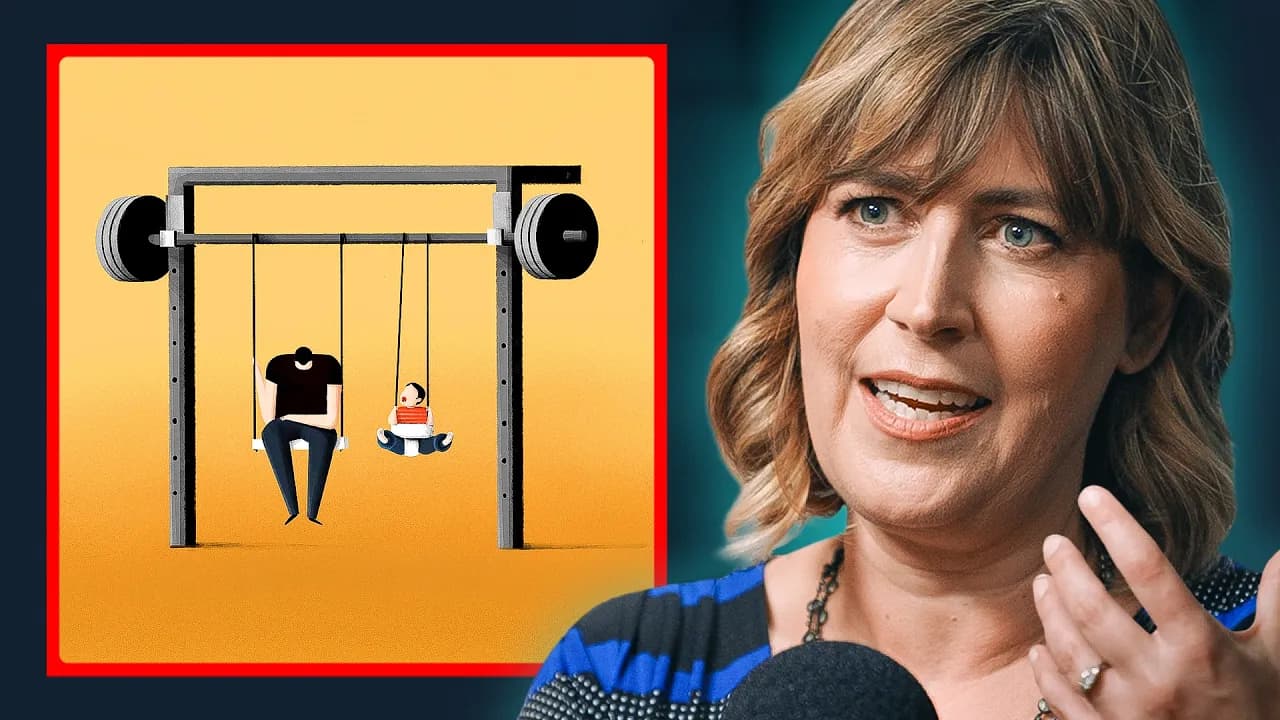
The Painful Psychological Cost Of Becoming A Dad - Darby Saxbe
In a Nutshell
Becoming a father triggers measurable brain changes—about 1% gray matter loss in the cortex—driven by hands-on caregiving, not just biology. These adaptations enhance empathy and mentalizing networks but come with trade-offs like reduced relationship satisfaction, higher depression risk, and hormonal shifts including lower testosterone. Modern nuclear-family isolation mismatches our evolutionary cooperative-breeding history, making social support, paid leave, and active paternal involvement critical for both parents' mental health.
These notes were generated by AI and may contain inaccuracies.
Most people are familiar with Mum Brain, but research shows that dad's brains go through a bunch of changes too. Men have been scanned midway through their partner's pregnancy and then again after they have their first child. The brain loses gray matter volume across the transition to fatherhood. The patterns look similar to those observed in moms, but they seem to be of smaller magnitude, more variable, and more tied to dad's parenting experience.
New moms lose about 2.5% of their gray matter volume across the transition into first time motherhood. They lose volume in parts of the brain that are really linked to hormones, including not just the cortex (the outer layer of brain tissue that does a lot of higher order thinking and reasoning) but also the subcortex which contains the amygdala, the ventral striatum which processes reward, and a number of other structures that are linked with drive and gut feelings.
Dads change mostly just in the cortex, which is the executive functioning thinking and reasoning part of the brain. Moms show profound changes across the whole brain. Dad's changes are smaller in magnitude at 1% of their gray matter volume. This change was totally tied to dad's parenting time and investment.
Dads who felt more bonded with their babies before birth were more motivated to take time off after birth. They spent more day-to-day time with kids in the first few months and reported feeling more bonded and having more pleasure in interacting with their kids. Those dads showed the biggest brain change.
There's been a dramatic change in fatherhood. By some estimates, dad's daily time in parenting has tripled or even quadrupled compared to the father knows best dads of the 50s and 60s. There was an inflection point around the pandemic where men who might have been commuting to an office suddenly had the experience of being hands-on parents. Millennial dads are spending more time with kids than any other generation of US dads, and there's evidence that Gen Z dads are spending even more time than millennial dads.
The Aka society in the Congo represents a model of hunter-gatherer fatherhood where men spend a lot of time within hands reach of infants and are very involved in infant care. The Aka have a very egalitarian flat social structure and there's a lot of cooperative resource gathering. Women contributed a ton of calories through joint cooperative net hunting, making strictly differentiated parenting roles economically non-adaptive.
In contrast, the Kipsigis society (a day's drive away from the Aka) has strict prohibitions against men picking babies up in the first year after birth. Men are never seen carrying a baby outside their own home and are not supposed to share a sleeping surface with babies because it's considered that the manliness of the father will disrupt the infant's rearing and that the infant will compromise the father's masculinity.
The Kipsigis practice slash and burn forest forestry, which is more risky and hazardous than the Aka's cooperative net hunting. This makes sense for dads to do most of the economic work while moms do most of the caretaking. Dads are very involved with older kids, teaching them how to hunt and provision, but they are not picking babies up.
There are parallels between modern society with more egalitarian access to work and more female breadwinners and the Aka model. Women have the opportunity to earn income, and most of human history was spent as hunter-gatherers or small family farmers where women were contributing to economic productivity. Agricultural society demands more specialization with more stability that allows accumulation and storage of wealth, requiring armies to guard wealth and resulting in less flexible and less egalitarian social structures where gender roles become more entrenched.
The first scan of the father's brain is done halfway through pregnancy. A study on mothers recruited from a fertility clinic found that the brain changed even during pregnancy, with about half of the women remaining non-mothers. Preconception scans would have been ideal but weren't feasible since couples were already pregnant when recruited.
A lot happens to fathers-to-be when their partners are pregnant. There are hormone changes, new emotional worries and concerns, couple relationship changes, and even sleep disruption that starts early before the baby's born. The hunch is that what reorganizes the brain more than anything else is parenting experience and the social demands it places on the brain, with most change likely happening after birth.
Research shows that how the relationship manages conflict impacts how painful the childbirth is. When couples fought in more negative ways during pregnancy, the birth was more medically complex and riskier, and both members of the couple appraised it as being more stressful. Emotional stress on a mother's body has downstream physiological impacts during childbirth, making it harder to release and relax when delivering an infant.
Birth is a very social process unique to humans. Most animals can deliver an infant solo, but humans have complicated pelvises and babies with gigantic social brains, making birth cumbersome and often requiring assistance. Through most of human history, the people helping with childbirth were almost always women: midwives, grandmothers, sisters, and community members. It was only in the 19th century that childbirth became medicalized with doctors in hospitals, and dads were kept out of the delivery room until the 60s and 70s when they started advocating to be present.
Having men in the delivery room has been really good for some couples and challenging for others. It's become controversial, with every sports season featuring a player who can't participate because he has to be present at his baby's birth. It's valuable for moms who benefit from having a partner there to provide support, especially since close intergenerational ties may not be normative anymore. Continuous social support is one of the best ways to have a positive birth experience. However, when dads are unprepared, terrified, and haven't figured out how to communicate effectively with moms, they can have a deleterious impact on the birth process.
Couvade syndrome, or male pregnancy, is a phenomenon by which males experience sympathetic pregnancy symptoms. It's controversial and more anecdotal than evidence-based. Studies have been done but results aren't fully trusted. In one sample of dads, no associations were found between hormones and dad's self-reported pregnancy symptoms. It's basically like a sympathetic pregnancy where men feel nausea, experience pregnancy patterns of weight gain, and sympathetic labor pains. A UK hospital study found that expectant dads reported a bunch of pregnancy-like symptoms during their partner's pregnancy. These pains are often stress-related, like gastrointestinal distress and difficulty sleeping.
Couples should learn how to communicate effectively and listen to each other during pregnancy. Women hear each other's birth stories, but men don't necessarily get the opportunity to hear about different kinds of birth experiences or watch media that portrays birth in realistic ways. Birth education that involves fathers can be really valuable to normalize what to expect, what the progress of labor is going to be like, and how to effectively provide support and be a calming influence.
If you think that having a baby is going to fix your relationship, don't do it. Studies show a reliable drop in relationship satisfaction around the birth of a baby. The challenges of adjusting to life with a new baby include going from good time pals to suddenly operating a small business with a very disappointed customer, with someone crying around the clock, disrupted sleep, and new worries about money and living arrangements.
Becoming a caregiver creates dad brain, not just becoming a father. It takes practice and repetition to build the brain just like learning an instrument or a new language. With moms, there's a high floor of investment primed and ready to go because it takes so much energy to incubate a pregnancy (thousands of calories). Moms have already devoted a lot of energetic resources to babies before they even arrive. The caregiving dial can be thought of as being turned up or down, with moms turned all the way up by the time the baby arrives.
With dads, the dial is set more in the middle and can be turned up or down depending on culture and local contextual demands. Dads come equipped with the biology that makes them ready to adapt to become sensitive caregivers, but whether or not they turn the dial is up to them. This concept is called facultative adaptation - an adaptation that comes online when needed.
Paternity uncertainty has a role to play in dad brain changes. You don't want to be locked in hormonally or neurologically to raising a child that you're not sure is yours. One of the really unique things about humans is that ovulation is concealed, so human males don't know for sure whether they've caused a pregnancy. This incentivizes human males to invest in courtship because you can't just have sex once and know you've made a baby - you have to show up repeatedly. This is adaptive to pair bonding, which is why humans have really high rates of pair bonding compared to other species. Dad's predilection to care can turn up or down depending on the stability of their relationship with the baby's mother.
The Westermarck effect explains how incest avoidance happens inside humans. There's a window between the ages of 1 and 10 where if you see primarily your mother but also your father giving care to another infant, you grow up with a sexual aversion to them. In some Asian cultures, future wives for baby sons were found as infants and they'd raise them together, locking in this biological imprinting of "that's my sister," which was highly maladaptive.
The father's level of brain adaptation is based on the behavior of how much time he spends raising the child and doing nurturing and caregiving. This means that you can go both ways. Mothers are the only ones that have a locked-in contract, a biological contract with the baby. Everybody else from brothers to sisters to aunts to uncles are all kind of just learning as they go. Humans evolved to be alloparents and are cooperative breeders, participating in collective care of offspring because human babies require so much intensive care that's too much for any one person to provide.
The behaviors that most create dad brain include picking your baby up, caring for them, sharing a sleeping surface with them, diapering them, feeding them, and bathing them. These are the kinds of intensive care that help you really get to know a baby and attune you more to their physiology and to their mind.
A lot of the change happens in men's brains in the mentalizing network, a part of the brain that activates when we think about other people's minds and their intentions. It's what reads other people's emotions and can be thought of as the seed of our empathy. This is a dynamic part of the brain in new dads because when caring for an infant who cannot communicate effectively (they can't talk, they just cry), you have to be able to read their emotions and problem solve to figure out what they need, getting a lot of exercise to that empathetic part of the brain.
Both mothers and fathers experience brain changes after having children, specifically a reduction in gray matter volume. This is understood as a form of pruning that makes the brain more efficient rather than a deficit. The hippocampus shows particular plasticity in new parents of both sexes.
Parents experience a trade-off in memory function. Short-term memory for objects unrelated to the baby becomes compromised, while memory for baby-related information is enhanced. This includes memory for the baby's smells and objects pertinent to infant care. The hippocampus, which processes memory and is also sensitive to smell, becomes more attuned to locating and caring for the infant.
This represents a different kind of memory workout rather than overall decline, with parents becoming more efficient at detecting what infants need and tracking items associated with baby care, while becoming less sharp about non-baby related matters like where the car was parked.
After having children, both mothers and fathers typically care less about work achievement in the short term. However, parents often make valuable contributions to organizations through the skills developed in caregiving. Priorities shift toward domains that serve the infant, with motivation to optimize certain areas over others.
Research from the UK Biobank shows that having more children correlates with better cognitive functioning in middle-aged and older adults. Machine learning algorithms analyzing brain scans found that parents with more children (up to around three) had brains that appeared younger than their chronological age. The proposed mechanism is social integration rather than pregnancy hormones or birth experience, as the effect appears in both mothers and fathers.
The brain changes associated with parenthood may extend beyond biological parents. Deep friendships, pet adoption, and other caregiving relationships could potentially create similar neural adaptations. People who adopt pets often practice many of the same skills used in parenting. The key factor appears to be caring for something vulnerable that elicits empathy.
One parent reported that a parenting class ultimately made him a better manager at work, suggesting that skills developed in parenting can transfer to professional contexts. Caregiving skills are applicable across domains including coaching, teaching, guidance counseling, and religious leadership.
A father's brain changes only occur with hands-on caregiving involvement. In contemporary societies where high levels of paternal involvement are expected, framing non-hands-on fathering as simply a personality preference may represent a missed opportunity. The context matters, as some cultures may have adaptive reasons for less direct paternal involvement based on local demands and specialized labor needs.
Comedian Bob Odenkirk expressed that having young children at home gave him a clear sense of purpose and eliminated existential questions about meaning. The daily tasks of fatherhood provided structure and understanding of his role, with the answer to "what am I doing here" being the practical responsibilities of getting children to school and engaging with them.
The sense of meaning and purpose that comes from fatherhood is crucial for psychological health, providing a feeling of coherence and reason for daily activities. Research indicates that approximately 76% of children in the US currently live with a father at home, representing a rebound from a low of 67% in 2005.
Fatherhood exists on a spectrum rather than a binary of absent versus present. Many non-residential fathers remain actively involved in caregiving. After divorce and the establishment of joint custody, previously hands-off fathers can become primary caregivers, demonstrating the transformative potential of increased involvement.
One father spent the first three years of his son's life in jail before reuniting and taking parenting classes. He now directs a Project Fatherhood program at Homeboy Industries, describing the bond with his son as the single factor that helped reroute his life.
While early infancy provides an optimal window for bonding, adoptive and stepparents can form profound connections with children even when meeting them later. The key factor is having a front row seat to a child's development during some critical period, with willingness to invest time and practice in building the connection. A stepfather who entered a child's life at age nine became a formative influence.
Testosterone levels decrease around the birth of a new baby in fathers, with this change linked directly to participation in caregiving rather than occurring automatically. This hormonal shift happens in animal models as well as humans, following the challenge hypothesis where testosterone drops after mating to support nurturing behaviors over competitive ones.
Lower testosterone in fathers correlates with increased investment in partner relationships, greater motivation to maintain stable pair bonds, and reduced aggression. Risk-taking behavior decreases, leading to health improvements including less risky driving, fewer fights, lower substance use, and more conscientious health checkups.
Testosterone levels respond to environmental cues, rising in competitive or status-seeking situations like athletic competition. The hormone is context-responsive, with men showing higher levels when weapons or competitive stimuli are present. This reactivity means testosterone supplementation during early fatherhood could potentially interfere with the natural biological adaptations that support nurturing behavior.
Rather than maintaining perpetually high testosterone as a marker of masculinity, positive masculinity involves adaptability and flexibility in responding to changing situations. Being a good father represents one of the most traditionally masculine roles, involving protecting, guiding, inspiring, and teaching the next generation.
Both mothers and fathers face societal pressure to "bounce back" to pre-parenting states, whether in terms of body, brain function, or hormone levels. This represents a denial of the transformative nature of parenthood. The definition of success matters: while meritocratic capitalist frameworks may view reduced focus on economic productivity as a loss, the enhanced attunement to children and development of caregiving skills represent different but equally valuable forms of success.
Research on whether the brain changes associated with parenthood recur with subsequent children is limited, with the literature being particularly scant on this topic.
One study from the Netherlands examined what happens to the brain when mothers have a second child. The brain shrinks again, but in different ways and different places compared to the first pregnancy. Maternal brain change appears to be U-shaped, where volume is lost initially and then regained in an adaptive process. The same pattern is expected for paternal brain change once more longitudinal data becomes available.
Second pregnancies show gray matter volume loss in areas tied to managing multiple inputs, task switching, and being cognitively oriented to variable demands. These changes appear to sharpen functioning for taking care of multiple children.
Mothers of twins or triplets experience double the dose of parenting experience and more parenting hormones. Both parents reach the upper limit of the 1-2.5% brain change range. Having multiples may accelerate mothers toward the second-time brain adaptations faster due to the immediate multitasking demands.
With multiples, fathers become more involved because additional help is needed. This effectively turns up the dial on fatherhood behavior.
Research from a longitudinal sample shows that when men have daughters, they experience a greater drop in testosterone across the transition to parenthood. They also spend less time caring for their babies and report more parenting stress and worse bonding. This suggests fathers expecting girls may need additional coaching and preparation to show up as effective parents.
Brain adaptation differences based on baby sex remain largely unknown due to insufficient studies. One study from Emory in Atlanta found that brains were more primed to happy facial expressions from girls and distressed expressions from boys, though the literature on sex-specific effects is minimal.
Testosterone reduction around having girls may relate to different interaction patterns. Fathers tend to engage in more proprioceptive touch with babies—picking them up, moving them around in space, active exploratory boundary-pushing play—which occurs more with baby boys. Baby girls may receive more cuddling and nurturing play.
Even before babies are born, parents describe anticipated traits differently based on sex: baby girls as delicate, vulnerable, sweet, and soft; baby boys as rambunctious, mischievous, tough, and strong. These expectations shape behavioral interactions.
Research with 3-4 year olds on playgrounds shows girls playing games involving keeping something alive while boys play games involving fighting in wars. However, experiments demonstrate that socialization begins early. A BBC experiment with 2-year-olds switched names and outfits, finding that adult volunteers played differently based on perceived sex—appraising play through gender expectations.
Outcomes reflect a mix of biology and culture, with biological propensities amplified through cultural socialization and self-fulfilling prophecies.
Research on dual-income couples in Los Angeles tracked time spent in household activities over a week. More time spent doing housework correlated with less cortisol recovery at the end of the day. Cortisol follows a circadian pattern where levels should drop from afternoon to evening, but evening housework reduced this natural decline.
When both partners' time use was analyzed together, mothers showed cortisol benefits when fathers did more housework, while fathers benefited from having more leisure time even when partners had less.
Stress contagion occurs when couples influence each other's hormone levels, with linked cortisol patterns found in cohabitating couples. Higher cortisol in one partner correlates with higher than usual cortisol in the other. More relationship conflict produces more tightly linked cortisol patterns, where partners increase each other's stress rather than helping modulate it.
Improving communication and fighting more effectively allows partners to calm each other down rather than amplify stress, leading to better biological recovery.
Fatherhood involves weight gain, testosterone changes, and increased vulnerability to mood disorders. Depression prevalence in new fathers is approximately twice that of the general population. Risk factors for depression are shared between new mothers and fathers: stress, disrupted sleep, relationship conflict, new responsibilities, identity crisis, hormone changes, and brain changes.
Perinatal depression serves as a better term than postpartum depression because it means around the birth of a baby rather than specifically after giving birth. The term postpartum simply means the time period following the birth of a baby and is gender neutral.
Some women feel that postpartum depression recognition required significant advocacy work, and they resist what they see as men claiming space in this area. However, mental health exists within a family system where the best predictor of mother's mental health is partner support. Untreated paternal mental health affects maternal mental health and child outcomes.
Approximately 10% of new dads experience depressive symptoms during the perinatal period and first year. Men are not routinely screened for perinatal depression, leading to many undiagnosed cases. The rate of postnatal depression in mothers ranges from 19-21%, which tracks with women's overall higher base rate of anxiety and depression in the general population.
Postpartum depression in fathers appears mediated by the amount of caregiving they perform. The more involved fathers become in direct infant care, the higher their likelihood of experiencing depressive symptoms, though most people experience baby blues that do not progress to debilitating depression.
Postpartum depression in women likely represents an evolutionary cultural mismatch rather than having an adaptive explanation. Humans evolved as cooperative breeders with extensive community support for caregiving, trading off care with kin and community members. Contemporary society places excessive pressure on individual parents and the nuclear family to fulfill roles previously handled by dozens of people with greater proximity and mutual assistance.
Modern society isolates new parents, fails to value their work, and operates under late capitalist incentives that prioritize ambitious drivers returning quickly from birth interruptions. The United States lacks universal paid maternity or paternity leave, forcing many women and men to return to work before feeling ready, creating inadequate time and protection that leaves parents isolated and drained.
No evidence exists of postpartum depression in hunter-gatherer societies, though tracking and measurement may be limited. Depression in general appears less observed in these populations. In hunter-gatherer societies, becoming a mother increases social integration into community life, whereas contemporary mothers often experience greater isolation.
Contemporary society creates barriers through public spaces that exclude babies from weddings, restaurants, and cafes. Hunter-gatherer mothers can remain economically functional while wearing babies, maintaining high-status social roles and full community integration. Modern socioeconomic rewards for women are not baby-accommodating, creating a sharp divide between work and home that stems from the industrial revolution. Previously, work occurred at home with both parents present and children contributing to family businesses as workers.
New fathers should give themselves grace and not expect the transition to be easy. Forewarned is forearmed - parenthood is meant to be transformative. Reject the myth that dads lack innate wiring for infant care or that mothers are born knowing what to do. Both parents must learn through motivation and practice rather than inborn reflexes. Dads possess the capacity to develop empathetic, responsive caregiving brains.
Depressive symptoms correlate between mothers and fathers - if one partner experiences depression, the other is more likely to as well. When one partner remains well and supportive, this serves as a significant resilience factor and buffer. Research shows that greater paternal involvement benefits mothers.
A Swedish study examining a paternity leave reform program found that babies born after policy implementation showed lower rates of anti-anxiety medication prescriptions among new mothers. When dads have greater access to leave, mothers demonstrate population-level mental health benefits. Research from the speaker's lab found that when fathers access paid paternity leave, mothers show reduced likelihood of postpartum depression.
Social integration appears to be a key driver for postpartum depression in both fathers and mothers. The evolutionary mismatch hypothesis suggests humans evolved to be embedded in social networks for child-rearing rather than managing alone. Interventions should focus on increasing socialization through mommy-daddy daycare meetups and similar activities.
Postpartum depression involves feeling overwhelmed compounded by sleep loss, identity challenges, relationship strain, financial and life worries, and disrupted brain chemistry and hormones.
Socioeconomic status predicts postpartum depression risk. Wealthier individuals typically have childcare assistance, reducing pressure and improving sleep. Some American mothers return to work less than two weeks after giving birth, particularly shift workers, gig workers, and retail employees who lack recovery and bonding time. This creates significant stress during the adjustment to parenthood.
Community resources and ability to afford support and childcare also factor into outcomes. Best interventions focus on strengthening social support networks through proactive help-seeking and relationship investment.
The speaker's lab conducts psychoeducation workshops with hospital systems serving low-income new parents, teaching participants to create social support maps before birth. Participants identify who can provide help in different domains after the baby arrives - for example, an older brother might assist with lawn care rather than baby care. The intervention coaches assertiveness in asking for help, countering societal conditioning toward agency and individualism.
Historical precedent exists in Renaissance England through the "lying in" period, where mothers remained in bed for two weeks post-childbirth, waited on hand and foot by family members while holding and feeding the baby.
Potential paternal guilt represents a common experience among expectant fathers who feel terrified about not knowing what to do or being good parents. This anxiety appears less common with second children. Men are socialized to be highly competent, making it difficult to accept that infant care requires learning through individual baby interaction rather than abstract optimization.
The domain of parenting lacks the same sense of skill and power that many men experience in professional contexts. Self-optimization and productivity culture often emphasize solitary activities and individual achievement rather than connection, giving to others, or caring for vulnerable people.
The worst advice suggests fixing relationship problems by having a baby. Another harmful message tells dads they don't know what they're doing and should keep their distance, or that dads are useless in early months. These preconceptions affect decisions about investing in paternity leave. Dads are capable of learning, with neurobiology adapting as they develop caregiving skills.
Society sometimes privileges early infancy as the only period for paternal contribution, but valuable roles exist across different developmental stages. Richard Reeves suggests paternity leave should extend until children reach ages 14-18, noting that fathers may play particularly important roles with daughters during puberty. Men can add value at various lifespan stages, and opting them out of parenting roles loses opportunities to build competence.
"It's manly to take care of vulnerable people."
Keep Chris Williamson in your library
Save the videos and channels worth coming back to, and find them again in one place.