These 3 Decisions Control Your Entire Life
In a Nutshell
The speaker learned that three unconscious decisions—focus, meaning, and action—control every moment of life, and by shifting focus from shame to gratitude during his childhood Thanksgiving delivery, he transformed a painful memory into a mission that fed 42 million people over 37 years and scaled to 92 billion meals through partnerships. The key insight is that scaling impact comes from treating goals as immediate "musts" with short deadlines rather than distant preferences, and that 80% of success depends on mindset and finding compelling reasons rather than strategy alone. Lives diverge based on whether people assign empowering or disempowering meanings to identical circumstances, and the secret to fulfillment is giving and finding purpose through service.
These notes were generated by AI and may contain inaccuracies.
At age 11, the speaker experienced a pivotal moment during Thanksgiving when his family had no food or money. A tall man arrived at the door with two bags of groceries and a frozen turkey. The speaker's father initially refused the delivery, stating they don't accept charity. The delivery man persisted, stating someone wanted their family to have a great Thanksgiving. The father attempted to slam the door twice, but the delivery man leaned in, preventing the door from closing. The delivery man then stated, "Don't let your family suffer because of your ego," which caused visible anger in the father, who ultimately accepted the groceries with shame and slammed the door without saying thank you.
The speaker was confused about why his father wasn't happy or excited about receiving the food. This moment led to understanding that all people are controlled by three decisions.
Decision 1: Focus - Whatever you focus on determines how you feel. What's wrong is always available, and what's right is always available. Focusing on something causes the brain to make the second decision.
Decision 2: Meaning - Once focus is established, the brain determines what the situation means. Different meanings produce different emotional responses. For example, interpreting someone's actions as disrespect versus love creates entirely different emotional reactions.
Decision 3: Action - After establishing meaning and emotion, the brain decides what action to take. The speaker identified that the meaning he assigned to the grocery delivery - that strangers care - changed his life trajectory.
At age 17, the speaker went to a grocery store and filled two baskets with food after saving money. He contacted a local church to identify families needing help but too proud to ask. He wrote a note stating it was a gift from a friend, hoping recipients would have a great Thanksgiving, and encouraging them to help another family if they became successful enough.
When delivering to a Hispanic woman's home, she reacted with "OH, GOD" and began kissing his face, interpreting the delivery as a "Gift of God." Three of her four boys excitedly grabbed his legs upon seeing the food. The speaker had to leave while the mother cried with a giant smile, and the children smiled on the porch. This experience caused him to break down crying in his van.
The speaker realized his "worst day was my best day" - referring to the original Thanksgiving delivery experience. The following year, he fed four families, then eight families. Over 37 years, he fed 42 million people. After 2008, he decided to scale his philanthropy, setting goals to feed 50 million people in one year, then 100 million people in one year, then 100 million people for 10 years totaling a billion meals.
The key insight was that a 10-year goal meant nothing without immediate action. He committed to feeding 100 million meals in the current year rather than spreading it over time. This created urgency that generated new ideas and strategies.
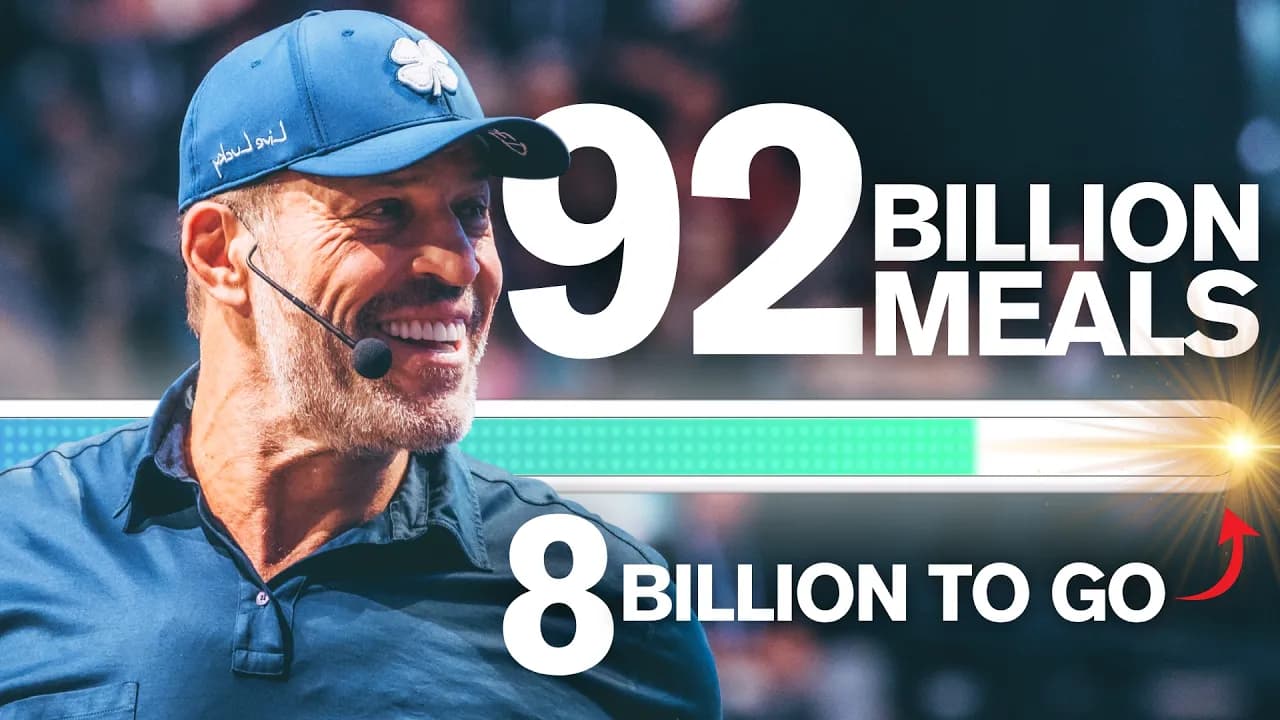
Working with Feeding America as a partner, the goal was achieved in 8 years instead of the projected timeline. The partnership announced feeding 30 billion meals, reaching 92 billion meals total in 3.5 years - a goal originally thought to require 20 years.
The speaker emphasizes that lives are controlled by decisions, not conditions. Two people can experience the same horrific event but have completely different experiences based on their decisions about focus, meaning, and action. These three decisions occur unconsciously every moment.
The modern challenge is information overload - drowning in information while starving for wisdom. The attention economy attempts to control focus through clickbait. Taking control of attention, deciding personal meaning rather than accepting external definitions, and determining actions are essential leadership qualities.
Most people try to avoid making wrong decisions or achieve perfect decisions, but making no decision is the decision to avoid. The three billion meals achievement resulted from coalition-building rather than individual effort.
Three important days exist in life: when you receive a calling (spiritually finding relationship with God), when you find your reason for existence, and when you take action. Purpose involves taking people places they wouldn't naturally go themselves and helping them achieve results they couldn't imagine while experiencing purpose they've never felt before.
The speaker wants people to find their purpose, stating that if they don't find purpose, they should leave organizations he's leading.
Purpose isn't singular - people can have multiple purposes across different life contexts. With five children, purpose differs when with kids versus grandkids versus running companies. Life isn't limited to one purpose, though finding something that drives everything underneath is valuable.
The speaker rejects motivation in favor of identifying what drives long-term behavior. Finding this requires exposure to different environments - both better and more challenging situations.
The hardest experience isn't dramatic hardship but doing the same day-to-day activities repeatedly while feeling unfulfilled.
Scaling success is 80% mindset and 20% strategy. Most people know strategies but fail to implement them due to psychological barriers. Humanity is driven by desire - finding a compelling, unreasonable but achievable goal inspires both the individual and others to participate.
Strong reasons are necessary to persist through difficulties. Goals must become "musts" rather than preferences. Deadlines must be short to create urgency - the 100 million meals per year commitment forced immediate new planning rather than gradual progress.
Human capital belongs on balance sheets - the right people fundamentally change business outcomes. The principle is to ask "who can do it" rather than "how to do it." AI can accelerate all processes and solutions.
Every 10 seconds, a child dies of hunger. If hunger were a country, it would be the third largest country globally. Sufficient resources exist to solve hunger - it requires different decisions focused on service. The secret to living is giving, and being a blessing results in being blessed.
Keep Tony Robbins in your library
Save the videos and channels worth coming back to, and find them again in one place.