This season's reports on the Iran war | 60 Minutes Full Episodes
In a Nutshell
**TLDR:** US and Israeli strikes have killed Iran's Supreme Leader, destroyed much of its military and nuclear infrastructure, and triggered a shipping crisis in the Strait of Hormuz that has spiked global oil and gas prices. Exiled opposition leader Reza Pahlavi claims the regime is collapsing and positions himself as a transitional figure for democracy, while Defense Secretary Hegseth confirms US objectives center on unconditional Iranian surrender and elimination of its nuclear program. The conflict has exposed critical US vulnerabilities to cheap Iranian drones and created a new insider trading scandal involving prediction markets betting on classified military outcomes.
These notes were generated by AI and may contain inaccuracies.
The United States and Israel conducted a second day of strikes on targets across Iran. Iran's supreme leader has been killed. Tehran has retaliated with missile attacks on Israel, neighboring countries, and US military bases in the region. At least three American service members have been killed.
Scott Pelley is in Paris following events, including what could be next for Iran. The most prominent member of the Iranian opposition believes the Iranian regime is collapsing and would like to lead a transition that makes Iran safe for the world. 65-year-old Reza Pahlavi is the son of the former king or Shah of Iran who was deposed in 1979 by revolutionaries and hardline Islamic clerics.
In that year of revolution, Pahlavi was 18 years old and living in Lubbock, Texas, where the US Air Force was training him to be a fighter pilot. He was never able to go home. He has lived in exile 47 years, mostly in the United States.
Reza Pahlavi was asked if he wants to be king, what Iran's policy should be toward Israel and nuclear weapons. The interview started with the news that the supreme leader of Iran, Ayatollah Khamenei, had been killed in the opening hours of the war.
"It is definitely a sort of earthshattering event in the sense that when people identify the entire monstrosity of a regime that is depicted ultimately by the chief monster of these monsters when he's gone one the minute such a personality disappears it's like elation it was like oh my god it has finally occurred maybe this is it this is our chance now."
Pahlavi called the Ayatollah a monster, stating: "Ever since this regime has taken over, how many Iranians lives have been lost, I don't think you can have an example of such level of atrocity ever in the history of Iran or at least contemporary Iran that has occurred under this regime. And this is all because of Ali Khamenei's insistence and persistence to keep himself and his mafia regime in power at the expense of the Iranian people. I don't know how else can you depict it other than being true monsters in the real sense of the word."
This past January, Iranians poured into the streets. Pahlavi urged them on and hundreds of thousands marched. The regime gunned down an estimated 20,000 citizens. The massacre was a prelude to war.
Video showed scenes overnight after the announcement of the death of the Ayatollah in the city of Isfahan. Pahlavi stated this means Iranians are finally ready to go back to the streets, though he cautioned them to take care of their own safety and stay at home for now.
"The time will come to go back on the streets. But then again you see that despite that people still are brave enough to say to hell with it because to us it's liberation. To us it's like a humanitarian intervention to protect lives that could otherwise be continued to be lost."
Pahlavi emphasized that the regime was always bound to collapse and that Iranians were prepared to fight regardless of outside intervention. He noted Iranians are thanking President Trump for standing on his word and acting upon it.
Pahlavi believes the regime could fall after almost 50 years. He wants to lead Iran in a transition to democracy but clarified: "I'm not running for office. They trust me as the transitional leader, not as the future king or future president or future whatever. I'm totally focused on my mission in life, which is let me bring the country to a point that they can make that free choice. That will be enough for me having submission accomplished."
Pahlavi envisions peace with Israel, noting that in modern history, Iran gave refuge to Jews escaping the Nazis during the Second World War. He stated the strategic importance of having a partnership with Israel is critical.
The four core principles for a new Iran are:
- Iran's territorial integrity
- Clear separation of religion from state, a prerequisite to democracy
- Equality of all citizens under the law and individual liberties
- Democratic process allowing people to elect and decide their future system of governance
Pahlavi stated the nuclear weapons program should be totally dismantled: "I don't think Iran has any need to pursue a military weaponizing of the nuclear program."
Pahlavi's father was the last king, Muhammad Reza Pahlavi, who was close to the United States but brutally suppressed opposition and showered friends with lavish wealth. In 1979, he left Iran amid rising political tension and a hardline cleric, Ayatollah Khomeini, returned from exile to lead a revolution.
Iranians blamed the US for supporting the king and revolutionaries overran the US embassy in Tehran and held 52 Americans hostage for 444 days.
When asked why people would welcome him given his father's reign of repression and opulent wealth, Pahlavi stated that people living in that era recognize where they were and where they are now, and want to support him. He acknowledged people were killed in his father's regime but noted his father left Iran voluntarily to avoid bloodshed.
"My father left Iran voluntarily to avoid bloodshed. And he said, 'I'm a king. A king doesn't build his throne on the blood of his own people. If the nation today wants me out, I would leave. I will not turn my guns on them.'"
Pahlavi argued that if being out of the country for nearly 50 years was an issue, people would not be calling his name by the millions on the streets of Iran. He stated people trust him because they cannot associate him with the revolution or the current regime.
Pahlavi stated that from the day he left, he never left Iran: "Iran had been on my mind every single year of my life. Every single when I wake up in the morning, the first thing that is my mind is Iran."
Pahlavi is in touch with the Trump administration and members of Congress. His message to President Trump is to thank him for intervening and that Trump will go down in the annals of Iranian history as the most celebrated foreign leader that changed the ball game.
In January, President Trump said about Pahlavi: "He seems very nice, but I don't know how he'd play within his own country. I don't know whether or not his country would accept his leadership, and certainly if they would, that would be fine with me."
Pahlavi responded that someone in his position would not expect an official endorsement from a foreign government, but millions of Iranians are calling his name and recognize him as uniquely placed to play a role of transitional leadership.
Unrest has been building for months. Last June, US and Israeli forces attacked Iran's nuclear facilities. In 2022, one of the largest uprisings erupted when Iran's morality police arrested a 22-year-old woman, accusing her of failing to cover her hair. She was killed in custody, and crowds demanded an end to the regime. Security forces killed more than 500, arrested 22,000, and blacked out the internet.
Pahlavi described the courage on the streets as the ultimate definition of heroism, comparing it to the lone Chinese student in Tiananmen Square standing in front of that tank. He referenced a viral video of a firefighter carrying a wounded person shot on the streets who was then shot to death.
Pahlavi stated there are units in the military and police who have signaled they would turn on the hardline government. He says many but not all troops could be given amnesty in a process of national reconciliation, presenting them with a choice to join the people or stand with the sinking ship.
Pahlavi's message to the Iranian people: "Have faith in yourselves. You are a nation with an ancient civilization. I know how proud you are of your heritage, how important Iran is to all of them. And I always said to them, 'You know what? I know you're always hoping for a better future. What I would like you to start doing and I have started to answer my call is instead of hoping, start believing that it can be done.'"
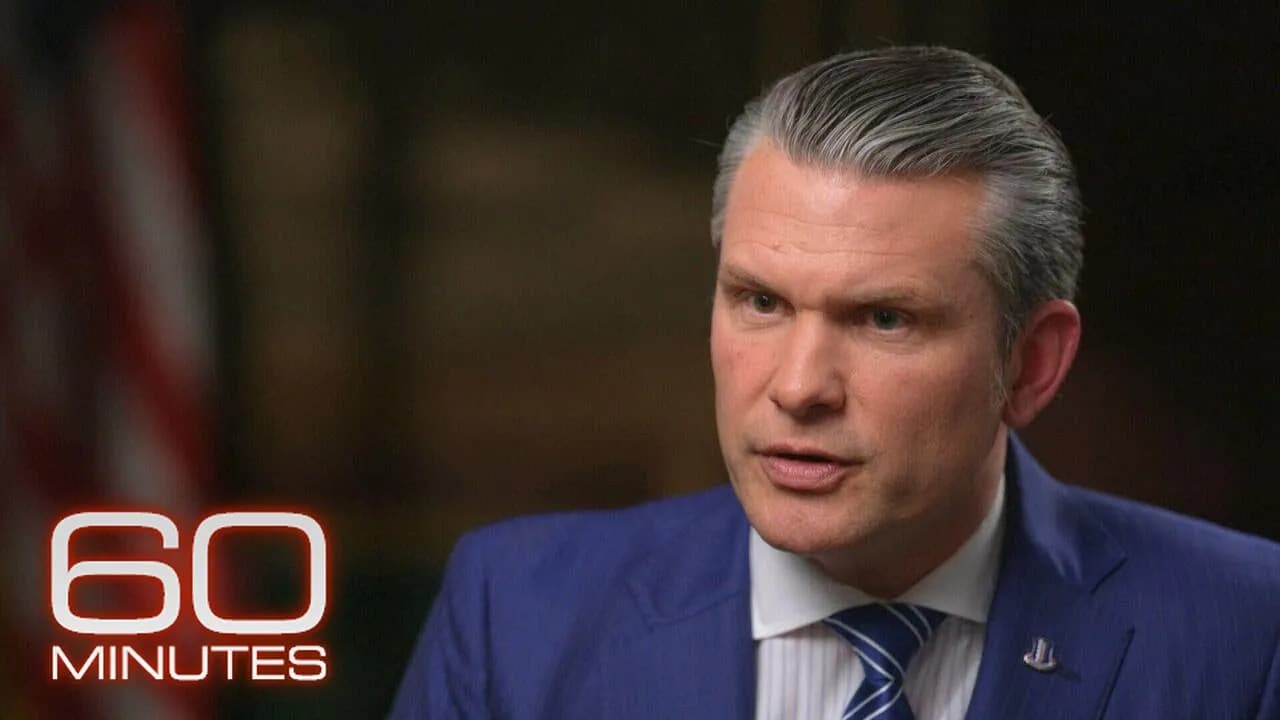
With US and Israeli strikes on Iran in their second week, Defense Secretary Pete Hegseth was interviewed. According to the Pentagon, more than 50,000 members of the US military are involved in Operation Epic Fury.
The US military had already struck 3,000 targets inside Iran when interviewed on Friday. Hegseth stated they are on track and on plan, noting this is not a fair fight and US capabilities are overwhelming compared to Iran's.
Hegseth stated they have not flown a mission accomplished banner. When combined with the Israeli Defense Forces, the US and Israel have the two most powerful air forces in the world. The president said there will be no deal with Iran except unconditional surrender.
"It means we're fighting to win. It means we set the terms. We'll know when they're not capable of fighting. There'll be a point where they'll have no choice but to do that. Whether they know it or not, they will be combat ineffective. They will surrender."
Hegseth noted there are different ways surrender could occur and that President Trump will set the terms. He referenced the long Iran-Iraq war where Iran never surrendered but stated this approach is different from previous conflicts.
Some supporters have criticized President Trump, suggesting Israeli Prime Minister Benjamin Netanyahu pulled the US into a war that did not put American interests first. Hegseth stated President Trump puts America, Americans, and American interests first.
Regarding reports that Israeli intelligence on February 23rd provided key information about the likely whereabouts of Ali Khamenei and his inner circle, Hegseth confirmed intelligence was gathered and checked by US intel agencies, and that operations can be trigger-based or condition-based.
Hegseth stated Iranians have been killing Americans for 47-48 years with unabated nuclear ambitions. International monitors estimate Iran still has more than 970 pounds of nearly bomb-grade uranium despite claims the nuclear infrastructure was obliterated.
Hegseth would not specify options for dealing with remaining uranium, stating they would make sure Iran's nuclear ambitions are never achieved and would not tell the enemy, press, or anyone their limits on an operation.
Hegseth confirmed there are no boots on the ground currently but reserves the right to take any option. CBS News sources report Russia is providing intelligence to Iran on US positions and movements. Hegseth stated they are tracking everything, have the best intelligence in the world, and President Trump has a knack for mitigating those risks.
Six US Army reservists were killed in an Iranian drone attack in Kuwait last Sunday. One more service member's death was announced. Hegseth stated there will be casualties and this fight will be finished.
More than 1,600 Iranians have been killed according to Human Rights Activists in Iran, including 168 people, mostly children, at a school in the southern part of the country. Hegseth stated they are investigating whether the US was involved in any military strike at that school, emphasizing they never target civilians.
Iran announced a son of its slain leader would replace him. President Trump said any leader picked without his approval is not going to last long. Hegseth clarified this is not a regime change war in the conventional George W. Bush context of hundreds of thousands of troops, and they are not remaking Iranian society from an American perspective.
Hegseth stated the best way to protect people who might rise to leadership is through current American and Israeli efforts, which present a generational opportunity for the people of Iran.
Iran launched missiles and drones at nearly a dozen Middle Eastern countries including Qatar, Bahrain, and Saudi Arabia. Allies in the region are running very low on interceptors. Hegseth stated the US is very prepared to help restock, noting Iran's missile projection is down 90% from its height.
Since the war began, oil shipments through the Strait of Hormuz, through which 20% of the world's oil flows, have stalled. US gas prices are up an average of almost 50 cents a gallon. The Iranian Navy is largely no more, and their ability to project power in the area in a naval sense is diminishing.
US military officials say 6,000 Iranian military targets have been struck, including ballistic missile sites and air defense systems, and Iran's navy has been rendered combat ineffective. Iran maintains its stranglehold over the Strait of Hormuz, a 21-mile wide waterway connecting oil-rich countries to the rest of the world. Normally 130 commercial ships pass through it every day, but on February 28th, when Israeli and American jets began dropping bombs, those ships ground to a halt.
An estimated 20,000 crew members are stranded and under attack in the Strait of Hormuz.
This was the scene this past Wednesday in the Strait. A Thai cargo ship was struck by a projectile from Iran, setting the ship on fire and trapping members of the crew. It is one of the few ships that has attempted to cross since the start of the war. Most others have been at a standstill in the waters surrounding the strait with the constant sound of drones and scenes like this all around.
At what point did you look at the situation out there and say it's too dangerous. These ships should not sail through this strait. That was very early and very quickly. Iran already said that they would attack any vessel that is passing through the Strait of Hormuz. This was the moment when we called off.
From her operation center in Hamburg, Germany, Captain Zilka Lemuster oversees a 300 vessel fleet for the German shipping giant Hapag-Lloyd. Hundreds if not thousands of ships are sitting hovering outside the Strait of Hormuz right now. Yes. And they're all waiting basically to go inside to go around the corner. It's at a complete standstill. This is a standstill.
Six of her cargo ships carrying furniture, electronics, clothing, anything you might have in your home were headed toward the strait as the war broke out. This is the message they heard from Iran's Revolutionary Guard: Attention all ships. Attention all ships. Broadcast over their ship radios. From now on, all navigating through the Strait of Hormuz is forbidden.
So, you heard this message from Iran and took that seriously? Yes. Captain Lemuster ordered her crew not to proceed. Today, 150 men sit trapped as the war rages around them.
What were they seeing out there? Drones flying by. Of course, they also saw explosions close to the port. A lot of smoke. They saw explosions close to the port. Yes. That must have been terrifying for them. It was.
They are not alone. Roughly 700 ships are currently sitting in the Persian Gulf, including 400 oil tankers holding 200 million barrels of oil. That's enough to fuel Japan for 2 months.
This is Captain Lemuster's view of the war. Now day and night, she and her team keep watch. Those orange dots are their ships. The men on board have been ordered to stay below deck as much as possible. How often are you able to have communications with the crews out there? Sometimes the communication is difficult because the satellite phone is interfered as well. But we are in constant communication with our crew.
Her biggest fear is what has happened to many other ships like these two oil tankers off the coast of Iraq struck by Iranian explosives and set ablaze in the Persian Gulf. One was American-owned. Crews had to be rescued by boat. The next day, scorched vessels were seen drifting in the water.
Since the war started, there have been 16 confirmed attacks on ships in and around the Persian Gulf. Iran has claimed responsibility for several of them. At least eight crew members have been killed.
Matt Smith monitors ship activity in the strait as an oil market analyst for Kepler, which tracks global trade and shipping. He made this time lapse showing how quickly ship traffic moved around the bend of the strait in the days before the war. So on a normal day, you see about 100 or so ships that passed through there. When the bombing started with Iran, we saw it drop to about 70. On the Sunday, we saw it drop into the teens. And then since then it's just one or two tankers that are passing through there every day.
All those red and green arrows represent oil tankers that haven't moved for the past 2 weeks. Fair to say this is a very expensive parking lot. It is a very, very expensive parking lot. That's right.
The few ships that have moved are mostly from one country, Iran. And you can see that Hilda is loaded with Iranian crude. Hilda is an Iranian vessel. Yes, an Iranian tanker with Iranian crude, 2 million barrels, and with all of that Iranian stuff, it is typically heading to China. That oil is going to China. Yeah.
This past week, Smith and his team made a surprising discovery that Iran has exported daily 100,000 more barrels of oil than it did before the war. Most of it going to China. Smith says nine Iranian oil tankers have traveled through the Strait of Hormuz by turning off transponders that reveal locations.
Thursday on Iran state TV the first public statement from the country's new supreme leader was read saying the leverage of blocking the Strait of Hormuz must continue. Choke point a fair description. Choke point understates it. This is the mother of all choke points. Imagine your heart has one artery taking that lifeblood to the rest of your body and that is what the Strait of Hormuz is.
Bob McNair was an energy adviser to President George W. Bush during the Iraq war who now advises clients on oil and gas markets. Last year he made a prediction. You saw this coming. Absolutely. My team and I wrote a big report and we're not surprised that if unmolested Iran would be able to make Hormuz unsafe for that lifeblood to flow. We're not surprised at all.
Would you have advised President Bush to go through with these strikes? Yes, I believe that what President Trump is doing in terms of defanging the Iranian regime is principled, courageous, and correct. Totally support the goal. If I were advising him on how to achieve the goal, I would emphasize the need to manage the oil and gas market implications. And that means making sure from day one we are attacking Iran's ability to do what it has done for some 12 days now and may apparently do for an entire month.
Did they do that? I don't know. Do you have concerns based on what you've seen so far? Yes.
In the United States, gas prices have increased by more than 65 cents per gallon since the war began. The fastest weekly spike in 20 years. The all-time high for the most consumers have ever paid for gasoline was in the summer of 2022 after Russia invaded Ukraine. It was a $5 per gallon average. If we don't open up Hormuz soon, I can see us making new records. We could be looking at the highest gas prices ever paid in this country if we don't open Hormuz to the free flow of traffic. Yes.
It's not just gas prices. The cost of jet and diesel fuel has risen 25% and as a result, higher plane tickets and grocery prices are expected to follow. The gasoline we pay for at the pump, the price of that gasoline is set in a global oil market. A supply disruption anywhere leads to a price spike for consumers everywhere, including here.
We're seeing this trickle down effect. We are. So when that mom in Des Moines goes to the store to buy food for her family, that food was grown with and transported by oil. And as those producers and growers of food react to and absorb these price increases, they'll be passed along to the consumer, to that mom in the store. So what's happening at the Strait of Hormuz today affects the entire supply chain? It does.
The Straits are in great shape. We've knocked out all of their boats. They have some missiles, but not very many. I think we're in very good shape. We're in very good shape. Despite President Trump's assurances this past Wednesday, the reality is most ships remain too wary to cross.
In recent days, US Central Command took out 30 so-called mine layers, boats believed to be used by Iran to deploy mines in the shipping lanes of the strait. The president said the US would help cover the cost of risk insurance as a way to reassure nervous ship owners and suggested the US Navy could offer escorts for protection. Though it is unclear when that will happen as the Navy is currently busy fighting the war.
Captain Lemuster is still not letting her ships move through the strait. Would more insurance help? You cannot insure the life of a seafarer. So more insurance would not necessarily help. We rather have the escorts. Has a US Navy escort been offered? No.
To move more oil onto the global market, this past week the Trump administration announced it will temporarily lift sanctions on Russian oil that had been meant to punish Moscow after its invasion of Ukraine. 32 countries, including the US, also plan to release 400 million barrels of oil from the strategic reserves, the world's emergency supply. A process expected to take at least three months.
I've worked in the White House during an energy crisis. There are no policy solutions to a prolonged closure of the Strait of Hormuz. You're saying there's not much a White House, a president can do to stop this bleeding. You open up the toolkit and the tools in there, the options range from marginal through symbolic to deeply unwise. Escorts are a sideshow. Strategic stock releases are a sideshow. Gas tax holiday. Gas tax holiday. Sideshow. You got to restore the flow of the Strait of Hormuz.
Even if the White House, President Trump declared an end of this war today, tomorrow. Is there any guarantee that Iran would open up the strait and it's back to business as usual? No guarantee. It's not like there's a big gate that swings open in front of the Hormuz and Iran locks the gate. So all Iran has to do is demonstrate every day, every other day that it has the means and the ability to attack ships in the strait and that will be enough.
And those attacks continue, including on this ship Thursday. Remember the orange dots Captain Lemuster was monitoring in the operation center back in Hamburg? 2 days after our interview, one of her six cargo ships stuck in the Persian Gulf was struck off a port near Dubai. The ship caught fire. No crew members were injured.
What needs to happen in order for you to get on the radio to your crews and say go, it's safe. We would need really an end of this escalation so that there are no drones, no missiles, no whatsoever flying and that there's a clear message from everyone that they will stop.
Yesterday, President Trump called on other countries, including China, to send ships to help secure the Strait of Hormuz, saying, This should have always been a team effort. This morning, Iran's foreign minister said its military decides which countries are allowed to pass through the strait. They call it asymmetric warfare.
Highly sophisticated interceptor missiles, Patriots, THAADs, against Iran's low tech drones made of materials you can largely get at your corner hobby store. While attacks by Iranian drones were down this past week, the amount of damage they have done has come as a jolt. An Iranian drone attack caused the first American casualties of the war when it killed six soldiers in Kuwait. Iranian drones are a drain on the US weapon stockpiles and a threat to the Strait of Hormuz.
We have found that in the race for a counter weapon, there are contenders that look like science fiction, lasers that focus on zapping drones out of the sky. This is Iranian propaganda footage of its arsenal of drones that have been menacing the Gulf States, blasting apartment buildings, airports, oil refineries. Oh my god. These Shahed drones are getting faster, stronger. They can move in swarms, and there are tons of them. Perhaps their greatest advantage, how cheap they are. Often made of flimsy plastics. One cost as low as $20,000. To shoot them down, the US is using anti-missile interceptors that cost millions.
A possible solution, lasers. It changes the economics on how we can actually defeat and defend against these targets that are now being deployed and produced by tens of thousands. Wahed Nawabi is CEO of American defense contractor AeroVironment AV that makes lasers that he says solve the money disparity.
So let me give you an example, a real example. A Patriot missile battery cost about a billion dollars to procure one system. Each missile cost about $4 million a shot. Compare that to a laser. And the cost per shot goes from $4 million a shot to less than $5 a shot. In most cases, about $3 a shot. That's shocking. The price difference of firing a missile or a laser is like buying a mansion versus a cup of coffee.
We visited AV in Albuquerque where their laser system called Locust is built. The top part that looks like Wall-E is the beam director. The deadly ray blasts out of one of the eyes. The base contains batteries as the power source and a cooling system. Each unit costs roughly $8 million and can be stationary or installed in the back of a truck.
Has it ever been deployed in battle? Absolutely. Yes. Multiple battles in different theaters around the world, including against Shaheds. Are you telling us that it has been deployed in the Middle East? Yes. He said he's not allowed to tell us exactly where, but it is not being used in the current war.
That drones have become so pervasive in the war brings up the question, why didn't the US have a cost-effective solution ready? They went into this war prepared for certain threats like missiles. They did not go into this war prepared for other threats like drones hitting soft targets. Mara Carlin worked at the Pentagon in both Democratic and Republican administrations. Her last job was assistant secretary of defense for strategy, plans, and capabilities.
Is Iran doing anything that surprises you? Not really. If anyone were to war game this out, you knew there were a couple things the Iranian regime would do. They would always look at how to use cheap, tough to counter capabilities like drones in as many spots as possible.
Is there anything within our arsenal to confront the drones? So, I can't tell you that there is one magic solution that will do it. And frankly, that's kind of the history of warfare. You find multiple ways to counter different challenges and then your enemy either catches up or they then get a counter to that counter.
While AV is not a household name, it's a leader in developing drones as well as lasers. But their lasers face stiff competition from some of the giants, including Lockheed Martin and Raytheon. Countries are in the hunt as well. Israel has Iron Beam, part of the Iron Dome. Ukraine has a system. And China just revealed its lasers in a large military parade.
John Gared, who's in charge of the Locust program, showed us how it works. First, Locust's radars find the enemy drone up to seven miles away as it moves toward the target. Then an operator, in this case me, locks in on the drone by clicking an ordinary Xbox controller. I'm gonna have you tap that bumper one more time. From that point on, the laser tracks the drone as it approaches using AI. I don't have to touch anything. It's going to follow the drone wherever it goes. Correct. Yes. Exactly. Yep. And that's the beauty of a laser weapon system, that ability to track and take that overhead burden off of the operator.
Now, as it gets two to three miles from the system, the final step, destruction. Tell us about the kill. So imagine if you will, you're taking a beam of light or a flashlight and pushing that out several miles away and that creates enough heat to melt through the plastics or what the material is that these drones are made of.
For a closer look, he had a drone placed in a hanger. The door was bolted and we observed on monitors outside. John showed me what an operator would do. All right, Leslie. What I'm going to ask you to do right now is go ahead and pull the trigger. Watch closely because the invisible beam travels at the speed of light. Here's the replay. The beam went right through the drone. And you can see there instantaneously flames. Look at the flames coming out of there. That is out of the sky. It is no longer a threat.
This is what the drone looked like afterward. And so let's go ahead and fire again. We were able to see the beam through cameras sensitive to infrared light. Look at look at that. Isn't that cool? And so what you're seeing there is effectively clear light that's traveling across the sky and hitting the target that you intend. So the benefit of a laser system is you can just keep on lasing at that target until it goes down.
Can this shoot down 100 drones at the same time? Because you're only taking one second or less to kill some of these drones depending on the range to quickly go through and complete your mission right now today. Is it strong enough to shoot down the Shahed drones that Iran is sending in? So, we've had a lot of great success with those types of drones and our new Locust system is directly intended to get after that Shahed fight.
As drone technology keeps evolving, lasers have to keep up. Laser technology overall is still relatively young and experimental. Ongoing military tests have raised concerns about performance, accuracy, how heavy the battery is, how much energy is required, and how effective the beam is in certain weather conditions. I'm told that there's a lot of trouble with these systems if it rains, if it's humid, if it's sandy like in the desert, if there's fog, if there's dust.
Now, when you're talking about does the system operate in rain? Well, traditionally drones aren't flying in rain. What about sand and fog and dust? You know, I won't get into our deployments, but I can tell you that our systems have been actively deployed and placed at their battle stations and never had to come inside during any weather events.
We asked Mara Carlin, the former Pentagon official, how laser technology should fit in the US arsenal. That would be an element and has clearly been an effort that has gotten some investment, though surely not enough. But even for the lasers, you've got to be able to figure out where the target is coming from. So, do you have sufficient intelligence along those lines? Are you able to make the physics work in terms of what you're actually aiming towards. So, you don't think lasers are a magic bullet? So, at this moment in time, they are very valuable. When we are sitting here 6 months from now, I don't know that will be the case.
But as the war enters its third week, there's an alignment of moments with laser weapons maturing exactly when less powerful, less expensive military hardware is needed. Is the US military right now procuring Locust? Yes, Leslie. Just this fall, the United States Army requested from us to deliver about a hundred million dollars worth of Locust laser directed energy systems.
Turns out the lasers have been in use since last month, not in the war in Iran, but in the war on drugs at home. We have learned that the army is routinely shooting down drones operated by cartels along the Mexican border. Drug smugglers are sending the drugs in by drone, not just one direction. It's a lot easier to fly cash via drone than to dig a tunnel and then transport it underground.
So, it's the army that is conducting these operations using Locust on the border area. I believe the United States Army is working in cooperations with Customs and Border Patrol. But after Locust was used near West Texas, the Federal Aviation Administration, the FAA, shut down the airspace near the border twice, causing flight cancellations and cargo diversions.
Do you know why the FAA shut down the airspace over El Paso? Because there was some concerns that these systems can interfere and hurt commercial airplanes. Can they? Which is not true. It's not true. It is not true. Well, how do you know it's not true. The FAA just this past weekend conducted a series of tests to ensure and demonstrate that the type of system that we've developed cannot and will not defeat or harm a commercial airliner. So if you aim this beam at a Delta flight, it won't burn through it and disable it and crash it. The system is designed to not make mistakes like that. Oh my god.
In order for the lasers to be sold to the Gulf States, the Pentagon and the State Department would have to approve the sale because of the national security aspect of the technology. And then there's another issue. Let's say Bahrain wants 500 of these to protect their hotels and all the other targets. Could you send them 500 tomorrow? Not tomorrow. Remember, there's a chicken and neck thing in here. So far, we've only been authorized and allowed to provide this to the US military. So, I cannot go at risk and build a billion dollars worth of this stuff when I don't have a contract in place that allows me to have a security or guarantee that somebody's going to buy it. The reality is that even if the government gave the go-ahead for a sale to the Gulf States tomorrow, it would take months for AV to scale up its laser production.
When America went to war with Iran last month, the US military faced an enemy using mass-produced drones to deadly effect. The same weapons have been used for years in Ukraine. Some of them supplied by Iran to Russia. Unmanned and remotely controlled drones have transformed the Ukrainian battlefield. They're estimated to inflict around 80% of combat casualties on both sides. The technology is nothing short of revolutionary and it's evolving rapidly. As we discovered, to adapt to the new era, the US military is learning lessons from Ukraine.
Forget everything you think you know about warfare. The traditional front line in Ukraine has expanded to a roughly 10 meter wide strip called the kill zone. Anyone who sets foot there can be spotted by a drone operator and hunted down. This was a narrow escape for some Ukrainian soldiers. They call these Frankenstein tanks, retrofitted with cages and mesh to deflect drone strikes. Netting covers roads close to the front. Designed to catch them before they hit their target.
To evade interference from electronic jammers, both militaries launch drones attached to miles long spools of fiber optic wire, leaving behind a digital spider's web. But the drones are not just in the air. Continuously innovating. Yes, for sure.
Beside a frozen lake, Ukraine's security service took us to see one of their most treasured weapons. I mean, it looks a bit like a fishing boat. Scout. That's an outboard motor. Yeah. Yeah. It's a sea drone developed in Ukraine called Sea Baby. We're protecting this operator's identity because he's a target for Russian assassination. What's the payload on this? It can really take 2,000 kg. 2,000 kilos of explosives. Is that enough to take out a Russian warship? Yes.
Produced for around $300,000, Ukrainian sea drones have destroyed warships that cost tens of millions. Ukraine says it's used them to sink or disable 11 Russian vessels. Which one is more useful? A warship or a sea drone like the Sea Baby? Sea drone. I think it's really hard to destroy these drones because they are smaller. That's why to have like 10 ships like this is much better than having one big one. Well, to be clear, you're saying you'd rather have 10 sea drones than a warship. Yeah.
Necessity is the mother of invention. Alexander Commission started out the war as the CEO of Ukraine's railways. He was so good at his job, helping millions of Ukrainians to evacuate, that President Volodymyr Zelensky recruited him to become the architect of Ukraine's drone program. Cheap, fast, efficient.
Commission told us he helped boost Ukraine's production from 2,000 drones a year to 4 million. For the outnumbered Ukrainians, the inexpensive new technology has allowed them to level the battlefield. It's a data driven war. We speak numbers. It's a numbers game. What do you mean by a numbers game? We have to count everything. We have to count number of drones we use, efficiency of each of them, cost to kill for every Russian.
And what is the cost of killing every Russian? You would be surprised, but the cost of killing every Russian is less than $1,000. Now, that's why they send so many people to die on the front line. They don't count them. They don't value them. Would you want to be in Vladimir Putin's shoes right now? No. Strategically, he lost. He wanted us to become weaker, became much stronger.
10 retired US generals told us they agree that Russia isn't winning the war despite its territorial gains. Some caution that Ukraine isn't winning either. But with the help of drones has managed to draw Russia into a stalemate.
This is like a kind of obstacle course for drones. Ukraine's military has set up drone training facilities to teach the new technology. Patience and practice. Yes. I mean, practice makes perfect. Am I right? And the rapid shifts in tactics that come with it. This ground drone mounted with a 50 caliber machine gun recently held off a Russian attack singlehandedly for 45 days straight. In January, three Russian soldiers surrendered to a similar robotic drone. Our main idea, we can send the robot and
Ukraine produces more than 95% of its own military drones, drawing talent from diverse backgrounds. Former brewery engineer Roman Teachenko founded Tenor and created remote-controlled armored evacuation drones for transporting wounded soldiers. Demonstrations at military training grounds showed these drones have saved hundreds of lives. Design decisions come directly from frontline soldiers who requested evacuation drones, and the company built them to meet those exact needs.
The same drone platform can mount a 40 mm grenade launcher operated remotely from bunkers hundreds of miles away. The innovation cycle runs roughly one week from frontline feedback to updated versions. Russian forces are also innovating rapidly, creating an equilibrium in the drone arms race.
Air Logix produces aerial surveillance drones for Ukrainian forces across more than 20 dispersed production sites to reduce bombing risks. The company has already been struck twice by Russian attacks. An American investment fund specializing in Ukrainian drone technology recently provided over a million dollars. The fund is led by former US Marines William McNalty, who has humanitarian experience, and Lenor Karafa, who transitioned from military service to finance.
Investors are wealthy individuals supporting Ukraine. McNalty stated his motivation centers on service, patriotism, democracy, and mission rather than financial gain. He described falling in love with Ukrainians upon arrival and feeling compelled to help people fighting against Russian aggression, the exact purpose NATO was created to address.
At a NATO training exercise in Estonia, roughly 1,000 NATO personnel were defeated by a small group of drone operators, some Ukrainian. Military experts describe this as a revolution in warfare comparable to historical shifts from horses to tanks to machine guns. There is significant risk that the US could lose military supremacy without adapting to modern battlefield conditions involving unmanned systems.
The US military plans to maintain supremacy not by purchasing or copying Ukrainian drones but by fostering the same innovation culture. The Forge at Whispen garrison in Germany is one of dozens of drone innovation labs established worldwide. Any service member can request time in these labs to develop ideas. Drone technology offers unlimited innovation potential where anything imaginable can potentially be achieved.
Captain Ronan Septton deployed to Germany with the Army's Second Cavalry Regiment shortly after Russia's 2022 invasion. His initial mission involved providing basic training to over 8,000 Ukrainian soldiers. Ukrainian troops immediately emphasized the need for more drones integrated throughout training to increase realism. Septton conveyed this feedback to senior commanders, stressing that drones were changing warfare and required immediate scaling.
Septton now serves on the Army's Ukraine Lessons Learned Task Force, translating Ukraine's combat experience to America's larger military structure. Traditional assets like howitzers and Abrams tanks remain essential but must integrate with drone operations. Ukrainian forces learned these lessons through combat, and US forces anticipate similar learning, potentially at cost, to prepare for future conflicts.
The Iran-US conflict centers on highly enriched uranium (HEU), essential for nuclear weapons. Iran is believed to possess enough HEU to produce 10 atomic bombs. International inspectors have been denied access since June when US and Israeli strikes hit three nuclear sites. President Trump stated the US would secure remaining material either through ground operations or negotiated agreements allowing scientists to safely remove and return it to the United States.
In 1994 following the Soviet Union's collapse, Kazakhstan held the fourth-largest nuclear arsenal. Andrew Weber, then a young foreign service officer, learned a factory held weapons-usable highly enriched uranium. After months of diplomacy including a moose hunting trip, the factory director passed Weber a note reading "U-235 90% 600 kg," indicating material sufficient for dozens of nuclear weapons.
The revelation reached President Bill Clinton. The US agreed to remove the stockpile to prevent acquisition by Iran or North Korea. Weber led Project Sapphire, documenting canisters holding over 1,300 pounds of bomb-grade uranium protected only by a militia woman and an antique-style padlock.
Three C-5 Galaxy cargo planes carrying 31 specialists from Defense and Energy departments executed the operation. They brought 450 specialized drums designed to survive plane crashes. The mission operated covertly under humanitarian cover. Over 30 personnel worked five to six weeks packaging material without detection. Material was transported on Soviet-era trucks during a night with black ice, representing the period of greatest vulnerability to Iranian or criminal interception.
All HEU reached Oak Ridge, Tennessee for safekeeping. The entire operation from arrival to departure took six weeks.
Weber stated unilateral US operations in Iran would require establishing secure perimeters deep inside the country, likely needing thousands of troops. Most of Iran's HEU is believed stored in scuba tank-sized containers in tunnels beneath Isfahan nuclear facility. Satellite imagery showed Iranians blocking tunnel entrances with dirt and establishing roadblocks weeks before the current war, suggesting concerns about raids.
Dr. Matthew Bunn, former White House nuclear adviser at Harvard's Belfer Center, stated President Trump's claim that Iran's nuclear program was completely obliterated is not accurate. Iran retains enough nuclear material for multiple bombs. Strikes set back capabilities substantially but knowledge cannot be bombed away.
UN inspectors estimate Iran holds nearly 1,000 pounds of uranium enriched to 60%, nearly weapons-ready. This quantity could produce 10 to 11 nuclear bombs with additional enrichment. Satellite imagery from February revealed an entrance to a massive underground facility at Pickax Mountain beneath solid rock.
Scott Roker, former NNSA official, noted the agency would lead any material removal operation. NNSA has removed over 16,000 pounds of HEU from countries worldwide. All previous operations required willing partner governments. Roker stated he has never seen successful removal without cooperation.
Roker indicated he would participate in an Isfahan operation immediately if requested. President Trump claimed Iran agreed to surrender its HEU stockpile, referred to as "nuclear dust," as part of a war-ending deal. Iran subsequently stated its HEU would remain in place.
Retired Vice Admiral Robert Harward, former Navy SEAL and Deputy Director of US Central Command, assessed that securing Iran's HEU would require occupying territory, forcing entry, and maintaining a large multi-service footprint potentially lasting weeks. Operations would need bulldozers for rubble clearance and possibly constructed landing strips. Primary threats include remaining Iranian drones and missiles.
Casualties must be planned for in any such operation. The US-Iran ceasefire was scheduled to expire Wednesday. Bunn emphasized any nuclear agreement requires verification rather than trust, given Iran's 20-year pattern of deception about its weapons program. Essential requirements include no highly enriched uranium and comprehensive international monitoring.
Israeli Prime Minister Benjamin Netanyahu stated in his first US broadcast interview since the war began that the conflict accomplished significant goals but remains unfinished. Remaining objectives include removing enriched uranium, dismantling enrichment sites, addressing Iranian-supported proxies, and stopping ballistic missile production.
Netanyahu indicated HEU removal could occur through agreement allowing physical extraction. He declined to discuss specific military options for forcible removal. He stated the war with Hezbollah represents a separate front that should continue independently even if the Iran conflict ends. Netanyahu expressed hope that regime change in Iran would collapse the entire proxy network including Hamas and the Houthis.
Netanyahu confirmed it is possible though not guaranteed that the Iranian regime could be toppled. He clarified his February presentation to President Trump acknowledged uncertainty and risk rather than guaranteeing regime change. He noted the Strait of Hormuz threat became understood during fighting. Arab states are increasingly interested in deepening alliances with Israel for deterrence and technological cooperation in energy, AI, and quantum fields.
Netanyahu confirmed China provided components for Iranian missile manufacturing. He stated Israel should absolutely reconsider its annual $3.8 billion US military aid relationship.
Israeli Prime Minister Benjamin Netanyahu stated he has told President Trump and Israeli officials that he wants to draw down to zero the American financial support for military cooperation. Israel currently receives $3.8 billion annually. He proposed weaning off the remaining military support over the next decade, starting immediately rather than waiting for the next Congress.
A recent Pew survey found that 60% of U.S. adults now hold an unfavorable view of Israel, representing an increase of nearly 20 percentage points in four years. Netanyahu attributes much of this reputational damage to the war in Gaza. According to the Hamas-run Gaza Health Ministry, more than 70,000 people have been killed, including both civilians and Hamas fighters.
Netanyahu described social media as "the eighth front of the war." He explained that anyone can use social media to paint individuals as monsters and that repeated messaging leads people to believe falsehoods. When asked whether Israel risks losing the social media war, particularly among younger Americans, he stated that Israel has gone to "unbelievable lengths" to protect civilians through millions of text messages, phone calls, and leaflets.
Netanyahu noted that the deterioration of support for Israel in the United States correlates almost 100% with the geometric rise of social media. He also claimed that several countries have manipulated social media in ways that have hurt Israel.
When pressed on whether Israel's own tactical or strategic mistakes contributed to negative impressions, Netanyahu acknowledged that "in war, armies sometimes miss and civilians die" but insisted these were unintentional mistakes, not deliberate actions. He stated that Israel has not performed well in the propaganda war and faces accusations from the International Criminal Court, which neither Israel nor the United States recognizes.
Netanyahu stated that Hamas must be disarmed and Gaza must be demilitarized and deradicalized. He questioned which countries would undertake this task and indicated that if Israel must do it, the timing and circumstances would be chosen by Israel. He emphasized that Hamas will never again be allowed to threaten Israel.
Addressing perceptions that he has a hunger for conflict, Netanyahu stated that before October 7th he was considered perhaps the most restrained prime minister in Israel's history—politically tough but militarily restrained. He described the October 7th attack not merely as an action by Hamas but as an attack by the Iran axis aimed at annihilating Israel and wiping out 3,500 years of Jewish history. He declared on the second day of the war that Israel would change the Middle East and that this would not happen on his watch.
More than a billion dollars has been staked online this year alone on military decisions and outcomes. This has created a new category of insider trading involving prediction markets. U.S. Army Master Sergeant Ganon Ken Van Dijk, involved in planning and executing the January 3rd operation that captured Venezuelan President Nicolás Maduro, was charged with using classified intelligence to place bets. He allegedly made wagers totaling roughly $34,000 and netted more than $400,000. Van Dijk has pleaded not guilty.
Prediction markets such as Poly Market allow bets on future events including military outcomes such as dates of attacks, airspace closures, and changes in enriched uranium possession. While military betting is prohibited on U.S. platforms, workarounds exist. Rob Schwarz, former Commodity Futures Trading Commission official, described this as a new kind of insider trading.
Michelle Kendler Cret of the Anti-Corruption Data Collective found that longshot military bets on Poly Market (less than 35% odds) had a 52% success rate, compared to 7% for sports wagers. Nicholas Vimman's firm Bubble Maps identified nine linked Poly Market accounts that collectively made $2.4 million betting almost exclusively on U.S. military operations, achieving a 98% win rate. These accounts placed winning bets on specific dates of pivotal moments in the war with Iran, including the first U.S. strikes, removal of Iran's supreme leader, and announcement of a ceasefire.
A source in the Defense Department stated there are "dozens more" cases beyond Van Dijk, describing him as "just a small fish." Former U.S. military officer Deeb noted that military planners, intelligence analysts, government officials, and even spouses have access to sensitive information that could be exploited.
Former commodities trader David Coll identified suspicious trading on March 23rd during the Iran conflict. At 6:50 a.m., more than $800 million was staked on oil prices dropping. Fifteen minutes later, President Trump posted that the White House and Iran had "very good and productive conversations" about ending hostilities, causing oil prices to plummet more than 10%. Potential profits from this trade could reach tens of millions, possibly $80 million. Federal investigators are reportedly probing these trades.
Emanuel Fabian, a military correspondent for the Times of Israel, received threats after reporting an Iranian missile strike in an empty forest near Jerusalem. One message threatened that he would cause the sender to "lose $900,000" and warned, "I know how often you visit your family." The threats related to $14–22 million in Poly Market wagers on whether an Iranian missile would enter Israel on March 10th. Fabian reported the threats to police and Poly Market, which banned the accounts involved.
The Commodity Futures Trading Commission (CFTC), established in the 1970s, oversees prediction and commodities markets. It is currently led by a single commissioner, Michael Seelig, nominated by President Trump. Enforcement actions have dropped by more than two-thirds since 2024, and staffing has declined sharply. The CFTC stated it is hiring more staff and using AI to pursue violations. In March, the White House issued a memo warning staffers that using non-public information on prediction markets is a criminal offense.
Sources expressed concern that today's insider trading scandals could become tomorrow's national security threats, as adversaries could detect irregular trades and adjust their war planning accordingly.
Keep 60 Minutes in your library
Save the videos and channels worth coming back to, and find them again in one place.