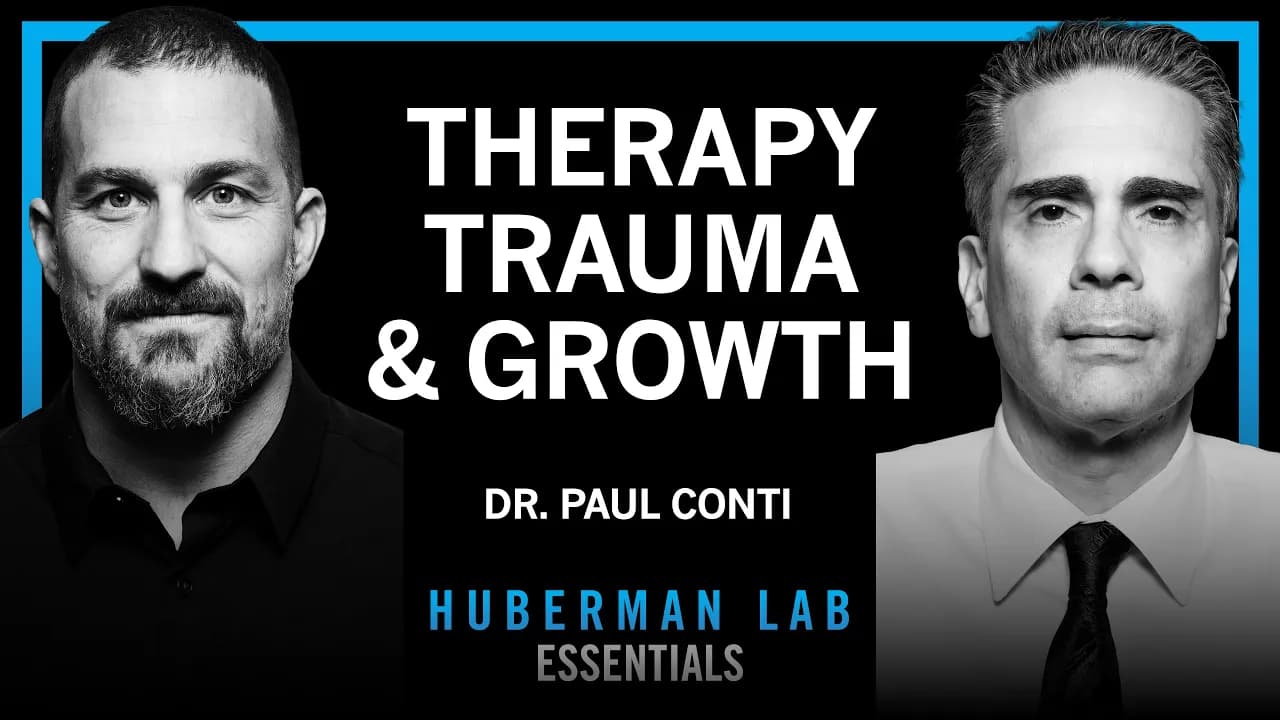
Tools to Bolster Your Mental Health & Confidence | Dr. Paul Conti
In a Nutshell
Dr. Paul Conti advocates starting mental health improvement by identifying personal strengths and what's going right, using compassionate curiosity to explore self-talk, true vs. false self, and imbalances between reflection and action. Key tools include daily questions like "What am I telling myself in quiet moments?" and "Why am I choosing (or avoiding) this?" to build agency, uncover inherited patterns, and align behaviors with goals through small, collaborative steps. True happiness emerges from weaving peace, contentment, and delight via an examined life, countering negativity bias with positive memory cues and getting on your own side without self-conflict.
These notes were generated by AI and may contain inaccuracies.
There's far more going right in any of us than going wrong if we're here and listening to educational material to better ourselves. Start from a position of strength to look at areas needing change.
Welcome to the Huberman Lab podcast discussing science and science-based tools for everyday life. Andrew Huberman is a professor of neurobiology and ophthalmology at Stanford School of Medicine. Guest is Dr. Paul Conti, MD, psychiatrist, expert in trauma recovery, and public educator on building agency, confidence, and well-being.
Discussion covers practical aspects of building mental health: identifying natural strengths, unseen opportunities to improve reflexive mental framework and relationships with self and others. Dr. Conti's approach differs from most online information, drawing on decades of clinical experience and data for questions to ask when facing lowered motivation, mood, or bad habits. Covers balancing action and introspection—more doing than thinking. Provides specific daily/weekly questions and action steps to become the best version of oneself with greatest meaning.
Dr. Conti's new book: What's Going Right? A Powerful New Method for Optimizing Your Mental Health—includes information and worksheet-like prompts for sticking points and building on strengths. Useful whether suffering or wanting to level up.
Podcast separate from Huberman's Stanford roles; brings zero-cost science-based tools to public. Includes sponsors.
Dr. Paul Conti, welcome back. Congratulations on What's Going Right?—amazing book. Holds record for most viewed/downloaded Huberman Lab episodes.
Talk about individuals first, then interactions between people.
Self: name, self-concept; wake up knowing who we are, what bothers/excites us. How malleable is self-view and relationship to self?
Very malleable with flexibility, but requires willingness to look at ourselves. Often avoid due to fear of findings or not knowing how to understand/change. Seeing ourselves as inflexible leads to feeling stuck. Approach with compassionate curiosity: what to learn, interested in changing/emphasizing.
"What's going right" is consistent with truth—far more going right than wrong.
Mental health system focuses on what's wrong, applies labels making us feel worse, helpless, hopeless. Start with what's going right (e.g., agency in life areas), bring curiosity for processes to understand/change.
Self-talk: In quiet moments or pauses, what messages do you give yourself? Often negative/critical, repeated unaware.
Life narrative: What do you reflexively say about yourself to yourself/others? Does it match reality?
Two foundational pillars of self structure/function (hashed out in 2023 series): applies to all humans. Look there to understand self better, bring health. Requires awareness of where/how to look, willingness without fear, belief in change for flexibility/malleability. Grounded hopefulness.
Variation in state dependence? Some affiliative/extroverted think/feel differently alone vs. with others—like two lives.
Life moves fast with stressors; rush to keep up makes us state dependent, not observing self. Observing knits one self across situations: aware of differences, but whole self above observing (observing ego). State dependent behavior/sense of self, but true self across states.
When thinking about strengths, self-talk, what we're made of, change: bring curiosity—light-hearted, high-spirited. Curious about external things for brain/health; include self.
What runs through all we do? Feel different in situations? Common threads? Reveals what's going right, situations where not doing well/happy. Leads to answers on true/honest self vs. false self.
Crucial ingredient: curiosity. Approach seriously/light-heartedly, alone/with others.
More state dependence confuses true/false self. Partial erosion of etiquette; oversharing, constant info from devices. People share kids, meals, wins/losses—odd vs. evolved separate experiences.
Clinical practice: challenges creating separation between self/life aspects due to info influx/sharing?
Depends on use. Falseness: engaging in unreal presentations (e.g., only best life to hide something). Curiosity: what protecting against? Why appear different from reality (stressors not glamorous)?
True use: find distant interests/passions, kindred spirits for compassion.
Use/misuse for stronger self or distraction/accolades, protecting something. Key: honest with compassionate curiosity—not mad/negative ("what's wrong with me?"). Guide from dishonesty; not afraid of findings (e.g., unhealthy group or need self-change).
Strange new humanity: alone time different—constant others' info or sharing externalizes internal process (evolved as just thoughts/emotions). Changes experience; not truly alone regardless of followers.
Sweet spot: enough connectedness (isolation bad), but not overconnected (external cues over own thinking). External check-ins good, but enough aloneness for own questions before pinging outside for info/validation/guidance.
Many find alone introspection anxiety-provoking (e.g., David Senra/Marc Andreessen exchange: great men didn't sit thinking; too much thinking self-destructive).
Useful provocation on thinking vs. doing to avoid spirals.
For non-depressed struggling patient: thinking vs. doing balance?
Depends on person/profile to break new ground. Anxiety from mental health leadership lack, stigma, blackbox fears of self.
Ways to be with self without fear: interesting findings guide to best balance. Some assertive/high-doing need reflection; reflective/low-doing need action. Understand profile of reflection/doing—not one exact place.
We need to understand the profile that works for each person, involving a balance of reflection and doing. When well-balanced, asserting ourselves in the world at levels that work for us and finding pleasure and gratification in healthy ways leads to balance. Too much doing without reflection results in diminishing returns, feeling unsatisfied, and taking less pleasure in activities. Too little doing leads to idleness and a sense of learned helplessness. The optimal range varies by person: asserting in the world and finding gratification. A happy, balanced person shows this. If not, issues like problems in the unconscious mind or over-assertion with insufficient reflection may be present. By examining the person through these steps, we identify what serves them best and how to adjust.
Some people do not think about their thinking much; they just act—brushing teeth, going about their day without introspection. This can occur in busy people or those where the 'mirror' does not activate in their cortex. They seem functional. Are they missing something fundamental, or is it ideal? Growing up, the idea of going through life doing without reflecting on the past seemed appealing to a 'get it done' person, but reflection happens spontaneously, often questioning if thinking or doing something is a problem—for self or others. Reflections tend to focus on negatives rather than positives like gratitude, unless something bad prompts inventory.
People differ in reflective capacity and interest. More capacity aids self-awareness, but less capacity with natural generativity allows forward movement. Even with varying natural reflective inclination, assess if life is going well: healthy, good mental health, secure relationships. If so, minimal reflection is fine—they live through the generative drive, being productive, contributing, learning, growing, making the world and themselves better. Most need reflection to reach this; it arises naturally when the brain signals the need to pause for better decisions. If moving too fast or defended against it, lack of reflection harms. Constant busyness to avoid reflection is problematic if the person is unhappy, complaining, feeling no reward. Spectrums of reflective capacity, assertion, and pleasure differ by person; all are unique. Self-assess: How am I functioning? Is it working? Am I pausing and thinking enough? Curiosity about self leads to understanding optimal functioning and needed changes.
Some are external processors, needing to talk things through to understand and decide; others are internal processors, thinking while sitting, walking, or driving. These are not completely separate but semi-distinct. Ability to think objectively varies. People get stuck in internal loops, unproductive. Externalizing—writing or speaking—activates different brain processes and error-checking. Some recognize internal stuckness and seek new angles; often, externalizing holds the brain accountable, leading to insights just by voicing to oneself or others. The listener's presence prompts due diligence.
Respect for internal processors who bring a vetted self forward exists, but external processing can yield synergy. Example: Conversation with sister—initial misalignment and pushback, but reaching Venn diagram overlap brought clarity neither could achieve alone, via friction, bending, and acceptance. This involves open communication: stating thoughts/feelings, testing, incorporating others'. Humans understand/agree/find ways forward through such external processes. Ideally, start internally for a vetted self, strengthening self-knowledge and flexibility for real-world collaboration, finding middle ground.
Cultural reverence for the 'strong silent type' (internal processing, not burdening others) persists, often male-centric but applicable to women. Assumes internal processors achieve more, serve others better than external ones revealing uncertainty. Stereotypes: women externalize more, men less overall. Internal holders may not reach greater understanding or accomplish more.
Best is balance, varying by person: resolute internals (e.g., moral boundaries, how to treat/be treated) not up for question, combined with external testing. Too much internal processing becomes self-referential, assuming one's view is correct without checking others' perspectives, missing gray areas. Vetted self knows it doesn't know everything, tests openly to learn, avoiding bigotry, prejudice, or ignorance. No one way is better; balance of resolute self-knowledge with humility and openness.
AG1 is a comprehensive foundational nutritional supplement combining vitamins, minerals, prebiotics, probiotics, and adaptogens in one scoop. Supports gut health, immune health, energy by filling nutritional gaps alongside whole foods. Recommended as the single supplement to take. Available at drinkag1.com/huberman with special offer: week supply of AG1, AGZ sleep supplement, free vitamin D3K2 bottle.
Example of internal processor: Graduate advisor Barbara Chapman, described as 'quiet but not shy'—observant, high signal-to-noise when speaking, organized, deliberate. Not white noise internally; a thinker. Hyperverbal can indicate anxiety or be structured/constructive. Assumptions (quiet = regulated/calm/deep; verbal = chaotic/anxious) are false. Quiet can be judicious communication; verbose can be enthusiastic idea-sharing.
Assess person and context, not stereotypes. Patterns exist but individuals are unique—observe closely. Quiet/resolute 'strong silent' type possible, but verify. Person and situation determine adaptiveness.
One strength of the book: probe questions for self-exploration.
Seeing an advanced copy of the book provided practical questions to ask oneself: what is going right as a stepping stone to exploring what is not going right, and to understand personal strengths. This is a unique gift because there is not enough focus on this; much emphasis is on what is wrong with oneself or the world. Starting with knowing the right questions to ask oneself is immensely useful.
Assuming no pathology, no life-crippling anxiety, depression, or panic, consider how much people should adjust their autonomic set point. Some people are more expressive with hands and words, want to move a lot, and feel anxious if they don't. Others are more still physically and internally, which is not necessarily bad. There is emphasis on sitting with stress and anxiety rather than letting it out. Despite value of tools like non-sleep deep rest and meditation, question how much to control states. Thinking something is wrong if feeling a certain way may not be good. Controlling states to be at one's best differs from controlling to change oneself.
Finding deep state of peace (not sleep) helps be a better self, provides groundedness, better problem-solving. That's learning something that serves well. Different from thinking "I need to be different, calmer, more peaceful," which imposes something external. Active people can sit quietly sometimes but are not built for it; activity works for them. They can be meditative internally while moving. Easy to misjudge by observing external state, talking or not talking. Must ask right questions, understand the person and their context.
Book provides practical routes to approach oneself, like learning physics requires basic knowledge, specific approaches, reading certain books. No guides exist for learning about oneself, the most important thing. Sitting with oneself without prompts is like sitting to learn horticulture without guidance, causing anxiety. Prompts make it real: ask how one functions, what works well, how one thinks of oneself, how others see them. Introverted, extroverted, combination? Sometimes one state, sometimes another? Working in big picture? Parts that work, don't like, uncomfortable? Bring curiosity, learn from patterns directed towards oneself. In reflection or helping process, see everything through that person's lens or lead astray.
Patient with unremarkable family background reports: work okay but issues with coworker, dating, news bothering them. Vague dissatisfaction. Observe patterns of emotion, match to templates. Like neurosurgeon seeing epileptic seizure pattern, know direction to explore. When absorbed by external things (social media, politics, life events) despite things feeling good, probe where to invest effort.
Encourage reflection. Reporting is like inventory or laundry list: doing this, that, mom did this, dad that. Wonder how much is chosen intentionally vs. reflex. Behaviors: how much wanted, working for them? Why doing all this? Some liked and interesting, others habit or routine without knowing why. Dating: who, why, how choosing? Along for ride with forward momentum vs. choosing? Examine what really choosing, what's working. Leads to examined life.
In intensive work with individuals or couples, by midway second day, people revisit 80-90% of activities: value some, want more; unsure why doing others. Happens when not examining life; things accumulate without organization. Examine life to keep mental health, structure and function of self, drives in balance. Positions to meet future challenges and opportunities from best health. Like building physical health to handle curveballs and be on front foot of life. Build good mental health same way.
To gain agency, ask why doing what doing, why not doing something better. Starts with questions of self.
Handling Resistance to Examination
If person says "this is just life, got to work, friends, what overhaul?", point out they show X's marking spots to dig for treasure. Drained after Sharon, frustrating job: where to dig. Link to goals, e.g., wants partner but keeps seeing draining person knowing nothing good comes, feels worse. Look at why, no fear needed. Something inside knows not working but fear of "what wrong with me?" Person may want Sharon to like them, need to be liked; or over-cares for others. Doing thing that won't get what want. Empower: understand self, align behaviors with wishes and strivings. Dig where X's are, find treasure, leads to real change.
Realize want different relationship, with different person or different kind with same. Starts with questions; inventories inform useful questions that develop agency.
Encourage specific actions collaboratively, not prescriptively. E.g., gym: agree on once before next session. Talk back and forth; person may want five times but frustrate and do none. Measured: Monday and Friday, or once to build to twice. For Sharon: talk about A, B, C not going well. How? What's holding back? Problem-solve openly, one step at a time. Set reasonable expectations: couple months possible. Put one foot in front, not easy but bolster: arrows same direction, set up for success (not gym after late night). Small wins empower bigger wins.
Good structure of self and function of self lead to empowerment and humility: accept human imperfection, same mistakes okay. Meet world with agency and active gratitude: grateful Sharon still there, gym available, healthy enough, agency to act. Make life change, small or big; big starts with small steps.
Function provides 160+ advanced lab tests for heart health, hormones, autoimmune, nutrients, etc. Added MRI/CT scans. Analyzes results, gives doctor recommendations. Example: blood lipids out of range, supplemented nattokinase, reduced LDL, confirmed in follow-up. Easy, affordable ($365/year, $1/day). Visit functionhealth.com/huberman, code huberman for $50 credit.
Families born into and grew up around impact tremendously. When to think about past patterns for agency and better why questions? Debate: introspection vs. doing (both needed); focus now on why to improve life vs. identifying childhood patterns for agency.
Insight sets us free and puts us in the driver's seat of our lives; without it, we just react. Consider a person with an overcontrolling parent who lacks insight and becomes overcontrolling themselves, associating high control with power and reduced vulnerability. They repeat the pattern with their own children. Recognizing this pattern repetition provides insight: "Oh gosh, that person doesn't have insight."
However, doing the opposite isn't necessarily better. Someone might say, "My parent was overcontrolling, so I'll be easygoing," but without insight, they become too permissive, failing to exercise healthy parental control. Insight allows discernment: parents were overcontrolling, perhaps abusively, so avoid that extreme but don't swing to the opposite pole. Instead, determine a healthy level of control—to keep the child safe while allowing latitude for growth and decision-making.
Early childhood experiences, especially in family units, profoundly impact us, guiding behaviors like automatons without awareness. Insight enables understanding past experiences, good, bad, or otherwise, and deciding how to integrate them as the whole self in the driver's seat of good parenting.
People often struggle with patterns they know aren't working: "I know I should do it, but I don't." Insight reveals the pattern stems from childhood—either mimicking or opposing it—granting agency. A clinician advising better eating and sleep fails if behaviors don't change, but linking it to childhood reflection unlocks change.
Realizing something external or internal controls us diffuses tension, clarifies vision, and restores control because humans hate being controlled, like the Manchurian Candidate triggered by a sound to behave automatically. For example, disagreement triggers childhood vulnerability, leading to overcontrol of one's child to avoid feeling bad, repeating the parent's pattern. Or, pushing against it results in unsafe permissiveness.
This realization—that a trigger prompts unchosen automatic action—has a strong effect; we dislike it. Combine with compassionate curiosity: if starving but not eating food nearby, ask why—what powerful internal forces exert control? Shift from "I want to but can't" to "What's keeping me from it? How am I keeping myself from it?" This mobilizes internal and external resources, shifting the dynamic.
Lack of motivation or inability to break unhelpful patterns (action or inaction) is the most common issue, driving curiosity about neural circuits and hormones but ultimately seeking agency over behavior. People hate being controlled—so much that anti-smoking ads in the 90s/early 2000s showing rich old white men profiting from health problems got kids to quit, not due to disliking nicotine (incredibly reinforcing), but defiance: "You're not going to control me."
Having an enemy puts one on their own side, fostering agency. Realizing parental or environmental patterns control us—even if thinking we're in control—sparks change: "This is just like my mom/dad/environment." Social media's us-vs-them dynamic and pandemic reactions exemplify this positive aversion to control in the human primate brain. Humans hate being dupes or having someone/something put one over on us.
The magic is realizing there's no enemy—we get in our own way, but we're not our enemy. For gym-going: if wanting health but not going, ask why you're standing in your way. Reasons include:
- Secretly believing you don't deserve the time/energy.
- Prioritizing others' needs over your own.
- Fear of failure from past attempts.
If truly wanting to go but not, conflicting desires mean you're not on the same page. Decide consciously: gym or not? If priorities shift (e.g., caring for someone sick), choose that fully—no self-conflict. Or address fear: examine past failures, set up for success differently to avoid repetition. Align all arrows in one direction via the simple goodness principle: get on the same page with yourself to accomplish goals.
People with healthy, trauma-free childhoods ideally move toward goals from genuine curiosity, neither resisting nor copying bad patterns—this maps to living intentionally: maximum self-awareness (though not complete) while acting deliberately. Trauma (overwhelming coping skills, altering brain function) makes it harder but doesn't prevent it; insight into trauma's effects and need for more work allows progress.
Even without trauma, circumstances like overambition or failed gym attempts can create cycles of self-downing ("You'll never do it"), making healthy changes harder than for some with trauma.
This indicates massive brain energy spent on internal turmoil—more exhausting than the action itself (e.g., gym). Mental rumination on failure, desire, and doubt complicates what can be simplified. It signals something to unpack for healthier processing.
Equivalent to 10 mental workouts yielding no physical benefit—redirect to one physical workout for gains in health and mindset.
Not universally true. Some are harsh externally but peaceful internally (e.g., "I don't get stressed, I give stress")—rare, unhealthy, warrants examination. More common: treating others better than oneself, giving them benefit of the doubt ("Everyone makes mistakes") but self-harsh ("What's wrong with me? I'm an idiot"). Don't make yourself special negatively—others get passes, but we don't.
Kindness to others doesn't guarantee internal kindness; unkindness to others usually signals internal turmoil.
- Identify: Notice repetitive self-talk (hundreds of times daily, unaware)—e.g., "Not safe," worries about children, job loss, scarcity. Be curious: What am I saying in quiet moments?
- Find purpose/meaning: Always a reason—e.g., preempting shock of bad outcomes, unprocessed loss/pain from past.
- Strategies:
- Thought redirection: Breaks loops, increases control.
- Understand why, take action (e.g., exit unsafe situations).
- Sometimes medication helps.
Contrary to modern mental health trends, understand root causes to change, not just surface symptoms.
Dreams often carry meaning regardless of waking thinking style. Concrete thinkers may have highly telling dreams as the unconscious finds rare outlets. Expressive thinkers also benefit. Key factor: curiosity about oneself—increases recall, reflection, writing down what the brain signals during sleep.
No single quality or characteristic of a person strongly predicts dream meaning. Dreams sometimes lack discernible meaning. Approach dreams with caution and respect for the mind's complexity. Avoid overinterpreting or forcing meaning. With a levelheaded, curious approach, dreams can reveal remarkable insights, often allegorically capturing events across years in family systems.
Curiosity about ourselves and our dreams provides significant insight, but requires careful, respectful engagement with our complexity.
Tap water often contains contaminants harming health. A 2020 Environmental Working Group study estimated over 200 million Americans exposed to PFAS (forever chemicals) via tap water, linked to hormone disruption, gut microbiome disruption, fertility issues, and other problems. Over 122 million Americans drink tap water with high levels of cancer-causing chemicals.
Aurora countertop system removes harmful substances like endocrine disruptors and disinfection byproducts while preserving beneficial minerals (magnesium, calcium). No installation or plumbing needed; medical-grade stainless steel; sleek countertop design. Visit ro ra.com/huberman for exclusive discount.
Anxiety, trauma, stress erase time; negative feelings feel eternal, making them terrifying. Healthy threading through life involves segmenting time: past doesn't dictate present, present doesn't dictate future. In anxiety, discomfort makes it hard to imagine feeling differently, though cognitively known as temporary.
Tools to Anchor in Emotional States
Start with understanding: shine light everywhere to see truth. Limbic system ignores clocks/calendars; logic says "that was then, this is now," but emotions don't. Triggers in present make past present. Strong emotions signal unworked-through past events—like fear/vulnerability mapping to prior incidents. Emotions act like a string connecting now to past, indicating unresolved emotion.
Markers of being lost in past while present: fear turning away, worry of unhealthiness or going crazy. These are normal human responses. Emotion systems prioritize negatives (fear, loss, terror, despair), bringing past into present as signals to dig deeper.
Most efficient way: bring compassionate curiosity to past without bias (no need to minimize or exaggerate). Observe motivations: minimizing to feel okay, or amplifying to explain current unhappiness. Gain equanimity for calm observation—what happened, feelings, mind's tendencies.
Acknowledge real impacts (e.g., abuse was wrong) without it defining self. View with calmness, recognize effects, leverage malleability of self-perception. Avoid fear/criticism; use compassion to observe, connect with past events and current interpretations. Externalize via writing, speech, trusted others, or therapist to process strong emotions blocking understanding. Approach without fear enables calm presence and self-learning.
People rarely reflect on good things enough due to negativity bias. Avoid stories centered on negatives; instead, note successes, learning from failures, effort. This bolsters, empowers without complacency—leads to happier, healthier, more effective lives.
Larry Squire (memory expert, UC San Diego, human hippocampus research): Photos on office wall of good times benefit adult memory, cue positive emotional states explicitly and implicitly. Surround self with positive memories (parties, liked people/experiences)—even passive exposure registers unconsciously, priming positivity.
Benefits: control internal climate via unconscious mind (sets parameters). Negative thoughts bias unconscious toward negatives (e.g., "No, I can't do that"). Positive photos pre-program positive bias with real memories, fostering confidence/control. Counteracts fear/lack of confidence from constant negatives. Aligns with truth: more goes right than wrong, or we wouldn't be here. Improves mental/physical health, effectiveness; be "on the front foot."
Display good memories in physical space (e.g., stairwell photo walls) to bask in positives, counter online/news negativity.
Notions of evil forces (external/internal) or positive forces (God/devil) can help choose better behaviors by pushing against negatives, fostering being on own side.
Psychologically yes/no: oversimplifying to single good/evil forces risks overidentification (feeling not good enough = evil) or beleaguerment (evil targets me). Better: broader view consistent with major religions/science—subtle forces toward good (generative) vs. not-good (e.g., looking away from needs, not pure evil). Nuance avoids self-persecution, aligns with reality. Feel part of greater whole; choose construction over destruction, bettering self/world.
Happy-go-lucky not reasonable/possible/desirable—implies unawareness of life's difficulties, losing grounding.
True happiness: weave peace, contentment, delight.
- Peace: be present (e.g., notice pretty trees), not constant turmoil.
- Contentment: aware of life's arc—successes, tragedies, shortcomings—yet feel good (embrace self-created fate, per Nietzschean humanism; relive willingly).
- Delight: childlike capacity to light up at things.
Studies/literature/philosophy affirm this. Possible despite difficulties/risks; complete peace/ease impossible for humans. Delight brings momentary joy on backdrop of strivings/hardships—not complete ease.
We start listing things that sound like death when trying to talk about happiness. Real happiness involves times of peace, not thinking about bad things, just observing a tree, bird, or log floating down the river, which brought peace recently. It requires awareness of our lives, acknowledging tragedies and things not as we want them, yet still feeling good about life. This is real happiness, not escapes. Happy-go-lucky often seeks escape, like substances that feel good for hours but at what cost.
We're seeking ability to apprehend our lives, feel in control so not afraid of the future, meet scary things as best we can. Feel good about life, enough control and understanding to say, "I'm good with me at the moment." Moments become sequences; be present as that's the only time we're alive.
Articles on end-of-life regrets say no one wishes more office time. Some love work without detriment to family; others do. These lists prompt questions: Am I overinvested in one area? People near death rarely nail it perfectly, but we hear negatives, not positives.
Encountered people close to death who genuinely felt good about their mental life and energies. Example: Family member in early 90s, no formal education, started a bank that became international, successful community member, gave back. Faced tragedies like losing a child. When learning of medical school plans, shared he was happy with life, could die any moment, accepted it, did his best, made something of himself. Sadness and wishes for different outcomes existed, but happy and okay with dying. Warned against pressure to achieve so much you can't feel good.
This stuck: He had peace, contentment, felt good despite not-great things, capacity for delight—face lit up. Early role modeling for living to feel that way in 90s.
Think more about what's going right, what went right, what I've made go right, what hasn't and I showed up anyway—that's going right. We default to losses, which can be beautiful, but easily fixate on what's wrong. Happy-go-lucky isn't the answer; needs contrast.
Live examined life to live intentionally: look at ourselves. Good news: It's okay. Most avoid self-examination from fear, but won't find shocks, already aware even if hiding. Process exists to improve. We have to look, but get to—live best life, look back feeling good about choices, embrace self and life even if not ideal outcomes.
Writing organized thoughts, helped know better by awareness of unknowns. Incorporating clinical examples and life events gave fuller view of human mind structured parallel to body, brought to four pillars. Felt hopeful it holds together, leads somewhere.
No response from Lex Fridman despite efforts; rumors in Dagestan or Austin. Love you Lex, sign you're okay or search party to Dagestan.
Love exploring caverns with you; gems like being on our own side by seeing what we don't want to control. Resonates for behavioral change, hardest thing—double whammy when not changing.
Focus on what's right vital now with challenging news. Lifeblood of joyous human being, addressing challenges/traumas. No other way. Bring excitement, enthusiasm, hopefulness: We get to do that.
Thank you for book, sharing training/clinical experience publicly—no obligation, serves world. Leading public educator on mind, self, life navigation. Come back.
Links to Dr. Paul Conti's work and What's Going Right? in show notes. Subscribe to YouTube (zero-cost support). Follow on Spotify/Apple, leave 5-star reviews/comments. Check sponsors.
Comments/questions for Huberman Lab podcast on YouTube—reads them all.
New book: Protocols: An Operating Manual for the Human Body (5+ years work, 30+ years research/experience). Protocols for sleep, exercise, stress, focus, motivation with science. Pre-sale at protocolsbook.com.
Follow Huberman Lab on Instagram, X, Threads, Facebook, LinkedIn for science/tools.
Neural Network Newsletter (zero-cost, monthly): Podcast summaries, 1-3 page PDFs on sleep, dopamine, cold exposure, foundational fitness (cardio/resistance). hubermanlab.com, menu > newsletter (no email sharing).
Keep Andrew Huberman in your library
Save the videos and channels worth coming back to, and find them again in one place.