Trump’s Reaction to the Midterms, the Democrats’ Strategy, and What Happens Next in Iran
In a Nutshell
Brandon Weichert argues that America must abandon its failed role as global policeman and adopt a new Monroe Doctrine focused on the Western Hemisphere, as the US lacks both the power and institutional capacity to manage a multipolar world against China and Russia. The core message is that decades of foreign policy driven by ethnic lobbies and unipolar assumptions have produced endless unwinnable wars, depleted military stockpiles, and allowed China to colonize Latin America and Canada through infrastructure and trade deals. The speaker concludes that America should withdraw from the Middle East and East Asia to focus on its own continent before it's too late.
These notes were generated by AI and may contain inaccuracies.
America is willing to risk nuclear war over regions thousands of kilometers away while foreign powers expand influence on the American continent. Attempts to build America's informal empire have only weakened the United States and alienated people rather than checking rivals. The American era is changing and the United States no longer has world hegemony, with China and Russia as rivals.
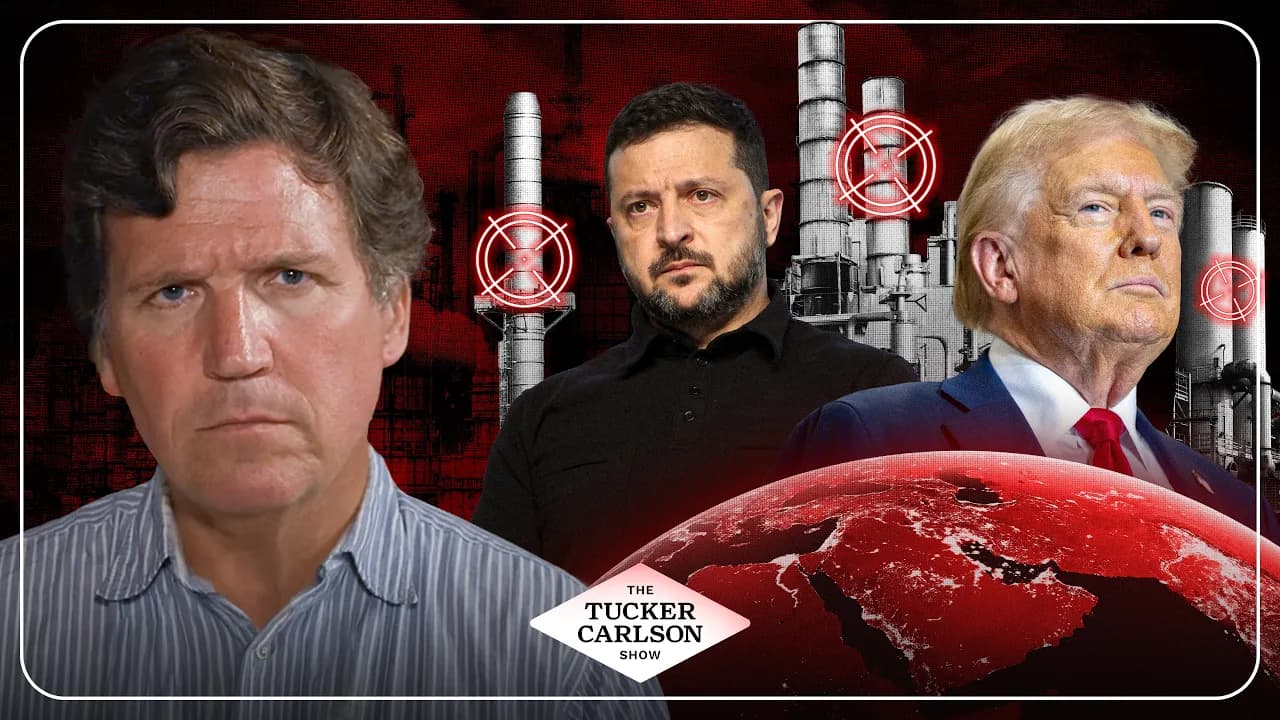
Geopolitical analyst Brandon Weichert has written a new book titled Fortress America: A New Monroe Doctrine exclusively available via tuckercarlsonbooks.com. The book presents a fundamentally different vision of how American foreign policy can serve America and preserve peace in the world.
The theory is that many conflicts stem from the inability of American policymakers and European leaders to accept living in a multipolar world. The rise of China and the power of Russia are real factors, and unless assumptions are based on reality, the outcome will be a kind of third world war.
In 2017, it was already clear there was a tripolar system with the dominant military and economic powers being the US, China, and Russia. The system is transitioning to a truly multipolar world with Turkey joining and India gaining influence. David Pine and others argue it will become a bipolar world like the Cold War with China against the United States, but this view is rejected in favor of recognizing multiple players who play decisive roles.
The United States must perfect its governance structure and policymaking to embrace the reality that it does not have to be the world sheriff. Institutions in Washington D.C., Foggy Bottom, the Pentagon, and the CIA all reflect the unipolar era, which is why America is defeated time and again in every conflict fought since Iraq, with miscalculations made even since Desert Storm.
No victory has been achieved since 1945. The bipolar world of the Cold War, the unipolar era after the Cold War, and the current tripolar world oriented toward multipolar currents show that institutions are unprepared, which explains involvement in senseless wars that cannot be won.
Trump has been trying to defeat Iran for a year and has used up crucial stocks of defensive ammunition and precision-guided standoff munitions. This has yielded nothing at a strategic level. Iran is not collapsing but has hardened and is probably on its way to becoming a true world power.
The entire worldview, way of thinking, and system is geared toward the idea that America is the world policeman. America is not that and should not want to be that. The goal should be to be a normal country in normal times.
The ambition to maintain an empire at the expense of the republic runs up against physical reality and its limitations. America no longer has the power to exercise violence and control in the South China Sea and should not want that either.
In 2025, right after the president's inauguration, a controversial essay was written in The National Interest arguing that America has lost the first island chain from the tip of the Kamchatka Peninsula via Japan, Taiwan, to the Philippines and the South China Sea. The position was that America should no longer want to control that area but should trade and maintain geopolitical relations while scaling back military involvement.
Instead of deterrence, military involvement has become a form of provocation. The USS Teddy Roosevelt, en route to the Middle East, was the first to carry out a FONOP operation through the South China Sea in the Bashi Strait near the Philippines. China deployed its aircraft carrier group within the same operational area as the American aircraft carrier.
America provokes wherever it goes and constantly provokes, thinking it has a deterrent effect and strengthens control over the seas. These other countries now have the opportunity to retaliate. The Iranians prove this, and the Russians are proving it in Ukraine. Provoking China in the first island chain would be catastrophic because China would prove it.
The recommendation is to withdraw and let the Japanese, South Koreans, and everyone over there mind their own backyards. America should be concerned about the forts in America and its own continent. The focus should be on relations with Canada, Mexico, and Latin America rather than going into Eurasia.
Zbigniew Brzezinski wrote The Grand Chessboard in the 1990s saying America must break up all groups in Eurasia and prevent them from uniting, but this cannot be an American target anymore.
American politics are governed by ethnic considerations. There is much talk about Eastern Europe and the Middle East because policymakers' ancestors live there or because they have religious or ethnic reasons to care about them, but these areas have nothing to do with American national security.
China has colonized Latin America and the Caribbean. The amount of infrastructure built by the Chinese includes all roads on St. Croix, which America supposedly controls. In Jamaica, everything is Chinese-built. Canada, America's second-largest trading partner with an 8,000-kilometer border and the highest resource density per capita in the world, is more or less controlled by China.
Greenland was taken over by Chinese mining companies trying to obtain rare earth metals, oil, and natural gas present in abundance there. No one stopped them or competed with them to offer a better deal. China effectively annexed the entire region through trade.
In Latin America, the port of Chancay, the largest port in Latin America, is 100% Chinese-built and Chinese-owned. A new railway line is being built between Peru and Brazil on the Atlantic Ocean, all Chinese infrastructure owned and managed by the Chinese.
Two ports on either side of the Panama Canal and some bridges over the Panama Canal are owned and managed by the People's Republic of China through their companies. They connect a direct transoceanic line to Shanghai via the port of Chancay, bypassing all North American checkpoints. Large container ships no longer need to make a stopover in North America on their way to Peru but go straight to Shanghai and back.
Milei received a loan of 40 billion dollars from the United States but does shady business with China. Trump's trade war with China over soybeans was undermined by Argentina and Brazil. When the soybean supply to China was cut off, China said it had friends in Milei's government and Lula's government and would sort it out there. The trade war had no effect on China at best and greatly strengthened China at worst because China was forced to find alternative solutions that are effective and more sustainable.
People at Mar-a-Lago said America had to attack Iran because it was an indirect attack on China's energy infrastructure. Almost 90% of Iranian oil and natural gas goes to China, but only about 14% of China's energy supply comes from Iran. China was able to compensate for it. China has teapot refineries and alternative energy sources. The green revolution being carried out in red China really works.
BYD products are quite impressive. China is conquering the world because America is no longer competitive geoeconomically in trade. America is competitive in building more nuclear weapons, but that will not improve lives and will destroy all life everywhere. China is significantly ramping up nuclear weapons production.
It is verifiable, obvious, and wise, but it is the conclusion drawn if viewing the world clearly at this moment. Very few people making decisions at the Pentagon, the State Department, and the White House think that way because they are paid by certain lobbies in Washington D.C. to sell weapons.
When speaking with soldiers at a base in Georgia in March of this year, all the middle- and lower-ranking Gen Zers and millennials agreed with the position. But the generals, colonels, and older officers did not like it and did not want to hear it.
Getting stars on shoulders makes people think they know everything. At a base on the West Coast when the war in Ukraine had just started, the only person on a panel who raised a yellow flag said this was going to destroy NATO, destroy the United States, and drag America into an endless war.
The two-star general in the audience became very upset during the question round and said the Russian army was being defeated in the field for nothing. When told that many people were dying, the general said no Americans were dying. The response was that soon there would be Americans dying.
Reports are now coming that paramilitaries in Ukraine are being killed because there are many people unofficially active there.
The CIA has a paramilitary army of ex-military personnel sowing chaos in Europe and the Middle East as advisors. When training people, knowing them, teaching them things, and arming them, there is a natural desire to fight on the front lines. American elements are fighting on the front line. Mercenaries paid by contractors are there, including Polish, British, and Australian mercenaries. Australians are fighting against members of the Australian Special Forces.
In 2023, someone flew to Ukraine via private contractors, not via the Australian army, and stayed there for a year. People fought in Ukraine and Western Russia, including RFK's son. Not all survive these confrontations. Some have been killed.
There is more optimism now that the conflict in Iran will come to an end or at least a long-term pause, but there is more worry about Ukraine. Neither party has an interest in ending it immediately.
It is a shame because Russia, if it were to end it, would probably get what it wants and that would be fine. But Putin has centers of power in Moscow that he has to satisfy. Putin is the least bad Russian leader at the moment, and he is the leader of Western Russia who will be seen for the rest of our lives.
The fall of the Soviet Union in the summer of 1991 took place about a year after the withdrawal from Afghanistan. There were an enormous number of demobilized soldiers scarred by the war. This always happens with the GI generation here, the World War II generation there, and the Vietnam generation there. This is a lot of men in proportion to the population.
Every leader worries about what to do with the army when the war is over. The suggestion is to give them all a piece of land in the Russian Far East to develop. The Romans did those kinds of things too. This is an age-old problem. If you are Putin in a super complicated country, you worry about that. Can your economy handle that? Can you integrate them into your economy?
There is a Russian general who is Chechen, a devout Sunni Muslim, and a fervent supporter of Russia and Putin. He leads troops at the front. Russia has the largest Muslim population in all of Europe and does not have the problems that America has. After two wars in Chechnya, a compromise was reached. Fifteen years later, there is a Chechen general leading troops for Russia. The CIA was driven out of Chechnya.
The wars were instigated by the United States, MI6, NATO, and the Five Eyes. There has been a constant attempt by the West to fragment Russia for thirty years.
A briefing from the Hudson Institute from 2005 contained a map of a divided Russia in five or six parts. The discussion was about how the end of the Cold War and the collapse of the Soviet Union was an opportunity for the transatlantic alliance to ensure that Russia would never again pose a threat. The briefing advocated using the power of NATO and the US to drive the Russians out of Sevastopol, Kaliningrad, and Tartus in Syria, ultimately leading to the collapse of the Russian state to its medieval borders.
The idea was to take away the warm-water ports that Russia has on the European side and push them back. In 2014, a white paper was written about how to isolate and contain Russia by doing what the people at Hudson said. Certain people in the Obama administration caught wind of it and thought it was a great idea.
The reason the US and Russia were on opposing sides in Syria during the Syrian civil war, while Assad was clearly the better choice of all possible candidates, had nothing to do with an empire in the Middle East. It came from an idiot staring at a map and saying they have a base in Tartus and Latakia in Syria and wanting to push them back.
John McCain and Congress pressured the Ukrainian government in 2010 not to renew the 100-year
John McCain and Congress pressured the Ukrainian government in 2010 not to renew the 100-year lease for the Russian naval base in Sevastopol as part of a plan that people like Hudson were thinking about in the early 2000s. Germany and Finland are threatening Kaliningrad because it is a warm area with a harbor, part of the broader strategy of pushing back Russia.
This battle for the base in Sevastopol in 2010 has a direct link to the moment when Putin thought in 2014: "Never mind. I will simply take Crimea myself with my little green men, because otherwise NATO won't let this go and they will keep staging coups and trying to oust Sevastopol through legislative and administrative means." The naval base was built by Catherine the Great and Colonel Potemkin, making it thoroughly Russian territory.
Owning a home has always been the core of the American dream. It is the asset families work for their entire lives, a place of stability, security, and true wealth. But too many homeowners are now stuck with credit cards to pay for groceries, while paying a survival tax of 20% interest or more. Currently you cannot buy a house without debt. Almost everyone has to take out a loan.
American Financing helps homeowners utilize their hard-earned equity and supports Americans who want to realize the American dream of owning a home. American Financing saves its customers an average of 800 dollars per month, almost 10,000 dollars a year. It is not just a loan, it is a complete financial reset.
People who govern the country care for reasons that have absolutely nothing to do with America's national interests. This is ethnic politics to a certain extent.
There is a question of whether there is any hope for a large-scale solution, at least a framework for a sort of power-sharing agreement in which other countries' national interests that they consider crucial are acknowledged. The concern is that you cannot ignore those interests and pretend they do not exist, simply because there is power to do so.
This is why Trump was supported in 2016. He was the only one who spoke of a new foreign policy. He did it in a very Trumpian way, but the meaning was understood, and it was thought that these people could do it. Of course, it eventually turned into a disaster.
There seems to be interest in giving the Western Hemisphere priority again and paying a bit more attention to it. It will be just like gravity - you can't fight it forever. But the problem is that the more you fight it, the more you run out of fuel instead of trying to land the plane, and the more you crash and land in pieces.
The fear is regarding the way the new tripolar world, which is becoming increasingly multipolar, will be recognized. Negotiations are currently underway for a trilateral meeting because apparently Xi and Trump are having a falling out. Trump wants an unprepared meeting, typical Trump, unprepared verbal diarrhea. Xi, who is Chinese, wants a prepared meeting - that is the big battle now.
In 2017, the suggestion was made to form a trilatino with Putin and Xi and reset the world. It is a new Big Three, like in World War II. That would have been the moment, because Trump had maximum political capital, which is actually one of the reasons why Russiagate happened when it happened.
Putin and Xi are thinking as if by gravity. They are just going to create so many alternative structures for the US-led system. BRICS, the Shanghai Cooperation Organization, and they just keep making them more powerful and letting the Americans discredit themselves with these ridiculous imperialist wars.
This can already be seen in the Global South, such as in Latin America and Africa, resulting in these countries saying: "We may not agree with certain trade practices of the Chinese, but they are stable. They are not crazy. They are not sending troops to bomb us into democracy." There will be a wave of those kinds of developments all over the world over the next ten years.
A colleague who makes a lot of money in Shanghai emailed the evening of the midterm elections and said: "Beijing now has two years to protect itself against a potential future trade war that the next American president might want to start." The Chinese are making themselves stronger through decentralization, hardening, industrialization. Eurasia, China, Russia, and to a certain extent India are doing all of this, and they are creating an alternative ecosystem that is completely separate from the United States.
Because they can conquer the Global South, which encompasses the fastest-growing population and the fastest-growing economies of the developing countries, they will, by gravity, surround us.
What China is doing is George Kennan in reverse. George Kennan penetrated the Soviet way of thinking and understood it. The idea of geopolitically balancing Russia as was done, without waging war, was absolutely fantastic. And that was all because he understood his enemy's way of thinking. He was attacked for that and hated for it.
With China, they are simply doing what was done with the Soviets. What was done after the Second World War? It was not a foregone conclusion that the Cold War would be won. The Soviets were also building up advantages for themselves. The problem was that they handled it too clumsily, too totalitarian, too ideological.
The stick was used when necessary, but what kind of Marshall Plan was created? Viable alternative infrastructures for trade and civil life were created that encouraged people to live. You can supposedly have a great life in the West. China is doing that now.
Things change rapidly, so the world will look very different in 10 years. If you are China, the fastest way to dethrone the United States, Canada, and Australia is to change the population. Just encourage migration from the Global South to their countries. Then you have a completely different electorate and a completely different set of attitudes and priorities, as they have done in Canada. They have completely overturned the population of Canada.
The way to change your country is ultimately not by defeating it in war, but by changing the people who live there. And to make them think: why did you ever oppose this? This project is going on.
Michael Jan has the advantage of having spent a lot of time all over the world. He has knowledge. He may be drawing the right or wrong conclusions, but they are not conclusions he drew in Canada. He was in the Darien Gap and all those things. He said: "Man, all that infrastructure is still there and is still being maintained." Not many people are experiencing this right now.
Trump does deserve praise, because he has at least stopped doing it a little bit. But they are waiting for the switch to be flipped, and Trump is already saying: "Hey, he hasn't done anything about the infrastructure. He hasn't done anything at all about the infrastructure."
Trump's task is to bring about the destruction of the West. He is America's Gorbachev. Biden was our Chernenko and he is our Gorbachev, and what comes next is feared. Maybe Trump is a bit Gorbachev and Yeltsin, in every respect. More Yeltsin than Gorbachev, but it doesn't quite fit the comparison.
What comes next is thought to be totalitarianism. We are heading towards techno-feudalism, a term Joe Kotkin came up with. It doesn't matter whether it is right or left.
No longer a right-wing politician. When the driver's license was changed, the Republican Party was left. Nothing more to do with it. The Democratic Party has a few very smart people. Matt Duss is a great guy. He is right about Iran and Israel. He informally advises people like AOC.
Two years are given to see what the Democrats can do now that they've won so convincingly. If they can keep focusing on affordability, if they can keep focusing on actually tackling corruption, real corruption, not something like: "oh, we don't like this man, so we're going to ruin his life." There is real corruption and it is known.
Matt said: "we are going to tackle corruption. But my concern is that the Democrats are becoming obsessed with Trump and all those things that harm them as a party. And I'm talking about hating white people. They are very fixated on hating white people, and on hating Christians. And white Christians. Those are the ones they hate."
The Republicans, and particularly the MAGA movement, have completely discredited themselves. There is no turning back here. JD Vance is a great guy. His wife is beautiful and smart, and his children are fantastic. They make a great couple. It is simply a fantastic group of people. But it is not known if he can win.
If there is a Republican behind your name and you have worked in the government, then people are angry at the government, and that won't make them any happier. Trump has the lowest approval rating of all Republicans, even lower than George W. Bush's. It will only get worse if he does not end the war. If he can end the war, he might get closer to the 40% and avoid impeachment and removal from office.
Justin, one of the Democrats, said: "get rid of Trump. He is the greatest Democrat we have ever had. Why would I want to get rid of this man? He has just achieved the largest majorities in my life." If Marco is chosen, you'll be ripped off immediately. Choose Nikki Haley or someone else.
The Israeli-Zionist lobby, or rather the Zionist lobby, is now trying to rehabilitate her and Mike Pence. But the dog isn't going to eat the dog food. That is ridiculous.
The first question for Nikki Haley would be: "you said that the United States needs Israel more than Israel needs the United States. Could you briefly explain that?" It was started doing this, recommended by one of old acquaintances. It only gets into trouble.
Asked guests on Mario's show, who are fanatical Zionists: "And you have a double passport?" It is wanted to know who is being talked to. Why is that not a fair question? Because dual loyalty is an antisemitic stereotype, they say. It is not meant that way. It is wondered why.
As said to Jonathan Conricus: "why are you, as a former Israeli military officer and media man, so passionate about my country's foreign policy? Why does it interest you?" They don't like that. One of the guests knocked over the microphone and said: "It is insane." And the response was: "It is not antisemitism, it is simply true. I live in New York and Tel Aviv. Fine. Well done. But I don't want to hear your opinion on US foreign policy."
Why is it unfair to ask if someone has a foreign passport? Because dual loyalty has always been antisemitic. It is thought that is completely justified. It is entirely justified, and that is why it is asked. There is no second passport, and if there was, there would be no problem being asked to which country loyalty is most given.
If you are an Israeli and you are a guest on a program that happens to be hosted, and you are a fervent supporter of the idea that young American men and women will die in the Middle East again without a clear reason related to our national security, then the question is asked why you are so passionate about that. And is it because you have dual nationality?
How does Trump get out of the war with Iran? He probably hates looking at you, so this is phrased in language that suits him. He is still watching, so he likes winners. A segment was complimented that was thought was great. It was a rather controversial segment. He said: "no, no, no, I think the guy made a few very good points. I liked her."
There was no influence on Trump. We are in the middle of the war. Before being a guest on the show, it was really thought Sean Spicer said that Trump would bomb for three days the day after the election - and he was quite happy with that, regardless of the outcome.
Heard from several people, including former Pentagon employees, that they said something like: "Oh my God, that man..." And with nuclear weapons. Things were heard that they were talking about nuclear weapons again. General Randy Manner, former CEO of the Defense Threat Reduction Agency, said: "Brandon, the Moab will have no impact on Pickaxe." He also said: "By the way, we don't have enough of the GBU-57s we dropped last year left. We only have about six left." They will have no impact, even if there were more of them.
A tactical nuclear weapon will have no impact on that mountain. This is all a little show for the president to create a mushroom cloud. We were really heading towards something very dark. Then the Democrats won the way they won. And thanks are given to God every day for the Democrats, because if they hadn't won that way - because Trump assumed, it is believed, that he could lose the House of Representatives but would probably keep the Senate.
Chamberlain observed that those aligned with losing positions would lose everything. Texas turning blue was noted as a significant political shift. Trump is described as someone who hates losers and losing ideas, and who remains fundamentally a PR man. The theory presented is that Trump took a beating in the by-election and realized his current position was a losing one, leading him to distance himself from Netanyahu in what Israeli media described as a hellish feud. Netanyahu reportedly wanted to proceed with an action the previous day, but Trump refused. The assessment is that Trump is reconsidering his position because he recognizes it as a losing stance, and wants to focus the next two years on directing his anger at Democrats rather than being embroiled in an endless war.
The speaker notes having been humiliated many times in life, and states that every time it has been a blessing. Some around the president are still trying to publicly humiliate the speaker, which is welcomed as it reveals their flaws and constant exaggeration of their own power, wisdom, and foresight. The speaker calls Trump "President Frontal Lobe" in angry moments. The assessment is that Trump had a moment of clarity, and while not saying there will be peace in our time, the belief is that Trump is de-escalating. The speaker states they are the only one saying this currently.
The speaker notes getting reactions when saying this on the Mario Show, with people questioning whether Trump has the power to de-escalate. The speaker is convinced Trump did not want to start the war at all, having talked to him constantly about it just before the start. The speaker has said this a hundred times, but no one believes it. The view is that Trump was forced to start the war. After a long recent conversation, the speaker is convinced Trump wants to de-escalate and sees no advantage in continuing. The speaker addresses the president directly, saying it is essential to step down, that there is nothing to win, and to accept the seven points.
The speaker believes the seven points have basically already been accepted, citing yesterday's news that the Iraqi Prime Minister flew to Tehran because reportedly four of the seven countries with which agreement was reached are adhering to the conditions. The points include lifting the blockade, letting oil flow, and letting the local population take the lead. This was discussed with the First Chain of Islands. The Arab states will figure out how to cooperate with Iran, and Turkey will figure out how to cooperate with Iran. The advice is to slow down and do it now.
The speaker warns that if bombs start dropping, the Iranians will completely overrun the region, probably attack Dimona, and a nuclear explosion will take place in Israel. The question is then asked what would follow, noting there are not enough troops to land, and the army is telling the president this. Dan Cain is mentioned as telling the president the same. The speaker states they can do it, but it won't work, and nothing is achieved at a strategic level.
The speaker hopes Trump is listening and watching, and hopes contact can be made again, because Trump can twist the narrative to say he won, destroyed their nuclear weapons, and they will not have nuclear weapons for a while. This was Trump's mission from the beginning. There is also an opportunity for Trump to rub it in Netanyahu's face publicly. Trump despises Netanyahu, as everyone does. There is a way in the next two weeks for the president to stand up and be the Trump remembered, the one who contradicted Hillary, and say to Netanyahu: "I'm not gonna wage your wars, man."
The question is whether Trump already tried this around the MOU in May, but now he has more influence. The American brain struggles with the realization that not all decisions are up to the United States, and there is no unlimited power. The opponent changes over time, and that change is accelerated by war. Putin is a different person than the Putin of three years ago. The assessment at the time was that Putin really wanted to get out, but it is not clear if that is still the case.
No American or even Arab from the Gulf States can truly understand how decisions are made in Iran. It is very complex, even unclear to the people in Iran themselves. There are millions of factions in the country. Iranians are getting rich from the sanctions, which is really true. The speaker recently spoke to someone in Iran about it. There are factions within the government that do not want the sanctions lifted because that is their main source of income, just as there are Americans who do not want the war in Ukraine to end because they are getting rich from it. They have their own 'deep state.'
It is not as simple as the American president saying the war is ending. It is not entirely the president's fault. If there is no one left to fight against, the war is actually over, so act unilaterally and the war is over. Joe Kent is mentioned, and a senator from the Vietnam era whose name the speaker cannot recall, possibly Hallister. Chaz Freeman was talking about this with Glenn Diesen recently. There was a senator toward the end of the Vietnam War who had a plan that was essentially just to run away, and that is what was eventually done.
The world did not end. The United States left Vietnam after ten years, and it had swallowed up all resources. Vietnam is now a trading partner. America has never really recovered from the Vietnam War. It was a time of unprecedented prosperity. The speaker does not know if it has had a huge impact, and is not saying it will not have harmful consequences, but states that is life and how you adapt to it.
It is a choice between two evils, not between the best and the worst. It is a choice between something worthless and something even more worthless. You want to lose little or lose a lot. Ayatollah Muchaba Kamani said a few days ago that he had instructed Rezaei, the Supreme National Security Council essentially their National Security Advisor, to resolve this war somehow. He called it 'no war, no peace.' He said he does not want that anymore. Everyone in the media, including people the speaker knows, is saying this means they are going to start the war again. The speaker says maybe, or maybe it means giving peace another chance, and if the Americans agree to the concessions, then de-escalation will occur.
Yesterday, the Iraqi Prime Minister reportedly sent a message to Rezaei stating that the Americans accept four of the seven conditions in principle and want to negotiate further on the last three. The speaker thinks this exit might be taken now, because they have already gone through it.
Looking at the military options, the hard facts are that approximately 67% of crucial stockpiles of Patriot missiles are depleted and will not be replenished until the 2030s. There are comparable figures for the production of Patriot missiles. It is difficult to build a Patriot missile because the defense industry has been downsized and cut back over the past 30 years due to the end of the Cold War and deindustrialization. The budget keeps rising to unprecedented heights. There is a reason why the seven richest counties in America are located around Washington D.C. The United States is spending all that money, more than any country has ever spent, and has fewer things that can be used. This is called corruption, bribery, and inefficiency.
Talking to any purchasing manager at the Pentagon reveals the problem. Most of them, especially young people, understand the problem but do not have the authority to resolve it because it does not depend solely on them. It also depends on the president's team, the politicians, and Congress. The speaker has been saying for years, ever since starting work in Congress, that the military budget must be drastically cut. The last time a defense contractor went to prison for corruption, or a high-ranking officer went to prison for corruption, cannot be recalled.
In normal countries there is always corruption surrounding military purchases because it is emotionally charged, involves large budgets, and no one wants to get involved, so opportunities to steal are enormous. Every country is Ukraine in a sense. In normal countries, people are regularly punished in China, with executions. There have been a lot in Russia. But the United States never had that because it is all one big club, to quote Carlin, and you don't belong. There has never been a real audit. The last time they did not pass it, they failed. The only ones who pass their audit are the US Marines, who consistently pass the Pentagon audit because they have no choice, constantly fighting for their survival. They are also afraid of being swallowed up by the navy and disappearing. They adapt very well. They are an amphibious force, and yet during the global war on terrorism where there was no water nearby, those men found themselves in the middle of Afghanistan and Iraq, and they developed the doctrine needed to survive. The army caught up later, but the marines adapt much better.
The argument is that the Marines are a smaller force, more agile. They are amazing. The speaker has had the pleasure of talking to and working with Marines. They are not just colored pencil eaters. The speaker spoke with men from the Naval Intelligence Service. Because they are under constant bureaucratic pressure to justify their existence, they kept the Harrier operational for 30 years. They did not want to lose the Harrier. They were forced to abolish it. It is the most dangerous airplane ever made. The question is why the other branches of the armed forces cannot be like that, and the answer is that they do not have to be.
The speaker would like to throw Russian generals out the window for purchases, but states it has never happened. In 80 years, there has never really been a corruption investigation. The Pentagon will likely receive 1.5 trillion dollars next year, the largest defense budget ever. Three aircraft carriers are currently under construction. The question is asked whether recent history has proven the usefulness of aircraft carriers, or tanks, or manned aircraft. They are building the sixth-generation fighter jet and testing it in Area 51.
The Chinese sixth-generation aircraft, the J-36, has been making constant victory laps over Shenyang since December 24, and the United States is still trying to attach the wings to their plane. It is pathetic, and the Chinese are laughing. Comparing industrial bases, the Chinese work with an iterative process. They release a prototype that is nowhere near as good as excellent American fighter jets, but they produce mass. They can perfect it along the way. The United States must personalize and perfect everything, which is exactly the opposite of what was done in the Second World War, the last war won.
China has modern robotics. Nobody is talking about the robotics revolution in China. What they have done with industrial robotics and the way they have combined it with their AI, which is not as good as advanced American models, but they can mass-produce fifth- and sixth-generation fighter jets, while the United States is still making everything by hand, hoping to have maybe a dozen by 2040.
The point about aircraft carriers is Rolls-Royce versus Toyota, and Toyota wins wars in this case. The aircraft carrier is very interesting because it is outdated. The Navy does not let the speaker come by anymore. The speaker used to go to naval bases sometimes, but they do not do that anymore. They do not ask the speaker to come over anymore. They want to scream at the speaker. The Navy is obsessed with aircraft carriers. The newest aircraft carriers, the Gerald R. Ford class, have been seen. They opened the Strait of Hormuz. They can dock in Bahrain again, just like before. Commander Bobby Jones, who used to command destroyers in that part of the world, always says that when his men arrive in Bahrain, then it will be known that the war has been won. But they cannot do that, and they will not either, because they are afraid.
This is a roundabout way to come back to the question about Iran. The assessment is that the United States is actually from the region and will still have a presence, but those bases will not be rebuilt. The United States is getting out, and the Iranians know that. The question is how much they want to humiliate the United States, and how much Trump will tolerate. The North Vietnamese humiliated the United States, and a decade later there was the Reagan era. It was a great time in the United States. The United States left on April 30, 1975, and in April 1985 it was a completely different country. It was a fantastic country, a great country. The 90s were too.
Bill Clinton was actually a good president. Hillary would have been terrible, but Bill knew how to triangle. That is what the speaker likes so much about Trump, because Trump knew that in the beginning too, but not anymore. He has to start with that again.
Looking at this in a broader perspective, the driving force behind the war with Iran was systematic. It took decades. The speaker has been talking about this for fifteen years, simply because they lived in Washington D.C. and saw that people's true priority was regime change in Iran. The United States has always been at war with Iran. You do not have to like the Islamic Republic to say you do not want to wage war with them. There are many countries whose governments are not liked. There are people who have thought this through carefully and have a strategy, something never had. That strategy entailed the United States withdrawing from the Gulf.
It is enormously important for that same coalition to weaken Saudi Arabia, even though they cannot openly admit it. That is why Trump is talking about the United States becoming the new OPEC. That is what matters. The question is who is pulling the strings of the Houthis and whether the Houthis are actually threatening the Saudi kingdom at this moment, or if they have a serious opinion on the matter that could potentially have terrible consequences for Saudi Arabia, but also for the United States. They currently occupy a part of Saudi Arabia. It is a fact, and Mario's program is the only one paying attention to it. It also has consequences for the Horn of Africa.
The question is worth asking who exactly controls the Houthis. Iran has had a huge influence on the Houthis and they have been a proxy for Iran, but Iran is not the only power behind this. The Houthis have ties with Iran, but due to their geographical location and the sanctions, the Houthis had to be more self-sufficient than Hezbollah, which is logistically much more dependent on Iran, though not anymore because of Iraq. The Houthis have always operated more or less in their own bubble, with the help of Iran. The speaker spoke with Houthis in the program. These are spokesmen, so propaganda, but when one of them started listing all the children who died in the bombings and shouted at the speaker, Bukadi said the Saudis have taken everything from his people, they will not take their pride and they will die before. The speaker does not think there is really any foreign influence. The Saudis blew up the plane coming back from Kamanis. The Houthis were like get lost. The Houthis currently pose a deadly threat to the Saudi kingdom.
The speaker is glad they did not accept the job offer in Riyadh in January. It is a great city in many ways, beautiful. The speaker was excited, and their wife wanted to move. There are many Saudis who are great people, despite what everyone says about them. They are phenomenal people, brilliant, educated, erudite, clever, in principle pro-Western in the ways that matter. It is a shame. The speaker said this right at the beginning when they said that MBS runs the risk of being overthrown. If you listen to the Houthis, for them this is what Karen Kwiatkowski calls sacred defense. For them, this is a kind of spiritual matter. This is more than just waging war because Iran wants it. It is terrible. It did not have to happen, just like the war with Iran. For whatever reason, Medina and the city lie within the borders of Saudi Arabia. This is really something that could be expected. It is insane. The Shiites control Saudi Arabia, at least that is how they talk about it.
The speaker said this to Bukhaidi and asked if they are not worried about the backlash. The answer was no, because they are the moral party. The speaker asked if they think the Sunnis in the region will accept this, and this is what worries the speaker because everyone is focused on Iran. The speaker thinks a solution will be found, but could be wrong. In two weeks, or next Sunday, there could be war again because the aircraft carrier is there. But the speaker thinks Trump will find a way out of this situation because he is ready. The problem is the Arabian Peninsula. What is going to happen is that MBS, just like the rest of the West, will not be able to reach an agreement. He will not make a deal. So the Houthis say they will keep increasing the pressure, and eventually internal resistance to MBS will arise.
According to the Wall Street Journal, MBS would move from bunker to bunker with carefully selected security guards. This is a very anxious time for the kingdom. People from the Houthis in the speaker's program, people of a lower level, say that their spiritual leaders say that they will take Mecca and Medina. Once again, propaganda, but the speaker thinks these men believe in it and mean it when they say that if there is a chance, they will try it. The question is whether there are Houthi fighters on Saudi territory at this moment. The speaker thinks so. There are some.
Gilani, who the speaker will always call Gilani because he killed Americans in Iraq, now calls herself Shara, who does Arafat-like things with that three-piece suit. He is sending advisors to Saudi Arabia now. He sends Al-Qaeda to Saudi Arabia. The speaker remembers that after 9/11 the argument was that the United States had to defend the Kingdom of Saudi Arabia because the House of Saud is the only counterpart to the Wahhabi factions there. Now the House of Saud is being linked to Al-Qaeda, which reminds the speaker of Michael Scheuer's amazing thesis from 2004, for which he received a lot of criticism. Mike was completely excluded from the decision-making. Mike said in 2004 that the global war on terrorism would lead to Bin Laden's vision. Bin Laden might not make it, but Bin Laden's vision, which was always aimed at eliminating the House of Saud in the first place and returning Mecca and Medina to the true believers, was how it would end. And it is happening now.
The question is what the House of Saud thinks about enlisting former Al-Qaeda members. What do they think is going to happen? They are desperate. These guys will point their weapons at the House of Saud before they point their weapons at the rest.
The goal of every empire is stability. The Romans built the roads for this purpose, and the United States has not succeeded in guaranteeing stability in the region. Michael Mann correctly describes the United States as having a "disjointed empire." The stated purpose of maintaining an empire has always been to keep shipping routes open, which is synonymous with stability. The key to global stability is the stability of the Saudi Arabian Peninsula, which is central to the dollar and global energy markets, and serves as the center of Islam.
The speaker explicitly states they are not a supporter of Saudi Arabia but is discussing American interests. When Arab countries in the Gulf region see missile defense systems being moved from the Gulf to Tel Aviv, they conclude they have only one ally in the region, which is not them. This raises the question of where they will seek protection. The speaker asked this question directly to contacts in the region this week.
The Gulf states are looking toward Pakistan and Turkey for protection. Pakistan serves as a conduit to Beijing, which in turn connects to Moscow. The speaker believes America's role in the Middle East is effectively over, though the transition will not happen overnight due to existing contracts for weapons systems purchases. There will still be a flow of transactions.
Middle East Eye obtained and published the text of the Mecca Agreement a few weeks ago, coinciding with the Turkish parliament's vote on official membership. The agreement states at length that signatories will continue purchasing Western weapons systems, indicating the transition will proceed more slowly than anticipated.
If current trends continue, the fall of MBS (Mohammed bin Salman) could occur within the next six months. The speaker is not advocating for this outcome and states they are absolutely not an enemy of Saudi Arabia, having almost moved there at the beginning of this year. MBS was not the intended successor; Muhammad bin Nayef (MBN) was the CIA's preferred candidate and the one Hillary Clinton wanted. Plans were made for MBN to take power if Hillary won. MBS became friends with Trump early on because he recognized he could use this relationship to his advantage.
The speaker advocates for stability, but America does not prioritize this goal, which is why the American empire has come to an end. America will always remain a continental power with influence greater than its actual power, unless the population changes completely, in which case it could become a vassal state to countries where immigrants originate.
Canada has been shaped by raw materials interests, as has Australia. The speaker had hoped Trump would address immigration concerns. Stephen Miller, though considered somewhat extreme, has been very consistent on immigration policy. A genuine concern about immigration would lead to suspicion of regime-change wars, as these create mass refugee migration.
Miller internally supports the Venezuela coup attempt. The speaker questions whether the goal is actually a war with Iran. The concern is that instead of proper enforcement against illegal immigrants, they are sometimes given visas through expedited procedures. The speaker suggests this approach may be used to discredit immigration enforcement, similar to Russian provocation tactics.
The speaker's father-in-law works in Washington D.C. near F Street and sometimes walks past St. John's Episcopal Church, which was set on fire during the George Floyd protests. During the riots, protesters climbed over the walls to the White House. There was no enforcement of the law during these events. The speaker told Trump at the time that such behavior should not be tolerated.
In contrast, Ashley Babbitt was killed during the January 6th events. Alex Preddy was killed after behaving aggressively toward officers. The speaker questions whether either deserved to die and emphasizes this is about the bigger picture of American citizens protesting. The speaker disagrees with the January 6th actions but notes that selective enforcement appears designed to discredit immigration enforcement efforts.
Nick Fuentes is being retweeted by neoconservatives. Fuentes stands for positions that discredit any counter-reaction to neoconservatives by associating opposition with neo-Nazi views. The speaker acknowledges having Fuentes on their show and later clarifying they do not support such positions. The speaker notes they do not go around claiming Hitler and Stalin were great. As a descendant of Germans with Prussian family background, the speaker states Hitler was not good for their country or people.
The speaker references what the Soviets did to Prussians when they invaded in 1945, noting that millions of Germans died after the war. The Allies forced Prussians from their homes and put them on trains to the West. The speaker emphasizes that people making extreme statements about historical figures do so with specific intent and are being encouraged to do so.
Ted Cruz retweeted Nick Fuentes. The speaker had confronted Cruz over comments Cruz made about the speaker's wife. Cruz paid a political price for these comments. The speaker notes that Cruz failed to defend his wife when Trump made comments about her, which the speaker believes would have won Cruz the election if he had confronted Trump directly. Instead, Cruz later begged to become Attorney General or a Supreme Court Justice.
The speaker describes this as a lack of self-respect and dignity, exemplified by senators who publicly state they have been "elected to represent Israel in the Senate of the United States." While one can love Israel, the speaker argues this represents a cowardly attitude that lacks proper representation of American interests.
The speaker worked on Capitol Hill and was informed about a fund used to compensate victims of congressmen. This knowledge came through having interns, including very handsome ones. The speaker maintained a list of offices where interns, particularly girls but also some boys, were never allowed to go without supervision. The speaker personally accompanied interns on simple tasks because they did not trust certain offices.
This fund existed more than ten years ago. The speaker knew of elected officials who left their office doors open specifically to watch girls walking past, which the speaker considered the least of their concerns. Lindsey Graham was described as a legend in this context.
The speaker identifies the need for renewal in the country, requiring better behavior, more wisdom, and more love from leaders toward the people they lead. This change is coming, though the country will likely experience another ten years of current chaos. Generation Z will not tolerate current conditions and will either vote for someone completely different or trigger a revolution.
The question is whether this will resemble the American Revolution or the French Revolution, with the speaker expressing fear of the latter outcome, which historically leads to tyranny as Napoleon followed the French Revolution. The speaker prays for a George Washington figure to emerge. The conversation concludes with thanks and a mention of Brandon's book "Fortress America, a New Monroe Doctrine" available at tuckercarlsonbooks.com.
Keep Tucker Carlson in your library
Save the videos and channels worth coming back to, and find them again in one place.