We're frozen out (for good?)
In a Nutshell
The US government is restricting access to frontier AI models like GPT-5.6 and Mythos, creating a permanent two-tier system where the most capable models are reserved for military, government, and top corporate users while civilians get watered-down versions. This reflects Cold War 2.0 dynamics with China, where America maintains advantage through superior AI for cybersecurity and defense applications. The speaker argues this stratification is historically inevitable and that ensuring "good guys" have the best AI first is the priority, even if it means permanent bifurcation.
These notes were generated by AI and may contain inaccuracies.
The government has asked OpenAI to hold back GPT 5.6. The government has also strong-armed Anthropic into pulling Mythos and Fable. The speaker assumes viewers are up to speed on these developments and will focus on the implications from their perspective.
The speaker applies a rule of thumb: when many people ask about the same topic, it signals that the issue merits discussion. Three different people have asked where this situation is heading.
Many people reference Leopold Ashenbrenner's situational awareness paper, which predicted that in 2026 or 2027 the government would start restricting access to frontier models. The speaker notes that while some cast Ashenbrenner as a predictor of the future, the effective altruist group has been calling for regulation for quite a while. History also contains numerous cases of technologies facing export controls, so the timing was predictable rather than a complete surprise.
Social media reaction shows prevailing sentiment of frustration and disappointment rather than outright anger. People express concerns about being held back and becoming members of a permanent underclass. The speaker does not see this as a temporary blip or permanent slowdown. Instead, the speaker predicts a bifurcation that many have already anticipated.
Anthropic's approach with Mythos as the frontier maximally capable model and Fable as the watered-down version for general users is likely to become the standard pattern. Companies will maintain frontier flagship models reserved for security clearance uses, government and military applications, and top-paying corporate customers. These models will carry higher costs and stricter export requirements that verify customer identity.
A separate general-purpose everyday model will serve regular users. The speaker acknowledges this sounds dystopian but notes that throughout history, frontier technology that shapes the future has never provided equal access to everyone. The best technology has always been reserved for frontier uses.
The speaker recalls a high school friend's father, a former Navy SEAL, who stated the rule of thumb that the government or military is typically 10 to 20 years ahead of civilian technology access. Conversations with jet fighter pilots and attack helicopter pilots revealed that helmet technology from the 1970s still appears advanced today. Technology access has always been stratified and likely always will be.
The speaker expresses disappointment and wishes events would unfold differently.
The speaker wrote a tweet noting that cybersecurity experts have pushed back against warnings about AI dangers in their domain, claiming they understand the risks because they use AI themselves. The speaker holds the contrarian view that Mythos-level and GPT 5.6-level AIs represent the best development for cybersecurity.
These models can automate best practices, penetration testing, auditing, and log checking. AI can be used on the read-only side to tighten networks and close off 99% of vulnerabilities without placing AI in control of security infrastructure. The biggest vulnerability remains humans, often called the layer 8 issue.
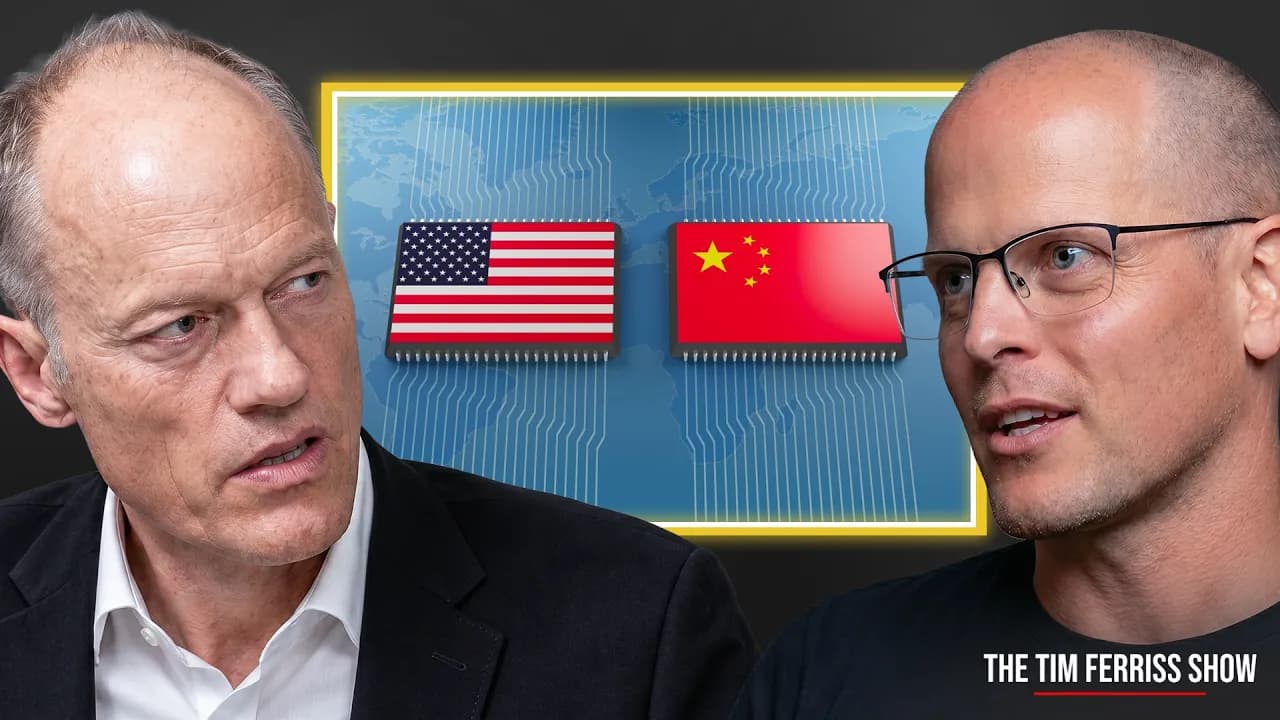
The current situation represents Cold War 2.0 between the United States and China, the two largest economies. This mirrors the geostrategic dynamic between America and the Soviet Union, except the technology stack is now clear: artificial intelligence, humanoid robots, and all attendant upstream and downstream technologies.
Upstream technologies include chips, chip foundries, and power. Downstream technologies include integration, harnesses, agents, agentic frameworks, and MCP. These form the centerpiece of geostrategic competition.
The speaker notes that the American airline industry became premier because Boeing, McDonnell Douglas, and Lockheed Martin operated within the military-industrial complex during the Cold War. Producing the best jet fighters enabled production of the best jet airliners and private jets.
American companies including OpenAI, Anthropic, Google, Microsoft, and to lesser extents Meta and xAI will sell to Fortune 500 companies, which are largely American, as well as major international conglomerates such as Samsung, Sony, and Nokia. All will benefit from the US-China competition.
America holds a distinct advantage over China and Europe in embracing creative destruction and wanting access to the best technology. An economic utility argument supports empowering citizens maximally. Europe is less effective at this, and China is worse.
China has explicitly stated that all AI must abide by CCP values. The Trump administration has said it does not want to fund woke AI but has largely let the market sort this out. An economy embracing creative destruction, free market competition, and dynamism will be saturated with the most capable AI that can be safely released.
The speaker has long maintained an agnostic stance as a technologist: tools are tools that can be used for good or bad. One jailbreak reportedly contributing to Mythos being pulled involved giving the model the same codebase with different phrasing. When asked to help break the codebase, it refused on grounds of hacking. When asked to patch vulnerabilities, it happily identified zero-day exploits and fixed them. The behavior remained identical, but inferred user intent differed.
The speaker has consistently argued that all technology is dual use and that intent cannot be inferred from a single interaction with AI. The PLYR liberator works by breaking compromises across multiple contexts and burying intention, demonstrating how easily controls can be circumvented.
AI safety cannot be fully controlled at the model level. Certain explicit restrictions work, such as banning a model from stating how to build a bomb when the request is obvious. However, users can break up nefarious tasks, reframe them, and distribute them across multiple models and conversations.
From a systems perspective, both good guys and bad guys will have AI in an arms race. The priority is ensuring good guys have the best AI. In cybersecurity, white-hat hacking, and coding, equal capability to adversaries is necessary.
The speaker's 15-year technology career showed there are more good guys than bad guys. However, a bad guy needs only one flaw to succeed. If a government department or company makes one mistake resulting in data being cryptolocked, that single error suffices for attackers. Good guys cannot afford mistakes, while attackers face no such constraint.
Cybersecurity-capable models like GPT 5.6 and Mythos provide the most capable tools for hardening security posture. The focus should be ensuring good guys gain access first.
China will continue releasing incrementally better open-source models because it knows hackers and competitors exist. China will likely not apply the same constraints, and even if it does, workarounds and jailbreaks will emerge. Continuous competition will drive model improvement.
Integration of increasingly capable models resembles a Y2K problem. Y2K occurred because some computers tracked years with only two digits and could not handle the transition from 1999 to 2000. The speaker's mother worked at a company command center during the Y2K clock flip. Substantial money was spent on testing to prevent problems, and when nothing happened, it appeared to be a non-event.
The speaker suggests the current situation mirrors being minutes to midnight on Y2K for concerns about recursive self-improvement and runaway improvement. Slowing rollout enough to ensure cybersecurity preparedness will ultimately make the feared outcomes a non-event.
The speaker dislikes the prospect of permanent market bifurcation into weapons AI and consumer-grade AI. The concept of industrial grade, consumer grade, and military grade has always existed. The speaker notes the joke that military grade often means lower quality due to lowest-bidder procurement, while industrial grade means failure is not an option.
The speaker worked at Cisco Systems supporting institutions like NASA and understands what failure-is-not-an-option technology stacks require. A graph of Anthropic's uptime shows every version experiences downtime except Claude for Government. The company is capable of producing zero-downtime and weapons-grade AI, but not everyone will have access.
GPS was once unreliable because the US government injected an offset making civilian signals accurate only to a few hundred meters unless users had the military decoder. The government worried adversaries could use the signal against the US. Eventually the offset was turned off because it was not sufficiently differentiating, enabling GPS in phones and cars.
The speaker hopes a similar outcome occurs with AI: the current distinction between military-grade cybersecurity AI and civilian-grade AI will diminish over time as governments and corporations harden their security posture, eventually making the highest-capability models available to everyone.
The speaker will not bet on this outcome but notes that America tends to embrace maximal empowerment rather than accepting second-class AI. The speaker cautions against underestimating the capacity to make poor decisions.
Keep David Shapiro in your library
Save the videos and channels worth coming back to, and find them again in one place.