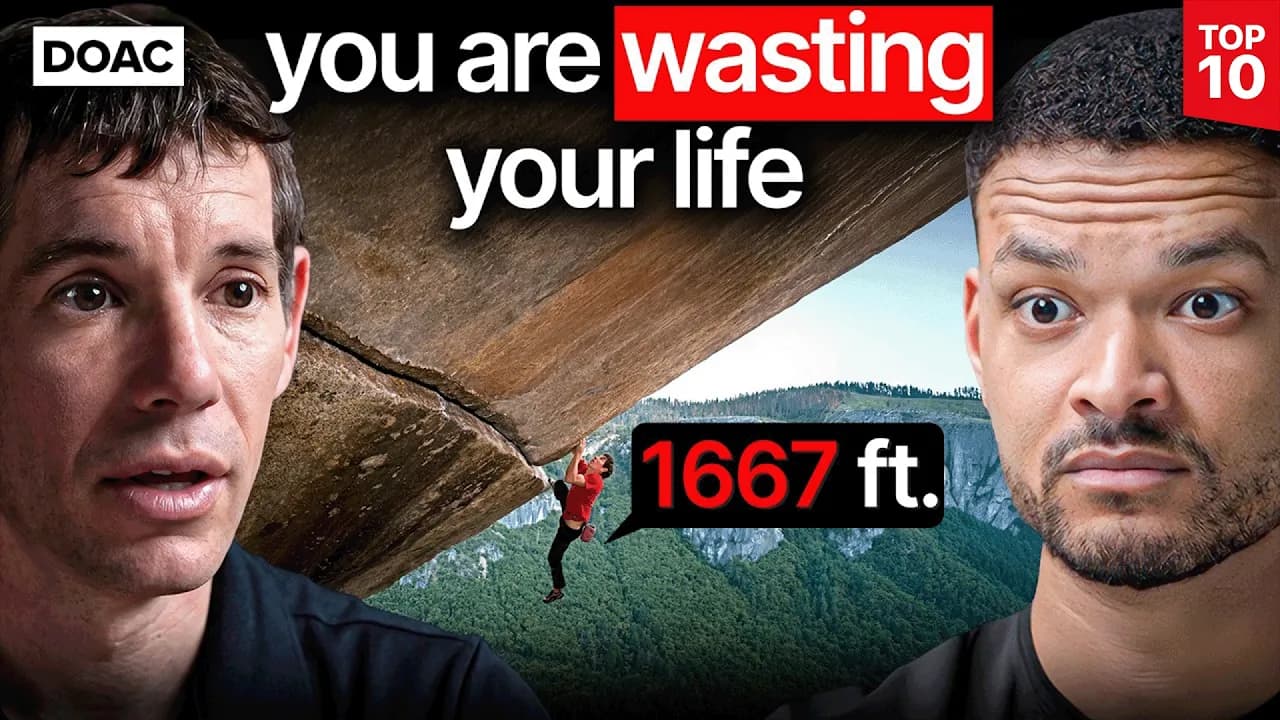
What really matters at the end of life (life & death discussion)
In a Nutshell
Alex's core message: measure happiness by how badly you want to stay alive rather than by fleeting emotions, and treat hopelessness as a lack of options that can be solved by building capacity through sleep, fitness, savings, and audience-building. He views death as returning to the state before birth—nothing to fear—and uses this perspective to live more ambitiously while recognizing that hard times and moods are temporary. The practical takeaway is to install daily contingencies (meaningful work, relationships, projects) that make tomorrow worth experiencing, and for beginners to trade time for money by offering services people need done.
These notes were generated by AI and may contain inaccuracies.
Many people who stop Alex in the streets mention that the life view content has helped them the most. Alex has struggled sharing these views because they are wild compared to most and generate the most heat, making it a double-edged sword that helps people but adds overhead without specific benefit to himself.
Defining happiness is difficult because different people give different definitions. Physical appearances of happiness like smiling or upbeat tone can be misleading, as some people who commit suicide seem happy to observers. People who choose to take their own lives are typically not happy. The opposite of not wanting to kill yourself is how badly you want to live, measured in terms of aversion to death.
Alex's lowest point was when he felt that if he didn't wake up tomorrow he wouldn't care, or when driving he had thoughts about going into the other lane. When asked if he was happy, his answer was that he is the most averse to dying he has ever been and strongly wants to stay alive. This provides a simple 1-10 scale measurement: 10 out of 10 is actively trying not to live versus 10 out of 10 actively trying to stay alive.
Solving for wanting to live makes the problem more concrete. This involves asking what contingencies could be installed in the environment that would make you want to live tomorrow. This includes whether there is interesting work and people you want to see tomorrow. Meaningful projects that make an impact create worthiness for tomorrow and increase the rating from negative 10 to positive 10 on the desire to live scale.
Alex notes that most entrepreneurs struggle with the emotional aspects rather than tactics. When everyone else is asleep and you're looking at the ceiling, there needs to be some level of worth it-ness in tomorrow to look forward to going through the onslaught again.
Alex shares that the fact he has a son coming has increased his quotient for wanting to stay alive, going from already really wanting to stay alive to wanting to stay alive even more.
When asked if an objective measurement for happiness would make community wealth less important, Alex agrees 1000%. Humans like to compete at anything quantifiable, and the more quantifiable it is, the easier it is to measure ourselves against others and create status. People play status games, not happiness games. If happiness could be quantified, that would be valuable, though it would need to be defined first.
When asked how to overcome hopelessness, Alex shares two things that helped him through hopeless periods. First was a deep conviction that as long as he continued focusing only on the task in front of him and distracted himself with work, he would eventually get through it if he did not stop. Second is understanding that hopelessness comes from a perceived lack of options, meaning you don't know what to do.
When you don't know what to do, you need to build capacity. Capacity includes physical capacity through sleeping earlier and getting more sleep, working out to get in shape, saving money to get offensive, and making content to build an audience. The people who maximize opportunities are those prepared for them. When you don't know what to do, you build capacity by digging the well before you're thirsty.
When asked if he would ever pursue philosophy or write a book on it, Alex mentions he has a draft of a book that is his opus. He believes philosophy is not something you can pursue in an ivory tower because that disconnects you from reality. Philosophy means lover of wisdom, and you cannot be wise without living in the world. The best philosophy should come from practitioners of reality, not academics.
Alex's views on death haven't changed much over 10-20 years. His simplistic view is that no one knows what happens after death, but the only comparison is when he was not alive before. We have been not alive for the vast majority of the 11 billion years of the universe, and things were fine during that time. He presumes that when he is not alive again, it will be the way it was before he was alive. He acknowledges this is his best bad guess and is open to being wrong.
Alex shares that hard times don't last, hard people do. You will survive and get through it. The human body keeps living as long as you have food, sleep, water, and air. Moods are more like the weather than concrete - they change, sometimes in minutes or hours, rarely more than a day. He views bad moods as cloudy days knowing sunshine is behind them, and advises not taking drastic action when feeling bad so you don't mess up tomorrow.
When asked about selling pasture-raised eggs from a family hobby farm, Alex notes that eggs are a commodity and must be sold in the cheapest way possible, typically to people closest to you. People buy eggs in person at farmer's markets or grocery stores through distributors. Shipping eggs online is not common. Alternative approaches include processing eggs and adding flavors to make egg whites for a more manufactured product, but basic eggs in shells require selling through established channels.
When asked what truth about death has changed how he lives and takes action, Alex shares he thinks more ambitiously. The constant reminder that you are going to die is important. He shares thoughts about alligators, his favorite animal since age six, noting they are 250 million years old and exceptional at surviving. Alligators eat every month or two months and spend the vast majority of their time managing body temperature by baking in the sun and cooling off, essentially chilling 24/7 while expending minimal calories.
Alex thinks about this when stressed, realizing that alligators haven't eaten in four weeks and it is not a big deal, yet they have been outliving humans. This perspective helps him realize that things stressing him out may not be as important as they seem.
When asked where beginners should begin creating capacity, Alex recommends learning the habits of work: going to sleep early, getting full night's sleep, and working out to get in shape when younger since it is easier to stay in shape than get in shape. The vast majority of time should be spent learning, both firsthand and secondhand learning.
For starting out, beginners should let people know about their service - something people don't want to do, don't have time to do, or don't have the knowledge to do. These are the three categories of services. Everyone trades time for money since you expend seconds of life and receive money over that time period. Start by doing one of these three things for somebody in exchange for money, do it as many times as possible until you have no more time, then raise prices. The extra money can be used to get help and scale.
When asked how to stay away from the allure of things that come with being popular like UFC events, sporting events, TV interviews, parties, and hanging with celebrities, the question cuts off without a complete answer provided.
Keep Alex Hormozi in your library
Save the videos and channels worth coming back to, and find them again in one place.