Where Demand Is Moving in Real Estate | Data Centers, Warehouses & AI
In a Nutshell
Real estate investors at Blackstone see warehouses and data centers as the key winners from two linked secular trends: e-commerce growth (which now requires 1 million sq ft of warehouse per $1B in sales) and the AI-driven surge in compute demand. Supply in both sectors is at multi-year lows (down 60-70% for warehouses, 1% availability for data centers), while demand from hyperscalers and automated logistics is surging, creating a powerful supply-demand imbalance. With property values reset >10% below peak and cash flows already recovering, they view the current moment as an early-cycle entry point into these “picks-and-shovels” assets behind AI and digital commerce.
These notes were generated by AI and may contain inaccuracies.
If you went back in time three years ago, we would not be talking about this. For every incremental $1 billion of e-commerce sales, you need an additional 1,000,000 square feet of warehouse space. So in summary, not going away anytime soon. If you look over history, this is a pretty good entry point. I think that today is a good time to be an investor into the sleeping giant. Every investor is always searching for the next big thing or asset class. The goal simply to get in early. At Blackstone, we're seeing exciting indicators about just what that might be.
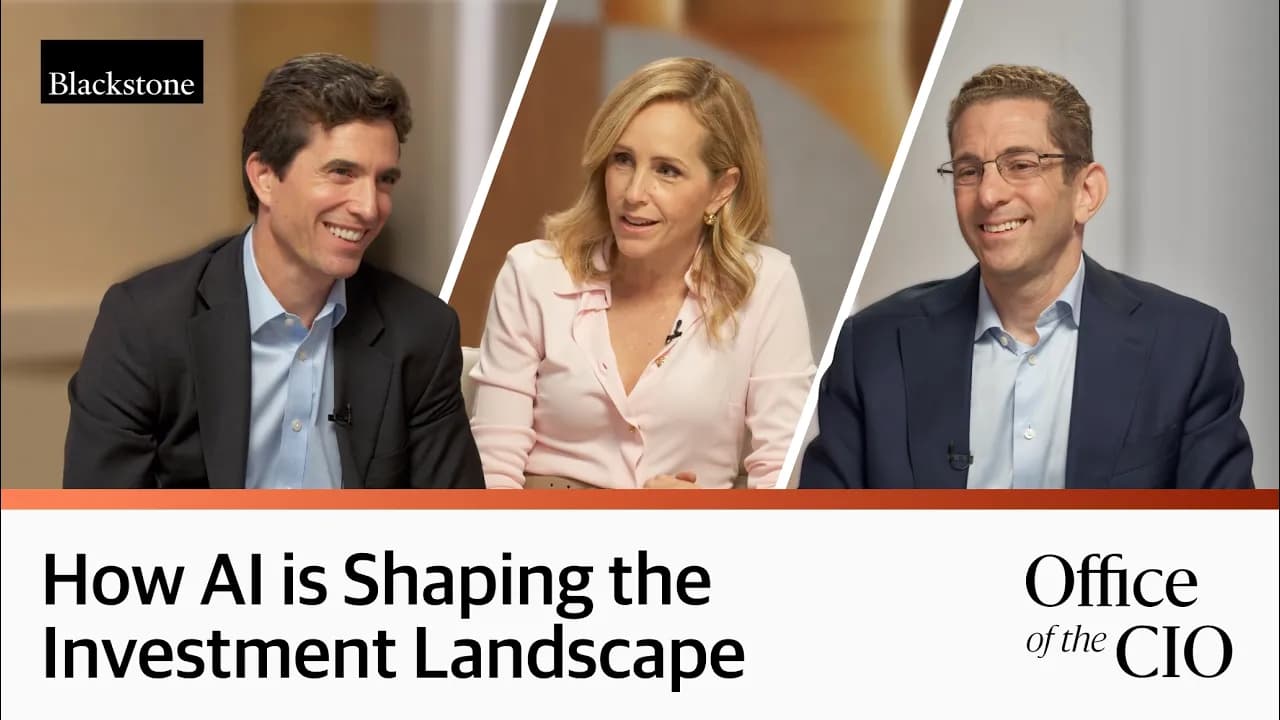
Here to talk us through that opportunity within real estate and break it all down is David Levine, Global Co-Head of Real Estate. And A.J. Agarwal, President and Director of Blackstone Real Estate Income Trust or BREIT. Thank you both for joining. Great to be here.
AJ I'm going to start with you. You've been at Blackstone 36 years and you've lived through quite a few cycles. So I'm curious what are you seeing today in real estate? Let me start by saying how people use real estate, how people interact with real estate is constantly evolving, how people work, how they live, how they shop, how they play. It's always changing. And that affects demand for real estate. And our job as investors at Blackstone is to think through this changing behavior, changing technology and position the real estate investing that we do to be ahead of that curve, ahead of those shifts.
As an example, if you go back ten years, 15 years ago, a big debate around real estate was e-commerce. What was happening with online shopping? What was the impact going to be on shopping malls? How much of shopping would actually shift online away from the mall? And as people were trying to debate how much harm was going to be caused to shopping malls, at our firm, and David was in front of this, we were thinking about who could be winners. And what we figured out was that, for example, online shopping may be harmful to shopping malls, but it's actually really beneficial to warehouses. You need certain types of physical real estate to basically transport goods from manufacturers to the end consumer to their porch.
Today, I would say we're looking at new things, new changes. We're seeing how people's changes in terms of how they work affects office. We're seeing how the change in how data is calculated, computed or stored driving the need for data centers, which didn't really even exist as an institutional asset class 10, 15 years ago. So our job is to just really be thinking constantly about what's changing and be ahead of that shift in terms of our real estate portfolio.
David, you and I joined the firm around the same time. You've been here 17 years and you were sort of there at the, at the, at the beginning when we were starting to lean heavily into logistics. I'm curious sort of what you saw and then what it prompted you all to do. Yeah. So look, we started buying in 2010, and I remember when you would look at our list of top tenants, there was this small company that was called Amazon, and they were toward the bottom of our top ten list. And I'd say every board meeting that we came back, they started slowly moving up. And eventually they became the top tenant. And, you know, at Blackstone, I'd say, broadly speaking, we're always looking at our data across our broad business, which is obviously very global. And as we see things in the data that are blinking green signals that tell us to go, we try to act on that.
So as we saw Amazon increase their share and this meteoric rise of e-commerce, we started to invest more capital behind that. So you're seeing this small bookseller start to all of a sudden show up in more places. Yeah, absolutely. And look, again, if you look back in time, e-commerce as a percentage of total retail sales was only about 4% when we started buying. Today, that's about 20%. So it's moved a lot. And this space continues to evolve with AI and automation and robotics. So curious to see how you're seeing it evolve even today.
I think one thing that we're starting to observe a lot is something called agentic e-commerce. What is that? Yeah. So obviously everyone reads in the news a lot about AI. And you know, if today or let's say yesterday I were to go buy something on Amazon, I would go on the website, I would do a dropdown menu, I would click I need two bottles of shampoo and some razors and some diapers for my daughter. And I would click and maybe that same day or next day those items would arrive. What agentic e-commerce is going to do is basically understand your habits, understand your patterns, understand what you might need, when you might need it, what that cadence is, and then it will automatically be shopping for you. This has already started. It's very nascent. It's very early days. But as you think about what that means, not only for e-commerce and businesses like Amazon and all of us getting our goods without having to think about it, but all of those interactions have to come from somewhere, they emanate from somewhere, and those will come from a data center. That is the big revolution that we're all talking about. This is just one sliver of that. And it's obviously a space that across the entire enterprise here at Blackstone, we're very focused on. It'll be a pretty amazing thing, when that AI starts to know when you need the bigger size of diapers too. I wonder if if that's in our future. Yes. I'm nervous.
Now, there are two asset classes within real estate that are much more connected than I think I expected, which would be these warehouse assets and our data center assets. So, AJ, I wonder if you could talk to us a little bit about the connection between the two. Well, as David mentioned, we did see that with e-commerce, it drove the demand for warehouses. In fact, we see that for every incremental $1 billion of e-commerce sales, you need an additional 1,000,000 square feet of warehouse space. So there is clearly a linkage between e-commerce growth and the need for more warehouse space. What people don't fully appreciate is that when you go to Walmart.com or you go to Amazon.com, these websites are actually hosted in the cloud, and the cloud is not up there someplace. The cloud is on the ground and it's a data center. So e-commerce, interestingly enough, not only drives incremental warehouse demand, but it also drives incremental cloud or data center demand.
The hyperscalers this year are going to spend something like $800 billion on CapEx. And the lion's share of that is going into data center. So AJ's right. We have seen about 15% of all new leasing across our US logistics business come in the form of data center related uses. If you went back in time three years ago, we would not be talking about this. That would have been basically 0%. And I think one of the unique advantages that we have is, you know, we are the largest data center developer in the world. As a result, we have really good visibility into where these projects are going to be built. And thus, as we think about where we want to deploy or invest capital, we can really focus on the markets that we think will disproportionately benefit from what's going on.
So can you can you expand on this supply and demand imbalance? We have a massive imbalance. This is actually true not just for these two asset classes, but I think AJ and I would both agree that one of the most interesting parts of investing in real estate at this exact moment in time is we are at a cyclically low level of new supply, really a decade plus level low, something we really haven't seen since coming out of the GFC back in 2010 when we actually started buying warehouses. So, you know, in the warehouse business, we're down 60 or 70% from the peak in terms of new deliveries. It's just not keeping up with the demand, new builds. It's not keeping up with the demand that we're seeing. And in the data center space, there's a massive imbalance in terms of the demand for compute that is coming from these hyperscalers, which is driven by margins that are quite healthy. Because all of this AI spend is translating into big productivity gains for companies like Blackstone and many others. So it's very profitable. The challenge they're having is that it's really hard to find sites. It is really hard to find land. It is hard to zone and entitle these sites. It is hard to get the materials. The scale of these projects is massive. I mean, there is just not enough being built. So the supply that's out there becomes incredibly valuable. Incredibly, in both sectors.
Now, for us, when we think about warehouses and we think about data centers, which, by the way, are about 50% of our portfolio in our flagship $60 billion equity real estate fund, US real estate fund for individual investors. When you look at those two sectors, the imbalance between demand and supply are extreme. Occupancy nationally, David, for where data centers in America? Yeah, it's basically 1% availability. Almost nothing. 99% occupancy. And what we're seeing is upward pressure and occupancy and warehouses as demand is growing faster than supply. And we certainly see the digital transformation, whether it's e-commerce, whether it's the cloud, whether it's AI driving different needs for real estate. But we do believe that, for example, warehouses, data centers are on the winning side of that. So in summary, not going away anytime soon.
So talk to me a little bit about where you think we are in the real estate cycle. Obviously we're in the midst of a recovery. Where do you, where do you see us right now? Yeah. Look, I think we believe strongly that we are in the very early days of what should be a multiyear recovery in the real estate cycle. And I'd really look at it in two ways. I think on the fundamentals to start, we've already talked a lot about supply, but the decrease in supply across pretty much every single sector we invest in should not be underestimated. And as we look forward, we don't really see that changing because it's only gotten more expensive. So you've really solved the supply side of the equation. And then if you look at the demand side, aside from just the longer term secular tailwinds, things like e-commerce, things like this digital revolution we're seeing, if you just look at the US economy, because that is obviously quite important when we think about demand tailwinds overall in real estate, unemployment is close to 4%, which is quite low. You have GDP growth in the mid twos. And we do think that all of this on shoring, manufacturing, all of the jobs that are getting created and these are very high paying jobs, that leads to more consumption. We think it will just lead to this flywheel of sorts. So we feel quite good about the supply demand fundamentals.
If you look at real estate and where we go from here, we have already reset values down. They have lifted off a little bit, call it about 9% across just US real estate from the bottom, but they remain more than 10% below where they were, you know, at the most recent peak. So we think it's a really good entry point. And when you layer on that lack of supply, if you look over history. This is a pretty good entry point. So needless to say very positive on where we are at in the cycle.
You spend a lot of time on the road with our clients talking about why you want to invest early in a cycle. What is it that you tell them? Well, I think there are a few things. David alluded to them. First of all, we've seen reset prices in US real estate. We are more than 10% below our 2022 levels. Meanwhile, and almost every other asset class in America, equities, were materially higher than 2022 levels. So good relative value. By the way, in many asset classes today, you can buy a piece of real estate, an apartment building or a warehouse for less than it costs to build which means below replacement costs. So for us, that is also a signal of good absolute value. And by the way, is we are seeing the cash flows in the US real estate grow. If you take a look at the same store, net operating income or EBITDA growth for publicly traded REITs, for example, is at the highest level that it's been at in more than three years. And we're also seeing improving cash flows inside of our private real estate portfolios. And then, as David mentioned, the other ingredients for recovery exist. We have debt markets that are open banks, private capital sources, CMBS markets lending at attractive cost, and that's leading to more transaction activity. And then lastly, I think you're seeing just more capital, both institutional and individual, flowing back into real estate after three or so tougher years when we didn't see as much capital flowing back into it. Interestingly enough, year to date the US REIT index, the publicly traded US stocks are actually outperforming the S&P. So you can see equity capital flowing back in.
Exactly. So is real estate across the board improving? I would say not all real estate is created equal right now. I would say you really have to pick your spots. And I would say we have different levels of conviction in different areas, both across sectors and geography. And what we really pride ourselves on doing here at Blackstone is using the data and analyzing a whole bunch of data. We own 13,000 different assets across our business. That provides us with a lot of real time proprietary insights. Then we look at that data and that guides how we deploy and invest capital. It starts to give you real signal on where the world is going. Yes. Yeah. And I would say one thing that I think we pride ourselves on is we are intentionally not pie chart investors. So as AJ mentioned earlier, logistics is around 40% of our total exposure around the world. That is a larger slice of the pie. But that is very intentional. And that's because what we use to guide our decision making is really data. And when we see megatrends or secular tailwinds like e-commerce, we move fast with conviction and in scale.
Exactly. So we've covered a lot. I'd love to just hear three takeaways that you think we should leave everyone with about about real estate and what you want them to know. Yeah. Like I'd say one sort of getting to the point we just mentioned. We do think we are in the early stages of a multiyear real estate recovery, really largely underpinned by very favorable supply demand fundamentals. I'd say two is, as AJ alluded to earlier, every one of these digital interactions and there are going to be a lot more going forward. They all require physical real estate. So more compute, more power means more data centers and more warehouses. And then I think logistics is probably the sleeping giant in all of this. As we think about just the growth of e-commerce, the AI ecosystem that is just getting going. We think investing in both of those asset classes is a really good place to be. Our jobs on behalf of our clients, our investors, is really to watch what's happening with consumer behavior and with technology trends, and to think about these hard, physical, cash flowing assets that are going to be on the winning side of long term macro secular trends. On the winning side of e-commerce, on the winning side of cloud growth, on the winning side of AI growth. And I think that today is a good time to be an investor into the sleeping giant that David alluded to, which is warehouses or logistics, as well as to be invested in the cash flowing assets that are basically the picks and shovels behind all of what's happening within AI. And whereas I don't know which direction it's going to be in, we have a lot more confidence that the compute capacity at data centers are going to be mission critical to make sure that whoever is the winner in these AI applications, you know, they do still need data center capacity.
Keep Blackstone in your library
Save the videos and channels worth coming back to, and find them again in one place.