Why Almost All of the Ocean is Still Unexplored?
In a Nutshell
The ocean's vastness—covering 71% of Earth—remains almost entirely unexplored, with less than 5% seen by humans and better maps existing of Mars than our seafloor. Extreme pressure, darkness, and depth create inaccessible zones where thousands of unknown species likely exist, including massive creatures and unique chemosynthetic ecosystems around hydrothermal vents. This unexplored frontier holds 3 million shipwrecks, unidentified biological sounds, and entire ecosystems that may vanish before discovery due to climate change.
These notes were generated by AI and may contain inaccuracies.
Standing on a beach reveals that everything known fits on the 29% of Earth not covered in water. The ocean covers 71% of the planet, yet almost none of it has been seen by human eyes. Better maps exist of Mars than of Earth's ocean floor. Humans have been sent to the moon six times, while less than 5% of the ocean directly beneath has been seen.
The ocean consists of distinct layers rather than a single entity. The sunlit zone extends to 200 meters and represents the explored portion with warm water, light, and recognizable creatures. The twilight zone spans 200 to 1,000 meters with dim conditions and pressure sufficient to crush a human body. Creatures in this zone exhibit bioluminescence through tiny pulses of blue and green light.
Below 1,000 meters lies the midnight zone with complete permanent darkness, pressure 100 times surface levels, and temperatures just above freezing. The abyssal zone begins below 4,000 meters, derived from the Greek word for bottomless. The Hadal zone occupies the deepest trenches, named after Hades, with the Challenger Deep in the Mariana Trench reaching nearly 11,000 meters. Mount Everest dropped into the Mariana Trench would leave its peak more than a mile underwater. Humans have been sent to this depth exactly three times in history.
At sea level, atmospheric pressure measures 14.7 pounds per square inch. At 10 meters underwater, pressure doubles. At 100 meters, pressure reaches 10 times surface levels. At 1,000 meters, pressure becomes 100 times surface pressure. At the Mariana Trench bottom, pressure exceeds 1,000 times surface pressure. A styrofoam cup attached to a deep-sea submersible compresses to thimble size under these conditions.
Exploration vessels require perfect sealing, pressurization, and maintenance to withstand these forces. These vessels accommodate one or two people maximum with limited battery life and oxygen supplies. The Titanic at 3,800 meters required specialized robots working days to document a single shipwreck. Current mapping rates suggest thousands of years would be needed to map the entire 361 million square kilometer ocean floor.
The deep ocean represents the largest living space on Earth by volume, comprising more than 95% of habitable planetary space. Scientists estimate 700,000 to 1 million ocean species exist, with approximately 250,000 formally identified. A new whale species was discovered in 2021, demonstrating that even large creatures remain undocumented.
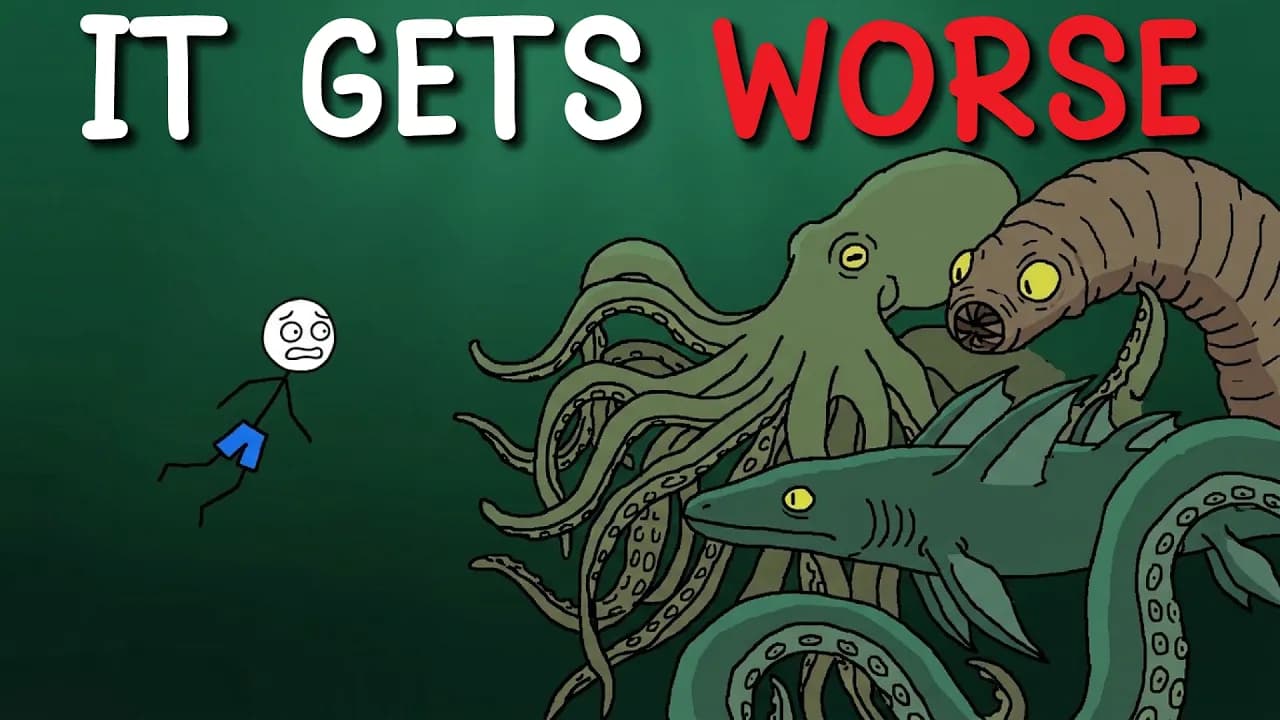
Documented deep-ocean species include the giant squid reaching 13 meters in length with eyes up to 30 centimeters in diameter, photographed in 2004 after centuries of dismissed sailor reports. Giant isopods grow to 50 centimeters, scavenging whale carcasses and dead fish on the abyssal plane. The Dumbo octopus uses ear-like fins for movement and lives deeper than most octopus species in complete darkness.
Hydrophones placed in the Mariana Trench in 2018 recorded unidentified biological sound sources during three weeks of monitoring. These sounds possessed biological characteristics but matched no identified species.
In 1997, NOAA recorded the Bloop, an extraordinarily loud low-frequency sound traveling thousands of miles through water, detected by sensors over 5,000 kilometers apart. Initial analysis suggested biological origin before eventual attribution to Antarctic ice quakes after a decade of investigation.
The 1977 Alvin submersible expedition near the Galapagos Islands discovered hydrothermal vents instead of the expected barren rock. These vents emit superheated water above 400°C containing hydrogen sulfide and minerals. The pressure prevents boiling at these depths.
Surrounding ecosystems include 3-meter tubeworms, eyeless clam shrimp navigating via heat receptors, and chemosynthetic bacteria deriving energy from chemicals rather than sunlight. This discovery established an entirely separate food web independent of solar energy.
The 2014 Malaysia Airlines Flight MH370 disappearance prompted a two-year multinational search costing hundreds of millions of dollars. Poor ocean floor mapping in the Southern Indian Ocean forced search teams to work blind, discovering previously uncharted mountains and valleys. A 60-meter Boeing 777 aircraft remains largely unrecovered despite satellite technology and global communication systems.
An estimated 3 million shipwrecks rest on the ocean floor, most unfound and many containing ancient cargo or hazardous materials. World War II vessels continue corroding and potentially leaking fuel into unmapped regions.
Rising ocean temperatures and acidification are altering deep-sea conditions before most ecosystems have been documented. Species and ecosystems may disappear before discovery occurs.
The ocean contains pressure capable of collapsing lungs in seconds, bus-sized creatures with unknown evolutionary histories, ecosystems independent of sunlight, unidentified recorded sounds, three million shipwrecks, and unknown species numbers across planetary volume barely touched in 300,000 years of human existence.
Keep Axen in your library
Save the videos and channels worth coming back to, and find them again in one place.