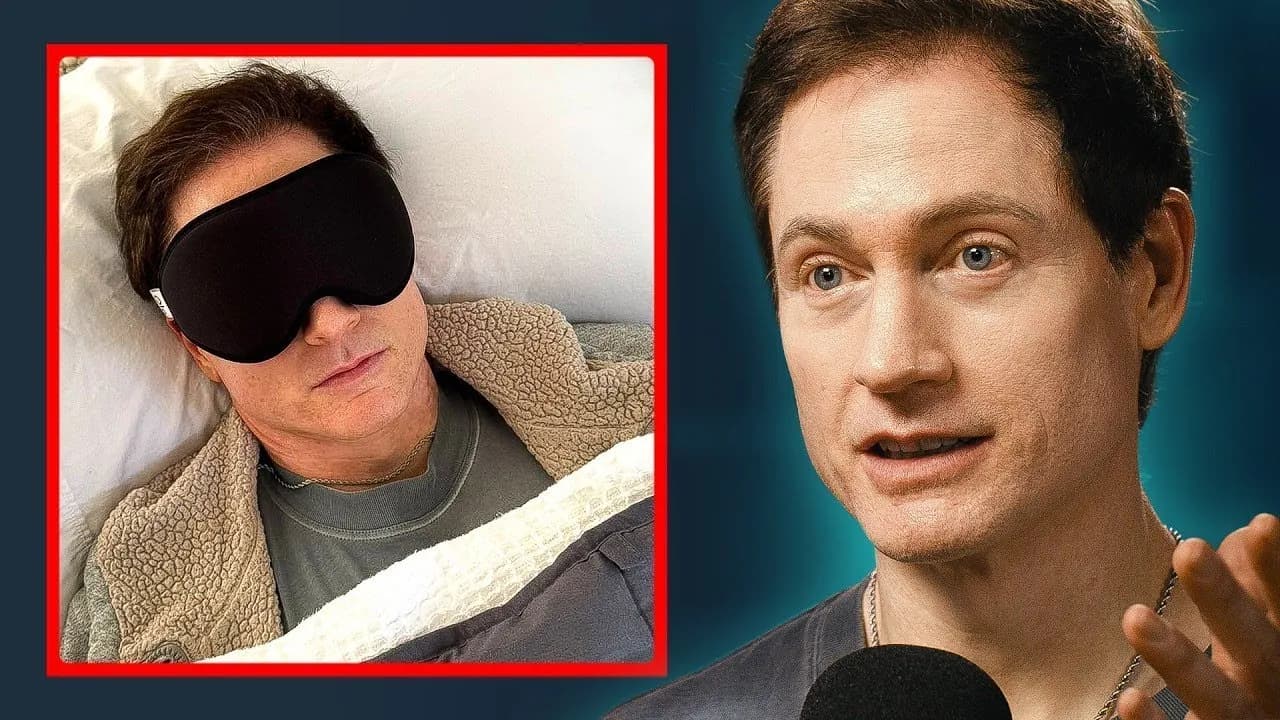
Why You Can’t Sleep (and How to Fix It) | Dr. Michael Grandner
These notes were generated by AI and may contain inaccuracies.
Video Notes: Why You Can’t Sleep (and How to Fix It) | Dr. Michael Grandner
Sleep apnea is shockingly common. One out of three people in the US has some sort of sleep complaint or problem. Untreated sleep apnea can lead to liver problems, kidney problems, brain problems because every cell that relies on oxygen starts getting stressed.
Tips on advanced sleep hygiene: The enemy of sleep is effort. Sleep is something that happens to you when the situation allows for it.
Supplements for sleep: Top supplement is melatonin. Some people take the wrong dose at the wrong time.
Best evidence-based way to fall asleep and stay asleep.
Dr. Michael Grandner directs the Sleep and Health Research Program at the University of Arizona. His research focuses on sleep science, behavioral medicine, and using sleep as a performance enhancer for athletic and cognitive performance.
When patients report insomnia, distinguish between casual sleep difficulties and insomnia disorder (like lowercase i vs. capital I insomnia, similar to depression).
Criteria for insomnia disorder:
- Persistent difficulty initiating or maintaining sleep or waking too early.
- Occurs at least 3 nights per week.
- Lasts at least 3 months for chronic insomnia.
- Causes daytime functioning problems.
- Adequate opportunity for sleep (self-deprivation isn't insomnia).
- Rule of thumb: Takes at least 30 minutes to fall asleep or awake for 30 minutes during the night.
Occasional difficulties don't qualify; it must interfere with function.
Underlying causes:
- Acute insomnia: Unlimited causes, often stress/hyperarousal (evolution keeps us awake when survival is threatened).
- Chronic insomnia: Only one cause—conditioned arousal. Initial trigger becomes irrelevant; like a ball rolling downhill due to gravity and momentum.
Switch from acute to chronic insomnia is conditioned arousal. Original cause (e.g., work stress, relationship issues) no longer relevant; insomnia takes on a life of its own.
Example: Stress causes lost sleep → effort to recover sleep in bed → arousal systems activate → bed becomes predictably stressful → brain patterns "sleep is difficult/stressful" → even when tired, bed triggers arousal.
Brain is a pattern recognition machine.
Analogy: Dentist's office—predictable stress creates arousal before stimulus (waiting room anxiety). In bed, activation prevents sleep, strengthening the bed=stress link. Self-perpetuating cycle: stress about not sleeping creates activation that prevents sleep.
Best treatments reprogram the cycle, not sedate.
CBTI (Cognitive Behavioral Therapy for Insomnia) targets conditioned arousal. Stimulus control (published 1972) reprograms bed=sleep association.
If bed only for limited activities (sleep/sex), it becomes predictable like gym for workout.
Opposite: Multi-use spaces (e.g., dining table for eating, work, TV during pandemic) dilute predictions.
Bed=sleep pairing demo:
- Bed → sleep (predictable).
- Bed, sleep/wake/think/scroll → unpredictable.
Human brains love patterns; control bed side if can't control sleep yet.
CBTI is multicomponent toolbox like physical therapy—teaches body to sleep (innate ability blocked).
Insomnia like trouble breathing—you were born knowing how; something's in the way.
Sleep-wake not unidimensional: two signals (treble/bass)—sleepiness and wakefulness operate independently.
Insomnia often excess wake signal, not low sleepiness. Sedatives boost sleep signal to overpower wakefulness, potentially breaking cycle long-term.
CBTI targets activation (reduce wakefulness), not just sleepiness.
Teaches control over sleep ability and when to surrender control.
Analogy: Stomach bug—no appetite, no panic about starvation/malnutrition; system self-corrects.
Temporary sleep loss same—stress interferes. Overcorrecting worsens.
Stimulus control for phone/scrolling/ruminating in bed:
- Separate phone from bed.
- If needed near bed: Stand next to it (stay connected to body signals; head bob or frustration signals readiness).
- Or sit up (propped, no pillow/blanket)—detect head bob.
Sleep is something that happens to you when the situation allows for this.
If can't sleep, get up—don't force like staring at unappetizing food.
Causes: Physical discomfort, untreated sleep apnea (sudden awakenings), natural events.
Awakening shakes snow globe (arousal settles naturally; poking prolongs). Stress escalates ("What if up all night?"); mind overrides body.
Solution: Surrender control, get up, wait to resettle, try again. Shortens awakenings. Even full-night awake: System corrects next day (like skipped meal increases hunger).
Key to stimulus control: Surrender performance anxiety/fear—enemy of sleep is effort. Effort adds energy.
Athletes especially vulnerable
Athletes are especially vulnerable because they are trained to gain control over their body in ways most people aren't. There's always a solvable problem, like injury recovery—sometimes you can't make it go faster; you must give it time. Sleep is a similar process outside your control; trying to control it makes it go slower.
Original publication called it restriction of time in bed. Concept: simple but difficult in execution. If spending 8 hours in bed but only 6 asleep, restrict to 6 hours time in bed. See if you can fill it, then slowly increase. More increasing than decreasing overall, but initial decrease.
Broccoli Analogy
Like a kid not eating broccoli: don't give 20 pieces if they eat 1-2. Start with 2 pieces they can eat. Next day, 3 if still hungry. Build up hunger by not giving extras. With sleep: don't stay in bed when not sleeping. Initially may reduce sleep short-term (days to weeks), but drives up natural sleep pressure. Separates wake time from bed time. Bed becomes associated with not staying awake. Overcomes mental blocks; get hungry enough to sleep fully, then introduce other activities.
No phone in bed—part of stimulus control. Make bed (head on pillow, under blanket, eyes closed, nose breathing) predictably tied to quick unconsciousness.
Benefits of Training
When you get good at that, you're using the prediction not just to solve a problem, but to create a benefit.
Even stressed with big day tomorrow: get in bed, fall asleep. Gives control. For early wakeup (practice), use environment as conditioned stimulus for sleep.
What’s Allowed in Bed
Sex is fine (in or out of bed; often helps sleep, not time-consuming). Phones biggest distraction—add energy instead of removing. Brief relaxation OK (not hour-long routine, erodes association). Not banning phones, but safe use: another room, sitting/standing. Create boundaries half-hour before bed: switch to non-mentally activating content (e.g., avoid anger-inducing news). TV not live anymore—control exposure.
Rule of Thumb for Media
If alarm says turn off now, can you? Yes = OK in buffer time. No (five more minutes, want to see end) = do earlier. Scrolling OK if can put down easily; not if loses half-hour unnoticed.
They work by overpowering barriers with massive sleep drive. Easier to prescribe than CBT-I (any primary care can). All medical orgs (NCAA, IOC) recommend CBT-I first. Every study shows it works reliably well:
- Chronic pain, fibromyalgia, cancer (better in survivors, more motivated).
- Sleep apnea (even pre-treatment).
- Older/younger people.
Retrains sleep, removes barriers ~85% of time (not 100%). Doesn't add hours (nor do pills). People lack access/good info/flexibility.
Accessing CBT-I
Can self-do basics:
- Bed = sleep.
- Get out if not sleeping.
- Compress time in bed opportunity, expand once filled.
Art to it; some need trained provider. Few trained despite evidence. Online automated versions (by-the-book). Telehealth anywhere in your state. Directories for board-certified (not normal training; must prove competence).
~1/3 US population has sleep complaint (falling asleep, staying asleep, not refreshed). ~1/10 meet insomnia disorder criteria. Many self-fix unhelpfully, frustrate, stress sleep, give up ("worst sleeper ever, tried everything"—6-8 sessions fix).
Shockingly common:
- 1/4-1/5 men >30; 50/50 if BMI >30.
- Women: 1/15-20. Higher BMI/mass (muscle/fat/tongue/cheeks) crowds airway.
Human airway: 90° angle (vs. straight in mammals) causes narrowing vulnerability.
Normal: 4-5 breathing pauses/hour. Mild apnea: ≥5. Moderate: ≥15. Many mild asymptomatic.
Especially if not sleepy:
- Wake mid-night "due to stress," hard to fall back (stress superimposed; actual respiratory event → failed airway opening → adrenaline/gasp/snort → racing mind).
- Shallow/fragmented sleep unexplained.
- Not refreshed despite more sleep ("empty calories").
Athlete Anecdote
Olympic trials athlete: not meeting times despite fastest; intuition something blocking. Shallow sleep, up few times. Had mild sleep apnea—treated, fixed. Otherwise missed for decades.
Normal: wake 10+/night (unremembered, brief). Red flags:
- Remember 3-4 awakenings.
- Gasp/snort.
- Not refreshed.
Low screening threshold (common; rules out early). Home tests easy (no lab unless narcolepsy/limb movements/complex medical). Finger oximeter → now wrist strap/strap-on.
Measure oxygen/respiration drops. False negatives possible (less sensitive); lab if negative but symptomatic.
Sleep Apnea Diagnosis and Differentiation
They measure your oxygen levels during the night and how your respiration is tied with your O2 because respiration drops during the night, so does O2 a little bit. But if respiration is dropping and O2 starts dipping then recovers, patterns show if someone has sleep apnea.
For obstructive sleep apnea, especially mild to moderate, home tests with straps have a gyroscope measuring breathing on side vs. back. Many cases are positional (worse on back).
Positional Therapy
- Simple fixes: strap/belt with bump on back (modern tennis ball in t-shirt).
- Roll off back when asleep; can't consciously control position.
- Diagnose positional easily; treat then retest to confirm resolution.
Allergies and Nasal Congestion
- Sleep docs check nostrils, nose, airway, mouth, soft palate, tongue.
- Flonase or similar clears nose, but obstructions are usually at 90° angle in airway (back of tongue), not nose.
- Snoring not nose-based; worse on back due to gravity, mouth opening, tongue blocking.
- Physical exam identifies; rare cause despite being easier fix.
Sleep Stages Overview
- Stage 1: Ultra light sleep (nod off, hypnic jerks; normal, harmless).
- Stage 2: "Normal/vanilla sleep"; >50% of night; most brain work (not light sleep).
- Stage 3/N3/slow-wave/deep sleep: Big/slow brain waves; highest arousal threshold; muscles relaxed; growth hormone secreted (key for athletes); protected/frontloaded early night; resistant to deprivation.
- REM sleep: Dreams/nightmares; peak brain blood flow (wake-like activity); low arousal threshold; paralysis (alpha motor neurons hyperpolarized to prevent acting out dreams); eye movements (mixed data on dream correlation); sleep paralysis when wake during REM.
Sleep Cycles and Functions
- Cycle every ~90 minutes (varies; Google for details); frontload deep sleep, later more Stage 2/REM (longer REM, vivid dreams/nightmares—defined as dream waking you).
- Deep sleep: Synaptic pruning/homeostasis; filter day's info (keep important, fade junk); brain cell spaces increase for waste clearance (e.g., early night).
- REM sleep: Synaptic strengthening/connection building; rewire using kept info (dreams as brain processing/filing in metaphors/concepts without rules).
- Stage 2: Recovery/repair (muscles, etc.); bridges other stages.
If you wake remembering dream, woke from REM.
Dream Hypothesis
New info sorted in deep (discard unimportant); REM attaches to memories/concepts (illogical, rule-free: car=person=house, etc.).
Dr. Grandner: Dreams read "between lines" of life; brain uses shortcuts/blueprints (minimum info + assumptions). Dreams explore unspoken connections (memory vs. experience; who you are from history).
- Artificially reduces slow-wave/deep sleep (can't detach; body alerts).
- Increases Stage 1; more shallow overall.
- Reduces REM (respiratory muscles weaker; snoring worse late night).
- More arousals/awakenings; feel unrested (like hungry after meal).
Links to Neurodegeneration
- Untreated sleep apnea risk for neurodegeneration (severe: ≥30 events/hour; mild/moderate gray if daytime symptoms).
- Disrupts deep sleep waste clearance (amyloid beta 42 aggregates).
- Not sustained hypoxia, but intermittent hypoxia: O2 drops few points, recovers repeatedly → constant reactive oxygen species/oxidative stress (cells stressed, no recovery).
- Leads to cell death, liver/kidney/brain/heart/immune issues.
- First: vigilant attention (sustained focus on boring tasks)—warning sign.
- Then memory/emotion/executive function (sleep key for sorting/consolidating info).
- Attention deficit → no info to store/process.
- Sedating meds impair attention/memory indirectly.
Sleep productive: recovery like post-workout; well-rested > sleep-deprived productivity.
CPAP: Effective blunt instrument (air pillow keeps airway open). Long-term adherence challenging.
Best evidence-based non-CPAP interventions discussed next.
CPAP creates a pillow of air so if the airway wants to collapse, it can't. CPAP is continuous positive airway pressure: continuous because it's blowing continuously; positive airway pressure (blowing) as opposed to negative pressure (sucking). It continuously blows air into the airway to keep it open. It's a blunt instrument: blow enough air and the airway won't close. For some, it's uncomfortable, so other approaches exist.
Mandibular Advancement Devices
Especially for athletes with mild to moderate sleep apnea, mandibular advancement devices are like a retainer worn at night that pushes the jaw forward. It creates muscle tone to keep the airway open without waking you. For mild sleep-related breathing issues, it knocks out enough events so you don't notice them. Easier than CPAP: no plugging in, no hose replacement. Needs adjustments as jaw remodels. Done via sleep dentistry (sleep medicine dentistry, not sedation dentistry) for diagnosing and treating sleep apnea with dental devices.
Other Options
- Myofascial therapy: Exercises muscles for more tone.
- Didgeridoo playing: Cyclical breathing strengthens muscles for more tone even asleep; helps mild apnea.
- eXciteOSA: Device on tongue when awake electrically stimulates tongue muscles (like TENS unit) for more tone at bedtime.
- Inspire device: Implantable like a pacemaker for tongue muscle; surgery required; zaps tongue when it falls back. No equipment replacement but surgical complications possible.
More options than ever; technology improving. Over 200 CPAP masks; most mask issues fixable.
Chin straps (elastic bands at night) used for decades for mild snoring without apnea, or mild apnea from mouth opening causing tongue fallback (if can nose breathe). Mouth taping keeps mouth closed; special tape allows airflow. Fine if problem is mouth opening. But if sleep apnea requires mouth opening to breathe (oxygen plummeting), avoid it. Not for curing severe issues. Overblown; mainly for snoring or with nasal aids like strips or Rhino nasal splints. If keeping mouth closed solves problem, great; otherwise, other options exist.
- Daytime feel: energy, focus, no falling asleep when stopping (e.g., TV, movies, meetings); normal appetite.
- Not perfect: some treated but symptoms persist (brain effects unclear).
- Best: retest sleep study, especially after years or for insurance on devices (check adjustments).
- Future: wearables for oxygen, heart rate spikes.
- Most important: how you feel next day.
Sleep hygiene sets up success for minor problems (like handwashing prevents but doesn't cure infection). Everyone should do it. CBTI is medicine.
Advanced Sleep Hygiene Tips
- Regular schedule: Brain loves predictability; time becomes cue (e.g., hunger at noon).
- If impossible (e.g., MLB players traveling): Build other predictability.
- Nighttime routine: same things in same order (even different places/hotels).
- Bring conditioned stimuli: pillowcase, same toothbrush.
- If impossible (e.g., MLB players traveling): Build other predictability.
- Avoid bright light at night: If can't, use blue blocking glasses (orange/red tinted; must block blue fully – if can't see blue color, works circadianly; not just eye strain blockers).
- Morning bright light (outdoor daylight, thousands lux):
- Starts clock: strong signal at predictable time; 16-17 hours later, sleep ready.
- Builds circadian amplitude: strong day → strong night rhythm.
- Inoculates against night light: strong day signal ignores conflicting night light (vs. weak day confuses).
Humans evolved for equatorial bright days/dark nights; modern life disrupts.
Morning Light Details
Earlier the better; 15-30 minutes (morning walk/run ideal). Accelerates natural melatonin drop (light suppresses it).
Don't caffeinate immediately upon waking: adenosine low; effect minimal (attributes alertness to caffeine vs. natural sleep inertia/melatonin drop resolving). Wait ~1 hour (adenosine accumulates). Peak effects ~30 minutes after ingestion, lasts hours.
- Morning routine: Wake, hydrate (dehydrated overnight), outside 15+ min (walk/run), then coffee.
- Smelling coffee perks up: placebo (predicting effects).
- Nappuccino: Drink coffee, nap 15-20 min, wake at caffeine peak.
Focus on morning (sets evening); more controllable. Think sleep as commute to tomorrow:
- Plan backward: Wake time? Morning activities? Sleep needed (budget awakenings)? Wind-down start? Bedtime to fall asleep on time.
- Night routine strategic/regular, but don't bed if not ready (bad stimulus control; like forcing uneaten food). Morning regularity builds tiredness at desired time.
Hygiene is hygiene. Hygiene isn't medicine. Washing hands won't cure infection, but everyone should.
If you're not hungry, don't eat. If not ready for sleep, don't count sheep.
It's possible to have a consistent wake-up time, but not everyone can. A regular schedule is good, but sleeping in on weekends after early weekdays allows extra recovery, which can be a net positive trade-off.
You'd think building sleep pressure from early weekday wake-ups would help fall asleep earlier.
That assumes people give themselves permission to go to bed at an ideal time. Many don't due to revenge bedtime procrastination, where they resent a day full of obligations and steal personal time at night, cutting off their nose to spite their face.
When people say, "I know I should go to bed earlier, but that's my one hour for mental health," respond: "You're right. Instead of taking time, what if better daytime efficiency frees up more time? Data shows improved sharpness reduces needed buffer time."
University Athletes Sleep Intervention
Dr. Grandner worked with Division I athletes across sports. He didn't demand more sleep but taught how to fall asleep faster, wake up early, get moving, and become their own sleep expert for informed choices.
- Average time in bed increased by 40 minutes.
- Total sleep time increased by over an hour.
- Most were already in bed; they chose to use extra time productively.
- Self-reported: better grades, productivity, social life.
Athlete Protocol Details (8-10 Weeks)
- Stimulus control: Bed for sleep only; separate sleeping and wake parts (sit up on wake part, no laying down unless planning to sleep). Beds often serve as couch/desk for college students.
- Normalize night awakenings: Don't freak out; take 5-10 minute break, get water, return to bed to reduce performance anxiety.
- Wind-down: Dim lights, blue blockers.
- Morning: Get light first thing.
- Education on sleep stages, circadian rhythms, sleep pressure buildup/dissipation (night awakenings due to insufficient pressure; wait it out).
- Demystify to reduce stress from awakenings.
- Program earlier sleep by creating conditions.
Typically, 6-8 weeks improves sleep dramatically, even for those with "terrible" sleep, unless major medical issues.
Melatonin is a very old molecule in plants/animals, a nighttime signal, not a sedating sleep hormone.
- No sedating properties; wakes nocturnal animals.
- Promotes human sleep by strengthening nighttime signal: faster sleep onset, better maintenance/restfulness.
- Almost universally useless for insomnia with conditioned arousal (body knows it's night but can't sleep).
- Works for non-insomnia boosts.
Natural production: Near-zero daytime, rises early evening, peaks at night, drops at expected sunrise; light suppresses it (bright light plummets levels even at peak).
Dosing and Timing
Wrong dose/time common issues.
- Natural rhythm ~24+ hours; morning light resets it.
- Blind people (non-24-hour disorder): 0.3-0.5 mg evening melatonin fixes rhythm as clock signal.
- 0.5 mg ~5 hours before bed (early evening boost): Signals earlier night, shifts clock forward (jet-lag yourself); fall asleep earlier, wake earlier.
- 0.5 mg morning: Delays drop-off, shifts later.
OTC 5-10 mg too high; more isn't more.
- 3-5 mg closer to bed: Sleep-promoting "scream" signal for natural drive (non-insomnia).
- High doses cause morning grogginess (overfill bucket; residual melatonin signals night during day). Cut dose in half if groggy.
Quality Control and Overage
Many supplements vary wildly (up to 100x label); unreliable manufacturers. Larger companies have good control, follow FDA rules.
- Label = amount at expiration date.
- Good brands add 30-50% overage (e.g., 5 mg label = 7-8 mg initially) to degrade to target over 2-3 years.
- Can't label actual initial amount legally.
Less is more: Cut dose if effects linger.
Other Benefits
Potent cellular repair molecule (stronger at ~10 mg, more side effects). Boosts immunity (less sickness, COVID adjunct). Regulates ~500 protein-encoding genes.
No evidence exogenous melatonin stops endogenous production or remodels receptors (old, flexible system). Aging reduces natural levels.
Supplement research scarce: Expensive ($2B/10 years for drugs), no IP protection/patent for natural molecules, no deep pockets, low NIH priority (not medical treatment).
None beat placebo for insomnia.
- Valerian: Closest, sedating/calming but doesn't beat insomnia placebo.
- Magnesium: Promotes sleep multiple ways (non-insomnia).
- Glycine: Helps fall/stay asleep; promotes inhibitory (GABA-like) effects; possible thermoregulation link (cause/effect unclear).
- L-theanine, chamomile, lavender: Calming/relaxing (helps non-insomnia; calm ≠ sleep if conditioned arousal).
- Anti-inflammatory/antioxidant supplements aid night healing (e.g., ibuprofen reduces discomfort arousals).
Recommend for what they do, not what they don't; gray area, not cure-all.
For non-insomnia "little help" or calming.
A lot of people take workout supplements at night for recovery. Branched-chain amino acids (BCAAs) are good for recovery after training, especially with extra glycine. Avoid supplements with a lot of glutamine because it's activating. Athletes have complained about insomnia due to nighttime supplements high in glutamine.
B vitamins are good to take at night for recovery. Avoid B12 at night because it boosts light's ability to suppress melatonin; take it in the morning to help wake up.
Take your multivitamin in the morning, not in the evening.
Dream of AM and PM vitamins: time raw materials for recovery and repair when needed, or take in morning if they persist all day. Some multivitamin components better in morning.
THC helps fall asleep, stay asleep, and feel refreshed, but has downsides:
- Sleep-promoting effects fade over time (works well for a few weeks, then tolerance leads to escalating doses; short-term vs. long-term benefits differ).
- Suppresses REM sleep in many people (similar to most antidepressants like Lexapro or SSRIs, which can knock out 50-75% of REM).
- REM important for memory incorporation? Hypothesis: processes more complicated; decrease in REM signals may not mean decrease in underlying process. In depression, blunting emotional processing might help (neutral vs. negative stimuli).
- Insomnia rebound and REM rebound (vivid nightmares, worst insomnia) upon stopping, like sedating medications; creates psychological dependence (tolerance masks baseline, withdrawal feels like return of insomnia).
- For athletes: increased injury risk due to amotivation and coordination issues.
THC at night: unclear if direct effect on coordination or via REM suppression/loss of motivation. More use correlates with more injuries, daytime amotivation (even slight cloud impairs split-second decisions on field).
REM suppression not clearly bad (murky literature; federally illegal limited research until recently; NIH funding restrictions; Canada leading now; watch next 10 years).
CBD: murky sleep data.
- Half of studies show sleep benefits, half don't, some show worse sleep.
- Dose, timing, individual differences matter.
- No objection to trying, but keep expectations low; most patients report little/no help.
- Relaxation vs. sleep promotion: may help if just need relaxation, not for insomnia.
- Lower dose better; sweet spot—too high worsens sleep, too low does nothing.
- Works indirectly via anxiety/stress reduction (not strong sleep-wake regulation data; not like L-theanine).
- No clear REM effects or major sleep architecture changes.
Alcohol is the most used sleep drug worldwide. Makes you fall asleep faster, sleep deeper early night, but metabolizes quickly, creating activation/rebound:
- Wake in middle of night, can't fall back asleep (e.g., after too much drink).
- Metabolites like acetaldehyde become neural stimulants; liver processing creates glutamine rebound (activating).
Glass of wine after dinner usually fine; if enough to make sleepy, likely wakes later. Time earlier (e.g., dinner wine out of system by bed) to avoid activating phase at bedtime.
Wearables detect: elevated heart rate, poor recovery (toxin processing). Patients realize via data it worsens sleep.
Most used psychoactive substance; works, safe; coffee provides antioxidants/phenols (whole coffee > isolated caffeine).
- Peaks ~30 minutes, trails off.
- Stop 4-6 hours before bed for most; some need 10-12 hours (or stop morning); genetic metabolism differences.
- Can be alerting signal, increase activity (circadian marker if habitual); may delay circadian rhythm via activity/light (one study: evening caffeine delayed ~45 minutes).
- Increases fast-frequency EEG; makes sleep shallower, likely reduces slow-wave/deep sleep.
People claiming coffee 30 minutes before bed: may disrupt (shallower sleep); variability in metabolism/adenosine interaction/sleep drive. Outliers exist; clinical reports of fine sleep post-coffee, but systematic lab data lacking.
Stop eating ~3 hours before bed (per Dr. Satchin Panda).
Food timing: cellular glucose transport clock-dependent; max efficiency window from first bite.
Psychological: night eating often emotional/stress/wind-down, not metabolic.
- Sleep deprivation: +350-600 calories/24h, mostly post-dinner snacking (not morning/midday).
- Late hunger signal to go to bed (brain expecting sleep).
Cravings: calorie-dense, pleasurable, highly palatable food (not salads); worse 2-5am (mind after midnight—reward-seeking with decreased processing, poor decisions, no tomorrow-thinking).
- Vulnerable time: suicide 4x higher, violent crime spikes, unhealthy eating.
- Normal human function when brain awake past sleep desire (circadian dip).
Middle-of-night freakouts resolve by morning.
Shift work problematic (worse than smoking? Circadian scientists ponder).
- Only species forcing it; disrupts natural bouts.
- Carcinogenic; ↑ diabetes, dementia risk.
- Society demands it (hospitals, fire trucks, phones, factories 24/7?).
Some resilient: night owls for night shifts (sleep morning); early birds for early sleep pre-night shift.
Trade-offs: do all shift occupations/factories require 24/7?
Hospital phenomenon: At start of shift, box of donuts untouched because known to be bad, but by end of shift all gone due to impaired decision-making, especially with limited midnight food options.
Suggestion: Provide palatable but healthy nighttime snacks that satisfy cravings without damage. Obvious solution but not widely implemented.
Home advice: Don't buy bad processed food; don't have it available.
Napping Strategies for Shift Workers
Best: Keep reliable fixed shift (turn day into night permanently) to minimize damage from shifting, like being in different time zone. Problem: Most have families.
Naps like snacks: Depends on type.
-
Power nap: Restricted time, wake before deep sleep (stage 3). High protein/fiber snack analogy.
- Mid-day: Up to 1 hour.
- Later: 15-20 minutes.
- Avoid during biological night (drops straight into deep sleep).
- Benefits: Increases reaction time, focus, learning, training recovery; improves metabolism, muscle strength even in sleep-deprived.
-
Sleep replacement nap (like meal replacement shake): Full cycle including deep sleep.
- Night: 90-100 minutes.
- Day: 2-3 hours (body resists daytime deep sleep initially).
- Used by athletes (late games), college students.
- Wake feeling good; nearly as good as nighttime sleep.
- Shift workers: After/before shift or on-shift if possible.
Caution: Nap like snack strategically to stave off tiredness. If in biological night, short nap like one bite when starving—may worsen.
Okay, that's great. As long as you're not drinking a lot of coffee, maybe.
Caffeine issue: Drink on shift but can't sleep home, worsening next shift fatigue.
Strategic Caffeine Use
Think: Caffeine peaks in 30 minutes, blocks sleep for next 6+ hours (dose-dependent).
- Start of shift: Yes.
- Second half: No.
Mental shift: On plane, adopt destination time zone immediately.
Short trips (1-2 days): Mostly no adjustment needed.
Few time zones (NY to LA): Adjusts in 2-3 days (~1 hour/day; faster west, slower east).
Many zones (10-15, e.g., West Coast US to China/Europe): Jerky adjustment; don't slowly adapt.
Pre-flight: Shorten day slightly, sleep deprive a bit.
Flight timing (e.g., to Europe): Afternoon US takeoff lands morning local.
- On plane: Treat as night (crappy fragmented sleep: earplugs, eye mask, melatonin).
- Land morning: Power through day (resilient if good prior sleep), outdoors for light.
- Night: Exhausted naturally (brute force sleep-wake homeostasis).
- No naps (mixed signals; like snacking at dinner ruins meal).
Asia (longer flights): Think local time; crappy plane sleep.
Plane hypoxia: Oxygen dips at night (circadian signal per Israeli lab); tricks body to nighttime. Door open: Alerting normoxia.
Exercise: Awakening signal; move immediately post-plane.
Light: Daytime signal (no sunglasses morning; blue/green tinted if needed to protect eyes while getting clock-influencing frequencies). Suppress natural melatonin.
Melatonin: Nighttime signal (supplement if producing during day/not at night).
Send yourself a daytime signal when you want your body to think it's daytime. Send yourself a nighttime signal when you want it to think that it's night.
- Block/give light accordingly.
- Pet hypothesis: Blue/green tinted sunglasses allow blue-green light (clock signal) without UV damage (macular degeneration risk in Arizona sun).
Morning light less damaging; extended outdoor time also protects from evening blue light issues (want morning inhibition, not evening).
Wrist-based actigraphy (movement for sleep/wake): Since 1970s, 90% accurate minute-by-minute vs. brain waves (even analog tech).
- Best at sleep vs. wake.
- Underestimates wake vs. PSG (misses micro-awakenings); overestimates vs. self-report.
- E.g., Self-report 7h, device 6.5h: Normal (device catches unrecalled arousals).
- Guidelines (7h+; from ASM/SRS/CDC panel Grandner on): Based on self-report correlated to health, not wearables.
- Device may show less; fine up to 1h under.
Heart rate (photoplethysmography): Accurate, good resolution from wrist/finger.
Sleep staging: 60-80% accurate (ballpark; better than assumed).
- Stages human-made (1930s: 4 buckets →5→4) from brain waves; humans disagree scoring.
- Devices use HR + movement → good estimates despite no direct brain access.
- Can't distinguish stage 1/2 (light sleep: stage 1 bad/shallow; stage 2 normal/most sleep).
- Deep sleep: 60-70% accurate.
- Low deep? Algorithm miss likely; body takes what it needs unless apnea/pain/environment/alcohol/age blocks.
- Interpret trends visually/weekly, not one night minutes (20-30% mismatch PSG but visually matchable).
Scores (sleep score, quality, need, readiness, recovery): Mostly ignore.
They're mostly made up nonsense to sell devices... telling people what they want to hear.
- Not vetted/published; opaque algorithms.
- Smart people build them, but untransparent (e.g., alcohol night: bad score meaningful?).
- Rare validation (Fitbit sleep score conference correlation to outcomes).
- As researcher: Useless without understanding.
Wearable devices provide numbers that are often unhelpful because their meanings are unclear. At worst, they're made up; at best, educated guesses with unknown assumptions. They aren't useless or all incorrect, but a single number without context is unusable.
Accuracy isn't the key issue—what is it accurate relative to? Memory of the night or actual physiology? These predict different things. Even physiological accuracy may not yield useful metrics for action. Companies avoid transparency to protect algorithms from copying, as algorithms can't be patented. As a researcher focused on public health, need transparent data for informed choices.
These numbers are what they say they are.
Measurement tools like wearables are not interventions.
A bathroom scale is not a weight loss program.
(Attributed to colleague Amy Ay, sports psychologist.) Just getting a number doesn't drive change without knowing its meaning.
Steps to Actionable Insights
- Understand what the number means.
- Track total sleep over time: e.g., usually 6.5 hours, but 5 today—what changed?
- Focus first on total sleep, detected awakenings (accurate if >2 minutes), discrepancies vs. memory.
- Insomnia: device may show more sleep than perceived, reducing stress.
- Tired despite feeling slept okay: fragmented sleep detected.
Heart rate should be low in evening vs. resting, drop overnight, inflect upward ~3-4 AM (circadian shift; more sensitive with age).
- High/staying high/not dropping/rising: investigate causes.
- Intense fluctuations: potential activation issues.
Irrespective of accuracy (60-80%), look for anomalies:
- Highly variable stages across night.
- Deep sleep in second half.
- Big REM bout in first 3-4 hours (unlikely). These indicate algorithm issues based on movement/heart rate, signaling something aberrant (e.g., sleep apnea, limb movements, bed partner noise).
- Chemical: alcohol, evening meds (move earlier), late caffeine (even 4 hours prior), metabolically active food near bedtime.
- Physical: pain, inflammation, old mattress.
- Routine: late exercise (high core temp/heart rate), poor relaxation.
- Introduce: breathing, stretching, yoga, imagery, body scans, mindfulness, meditation, progressive muscle relaxation (mind-body).
- Too hot: chill mentally/physically.
Interpret as algorithm detecting pattern of insufficiency—investigate causes like variable heart rate.
Diagnostic Framework (Like Breathing Issues)
- Physical barriers: lung disease → airway issues (asthma) → pollution.
- Sleep equivalent:
- Physical: systemic inflammation, untreated sleep apnea, chronic pain, suppressing meds.
- Environmental: too hot room, uncomfortable bed, snoring spouse, light/cars.
- If continuity fine, no medical/environmental issues: body is doing what it wants/needs; don't force more.
Orthosomnia (coined by Kelly Baron, University of Utah): obsessing over data like orthorexia with food, causing conditioned arousal and worse sleep.
Sleep doesn't have to be perfect to be perfectly fine.
Advice: remove device if net loss; teach satisfaction with current sleep first, then reuse informatively. Clinicians diagnose/fix via questions/tests, not wearables. Often, stress impairs more than sleep itself.
If unhappy: see sleep specialist (fix real issues) or optimizer (if normal but seeking better).
Sleep enhances resilience (physical/emotional). Review by Teresa Aurora (project leader, with speaker's help): improving sleep boosts resilience, reaction time across studies. Younger/elite athletes (<30) benefit most from more sleep.
Too much sleep rarely a problem for adolescents/young adults.
Rip Van Winkle effect: oversleeping (e.g., 10 hours) causes grogginess, harder in older adults. Studies: 6-7 to 9-10 hours → faster, stronger, sharper.
Tips: budget time, plan wind-down to land in bed ready.
Adolescent rhythm shifts later: midnight feels like 9 PM to 18-year-old body; 7 AM wake like 4 AM.
- Use light, behavior, melatonin to shift.
- High schools/colleges start ≥9 AM (developmentally appropriate; California to 8:30, data shows benefits).
- Improves academics, reduces sleepiness, ADHD misdiagnoses, mental health issues (depression/anxiety from deprivation). (Wendy Troxel TED talk on school start times.) Society designed by older people (e.g., Congress early risers).
- Early bright light + movement/exercise (powerful phase shifter).
- Evening dim lights + low-dose melatonin (0.5 mg) to force earlier rise.
- Jet lag yourself purposefully. (Varies by sensitivity; peaks ~age 22, then advances.) Athletes adapt via morning light/movement; less extreme night owls (self-selection?). Chronotype study confirms.
For athletic performance, especially in younger elite athletes (19-29 year olds), the most consistent sleep hack is to get a little more sleep. Do an experiment: extend sleep and track performance objectively using a tracker, stopwatch, or metrics like speed or lifting ability. Data show extending sleep improves performance, even if not perceptible by memory (e.g., 5% faster may not be noticed but shows on stopwatch).
- Slowly increase time in bed by 15 minutes a night to avoid creating insomnia if you can't fill the time.
- Easier to find 15 minutes than an hour; it may boost productivity for the next increment.
- Advance bedtime by 15 minutes (people have more control over bedtime than wake time).
- If exhausted, can go to bed an hour earlier, but gradually is safer to avoid shallower sleep or arousal.
Second most important hack: sleep banking – get as much good sleep as possible while you can. Elite athletes often sleep poorly before high-stakes competitions.
- One to two nights of short sleep (e.g., 8 to 5-6 hours) does not dramatically impair performance if coming from a place of strength (well-rested baseline).
- Allows recovery from minor cognitive impairment; stress/psyching out may impair more than sleep loss.
- Cumulative: a week of short sleep is pronounced, but 1-2 nights minor.
- Applies to week or two before competition, not just night before.
- Same for cognitive performance.
- Analogy: well-planted vs. off-balance; or nutrition – not what you ate today, but overall.
It's like with nutrition. It's like, you know, it's not about what you ate today. It's about what you've been.
- Weekend catch-up sleep doesn't fully recover weekday deprivation (analogy: kale on weekends doesn't undo week of cheeseburgers/pizza; better than nothing, but get back in balance).
- Sleep debt isn't financial debt; body recovers once balanced.
Sleep is critical for recovery (instinct to rest when sick/injured).
- Sleep-deprived people injure more across occupations (e.g., crash cars more).
- Amount of sleep predicts drowsy driving (3x more likely at 5-6 hours even if feeling well-rested); people poor judges of sleep deprivation impairment.
- Bigger drivers for athletic injuries: insomnia and daytime sleepiness (common in college students).
- Daytime sleepiness (nodding off, trouble staying awake) increases injury risk via lapses in focus.
- Insomnia (inability to sleep when trying) predictive regardless of sleep amount.
Division 1 Study on Concussions
Largest controlled study: measured athletes over summer before classes/training, tracked all healthcare interactions (stress to ankle twists documented).
- Predictors of concussions: prior history, male, high-risk sport, high insomnia severity (questionnaire on daytime interference/stress), daytime sleepiness (trouble staying awake ≥2 days/week).
- Sleep variables better predictors than concussion history etc.
- Consistent with literature: poor daytime functioning from sleep issues increases injury risk.
Inspired by Ben Patensiano (sports psychologist, works in pro sports including MLB): gave sleepiness questionnaires to MLB players, followed up years later.
- Dose-response: every 1-point increase on scale raised likelihood of no longer in majors.
- Clinical range (>10): 75% out of majors.
- Simple questionnaire predicted career trajectory.
Even with goodish sleep, can improve cognitive performance.
-
Caffeine improves attention, focus, reaction time, speed; but not complex decision-making (caffeinated sleep-deprived make bad decisions faster).
- Military/sports data consistent.
- Tennis study: 5 hours sleep impaired serving accuracy ~35%; caffeine recovered ~1/3, not all (higher-order functions affected).
-
Insulate/bubble wrap sleep: protect against minor disturbances for more consolidated sleep, especially deep sleep.
- Cloth eye mask (study in Switzerland vs. placebo with holes): improved consolidation in noisy environments, better next-day test scores.
- Earplugs, darkness, white noise machine, no puppy/other mammal in room (causes fragmentation).
Best Evidence-Based Way to Fall Asleep and Stay Asleep
- Stimulus control: Bed = sleep only; rigorous pairing conditions body to fall asleep fast anywhere (e.g., travel/time zones).
- Sufficient wind-down time (≥30 min): dim/orange lights, detach mentally (analogy: brake gradually before stop sign).
Bang for Buck Sleep Tip / Most Effective Pre-Bed Routine
Orange lights, put down screens, read paper books (self-paced, taps body signals; unless over-engaged).
Best Strategy After Nighttime Awakening
Algorithm:
- Try falling back asleep in 2-3 minutes.
- If not, evaluate: body need (get up if yes)?
- If no, let activation ride out; do not add performance anxiety.
Read the room. If not in control, don't try to control it. Don't panic.
Proven Method to Increase Deep Sleep in Healthy Adults
- Remove barriers (e.g., apnea).
- Neural stimulation: auditory (binaural beats-like) tricks brain into deep sleep waves (jury out on benefits vs. just waveforms).
- Biofeedback for brain waves.
- Bubble wrap sleep (eye mask etc.) prevents stimulation interrupting deep sleep.
Reduce Nighttime Urination/Wakeups
- Often due to being awake (e.g., untreated sleep apnea causes arousals, bladder activates).
- Experiment: train to hold until morning (speaker did: used to wake once, now never; just go back to sleep).
- Average person wakes 10+ times/night; issue is stress/remembering – reduce performance anxiety.
Actionable Change for Overall Sleep Quality
- Daytime: activity, light exposure, good nutrition (avoid crap/late eating; reduces inflammation).
- If bed partner has issues: test/treat or separate mattresses (twin XLs side-by-side).
- Own blankets OK (microclimate control + social benefits; reduces movement disturbance).
Assess Enough Sleep Without Lab Test
No good test even in lab.
- Quiet/dark room 20 min: stay conscious? No → insufficient (quality or quantity).
- Easy fall asleep situation: do it? → issue.
- Appetite analogy: resist non-meal food?
- Experiment: more sleep → feel better?
- Fall asleep instantly on pillow → went to bed too late.
Do You Need 8 Hours?
No; now 7 hours (data: no difference 7 vs 8; recall-based; problems start at 6).
- Outliers exist (6/5 hours fine for some), but unlikely you (bell curve middle).
- Athletes need more (recovery load).
Distinction between minimal sleep to avoid death versus sleep for optimal functioning. Most people need seven hours by self-report, which might equate to six or six and a half hours on a wearable.
Practical tip: Give yourself permission to schedule activities at times that match your chronotype.
- If possible, adjust meal times, heaviest workload, or meetings accordingly.
- For night owls with early morning jobs: Wake up as late as possible, minimize morning time to get to work, handle household tasks at night, and maintain a consistent schedule seven days a week.
Guest has a textbook on wearable sleep technology coming out in October this year.
- Also edited textbooks on sleep health, sleep and sports, and adapting CBT-I.
- Books are academic, priced for libraries and academics (not regular consumer pricing).
- Invites questions via email; easy to find and responsive.
Guest runs a lab at the University of Arizona.
A book on wearable sleep technology written by an academic who actually knows about it.
Host thanks guest for sharing knowledgeable, important information.
Keep FoundMyFitness in your library
Save the videos and channels worth coming back to, and find them again in one place.