DON’T Take Peptides Until You Watch This
In a Nutshell
Peptides are short amino acid chains that act as signaling molecules, and while some like Sermorelin simply amplify your body’s existing growth hormone pulses, others like GLP-1 drugs create a continuous new signal that suppresses appetite 24/7 but often strips muscle along with fat. BPC-157 and similar healing peptides show promise in rodent studies for tendon repair, yet 80-90 % of research-grade material comes from unverified overseas sources that routinely fail purity, sterility, and heavy-metal tests. The safest route is to first fix root causes—high-intensity sprinting, sleep optimization, fasting, and key nutrients like zinc, vitamin C, glycine, and magnesium—before considering a prescription-grade peptide from a legitimate pharmacy.
These notes were generated by AI and may contain inaccuracies.
A GLP-1 is a peptide, collagen powder is a peptide, and there's a popular peptide called BPC-157. One gets rid of hunger and lowers blood glucose, one supports joints, and BPC-157 helps heal tendons. The confusion stems from whether a peptide is a powder or injectable, whether it just helps with weight loss, and the variety of effects they produce.
A peptide is made from amino acids as a very short chain, unlike a steak which is a very long chain of protein. Peptides are short chains that function as messages giving signals to tell the body to do certain things, functioning like a blueprint. They are built out of amino acids which serve as raw material or bricks used structurally for building tendons, collagen, muscles, and ligaments.
With growth hormone involved in tissue repair, a peptide can turn up the dial with that growth hormone. It can enhance the hormone you already have that might be lowered because of age. As we age, we produce less and less growth hormone, and a peptide can help turn that up a bit.
Peptides are not like steroids. Steroids are made from cholesterol. Collagen powder consists of peptides that function more like raw bricks to build certain things. Most people trying to heal a tendon inject themselves with BPC-157.
The single question that helps understand this topic: are you forcing the body to do something it was never meant to do, or are you just helping the body do something that it already is supposed to do, but it's not doing it? Peptides can be viewed from two different viewpoints: a dimmer switch type peptide, or getting the entire new lamp type peptide.
Sermorelin actually activates growth hormone. Your pituitary gland makes growth hormone on a pulse, with every 90 minutes you have this pulse of growth hormone, mainly happening through the night. When we're young, we produce more than when we get older. This peptide turns the dimmer switch up. It's not growth hormone itself, but more like telling growth hormone to work more by sending a signal to the pituitary, which already makes growth hormone, and just turning up the dimmer switch on the light a little bit.
Your gut makes GLP-1 naturally, which is a signal that tells you that you're not hungry, and within a short period of time it kind of goes away with a very short half-life. GLP-1s are engineered to be active in the bloodstream for seven straight days. That's installing a new lamp in the system, turned on 24/7 for a week. The signal never shuts off, so you're not hungry, you're not going to eat as much, and you're going to lose a lot of weight, but it comes with a package because anything that is that strong can come with side effects, especially with your gastrointestinal system and especially with muscle loss.
With people taking the peptide GLP-1s, they lose a lot of weight. A good portion of that weight loss is muscle. They gain the weight back, but not the muscle. They gain the fat back. So they're in a worse situation than when they started because your metabolic machine that helps you lose the weight is muscle.
BPC-157 is one of the most popular peptides and is used to help repair tendons and ligaments. The big problem with tendons and ligaments is they have almost no blood supply. When you injure them, they heal really slowly. The research on rats is amazing, with like 50% more blood vessels in the damaged area and healing accelerated across muscle, tendon, and ligament areas. Almost all those studies were in rodents.
There are two versions of this peptide: one is injection and the other is oral. For ulcers in the stomach area, sometimes they'll take it for irritable bowel syndrome or leaky gut. In those situations, the person has taken it orally and it's not getting into the bloodstream. It's working topically in the digestive system. With the injectables, they're actually doing these injections in a knee joint.
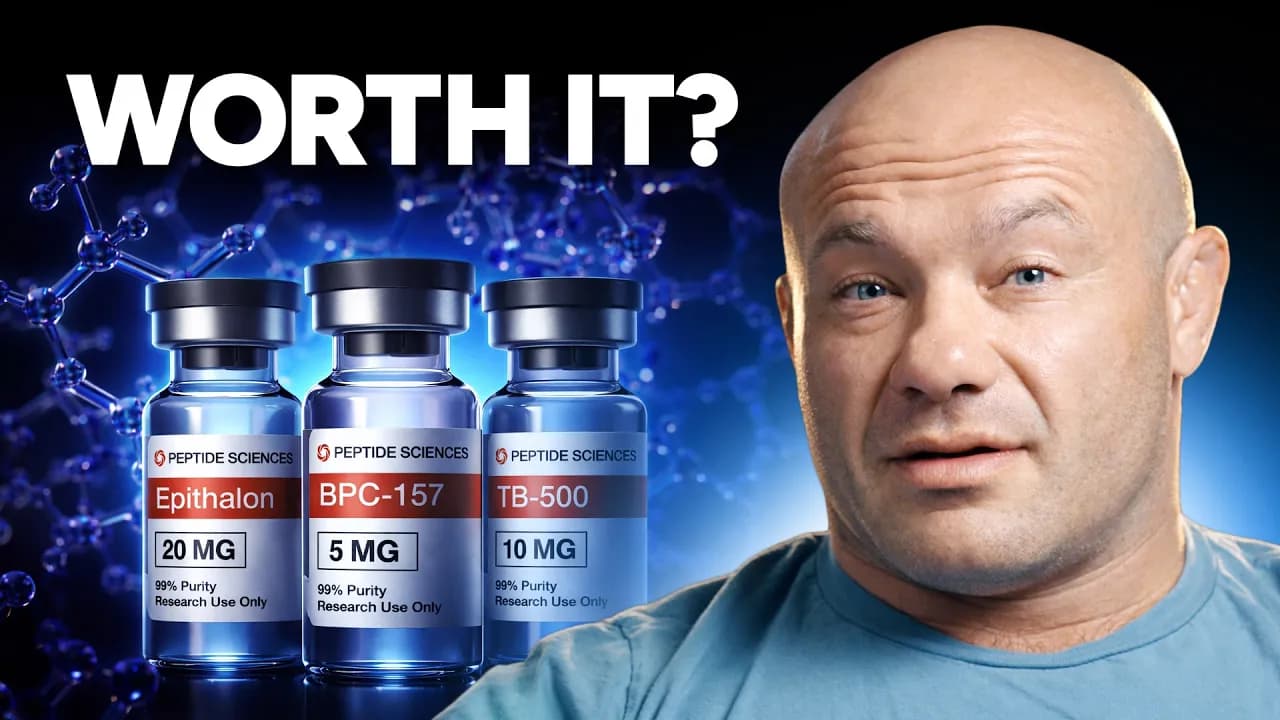
One research study involved 12 people with knee pain who used between 200 and 400 microgram injections once a week for 48 weeks. Seven out of the 12 people noticed significant improvement for a period of 6 months. In another study, they combined this peptide with another one called TB 500. In this study with 16 people, they found 14 out of the 16 people had significant reduction in pain within 6 to 12 months. These injections were delivered by a physician inside the joint itself. If you were to get this done, you wouldn't be doing this yourself. You would need a doctor to inject you.
The GHK copper peptide helps with collagen synthesis and tissue remodeling. It's used topically on the face, not through injections, and the results are pretty significant topically.
Epitalon targets telomeres, which are the protective caps over your chromosomes that shorten as you age. This activates an enzyme to help rebuild those caps. In fleas, mice, and rats, it does extend the lifespan. In humans, the only studies that are out there are from a single Russian research group in 2003 and also 2006. Neither was independently replicated by any outside institution.
BPC-157 does not trigger cancer. But if you have an active cancer, it's probably not a good idea to take it because it's going to increase more blood flow to a tumor potentially. That also goes with other peptides that stimulate growth hormone. It's probably not a good idea if you have cancer to take them.
80% to 90% of all raw peptide materials originate overseas, usually from China, not pharmaceutical companies. When independent labs have done testing, 30% contain the wrong amino acid sequence, meaning you would be injecting a completely different chemical than what was on the label. 65% failed bacterial endotoxin limits, which are bacterial toxins that survived the sterilization process and can trigger immune reactions. Some batches contain arsenic at 10 times the safety limits.
The certification of analysis that sellers email is almost always reflective of a single test called HPLC. HPLC does not check for heavy metals, does not check for bacterial toxins, and does not verify if the product is sterile or standardized. A vial could score like 99% pure but be loaded with arsenic.
Things to look out for include when it says for research use only, not for human consumption, but the seller includes dosing charts and mixing guides, or the transaction happens over Telegram, or you find the price is like super cheap. These are signs that there could be a problem.
Legitimate sourcing would probably involve a prescription from a licensed clinician who reviewed your labs and health history, sold through a credible pharmacy that actually has data for you that you can actually review. It has the exact name and the exact concentration.
There are basically three labs that the research community trusts: Janel Shik Analytical, Covera Labs, and Freedom Diagnostics. If the lab on the COA has no independent website, no phone number, no physical address, you want to be suspect.
If you get one of these peptides and you inject yourself and you have a reaction, you need to go to the emergency room with the peptide and explain what happened.
There have been questions about BPC-157 regarding whether it's still being sold and if it's legal to purchase it in the US. In February of 2026, the FDA reclassified 14 peptides back to category one, where you can have a prescription and get these. As of right now, a doctor can give you a prescription for this specific peptide.
The elephant in the room is why you're wanting to take these peptides in the first place. What problem are you trying to solve, and what is at the root cause of that problem? If we're talking about trying to increase growth hormone, there are several things you can do right now that will massively increase growth hormone.
The biggest thing is the type of exercise called sprinting or high-intensity interval training. Out of all types of exercises, sprinting is at the top of the list, but also high-intensity interval training of different types can dramatically increase growth hormone. If you can optimize your sleep, you can really preserve your growth hormone, which is part of the anti-aging, fat burning, and the repair. Exercise and sleep for growth hormone is essential. Also, keeping your insulin down as low as you can. Fasting is another trigger for growth hormone. If you do intermittent fasting and periodic prolonged fasting, you can spike your growth hormone tremendously.
If you're going to take peptides to repair your stomach from maybe NSAIDs or whatever, there are some other things you can do as well. Number one, you can take zinc carnosine for an ulcer or for some type of gastric problem. You can also crush up a clove. It can greatly enhance your healing from the inside of your mouth to the throat to your esophagus to your stomach to the small intestine. It mimics certain drugs for pain and inflammation.
People take peptides to enhance their healing effects and various things. You can also make sure you have enough zinc. Zinc is involved in over 300 different enzymes, a lot of them for healing different things and for maximizing your testosterone. Vitamin C is a cofactor. Glycine is a cofactor, especially for collagen. Magnesium glycinate provides both the magnesium cofactor in so many different processes and then glycinate, which is glycine. Together it's really going to be helpful for connective tissue and also sleep and reduce stress.
Keep Dr. Eric Berg DC in your library
Save the videos and channels worth coming back to, and find them again in one place.