How Did Ancient Humans Have Privacy?
In a Nutshell
Ancient humans lived without physical privacy for 99% of history, sleeping in groups of 15-50 with no walls or rooms. They managed intimacy through timing (night), distance (walking 50 feet from camp), and social pretense—everyone agreed to ignore certain activities. Privacy only emerged as a physical possibility with agriculture 10,000 years ago and remains a modern luxury tied to individualism rather than group survival.
These notes were generated by AI and may contain inaccuracies.
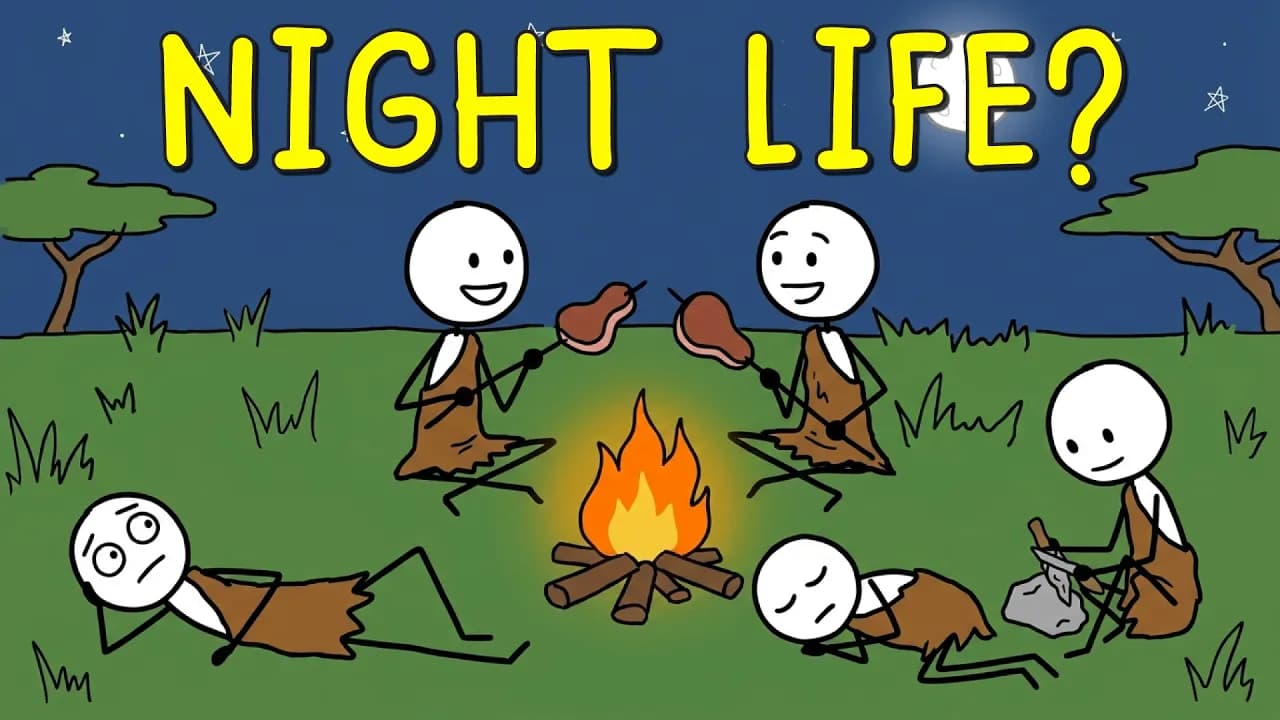
For 99% of human history, the modern experience of lying in bed alone with a partner behind a closed door did not exist. There were no doors, no walls, and no bedrooms—only you, your family, and roughly 20 other people sleeping within 5 feet. For roughly 300,000 years, humans lived in small groups of 15 to 50 people. Hunter-gatherer camps had no walls, no separate rooms, and no private spaces. People slept in a pile for warmth, ate together, and sat around the same fire. Any conversation was overheard by everyone, emotions were public knowledge, and intimate moments between partners were known to the entire group.
Anthropologists studying modern hunter-gatherer groups have identified consistent patterns for managing intimate moments without physical privacy. The first strategy is timing: most intimate moments occurred at night when it was dark and others were asleep or pretending to sleep. Darkness created a form of psychological privacy even without physical separation. The second strategy is distance: couples would walk a short distance away from camp—far enough to gain some separation but not so far as to leave the protection of the firelight and risk predators. Fifty feet in the dark rendered them effectively invisible. The third strategy is social protocol: everyone pretended not to notice certain activities, creating an unspoken agreement to grant psychological space even when physical space was absent. This is analogous to looking away when someone changes clothes inside a small shared tent.
Anthropologist Colin Turnbull, after living with the Mbuti people in Central Africa, observed that they had no word for privacy. This was not due to primitiveness but because the need to be alone was foreign to their worldview. Being alone meant vulnerability and separation from group protection. For most of human history, solitude was not a luxury but a death sentence. When nature called, people walked to a designated area downwind from camp. While visible by modern standards, social protocol ensured others did not follow or watch, granting an illusion of privacy through intentional ignorance—similar to how modern people behave in public restrooms.
Ancient humans slept in groups out of necessity rather than preference. Nighttime brought dropping temperatures, active predators, and the need to tend fires. Archaeological evidence from Ohalo II in Israel shows that 23,000 years ago, humans constructed small shelters barely large enough for a family to lie down in, with everyone touching. This pattern persisted for tens of thousands of years. Even in medieval Europe, entire families commonly shared one room and often one bed. The notion of children having individual bedrooms only became widespread in the 1900s.
Privacy as a physical possibility arose with the advent of agriculture around 10,000 years ago. Farming required permanent settlement, which led to the construction of permanent structures with walls. For the first time, people could close a door and create spaces unseen by others. However, privacy remained a luxury reserved primarily for the wealthy; most continued living in single-room homes with their entire families. The concept of privacy as a universal right only developed in the last few hundred years.
Psychologist Erich Fromm argued that the need for privacy is a symptom of individualism. In societies where identity is tied to the group, solitude feels wrong and isolating. For ancient humans, the group was central to survival and self-identity; being alone was terrifying rather than peaceful. In contrast, modern society faces an epidemic of loneliness due to excessive isolation. Ancient humans achieved a form of privacy through social agreement—using timing, distance, and mutual pretense—rather than physical barriers. The development of walls enabled the modern condition of being completely alone, sometimes for days, at the cost of the communal protection that defined human existence for 290,000 years.
Keep Axen in your library
Save the videos and channels worth coming back to, and find them again in one place.