How to Use Aspirin to Clean Arteries
In a Nutshell
Aspirin doesn't clean or remove arterial plaque but prevents heart attacks and strokes by inhibiting platelet clumping that forms clots on unstable plaque—essential for secondary prevention (post-heart attack/stroke/stent) and anyone with detectable plaque via calcium score, reducing recurrent events by ~20% with low-dose (81 mg) daily. Avoid routine use for primary prevention without plaque, as it raises bleeding risks; take at bedtime with food if stomach-sensitive, and skip if active bleeding, hemorrhagic stroke history, or aspirin allergy. Combine with lifestyle changes and supplements like nattokinase/berberine for optimal plaque stabilization, not replacement.
These notes were generated by AI and may contain inaccuracies.
If you're taking a daily aspirin to prevent a heart attack or you stopped taking that aspirin because you heard it can cause dangerous bleeding. One of those choices is the right one. The other one causes increased risk. The aspirin decision depends on one critical question that most doctors never really ask: do you already have plaque inside your arteries? That single detail completely changes the aspirin decision.
Most heart attacks do not happen because arteries slowly close off. If they did, we'd be able to predict when a heart attack happens and exactly where it's going to happen because we would know how to find that plaque. We can't predict when or where a heart attack is going to happen. Most people that have a heart attack didn't have severely blocked arteries before. It happened in people with less severely blocked arteries because there's a lot more people with that. It's not really how much plaque you have that's causing this. It's something else.
Despite following the best diet at the time (low-fat diet was considered the best thing), exercising on a regular basis (long slow distance), arterial plaque still developed. That was a wake-up call.
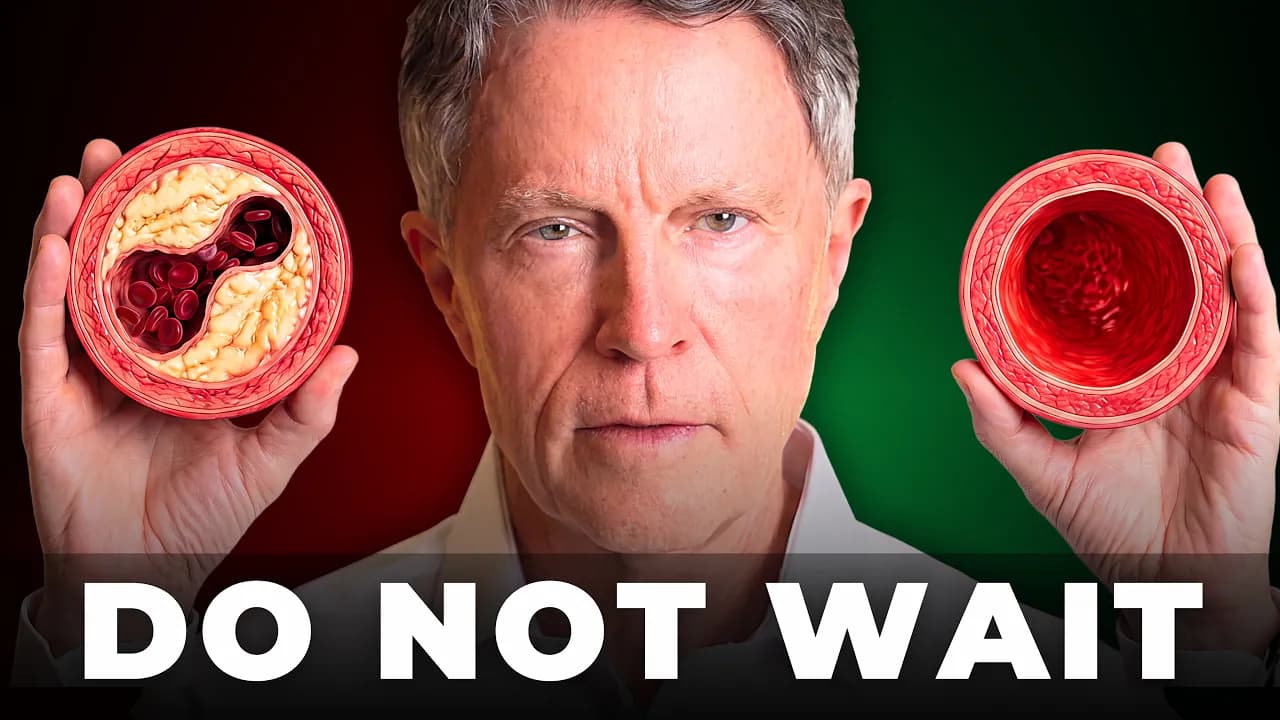
If the artery's not fully blocked, what actually triggered that heart attack? It's plaque instability. Plaque sits quietly inside arteries for 20 or 30 years. Instead of a slow blockage, the plaque becomes unstable: leakage of soft plaque forms a clot. If the clot is big enough and goes to the heart, it causes a heart attack. If it goes to the brain, it causes a stroke.
Over time, cholesterol, inflammatory cells, and damaged tissue collect within these plaques when they're softening and getting inflamed. The body tries to seal that area off with a thin protective layer called a fibrous cap. For years, that cap might protect you from heart attack or stroke. But if that cap weakens or erodes, the body treats it like an injury inside the artery. Platelets rush to the area. Clotting proteins activate and a clot begins to form.
Platelets are tiny cells (technically without a nucleus). If you cut your finger, platelets rush to the area and form a clot, saving our lives every day. But the same system can cause problems inside arteries.
Think of plaque like a pimple under the skin of the artery. Tim Russert, longest-standing host of Meet the Press, died of a heart attack. Autopsy showed his arteries looked like the skin of a teenager with a bad case of acne. If the surface tears open, the body forms a clot that can block blood flow to the heart.
That's exactly where aspirin works. Aspirin makes platelets less likely to clump together. That effect lasts about 7 to 10 days.
Not all plaque behaves the same way. Some plaques are stable: thicker fibrous caps, lower inflammatory activity. They narrow the artery a little, may cause symptoms like angina, but remain quiet for years or decades. The body calcifies stable plaque.
Other plaques are much more dangerous: larger lipid cores (soft plaque), fats and oils, immune cells, thinner fibrous caps, inflammatory cells.
When plaque becomes unstable, preventing excessive platelet activation reduces the risk of a vessel-blocking clot.
Aspirin doesn't remove cholesterol deposits from artery walls. Instead, aspirin mainly reduces the chance that a clot forms when plaque becomes unstable.
Think of plaque as the fuel. Platelet activation is the spark. Aspirin reduces the chance that the spark ignites a fire. You may still get soft, unstable plaque that releases inflammatory tissue (sparks), but no fire because platelets are not as ready to form a clot.
In the protocol, aspirin is not meant to magically dissolve plaque. It's one of the tools to help stabilize arterial disease and reduce the risk that a dangerous clot forms on top of an unstable plaque.
Depending on your arteries, aspirin can lower heart attack risk or increase bleeding risk.
If you've already had a heart attack, stroke, blocked artery procedure, take aspirin. Arteries have proven they can form dangerous clots. Baseline risk is much higher.
Large clinical trials (tens of thousands of patients) show low-dose aspirin reduces recurrent cardiovascular events by roughly 20%. Meaningful, especially for a 68-year-old male. Platelet clotting plays a central role in recurring events. Aspirin is a cornerstone of secondary prevention (you already have the disease: heart attack, stroke, stent).
For people who haven't had an event (primary prevention), confusion begins. Guidelines (US Preventive Services) said no routine aspirin if no prior event. But those saying this don't understand details.
Doctors estimate risk using calculators (age, cholesterol, blood pressure, smoking). Calculators never look inside arteries or detect plaque, despite reliable methods.
Someone appears low risk on paper while plaque grows inside arteries. 3/4 of men age 60 have plaque (advanced calcification stage via calcium score). Only a fraction had an event, so labeled low-risk primary prevention when not. Same for women, 5-10 years later.
Once plaque is present, you have arterial disease/vascular disease. Even without event, clear evidence of plaque means secondary prevention. Risk much higher with plaque than no plaque.
If somebody truly needs aspirin, dose matters. More aspirin is not better. Higher doses significantly increase bleeding risk without improving cardiovascular protection.
Adult full-dose aspirin: 325-360 mg. Low-dose aspirin: 81 mg (US), 100 mg (rest of world).
Goal: reduce excessive platelet activation while preserving normal clotting. Eliminating clotting completely would be dangerous.
Does timing matter (morning, noon, night)? Take at the same time every day.
Heart attacks most common in early morning. Cortisol (stress hormone) rises. Blood pressure rises, sympathetic nervous system activates, dawn phenomenon (10-20% with metabolic disease/pre-diabetes, more if low-carb/fat-adapted). Platelet activity increases, blood more likely to clot.
For healthy arteries, minimal effect. For soft plaque, higher chance of clot on unstable plaque.
Recommendation to take at bedtime to cover morning risk. Counter: aspirin's effect lasts 48 hours minimum, up to 5-7 days, so evening dose not significant if regular.
Low-dose aspirin can irritate stomach lining by reducing protective mucus. If history of stomach irritation, take with food or after a meal. If tolerates well, no difference.
Three situations where aspirin dangerous:
- Active bleeding in stomach or intestines.
- Hemorrhagic stroke.
- True aspirin allergy.
Avoid aspirin in those. For mild bleeding issues, adjust to every other day or once a week.
Rare side effects with long-term use:
- Affects kidney function (especially with existing kidney disease or NSAIDs/other kidney-stressing meds).
- Tinnitus (ringing in ears, associated with higher doses; rare with low-dose).
Alternative if can't take aspirin: clopidogrel (reduces platelet activation via different pathway). In high-risk (e.g., after stent), dual antiplatelet therapy (DAPT): aspirin + clopidogrel.
Aspirin doesn't prevent all strokes. Two types:
- Clot blocks blood flow to brain.
- Blood vessel ruptures (bleeding).
Aspirin reduces clot-related strokes but increases bleeding stroke risk. Balancing act.
Natural supplements influence inflammation/metabolism but none replace aspirin's platelet clotting reduction. No free lunch.
Uses some supplements as additional tools. Covered nattokinase and berberine (links in description).
Low-dose aspirin + healthy lifestyle + supplements has highest chance to heal arteries.
Most powerful plaque-stabilizing strategies have nothing to do with medications or doctors. Foods to stabilize plaque and protect arteries: watch related video.
Growing old's not for sissies, but it's a lot easier with healthy arteries.
Keep Thomas Fordham Brewer MD MPH in your library
Save the videos and channels worth coming back to, and find them again in one place.