I Just Bought $77,000 Of This Stock
These notes were generated by AI and may contain inaccuracies.
Bought $30,000, another $20,000, another $15,000, and another $12,000 of Mastercard stock within the past 30 days, totaling $77,000. Previously planned to buy $10,000 to $20,000. Entire position now $183,000 with $34,000 in the green. Covers four reasons why Mastercard is in a strong position and likely to outperform.
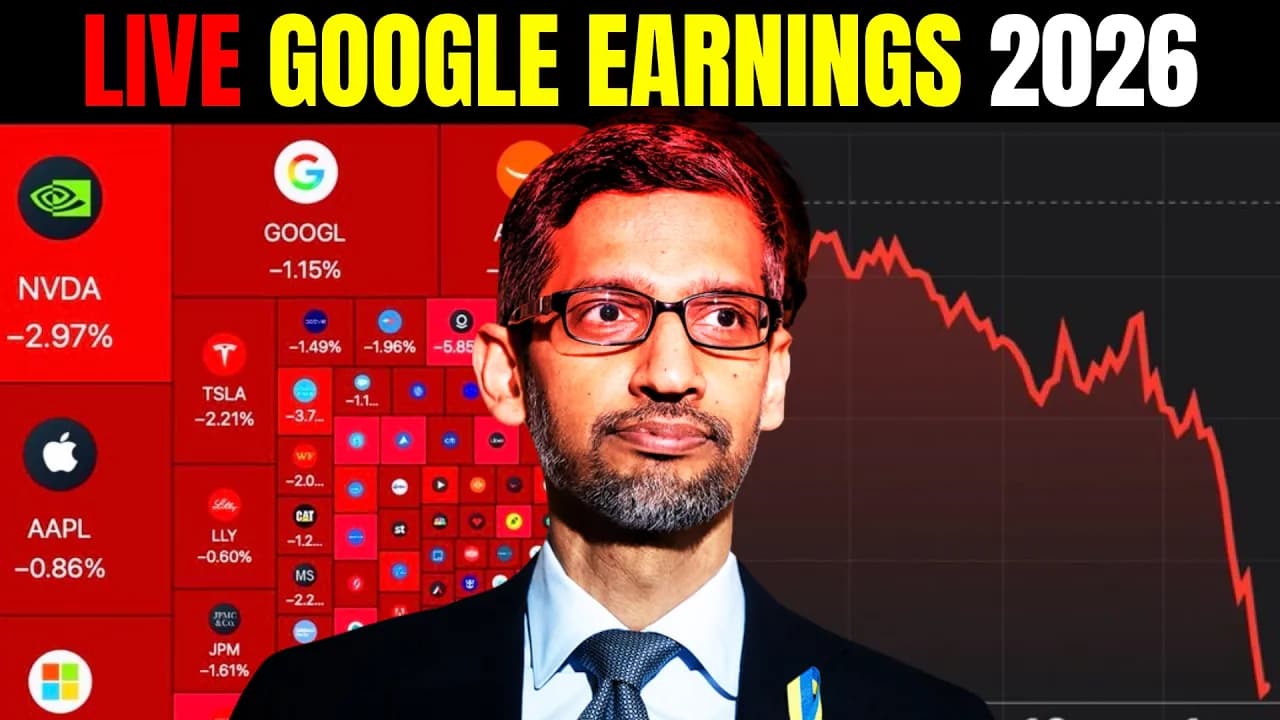
Big news: Google challenging Nvidia's dominance with TPUs; Nvidia responded with a post saying they're delighted by Google's success but still ahead with GPUs. Opinions on Google's challenge. Mark Mahaney on why Alphabet remains strong into 2026. Netflix's Stranger Things premiered to great reviews (Rotten Tomatoes above 86% for both users and critics), crashed Netflix's service due to high viewership. Fail of the week: Jim Cramer (7 months ago called Google an eBay-like company in slow chronic decline; now says Alphabet is the best Mag 7 stock into 2026). Covers other analysts who lost the plot on Google.
Promotes Qualcomm (likely Quartr or similar; platform built and owned by team, no VCs or private investors). Offers 30 years of financial history, segment breakdowns (e.g., Google 'Other Bets', Google Network, Waymo weekly rides). Low monthly price, includes hundreds of exclusive episodes. Try monthly risk-free at qual.com.
Most significant buys in short period: four separate substantial buys shown in trading history. In passive income portfolio: largest position at $183,600 with $34,000 green. Next is Google at $114,000 with $48,000 green. Mastercard only in passive income portfolio. In story fund (more aggressive): no Mastercard, additional $74,000 Google ($46,000 green). Combined: Alphabet top at 14% ($91,400 gains, plus $3,000-$4,000 dividends). Mastercard 13.6%-13.9% ($32,000 green). By value: Google $189,000, Mastercard $183,000, both ~14%.
Builds positions heavily when odds favor low downside and ample upside. Past examples: leaned into Netflix when beaten down after subscriber loss (non-stop content until 2025); shifted to Google in 2025 (bullish videos back to 2023, added significantly). No longer buying Google (priced above $300/share, risk/reward less obvious). Mastercard best fit for 2025 focus.
Reason 1: 3.45% free cash flow yield (notable undervaluation historically).
- Historical periods at 3.45% or higher FCF yield:
- 2022: +94% over next 3 years.
- COVID scare: +77% over next 3 years.
- Dec 2018: +108% over next 3 years. Every time, outperformed market significantly.
Reason 2: Wide moat, unlikely to be disrupted (moat widening).
- Faces competition (e.g., Klarna, PayPal, government debit networks in India/South America), but duopoly with Visa in credit/debit; not in all digital payments.
- Payments networks (~50% revenue): credit/debit cross-border; more credit-driven than Visa (advantage). Now agnostic: supports ACH transfers, entitlements, multiple rails.
- Value-added services: evolved to SaaS, cybersecurity; universal (fraud, security, ID verification, KYC) for any payment system, including governments. Platform for all commerce, less disruptible.
Reason 3: Fast growth.
- 12-13% annual growth past 10 years; expected 12-13% next 5 years. Natural hedge to spending increases. Additional growth from value-added services.
Reason 4: Shareholder friendly.
- Generates enormous FCF, returns via buybacks ($1B in 2024, billions more in 2025) and 15% annual dividend growth (more to bucket + share count reduction).
Not complicated; overlooked easy buy. Low historical valuation + wide moat + fast growth + strong capital returns = winner. Transparency on actions, not advice. Risks exist (competition), but lower risk than most.
Super investors sold Google in Q3 (mistake); many catalysts, high 20s forward P/E. Huge cloud winner; TPUs very good and cheaper than Nvidia's. Wall Street Journal: "AI trade splinters as Google challenges Nvidia's dominance." Google stock up, Nvidia down (divergence).
Philipp Lefont (Katau) tweeted: "I bet these dots cross again" (Nvidia down, Google up). His 40 best AI companies list (earlier 2025) excluded Google, which outperformed all.
Reports: Google talks with Meta to use TPUs for data centers; increased semiconductor production to reduce outside reliance. Nvidia post: "We're delighted by Google's success. They've made great advances in AI and we continue to supply to Google. NVIDIA is a generation ahead... greater performance, versatility... than ASICs, which are designed for specific AI frameworks." Admission of competition concern (ignores Google's lower cost).
Nvidia moat: CUDA proprietary language (software layer). Shift: Google making TPUs native for PyTorch (eager execution, native distribution APIs, torch.distributed, torch.compile; contributing to open-source like LLM). Challenges both hardware and software moats.
Nvidia demand high, but risk: 40% revenue from 4 customers (Google, Amazon, Meta, Microsoft), all building alternatives (TPUs, Tranium, own hardware). Contrast ASML: higher customer concentration, but customers not replacing (lithography 100x more complex than Nvidia Blackwell).
Prefers ASML over Nvidia as AI gatekeeper. Holds Google for more share gains (vs Nvidia, ChatGPT); analysts bullish. Mark Mahaney:
"We've had a phenomenal run in the stock. It's whatever doubled over the last 6 months. It kind of reminds me a little bit of the dramatic recovery you had in Meta and Netflix's stocks 3 years ago, except those were stock recoveries off of what were kind of broken fundamentals. That's never been the case with Google. Their fundamentals were really have been pretty consistent. It's just that the market was so negative on Google 6 months ago because of the DOJ and because of ChatGPT. And I just think this market was way too negative. The stock was oversold at 15 times earnings. Is it overbought here 29 times? No. But I think that the pitch you make for it... it's very hard to see a material rerating in the multiple... But fundamentals look great for the company and this big broad pitch they can
Google has the leading AI model, the broadest way to monetize it of any company in the world, and the lowest cost infrastructure because they're vertically integrated up and down the tech stack. That's a very powerful pitch. This stock is now a high-quality compounder that can largely hold the multiple, although watch for some negative catalysts from ChatGPT in the next 12 months, but the stock can go higher from here. There are better candidates with more dislocated opportunities, but all credit goes to Google; the stock can still compound and you can still hold it.
Mark Mahoney describes Google as a continued compounding machine that should hold around the same multiple as earnings continue to grow. Likely negative catalysts with ChatGPT: news of a new model more competitive to Google, or ads on their searches. There's always scary news for Google over the next year, but it remains an incredibly good bet. Google owns robo taxi networks, YouTube, Google Cloud, and now TPUs posing a real storyline threat against Nvidia. Still want to hold it in the portfolio, though more dislocated companies exist at this point.
Netflix hasn't been dislocated for a while but is starting to trend down, giving an entry opportunity. Was at $132 per share split-adjusted, now at $108. Great Q4 ahead. Stranger Things season 5 premiered last week. Characters look older, like '80s shows with 25-year-olds pretending to be high schoolers, but it's entertaining with a well-paced storyline. Ratings: user 86%, critics 91%—highest of the last four seasons for the first four episodes. More episodes in two drops going into Christmas.
Popularity crashed Netflix for 5 minutes at 5:00 p.m. Pacific on Wednesday premiere because hundreds of millions tried watching simultaneously—very rare. Netflix creates massive hits repeatedly: Squid Game, Demon Hunters set records, Stranger Things season 5 likely will too. Happy to hold in portfolio; great Q4 and looking forward to next earnings.
Regretfully calling out Gene Munster, a nice guy and analyst on TV open to criticism. On April 25th, 2025 (7 months ago): > "Basic terms, Google is becoming eBay effectively. Its energy is getting zapped out. Before eBay, it was Amazon kind of taking its energy out. Now it's GPT, Anthropic, and Grok doing the same."
No qualifiers; compared Google to eBay because ChatGPT zapping energy like Amazon did to eBay. This was false at the time—the week of that statement, a video called referring to Google as eBay ridiculous and patently false.
Recent CNBC appearance last week: Guest says Alphabet will be the best Mag 7 stock for next year into 2026—called a "bold bold bold statement." Picking the stock with most momentum and good things going on isn't bold; it's spineless, following the crowd with no dissenting view. Bold was saying it was the best buy 7 months ago when called eBay and doomed.
"GM's case... bare case around them being able to compete and navigate with generative AI taking away from search... addressed by accelerating search from June quarter, beating by 300 basis points growth in September quarter... capturing renewed interest tunneling into search revenue... Gemini shows they can compete toe-to-toe against OpenAI... culture reignited... over next year more distribution... only 20% of Google population uses chatbot daily... big opportunity, multiple will go up."
7 months ago when multiple was half, called it eBay; now says multiple should go up from 30x further. Analysts like this brought on CNBC weekly say the stock up 70% is best buy into 2026. Gene followed popular sentiment entirely, no alpha. For that, Gene Munster is fail of the week.
Keep Joseph Carlson in your library
Save the videos and channels worth coming back to, and find them again in one place.