I Tried Retatrutide – Here's What Happened
In a Nutshell
Retatrutide is a triple-agonist (GLP-1/GIP/glucagon) that drives ~25% weight loss by both cutting appetite and raising energy expenditure, with the glucagon pathway increasing resting heart rate over 50% and core temperature ~1.2 °F. In the speaker’s one-month self-experiment at 1–2 mg/week, 4,000+ kcal intake still produced 12 lb loss and a drop from ~5% to 3.2% body fat, while strength remained stable and LDL/ApoB unexpectedly fell—likely via glucagon-mediated PCSK9 inhibition. The two paradoxes (increased hunger, muscle sparing) arise because lean users are more FGF21-sensitive, so metabolic-rate elevation can outpace appetite suppression and may protect muscle; however, clinical data still show ~38% lean-mass loss, and hs-CRP rose secondary to sleep disruption.
These notes were generated by AI and may contain inaccuracies.
Retatrutide is described as potentially the biggest weight loss drug in history. In published trials, people taking retatrutide lost a quarter of their body weight in under a year. The drug is 60% stronger than Ozempic and outperforms all other weight loss drugs significantly.
The speaker tried retatrutide despite being lean, motivated by curiosity about unusual reports: people getting hungrier on the drug, claims of shedding body fat without losing muscle, and even building muscle. The experiment was conducted to investigate these claims, not for health reasons, and carried potential health risks. 127 biomarkers were tracked before and after to observe metabolic changes.
The speaker notes eating over 4,000 calories per day and still losing 4 lb in the first week. Resting heart rate increased over 50%, and the speaker ended up sick on the bathroom floor. The core questions addressed are whether these drugs should be used and whether users should stay on them long-term.
The video roadmap includes five parts: why retatrutide differs from other weight loss drugs, unpacking two paradoxes about retatrutide, the speaker's personal experience including unexpected effects and blood markers, resolving the retatrutide paradoxes, and answering whether one should use these drugs.
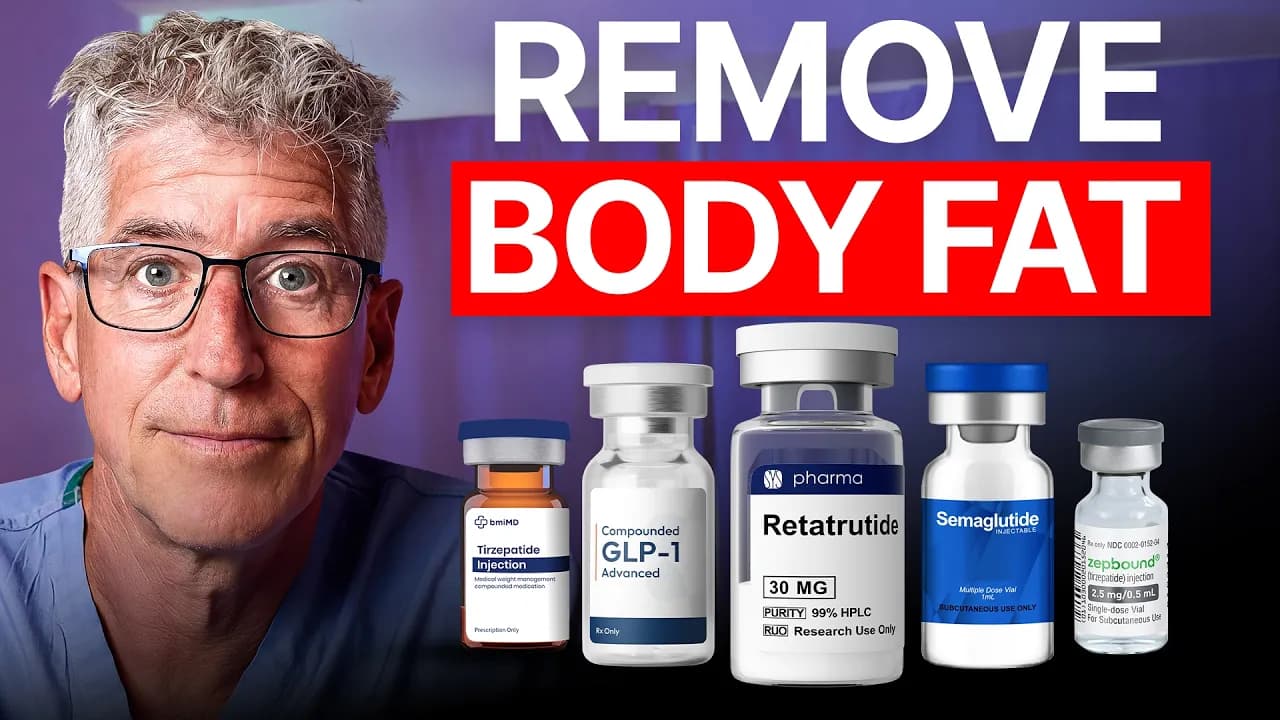
Retatrutide, sometimes called reta or informally GLP-3, is the next evolution in GLP-1 receptor agonist weight loss drugs. First-generation drugs like Ozempic and Wegovy target only the GLP-1 receptor, which reduces hunger. Second-generation drugs like tirzepatide (Mounjaro, Zepbound) target GLP-1 plus the GIP pathway, which improves how the body partitions fuel and supports fat cells releasing fatty acids during fasting.
Retatrutide adds a third mechanism: activation of the glucagon receptor, which increases energy expenditure. This means users are not just eating less but also burning more. The speaker experienced this directly with resting heart rate increasing over 50% from the low 40s to 65-70 beats per minute.
Retatrutide hits three hormonal pathways: reducing appetite via GLP-1, altering fuel partitioning via GIP, and increasing energy expenditure via glucagon. The term GLP-3 is noted as a marketing ploy playing on the brand recognition of GLP-1 drugs.
Despite being a weight loss drug, retatrutide does not uniformly suppress appetite. While many report reduced hunger like with Ozempic, others report getting hungrier yet still losing weight. The speaker heard this from trusted friends, scientists, and doctors. This counterintuitive effect—getting more hungry, eating more, and losing weight—has a mechanistic explanation.
A rumor suggested retatrutide could cut fat without typical lean mass loss seen on GLP-1 drugs. Andrew Huberman mentioned on TV that retatrutide might have some degree of muscle sparing, with people losing a third of body weight in about 6 months. If true, this would differ significantly from Ozempic-class drugs where 25% to 40% of weight loss comes from lean mass.
However, actual human data from main body composition studies at higher doses (8 and 12 mg) show about 38% of weight loss on retatrutide appears to be lean mass, contradicting the muscle-sparing claims.
The speaker started retatrutide at 1 mg per week, eventually increasing to 2 mg per week. For context, clinical trials go up to 12 mg per week. The source was an FDA-approved 503A compounding pharmacy, not a gray or black market source.
The first morning after the 1 mg injection, the speaker woke up famished and ate a six-egg omelet with 4 oz of feta cheese cooked in butter, then drizzled with olive oil, followed by another meal. Appetite was increased rather than suppressed at 10:00 a.m.
The explanation is that retatrutide's effects do not hit simultaneously: the glucagon-driven metabolic rate increase can occur before or more intensely than the GLP-1 appetite suppression. The speaker believes the energy expenditure boost hit first and hard, causing increased appetite as the body burned more energy. The speaker ate over 4,000 calories per day and lost 4 lb in the first week.
Despite losing weight, the speaker noticed no drop in performance over the month. Strength, power, and energy felt the same or better, with a feeling of being more energized. On day one after retatrutide, there was a weird feeling of being really warm with a great workout.
When increasing to 2 mg, the speaker had an intense reaction around 3:00 a.m., 8 hours after injection: waking up feverish and sweating, with heart racing and palpitating, ending up sick on the bathroom floor. Heart rate reached 80-90 beats per minute, roughly twice normal for the speaker. The speaker felt very warm with a pounding heart and described the compound as powerful. The reaction resolved after some time.
The speaker cannot confirm with certainty this was the drug but had not eaten anything unusual and ruled out food poisoning. The experience provided insight into the compound's potency. The metabolic boost was felt intensely, with the body feeling on fire and the heart racing.
Consistent signs of increased metabolic rate included resting heart rate jumping from the low 40s to the 60s and 70s. Heart rate variability dropped, and core body temperature increased by about 1.2° Fahrenheit. The speaker knows how to properly measure core body temperature.
Higher resting heart rates and lower heart rate variability are typically associated with worse health outcomes and lower life expectancy. Comparative biology examples include Greenland sharks with resting heart rates of about 12 beats per minute living over 400 years, versus hummingbirds with resting heart rates of about 500 beats per minute living 3 to 5 years.
The increase in resting heart rate and decrease in heart rate variability on retatrutide is concerning and deserves further study. However, high resting heart rate is typically a signature of underlying cardiovascular dysfunction, not necessarily caused by exogenous compounds increasing heart rate. The speaker states this is an area needing deeper understanding.
After about a week and doubling the dose from 1 to 2 mg, appetite started to come down noticeably but not dramatically. The speaker was still eating 2,800-3,000 calories per day, and weight continued to come off. Attempts to stop weight loss by consuming extra 1,000 calories per day via butter fat bombs did not work.
Over the course of a month, the speaker lost 12 lb while eating around 3,000 or more calories per day on average with no change in activity. Starting body fat was around 5%. After one month, a bioelectrical impedance scale showed 3.2% body fat. The speaker notes these scales are not as accurate as DEXA scans but are precise enough to measure changes, and the result should be considered directional.
127 biomarkers were tracked using the 100 Health app. Stable markers included the full thyroid panel, cortisol, blood sugar, and all blood cell counts. Across 127 biomarkers, labs were incredibly stable with some notable exceptions.
High sensitivity C-reactive protein, a marker of inflammation, increased from 0.3 to 1.8 mg per liter, moving from optimal to suboptimal. This is notable because GLP-1 based drugs including retatrutide are generally thought to reduce inflammation, not increase it.
The speaker's hypothesis is that this was not directly caused by retatrutide but was indirect: retatrutide increased metabolic rate and caused restlessness with occasional racing heart at night, disrupting sleep more than normal. The night before the second lab draw, the speaker slept about 5 hours. Short-term sleep disruption can increase inflammatory markers like hs-CRP. The takeaway is that these medications do not replace fundamentals like sleep, nutrition, and exercise.
LDL cholesterol and ApoB dropped unexpectedly. Historically, weight loss tends to drive the speaker's LDL up, not down. The explanation involves the glucagon component of retatrutide influencing PCSK9, a protein targeted by potent cholesterol-lowering medications like Repatha (PCSK9 inhibitors). Retatrutide appears to act like a PCSK9 inhibitor light, lowering LDL cholesterol and ApoB.
The variability in hunger response occurs because retatrutide performs multiple actions simultaneously: suppressing appetite via GLP-1 while also increasing metabolic rate via glucagon. This creates a tug-of-war effect. Individual outcomes depend on dose, timing, and bio-individuality. Leaner individuals appear more likely to experience increased hunger. In the speaker's case, the effect was transient and faded after about a week, though hunger was never dramatically suppressed.
The muscle paradox—reports of losing fat without losing muscle despite clinical data showing 38% lean mass loss—may be explained by FGF21. A downstream effect of the glucagon component is release of FGF21 from the liver. FGF21 increases metabolic rate and protects against muscle loss.
Not everybody responds to FGF21 the same way. Obesity is an FGF21 resistance state, meaning the FGF21 signal does not land as effectively in people with obesity. Clinical trials are done in people with obesity who may be more FGF21 resistant and therefore see less muscle preservation. Leaner individuals like bodybuilders, athletes, or biohackers may be more sensitive to the FGF21 pathway and experience stronger muscle-preserving effects. This remains a hypothesis.
The claim that GLP-1 drugs cause more muscle mass loss than diet and exercise alone is based on trials showing 25% to 40% of weight loss as lean mass. However, DEXA scans measuring lean mass do not measure only muscle; they include organs and non-contractile components. When lean mass decreases on DEXA, it does not necessarily mean functional muscle mass is being lost. New trials show strength is actually fully preserved. It is possible that observed lean mass loss includes effects like a shrinking liver rather than muscle loss.
A friend on Mounjaro lost 40 lb, felt great, had no side effects, and asked how to come off the drug, assuming it was temporary. The speaker responded that one does not necessarily need to come off if it works, framing this as a liberating idea rather than a pessimistic one.
These are not just weight loss drugs. Beyond reversing obesity, signals across the literature show benefits for heart health, joint health, liver health, and potential neuroprotective effects independent of weight loss. Weight loss is just the tip of the iceberg.
Even people not trying to lose weight might eventually use these drugs or similar compounds for biological tinkering rather than weight loss. The speaker does not care about scale weight but cares about the ability to tinker with inner workings of bodies. What is being witnessed is the early stage of a shift toward using targeted bioregulators beyond retatrutide to shape human biology in new ways. This is exciting yet unsettling, as every major leap in human history has carried tension.
The speaker is working on a definitive 7,000-plus word guide for GLP-1s based on over 100 papers read, inviting questions to be answered in the manuscript.
Keep Nick Norwitz in your library
Save the videos and channels worth coming back to, and find them again in one place.