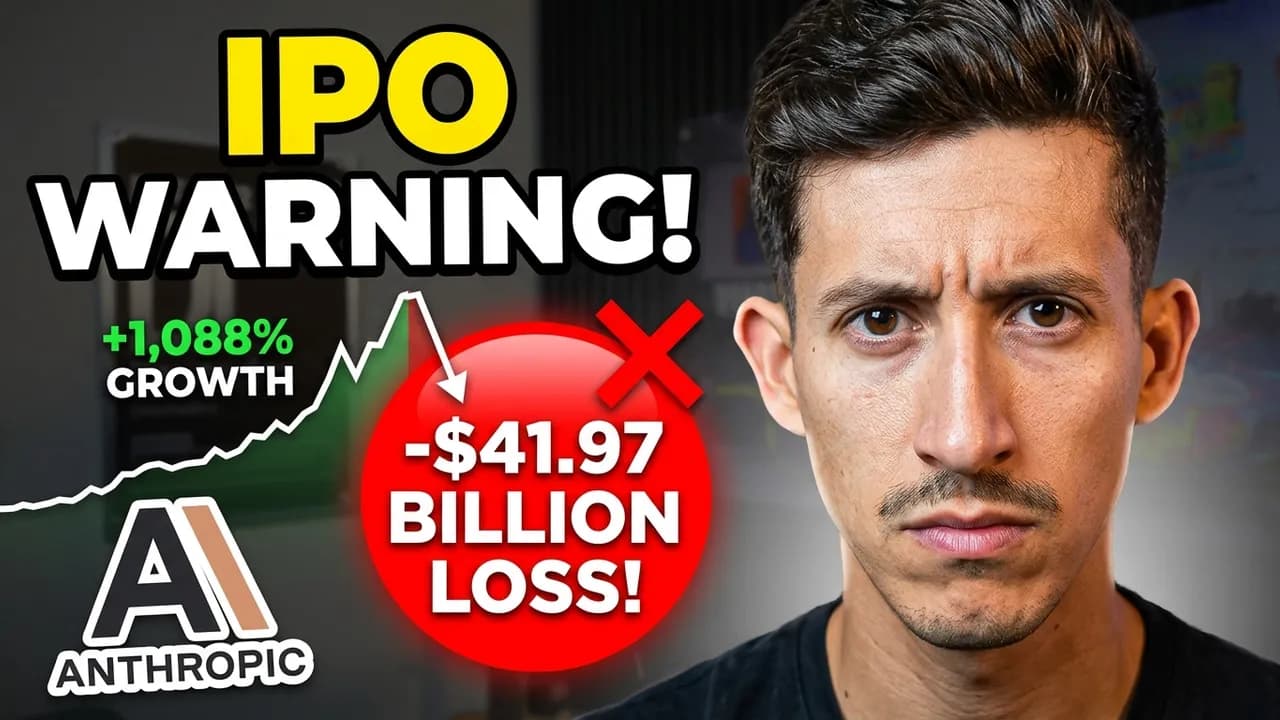
ED ZITRON: ANTHROPIC IPO IS A SCAM
In a Nutshell
The stream analyzes Ed Zitron's claim that Anthropic's IPO represents exit liquidity for a company with $430B in non-cancellable computing liabilities and rapidly declining profit margins. The host finds Zitron's financial analysis credible—Anthropic's S-1 shows blank Q2 data, massive losses, and unsustainable costs—but disputes his technical predictions, noting 19 of 43 predictions were wrong, including claims that AI had peaked and would stop improving. The core takeaway is that while AI models are demonstrably advancing, the industry's financial structure appears unsustainable, with Big Tech's $1T+ capex yielding no measurable productivity gains outside the tech sector itself.
These notes were generated by AI and may contain inaccuracies.
The broadcaster experienced significant technical difficulties setting up the stream, including confusion about how to use Restream for the chat window. The broadcast was initially started on the Less Bitter channel before attempting to broadcast simultaneously to both channels. The streamer acknowledged being a bad broadcaster and struggling with the technical setup.
The Mo More Bitter channel had stopped posting content because the audience wanted very anti-AI content, but the host had run out of such material. The current stream was being broadcast on the Less Bitter channel. The host mentioned the overlap between audiences on both channels was unknown.
A comment suggested that if artificial intelligence breaks encryption, it would be considered Armageddon and the end of the beginning of the end. Another comment mentioned that if AI could analyze prime numbers, it would be all over.
The host clarified that they were not declaring that Anthropic's IPO is a scam, but rather echoing what Ed Zitron had said. The host positioned themselves as an engineer rather than a money person, noting that Ed Zitron is good at financial matters but not an engineer, potentially overestimating technical aspects. The host believed Ed's financial analysis was good and that expressing viewpoints was important even if disagreed with.
The host discovered that using a wired internet connection instead of Wi-Fi reduced stream delay from 10 seconds to faster performance. Previously experiencing delay issues with Wi-Fi, the wired connection showed improvement.
A viewer comment stated that Anthropic's S1 model is absolutely terrible, claiming they lost 80 billion this quarter with liabilities of 750 billion for the next five years, questioning how the company is allowed to go public.
The host stated they aim to broadcast on weekdays at 11:30 Central Time, noting that consistency is important even when difficult, and that developing the habit matters.
The host began reading Ed Zitron's article titled "Anthropic's S1 model uses an unusual quarter to trick investors into becoming its exit cash, and explicitly states that its costs will grow sharply as profit margins decline. Its $430 billion, non-cancellable contracts have yet to take effect."
Ed Zitron appeared on The Weekly Show with Jon Stewart and on his own podcast. The host noted that OpenAI and Anthropic are economically interesting because they are losing billions of dollars, with Anthropic's S1 model showing they are losing billions less than OpenAI.
The S1 form is the document submitted when taking a company public to the Securities and Exchange Commission. All data for the last quarter in Anthropic's S1 filing is blank, meaning numbers needed to understand the company's situation are empty. The host noted that many figures were shared with investors on Investor Day two weeks prior, suggesting small investors were disadvantaged.
The company made a small profit in the second quarter because Elon Musk discounted their computing costs at SpaceX for two months. The host questioned whether SpaceX has its own computing capabilities and whether this represents a vicious cycle of self-interest.
AI labs like Anthropic and OpenAI rent computing power rather than building their own. By December, Anthropic would be paying $3.1 billion a month for computing. The host noted that banks are concerned about lending to companies losing billions, so AI companies get big cloud computing companies to take over infrastructure.
Derek Thompson, a writer for SpaceStack and contributing writer for The Atlantic, criticized Ed Zitron's claim that AI reached its peak more than two years ago, comparing it to covering Intel's IPO in 1971. The critic suggested looking at Zitron's track record in AI predictions before broadcasting opinions as an expert.
The host believed Ed made good points on financial matters but was often wrong about technical matters outside his expertise. Examples include saying in 2024 that generative AI had reached its peak and would not get better. However, the host noted that when it comes to financial matters, there are many shady things happening.
The host expressed feeling that Anthropic's IPO would be the peak of the market, noting that by definition, IPOs represent exit liquidity.
By February 2024, Ed Zitron believed generative AI would reach limits of what it can do and how accurate outputs can be. The host noted this was a technical prediction that was difficult to make correctly.
The host mentioned that even Dario said most people, about 90% of those who worked with him at OpenAI, saw GPT-2 and couldn't extrapolate correctly, saying it was just a nice autocomplete. Elon Musk was also wrong about generative AI, coming late to the game and leaving OpenAI.
A viewer clarified that Ed Zitron criticizes companies, not technology. The host agreed that criticizing companies is supported, but noted that Zitron has criticized the technology itself, which is understandable.
A viewer tweeted that while not agreeing with everything Ed says, they are glad someone is putting forward the pessimistic viewpoint. If there wasn't someone like Ed shouting about financial matters, who would do it? The host agreed this may not all be accurate but represents a valuable service.
The host noted that Silicon Valley got Trump to the presidency and Silicon Valley is getting a takeoff track. Ed is described as very dogmatic about his ideas and not a financial expert.
Ed Zitron used to work in public relations for Silicon Valley companies through EasyPR since 2012, working with clients ranging from Fortune 500 companies to taking startups from obscurity to global fame, with focus on media relations.
A viewer mentioned that Anthropic built everything on criminal activity and literal theft, referring to scanning books. The host questioned whether this was accurate.
- March 2024: Have we reached the peak of artificial intelligence?
- Another prediction: hallucinations mean AI progress is limited
- As previously warned: AI companies are running out of data
- Another prediction: models cannot improve because there is no longer any data
Austin Allred, CEO of Something, stated that on the day Zitron should have been humble, he finds a way to fool himself into continuing to believe that it's all just a vicious cycle and fake. All companies are buying computing power from other major companies, calling it a scam.
The host stated they are a technology expert who sees progress in models and they are improving, which is hard to deny. However, the host doesn't consider that to mean nothing else matters. The host suggested if Ed had changed his message to say the technology is amazing but finances are a disaster, it would be different.
The host clarified they did not sell out principles, stating the technology has become better. However, Ed was right that AI is still bad at any problem that cannot be automatically verified by a third party.
In principle, verifiable work is where AI is most useful. The host noted that no one has been more wrong than Zitron over the past year, but because he says things against big corporations, biased people like left-wing zealots like Jon Stewart will listen without scrutiny.
The host, not being a finance expert or economist but an engineer and expert in drafting advanced prompt commands, used Ed's favorite tool to create a simple fact check. A research report took about two hours using six sub-agents, creating a small webpage for fact-checking assessment.
Last week the host opened their newsletter with a quote from Apollo's chief economist Torsten Slok: "Despite the huge investments and widespread hype surrounding artificial intelligence, the technology has not generated any financial return for American companies outside the technology sector."
The host asked if anyone outside the technology sector has received financial benefit from AI. Examples mentioned include legal field where people are getting tremendous benefit. A viewer working in construction uses AI for estimating bids, preparing reports, reviewing contracts, generating documents and plans, noting savings are difficult to measure but increase capabilities.
Revenue per employee is rising at the Big Seven companies but flat at the rest of the S&P 493 companies. Profit margins are rising for Big Seven companies but flat for the rest of S&P 493. There are indications AI does not boost productivity growth or affect bottom line profits. Major American companies have begun viewing spending on technology as a cost center putting pressure on margins rather than a source of growth.
Game makers don't release beta versions because people steal their games using AI. Only one or two successful games are released per year. Tim Sweeney, CEO of Epic Games, suggested using AI to accelerate production, and the host trusts this assessment given Tim's integrity demonstrated by suing Apple over App Store practices.
A viewer working at a company stated developers are moving toward what they call feature fountains, releasing new products on timelines of months rather than years.
The host defended quoting Sabine Hossenfelder, noting they cannot keep up with everyone the audience calls frauds and will not take seriously when the audience calls everyone a fraud. The host stated they have seen those called non-crooks and will not take seriously blanket fraud accusations.
The host praised Tim Sweeney as a dependable man and one of the few technicians who are honest. He built a truly amazing, top-tier game engine that the host uses for free.
The host noted that Ed Zitron seems arrogant to some viewers but finds him quite funny and entertaining to watch. The host questioned whether being right or wrong matters when someone is entertaining.
Revenue per worker at the seven major companies—Alphabet, Amazon, Apple, Meta, Microsoft, Nvidia, and Tesla—rose from 600 to 800 between Q3 2022 and Q3 2026. The rest of the S&P 493 index has declined since the third quarter.
AI was promoted as an augmentation or replacement for jobs, meant to make existing resources more efficient or allow replacement of those resources. After four years, profit margins across the S&P 500 have worsened since the November 2022 launch of ChatGPT, with no measurable improvement for companies outside Google, Amazon, or Meta. Tesla and Apple are not part of the AI bubble as understood.
There are no signs of rising profit margins outside the technology sector. The market views the green line of technology as early adopters who started using AI before others, with the expectation it will spread to other companies.
Every new technology has its bubble moment before a collapse, typically preceded by significant growth. The timing of when AI's impact will be measurable could be now, 5 years from now, or 20 years from now.
Anyone claiming AI completely edits videos from beginning to end is lying. Controlling each frame is essential, and AI cannot make precise adjustments or subtle edits at the speed of traditional workflows in Final Cut. AI can add overlays and animations and generate somewhat interconnected stories, but it is bad at cutting. The principle of "bad input means bad output" still applies.
The counter-argument is that organizations have not yet fully integrated AI into their workflows. AI does not generate more money or profits for companies, nor does it improve measurable performance. Modern science needs AI to push boundaries so that the impact of AI itself can be measured. AI does not improve return on invested capital for giant cloud computing companies.
Return on investment for giant companies fell from 35% to 20% over the past six years. AI does not appear to be increasing revenue or margin growth in the S&P 500. The seven largest companies have seen their return on invested capital decline quarterly while spending more than $1 trillion in capital expenditures.
Alphabet (Google) stock fell more than 13% after announcing weaker-than-expected earnings, marking its biggest ever post-earnings drop. Stock market value was wiped out by approximately $20 billion. Search revenue grew by 12% to about $63 billion, below Wall Street's estimate of about $65 billion. Free cash flow turned into a loss of about $9 billion due to AI spending.
The industry markets itself with genuine contempt for the end customer or investor. Anthropic's terms of service, anti-open source stance, anti-China position, and attempts to pass laws reflect this contempt. Security concerns are justified—unleashing an agent with infinite tokens will find security gaps.
There is no competitive trench beyond a preliminary step. A trench requires working on the product, discovering the product, solving problems, being first to market, and exploiting that advantage. Products can be copied in half an hour. The trench is doing great work on the product, marketing it effectively early, and seizing a one-week window to attract and retain customers. Being first is more important than ever.
At the beginning of the internet, things were chaotic and only settled after a decade. Cloud and AI may never reach stability because AI is extremely annoying by its very nature. Only when limits of measurement laws are found will stability occur.
AI is loved for personal use and is extremely useful in expanding individual capabilities, especially for non-programmers. However, there is complete pessimism about the business philosophy and how AI is priced. AI cannot do a good job on the product—that has to come from the user. Taking AI recommendations literally results in products with zero taste and market impact.
The timing of Anthropic's IPO is deliberate. The $1.7 trillion valuation is questioned as having no basis. Anthropic's S-1 report from Q2 2026 tells a different story than the public narrative, with non-cancellable liabilities exceeding $430 billion. The vast majority of Anthropic's big-computing contracts only started in or around Q2.
Anthropic has an entire risk factor dedicated to the statement: "We are in the early stages of our revenue growth. We've seen rapid growth in recent periods, and our historical growth rates are not indicative of future performance or our ability to sustain our projected future growth earnings." S-1 reports contain intentionally honest and negative risk factors.
AI can transform something into something that already exists, but cannot create original products. Whisper Flow is an application where pressing the FN key starts listening and converts speech to text in the currently active text field. It uses the open-source Qwen model.
Ed has previously stated he has no financial position in the stock market. Not participating in the stock market for 20 years is considered an indefensible position. The S-1 model functions like a health warning on a pack of cigarettes.
Anthropic is accumulating cash to exit public markets. The company has committed $430 billion in irrevocable pledges and stated outright that its economic situation will worsen. Anthropic's biggest clients are openly building competitors or discussing abandoning services. SpaceX has the Grok system and took on $40 billion in debt to buy more GPUs.
The sole purpose of Anthropic's IPO is to get off public markets. The company has long passed the point where there is room for growth at a valuation between $1.4 and $1.75 trillion. Historical IPO valuations include Amazon at $438 million, Microsoft at $777 million, Google at $23 billion, and Meta at $104 billion. Open-source competitors are only four months behind Anthropic's models.
The theoretical counter-argument is that iterative, self-evolving intelligence could create infinite demand for intelligence, potentially making Anthropic a $10 trillion company.
Current AI systems remain highly limited despite widespread hype. The technology functions primarily as sophisticated autocomplete rather than genuine understanding. While users can dictate goals for an hour and receive polished outputs that align with intentions, this represents pattern matching rather than true comprehension. The speaker notes that all AI discussions were once considered science fiction, yet the gap between current capabilities and genuine understanding remains vast.
An optimistic scenario suggests AI could generate enormous market value of $10-30 trillion if demand proves endless. However, this view fails to account for fierce competition within the AI sector. The speaker acknowledges that visionary thinking is required to exclude AI from consideration entirely.
The speaker purchased Nvidia shares in 2014 due to interest in gaming and 3D graphics. A $2,000 initial investment subsequently doubled through cryptocurrency exposure and doubled again through AI applications. The speaker expresses regret at not being older with more capital during Nvidia's peak performance period. Jensen Huang emerges as the primary beneficiary of current AI developments, with the speaker noting uncertainty about how others will profit when companies build proprietary tools rather than outsourcing.
Fundamental questions arise about AI's economic impact: if AI replaces human workers, who purchases the remaining output? The speaker observes increasing difficulty affording basic living expenses, noting TikTok videos of people crying in cars while struggling with rent, food, and other necessities. This situation has been worsening over five years of observation. The speaker questions how retail and professional workers maintain cost of living amid extreme price increases.
Anthropic lacks meaningful competitive immunity, as its technology remains subject to imitation and copying from competitors. The speaker notes this vulnerability is explicitly listed as a risk factor in Anthropic's S-1 filing. Precedence provides temporary protection but remains volatile. Distillation processes and iterative self-improvement capabilities already exist in current models, though these do not automatically generate artificial general intelligence.
The speaker references the assessment that we received the AI we needed rather than the AI we wanted. After approximately 1,500 sessions with Opus, the speaker reports no instances where improvements were urgently needed or desired. This raises questions about how much better AI models could realistically become. The speaker acknowledges that AI training has effectively distilled human knowledge to create closed-source models, creating proprietary distillation pipeline technology that companies claim rights to protect.
The speaker emphasizes diesel fuel's critical role in supply chains - without diesel, trucks stop moving and supermarkets empty. Economic constraints limit total available capital, meaning Anthropic cannot achieve $10 trillion valuation without eliminating substantial human labor and replacing workers to justify $30 trillion market value.
Meta's current market capitalization stands at approximately $1.6 trillion for a company holding effective social media monopoly. The speaker questions how Anthropic justifies its extreme valuation and how it would maintain such valuation if offered through subscription. Maintenance strategies appear to rely on incremental model releases (Opus 5.5, 5.6, 5.7), occasional concerning demonstrations, public relations campaigns, and hiring PR firms for promotional efforts.
Anthropic's blackout schedule permits non-founding insiders to sell 10% of shares on the first trading day and 45% total on the second day following 2026 year-end results. Bloomberg reported in July 2026 that US executives were selling shares at the second-fastest pace in over 20 years, exceeded only by 2021 levels. Corporate share purchases totaled $6.9 billion, slightly above the seven-year low of $6.7 billion.
The market exists in a bubble with institutions questioning AI return on investment. Apollo's chief economist reports no returns on AI investments. Data centers require continuous high-interest debt financing. OpenAI and Anthropic together carry liabilities exceeding $1.3 trillion. The Nasdaq 100 index shows 46.5% exposure to AI chip manufacturers (Nvidia, AMD, Broadcom) and cloud computing companies (Google, Amazon, Meta, Microsoft, Micron, CoreWave). More than 37% of total American household wealth remains concentrated in an inflated US stock market.
Discussion of AI market conditions shows extreme polarization with no middle ground between skeptics and proponents. The speaker identifies Ed Zitron and Dario Amodei as representing opposite positions. Financial commentators capable of balanced analysis would provide valuable service, though the speaker notes that industry insiders have financial incentives that compromise objectivity. Steve Iseman, known for short-selling debt obligations, represents a multi-billionaire investor perspective.
Ed Ludlow of Bloomberg Technology presents balanced coverage without taking definitive positions on the AI bubble. His recent reporting addressed concerns about augmented reality traders. The speaker notes difficulty finding clear bubble assessments from Ludlow as a Bloomberg Tech host.
Analysis of 43 verifiable predictions made by Ed Zitron from October 2024 through October 2026 shows 13 correct predictions, 4 mixed results, 19 incorrect predictions, and 7 still pending. Zitron demonstrates strength in credit and deal structure analysis, accurately identifying Oracle and CoreWave bond issues, Nvidia's reduced OpenAI commitment, and the 2026 credit crunch. Weaknesses appear in demand, capability, and survival predictions.
Correct predictions include OpenAI requiring continued massive funding rounds (October 2024 prediction of July 2025 funding need, with $40 billion raised by March), OpenAI's billions in losses, CoreWeave as a debt time bomb (described March 2025, trading at distressed levels by October 2026), Oracle's exaggerated gains that vanished within three months with S&P downgrading to near junk status, Nvidia's $100 billion commitment shrinking to $30 billion stake (October 17), data center funding running out by October (December 25 warning), credit tightening for risky AI borrowers, and GitHub Copilot moving to token billing system.
Zitron incorrectly predicted OpenAI's growth would slow considerably in 2025 when revenues actually tripled to $13 billion. He stated OpenAI sells inference services at a loss when audited gross profit margins reached approximately 43% in 2025. His October 2024 prediction that OpenAI couldn't survive another two years proved incorrect as the company seeks $1.25 trillion valuation. Meta was described as a dying company in November 2024 despite $64 billion quarterly revenues announced in October. January 2025 predictions about large companies struggling to justify GPU spending proved wrong as Big Four capital spending rose 79% in 2026. Agent predictions proved incorrect as Claude Code and Cursor exceeded $2.5 billion and $4 billion revenue rates respectively.
Model improvement predictions proved wrong as measured capabilities continued rising. Anthropic's $35 billion 2027 forecast was called "astonishingly optimistic" when third quarter 2026 revenues reached approximately $67 billion annualized. Google's 500 million Gemini user target was predicted to require firing someone, but Gemini exceeded 750 million then reached one billion users. Microsoft was predicted to back away from data center expansion when quarterly capital expenditure reached $45 billion. CoreWeave IPO was predicted insufficient for survival when the company raised $20 billion in 2026. Abilene data center construction was predicted to face significant delays when Oracle announced six of eight buildings operational by September. Cursor was predicted to fail at $10 billion valuation when SpaceX acquired it for approximately $60 billion.
February 2026 prediction that Anthropic had no path to profitability proved incorrect when the company achieved $1 billion operating profit in Q2 2026 under GAAP accounting, attributed to SpaceX computing discounts. October 2025 prediction that the bubble would burst no later than Q2 2026 proved wrong as stocks approached record highs by October 28.
2026 represents a critical year with credit conditions deteriorating and stock market indices approaching record levels. Broadcom, AMD, and Gigawatt UAE's OpenAI projects have not arrived in full. Stargate was predicted to destroy Oracle, though Oracle sits one notch above non-investment grade while publishing funding plans. Most AI services were predicted to move to tokenized accounting by end of 2026, though GitHub implemented this while OpenAI and Anthropic show no indication of abandoning subscription models. Anthropic's second quarter was predicted to represent peak performance, with third-quarter margins already declining and S-1 predicting contraction.
Critics focus excessively on Zitron's incorrect technical predictions while financial analysis reveals concerning patterns. The speaker suggests that excluding technical projections, financial documentation demonstrates unusual market conditions that warrant attention. Many technical observers dismiss financial concerns entirely, though raising these arguments provides value. The speaker expresses interest in balanced perspectives from financial commentators at CNBC or Bloomberg.
The speaker broadcasts weekdays at 11:30 Central Time, 9:30 Mountain Time, and 12:30 Eastern Time. The Enjoy.dev application provides AI guidance tools claimed to be 100 times better than alternatives. The broadcast concludes with thanks to viewers and supporters.
Keep Mo Bitar in your library
Save the videos and channels worth coming back to, and find them again in one place.