Iran's AI Supply Chain Threat, Claude vs. SaaS, and Elon's $60B Cursor Bet | EP #249
In a Nutshell
Moonshots Podcast EP #249 analyzes AI's rapid disruption: Anthropic's Claude Design threatens SaaS giants like Figma and Adobe by unlocking latent model capabilities, frontier labs predict entry-level software jobs vanishing in 3 months amid recursive self-improvement, and SpaceX negotiates a $60B acquisition of Cursor to boost xAI's codegen for AGI via Grok 5. Elon ramps xAI compute to 2GW leadership, OpenAI advances image reasoning and loses execs, while hyperscalers' $1T capex signals a Dyson swarm era outpacing historic mega-projects. Amid Iran Strait disruptions risking AI supply chains (helium, oil), entrepreneurship explodes as AI enables solopreneur antifragility—anyone can now build value at near-zero cost, urging agency over job ladders.
These notes were generated by AI and may contain inaccuracies.
Iran's AI Supply Chain Threat, Claude vs. SaaS, and Elon's $60B Cursor Bet | EP #249
Having this global geopolitical dependency on one narrow volatile geographic region is completely unacceptable. This Iran war is not really just an oil shock. It's a system shock. TBD whether you know what direction the US goes on that. It's almost easier to predict what happens after it ends. We're seeing all of a sudden the frontier labs beginning to compete with the vertical businesses built on top of large language models. You're going to get this horde of startups building in an AI native mode and the big companies will struggle to adopt. SpaceX negotiates the right to buy Cursor for $60 billion. Is this just Elon's normal play? This is actually what a Dyson swarm probably looks like. This is where it's all coming down to. This is like the final countdown of whatever stage of the singularity we're in. Now that's a moonshot.
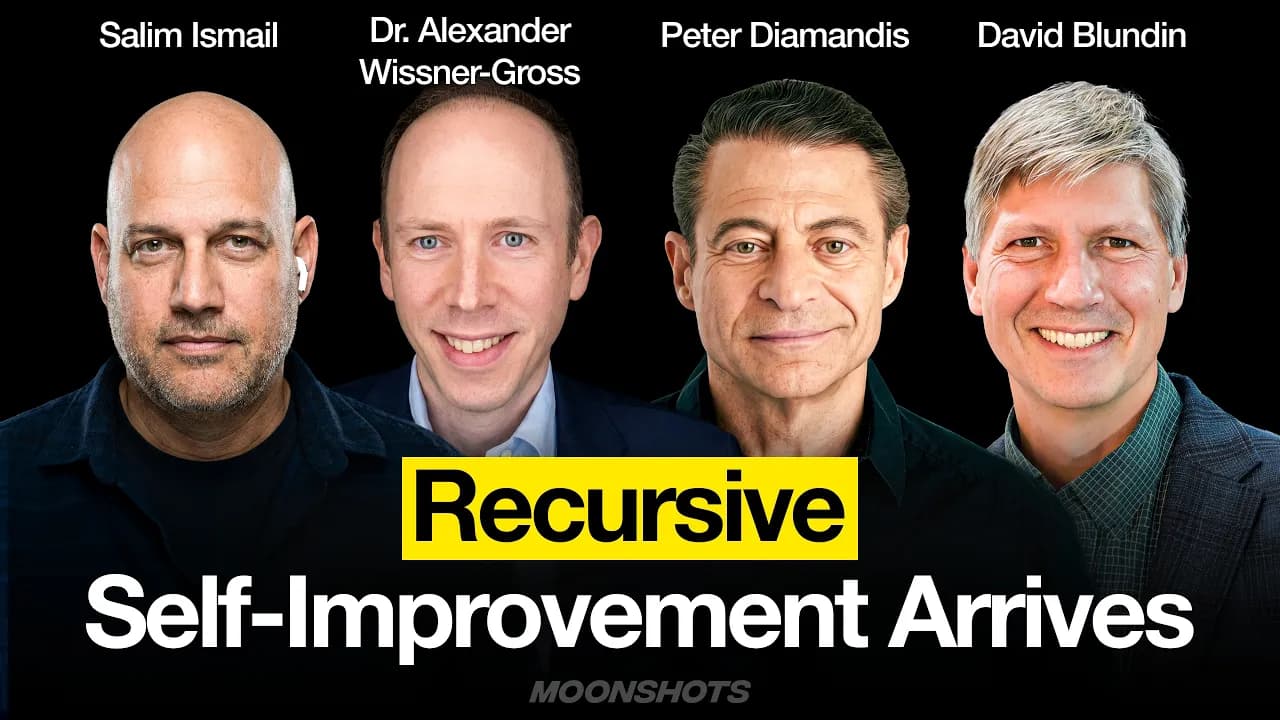
Everybody, welcome to another episode of Moonshots. WTF just happened in tech this week. Your opportunity to hear about what's going on in the world at a hypersonic speed. Here to help prepare you for the future with my incredible moonshot mates, our resident genius AWG. Alex, good to see you in your normal haunt. It's good to be haunted. And of course our exponential investor DB2 Dave uh back at MITIC.
Uh yes, back from San Fran for one day and then off to New York tonight. We talk about the three-day work week, the 4 day work week. I think this is uh invented the nine and 10 day work week for us. I don't think I've ever worked hard in my life. Alex is constantly reminding us? There's only going to be one singularity in our lifetimes. and you have to just savor and use every minute of it. So, it's worth it. It's so worth it. All these people who are absolutely convinced that human attention is a scarce resource, I think they're going to get proven wrong. Ultimately, I think we can manufacture more attention. Peter 2 of 10 is going to be dedicated to this podcast all the time. Or as they say, go fork yourself.
Oh, no. Salem, you are worse than all of us put together. Where are you on the planet today? I'm at the Breakers and Palm Beach doing a keynote to 700 CEOs, uh which I did this morning. They're pretty freaked out. Um as they should be because the world is changing pretty rapidly by AI or by you about about the content. Look, it's such a huge shock for people in the normal world to go what is happening and how do I juxtapose with this? It's really a big topic. So, it was a great time. Great questions. That's always the great um the best moderator whether an event was good or not. The quality of the questions was excellent. And the number of people who are standing up and screaming, "Okay, it's the usual Palm Beach dilemma of billionaires worrying that they might become millionaires again." This is not Palm Beach residents. These are people coming in for this event from all over the country. So, this was really um Main Street USA in one place. It was really quite surreal.
I'm here in uh in our Moonshot Studio Galore again. I still want to get you guys here.
I had an amazing Saturday night and I want to just tell you guys about it. So, I was at the annual Breakthrough Prize. It's put on every year by Yuri and Julia Milner. Uh it's an annual event began back in 2012. It was co-founded by Sergey Brin and Mark Zuckerberg and Anujiki. This used to take place in the giant airship hanger at Moffett Field. Do you remember that giant structure very right next to Singularity University this year? It took place at the Barker Hanger in Santa Monica airport, right near my home.
Yuri Milner, who's the principal sponsor of the prize, uh is an amazing guy. uh a Russian Israeli physicist turned VC billionaire had some of the most precient investments. Uh he invested in Facebook and Twitter, Airbnb, WhatsApp and he decided along with Sergey and an and um and others they wanted to put on sort of the Oscars of science sort of the new Nobel Prize and recognize the top researchers and breakthroughs and they give out $3 million in cash to the researcher who did the breakthrough. So, it's it's a big deal, bigger than the Nobel Prize, you know. Past winners were Steven Hawking for Hawking Radiation back in 2013, Jennifer Doudna for CRISPR, Demetrius Abavis won it a couple years ago in life sciences of course for his incredible work.
And this Saturday night was like the best ever. I've been honored. I've been going since the beginning of this thing. Uh it was all the Hollywood stars, all the tech CEOs were there, right? On the Hollywood side, it was like Ben Affleck and Anne Hathaway, Robert Downey Jr. On the tech side, it was Elon, Sundar, Demis were there. I spent time with Jensen and Sam Altman. Did you invite them on the pod? I actually did. Uh Sam said he would come on as soon as things slow down a tiny bit. He's got a busy couple of months ahead of him. That's like 2028. Well, no. Hopefully sooner than that. I Elon said he's happy to come back at the end of the year for day our annual catch up on what predictions, you know, came out, which didn't. That's going to be stacked. Yeah, I invited Sundar and Demis as well. So, all and Chamath was there uh from the All-In podcast and Chamath 100% said he's coming on the pod. So, that will be super fun. Um, just that will be Oh my god, I'm so looking forward to that. Uh, what about Robert Downey Jr.? Yeah, I did chat with him about longevity and uh and Yep. I think that could be fun, but uh you know, I think having them comment on all the tech news isn't going to work out.
But the winners this year by the way I should just mention them since it was the point of the whole evening. Uh gene therapy for inherited blindness, sickle cell anemia uh sickle cell disease and betathalassemia sort of a a gene therapy for curing that for turning on uh early infant versions of your sickle cell uh hemoglobin or your hemoglobin ALS and frontotemporal dementia genetics. Uh muon anomalous magnetic moments. Alex, you probably know all about that. And then mathematics of wave behavior. So, uh, they did an incredible job explaining the implications of each of these breakthroughs. And it was just a great award. In this photo, you can see, uh, Jensen down at the bottom right along with, uh, with Yuri Milner, our host. Um, and it was just an incredible evening. Super super pumped. And thank you to uh, uh, to the Milners for putting this on this year. The best ever.
You know what's awesome about this is if you go back to the Renaissance, scientists at that time were treated like rock stars and global celebrities and when we can recreate that it actually affects civilization. So that's awesome. It's interesting right? It's like who do you celebrate in the world right? It tells you a lot about the culture and I remember when I was growing up in the 80s and you know in typically in the 80s all of the Wall Street bankers were being celebrated right so everybody would you know to Wall Street Dave I don't know if you remember that um yeah yeah and now of course it was some of the best and brightest the people that would have changed the world you know with with breakthroughs were going off and and putting together pitch decks you know for for real estate transa was so frustrating and painful to see but a lot of our classmates got sucked into that and luckily people are now focused on changing the world and uh anyway again an amazing evening.
All right, let's get on to our docket of incredible stories. The first one here is on Anthropic's dominance in particular Anthropic releases Claude Design. So I'm going to play a little bit of a video here. Um it's a uh you know Claude Design uh released on top of Opus 4.7 uh allowing you to design almost anything that you want. And what we saw here was immediately uh the stocks from both Figma and Adobe started dropping. Figma was down 10%. Adobe was down about 2%. And so the question here and I want to talk about this as a as the underlying part of this. We're seeing all of a sudden the frontier labs beginning to compete with the vertical uh you know businesses building built on top of large language models. Uh gentlemen thoughts.
Well, I think the elephant elephant in the room here is this is just an unhobbling of capabilities that were already present in the model. There there may be some fine-tuning or post-training that's involved at the back end. But this is essentially I think what one might call an unhobbling of latent capabilities. And I think it does raise the question every time a few of these other SaaS stocks have a mini SaaS apocalypse freakout from some unhobbling of a base model, whether and how much of the remaining economy is one unhobbling of a scaffold away from utterly cratering existing verticals. I really do think that and I say this to uh to every company I advise, you really don't want to be just a SaaS at this point. You don't want to be just a scaffold around models. You need your own vertically integrated native capabilities. If there's a physical world integration uh that that you can credibly claim uh or or build out, you really should be doing at this at this point because software is getting dissolved.
And in the case of Claude Design, this was I I've been using Claude to design PowerPoints and websites and other call them prototypically Adobeesque outputs and artifacts for months now if not low numbers of of years across all of the frontier models. We already had these capabilities. It's just that through unhoblings like Claude Design or Co-work originally, Anthropic is very successfully giving users permission to do what they could already do with first class Chrome. And I think it does raise the question, how many other user experiences that right now are their own dedicated verticals are one unhobbling away from just latent capabilities? And I think near the top of my list is creating new businesses. I think creating new businesses is just enough hobbling at this point.
I used it last night and um it's incredible what it can do and it's so dog slow. It's like torture and I'm sure it's dog slow because it's overloaded and I'm sure it's overloaded because Anthropic doesn't have the compute to support all of the growth. Really important. it's being shared and like I they they desperately need a Steve Jobs Johnny Ive kind of guy over there that understands out of the box experience and the other thing they desperately need is some kind of an ISV independent software strategy. So they need to build a software community that knows where they're going and can work with them and not just be in their way all the time. But right now they haven't declared any roadmap. And so you know we I think we all know that any big company like a Microsoft can kill any small company if they want to you know but but why would they want to you know some things they do want to do some things they don't want to do but you have to be intentional and explicit about it so it really feels like Anthropic is very PhD-ish and acting very PhD-ish and they need to they need to think a lot about how much power and influence they have now and going out and just bombarding the stocks of Adobe and Figma and driving them through floor and then not offering enough speed to be usable. Like what did that achieve? That's good for nobody. You like what is the plan guys?
You shorted the stock before you made the announcement. I mean that would be the play. That's the classic play today, isn't it? They did recover. They they they did recover, but you know, the markets hit them hard. And to your point, uh Alex, you know, I think about what's going to be hit next. I'll give you my my top ones. you know, legal research, document review like LexisNexis, right? Um, uh, you know, business intelligence from like Tableau, uh, medical documentation, clinical decision support from like Epic. On my list, I have, you know, the Bloomberg terminal, financial modeling and research, you know, seen a lot come out there. And then Workday, you know, HR, recruiting, performance. I mean, all these are going to get hit.
It's easier to ask what's not because, you know, AI is not anymore two-layer. It's the control layer over design, coding, etc., etc. And to Alex's point that you made elsewhere, um, you know, when you're not the incumbents aren't competing against new software features, you're competing against compounding intelligence. And that's a hard task to take on. And then the question is, who moving target?
And I have a shout out here because last on our last podcast, Dave, you complained about the design side and Alex, you guys talked about it and literally the answer to that was right there. So, perfect. We were when the iPhone came out, um Steve Jobs actually was originally opposed to the App Store. He thought it was a bad idea. He hated it. And the the team there talked him into it and it became the most incredible experience for everybody. I mean, you would never have had Waze and navigation and and great weather apps and your you know all these niche apps too. Like I use the tide app to know when the tide's coming in. You know, none of that stuff would have ever existed if they hadn't convinced Steve this was a good idea. And this this is where Anthropic is right now. You're about to destroy the careers of 80% of software developers. What do you want them to do? Give give us the proactive future for where where are you going and what are they supposed to do with this new tool you rolled out? Tell us. And that's what they need to do next.
So Claude is launching a partner program. We're in the running for that as as open exo. So, uh there are actually starting to put that ISV type of structure into place. Dave, I imagine you're going to see a lot of people come up with a business idea that they brainstormed with Claude and then they hit print and a pitch deck comes out and you're going to get AI slop in terms of business and pitch decks. We're already there. Yeah, that's there now. Accelerating rate. Yeah. I think now you and it builds the business for you per point entire businesses not not just business plans.
I think maybe we need to do a little bit of brainstorming for Anthropic here on the pod. I proposed the name we need a plan for a country of non-geniuses outside the data center. Totally totally right. And I yeah, I think um we're in a really weird moment of time right now where uh if you use this tool to create a PowerPoint deck what's the point of the PowerPoint like who's going to even look at it? Oh, it's probably another AI. Well, like well then why is it in PowerPoint in the first place? But right now we're in this transition phase where where a product like this makes sense. But it's only like a maybe a year of human history where something like this makes sense because we're moving to this world where you just tell the AI the outcome you want and it doesn't need a deck in the it doesn't need a Figma design in the first place. So it's a it's an interesting transition phase but desperately in need of leadership and a road map from Dario or from Daniela would be incredibly welcome.
Hey everybody, you may not know this but I've got an incredible research team and every week myself my research team study the meta trends that are impacting the world. Topics like computation, sensors, networks, AI, robotics, 3D printing, synthetic biology, and these Metatrend reports I put out once a week enable you to see the future 10 years ahead of anybody else. If you'd like to get access to the Metatrends newsletter every week, go to diamandis.com/metatrends.
Dario has been saying for, you know, at least the last year, AI is going to wipe out 50% of entry-level white collar jobs in the next 1 to 5 years. And so out of uh Anthropic comes a survey of the employees. Not a large number of employees, a small number, but their estimate is that entry-level software engineers and researchers will be replaced by Mythos in 3 months. So a little bit of uh uh of an extreme here. I mean the speed of replacement is key here. So I mean what's most significant about this prediction is it's coming from the engineers that this tech is likely to replace. You know I guess you guys can all remember the golden ticket for your kid was always go and you know get a degree in coding go get CompSci get an internship get an entry-level position and then work your way up the chain and uh all of that is disappearing. And what I find it fascinating here is the idea that software engineers and coders are really the canary in the coal mine for a whole slew of other jobs.
Human arrogance is unbelievable. Actually, if you if you go to San Francisco and you talk to these exact people, they all say exactly what this slide said. You know, this is going to replace almost all entry-level engineers. Are you an entry-level engineer? No, not me. I'm not. I'm a hyper senior whatever engineer. Well, you know, it's on an exponential curve, right? You you're you're talking about 3 months after this 3 months. Either way, you're coding yourself out of a job very very quickly yet. Yeah. Okay. I guess I am.
I'll take the other side of this. I thought that was saying one-third of the employees think they'll be replaced. Why isn't it at 80%. Uh that would be much more indicative. I think a third tells me not a lot about that particular thinking. And yes, they're going to be wiped out. I think we'll just change the types of what we mean by entry-level job. Maybe the the one-third who thought the entry levels are going to be replaced or are the the senior suites and executives at the company who are better positioned to to judge that.
I would just comment, you know, I talk we talk I think it's fair to say about being in the singularity. It's not just vibes and recursive self-improvement is not just vibes. This is exactly what one would expect to see if we are as I would argue we are in the midst of recursive self-improvement where almost all of the code uh it's been widely reported at Anthropic is now generated by Claude at other companies too uh at Apple at Google. This was I I I don't think we're we have a slide for it on this pod but pretty spicy news in the past 24 to 48 hours. Rumors out of Google DeepMind that a lot of Google DeepMind code is now being generated by Claude. So I think it it's not just necessarily junior sues that are being replaced by hypothetical future releases of Claude. It's also other frontier models from other vendors that are being displaced. This is the blast radius is pretty wide for this.
I think we expect everybody's leapfrogging each other. I expect this will occur in every single lab. I think there's also something here for organizations because the metabolism really gets affected. How do you develop talent when AI is doing all the apprenticeship work and this is going to be a big structural problem over the next few years? Yeah. How do you get to senior level players if you don't have junior level players? Exactly. The the sweet ladder gets yanked up.
But then we see in in other news in the past 24 hours, Meta announcing an upskilling program to teach people over a relatively short period of time how to lay fiber optical fiber in data centers. So I think the these are all just patches or bridges to an ultimate solution. Can debate what the ultimate Star Trek economics look like after this is all over. But in the meantime, certainly if if you're a software engineer, you uh a junior one, maybe you want to start your own company or or shift to to some other career ladder that that has more of a ladder to it.
Yeah, I was going to say something similar. You know, if you look at all the senior execs at OpenAI, I don't know about Anthropic as much, but we know a lot of the people at OpenAI, but vast majority of them were previously founders and co-founders of other companies. So, they became senior through the entrepreneurship pathway, not through the work your way up the ranks pathway. So that's the answer to your question. Now I know a lot of the listeners then say not everybody can be an entrepreneur. Well, we're going to talk to that. Yeah. We at the end of this podcast um we're going to have a session addressing the question that's been asked by all of our listeners. Hey, you know, I don't think I can become an entrepreneur. Is it for everybody? So, we're going to dive into that a little bit.
So, Dave, a question for you. Um, you know, I can imagine this 3-month survey, you know, this uh this uh SWE apocalypse in 3 months works for the hyperscalers where you've got these highly software engineers, but what about large Fortune 500 companies? What about like Chase and Kaiser Permanente? You know, I think this Mythos or all these technologies is going to take a while to permeate through the larger companies. How fast is it going to happen there, do you think?
Uh I think it'll it'll vary depending on the quality of the management team, but a great well-managed companies uh it'll happen very very quickly. And I I think you have to realize that, you know, after Sam's house got firebombed and then shot at and he has bullet holes in his door, the bias when you survey these people is toward downplaying, not toward exaggerating. That wasn't true a year ago. A year ago, the bi the bias was toward exaggerating. But now it's the exact opposite. So the the the capabilities of the AI are going to be far far ahead of what they want to talk about. The employers will then underreact by and large and a lot of them just don't want to deal with it. And so you'll see a subset of them that are early adopters. You know part part of it is you know cost reduction but another bigger part of it is green field building of new things that you never could have thought of before. And that's such a massive sweeping opportunity that those companies will get miles ahead, hopefully create new jobs as they grow. Uh, and then the legacy guys will be very very late to catch up and will probably get crushed in the process actually. And that'll include some really big companies, you know, big banks, big insurance companies, but they just won't move fast enough and and they won't see the little guy coming up. But you know, a little guy with a with a effective workforce of a billion AIs, they're they're going to go very very quickly past you and you won't see it coming.
I have a clear lens on how this will happen. I think what's going to happen is you're going to get this horde of startups building in an AI native mode and the big companies will struggle to adopt because as I've mentioned before, all our workflows in big companies are human to human. all the approval lines are human to human and you need to be AI native uh which means you completely need to redesign your workflow. Most big companies don't have the skill set or the ability to do that. So what'll happen is they'll watch the incumbents come along and then they'll start buying them because they have to in order to compete and then they'll reverse into them that way. That's what I think happens. innovation thing is really clear, you know, since you're in every
San Francisco, Austin, and Boston are moving at warp speed on AI adoption, while elsewhere in the country it's much slower. Europe shows no action or reaction. Adoption is sublinear. A tribal village in Africa might remain untouched by AI, continuing as it has for 100 years. Parts of America will be similar. With over eight billion handsets worldwide, AI diffuses to individuals. Story from Morocco: a young man chatted with ChatGPT to invent a new career. Initiative-taking people will grab AI tools to improve lives.
At the current growth rate, those who grab tools will thrive regardless of old job loss. People lamenting 10 years mastering Python will suffer if they don't grab the new paradigm. Release the past, focus on the new, ride the wave—value creation ensures you'll end up ahead.
Elon predicts Grok 4.4 (twice the size of 1 trillion parameters) and 4.3 in early April, then Grok 4.5 (1.5 trillion parameters), 4.8, 4.9, Grok 5 as AGI, Grok 6 as ASI, Grok 7 as ASI 2. This was a 2 a.m. tweet. Critique: we haven't defined AGI, parameter obsession is crazy.
"We need to stop masturbating over parameter count."
Sam Altman said this at MIT in 2020 when asked how long to a trillion parameters. Elon now shares exact parameter counts per model, with IQ rising with parameters, then distillation. Transparent roadmap is great.
Alex: Bragging about parameter counts doesn't bode well for xAI. Race to superintelligence akin to Moore's law ending when Dennard scaling ended mid-2000s; CPU cores topped at 4-5 GHz. Unlikely to see ever-larger parameters. Most weights wasted on world knowledge, better externalized to database or text file, especially with infinite context windows (few billion tokens). xAI running last race, not current one on distillation, iterated amplification. Hope for race to reduce parameters at constant capability—intelligence density. Bragging about doubling/tripling/10xing intelligence density per model, like some Neolabs. Discuss ternary quantization, binarization. Breakthroughs could compress 10 trillion parameter model to few million equivalents.
Elon aware of this (mentioned in Austin), but body language suggests focus on hyperscalers/builders. Analogy: launching 50-100 tons per Starship vs. making smaller satellites—less marketable but important. Elon minimizes components, makes elegant (e.g., smaller V3 Starship engines).
AGI function of compute power? xAI at 2 gigawatts by year-end, OpenAI 1.2 GW, Meta ~1 GW, Anthropic + AWS ~1 GW. xAI leads, good position. Elon king of brute forcing. Better to highlight training kilowatt/gigawatt hours than raw parameters—experience law curve more convincing than outdated trend.
Grok 5 as AGI, then what? Do labs release or hold for own science breakthroughs? Mythos already limited to select users, not shared widely in Europe (except UK). Frontier labs expect this in next couple years. Possible Elon defining AGI as Grok 5.0 via pseudo-code arrows. Definitions malleable: Amazon investment defines Anthropic AGI, $100B revenue for OpenAI.
xAI ships standalone speech API: 5% error rate on phone calls (vs. ElevenLabs 12%), 10 cents/hour, 25 languages. Elon's play: vertical integration, price to zero, real-world data dominance. Will xAI displace ElevenLabs ($6B valuation, voice AI leader 3-4 years)?
Compounding capability; xAI launching voice because superior demo. Elon leverages X for best media experience: image/video creation, voice, synthetic characters, virtual partners. Speech on roadmap. ElevenLabs fine—trillion-dollar call center payroll, only 0.001% penetrated. Declare roadmap so others work with you.
Liz Harky (a16z): Young YC teams may get crushed, mature teams with enterprise distribution or consumer base thrive. Massive untapped: e.g., moms with money for AI-enhanced Uber hailing, Tesla decisions.
Key: data moat, flywheel effect. Avoid direct crosshairs; predict labs' moves. Differentiators: marketing, customer relationships, reach, brand. Regulatory (e.g., Vocara in mortgages/insurance—AI quoting prices, accountable agents). Labs won't touch regulated verticals—better APIs help entrepreneurs.
Tech stack model-agnostic for swapping (e.g., ElevenLabs for xAI). Edge close to customer. Box.net/Dropbox thrived vs. OneDrive/Google Drive/iCloud via passion/domain focus. Big cos spread thin (e.g., Yahoo storage team of 3 vs. dedicated players). Regulatory/industry/tacit knowledge sustains.
Launched 10,000 concurrent agent swarm yesterday (math problems, Sonnet for cost). Claude 4.7 switched half to different vendor in one line: wildly flexible now vs. old API planning.
April 17: Kevin Weil (VP Science), Bill Peebles (Head of Sora), Srinivas Narayanan (CTO B2B) left. Tied to restructuring, reallocating SAR resources, decentralizing science team. OpenAI pre-IPO, focusing capital on near-term revenue.
Waves of exits; recall Anthropic schism (Dario, Jared et al.). Possible new lab from this: OpenAI post-$120B+ round targeting end-2024 IPO, deathmatch with Anthropic on recursive self-improving AI (codecs vs. Claude code). Non-core (AI science, video, B2B) thrown out. New frontier lab possible in 2-3 months with massive capital, novel AGI/ASI approach.
Of 11 OpenAI co-founders, only Sam Altman and Wojciech Zaremba remain (met Wojciech; likely heads OpenAI Foundation).
Numbers wacky: Mark Chen turned down Meta's $1B offer; Sam gave $1M spot bonuses to all non-baristas. Kevin (joined 2-3 years ago, ~0.1-2% equity): half-vested = $500M+ unvested (0.1% now $1B post-funding). Frees comp for 20-50 top researchers vs. Anthropic.
99% text accuracy, extraordinary resolution.
"If we think of DALL-E as cave drawings and Image Gen 1 as ancient art, then Image Gen 2.0 is the Renaissance."
Smartest image model: complex, polished, production-ready visuals with accurate text/structured design. Thinks, researches, web-searches for accuracy. Generates infographics explaining systems, math proofs. Multilingual visuals. First: multiple distinct images at once (e.g., full magazines with typography/photos, house renovation plans).
Incredible, easy via ChatGPT "create image" (defaults to 2.0). Fast, stunning. Got specific personal scene/background right, fills gaps with built-in knowledge.
Alex test: molecular diagrams (ibuprofen, acetaminophen, caffeine/1,3,7-trimethylxanthine)—some errors (extra alkanes). Manga for Accelerando chapter: decent. Text quality vastly improved. Arena.ai benchmark: 1512 ELO score, #1 text-to-image model, largest gap to #2.
OpenAI rolled out a model emphasizing reasoning abilities, marking a jump toward images as first-class reasoning modalities. Frontier models are starting to think with gestalt images like humans, rather than just language. This is the dawn of first-class visual reasoning. Tool use for image generation in ChatGPT Images 2.0 (or GPT Image-2) is an interesting development, potentially leading to copyright infringement claims.
Strategic Questions on Timing and Compute
Key OpenAI executives departed to compete with Anthropic in codegen races. Why release a compute-intensive image model now? Google’s Gemini Nano Banana Pro 2 consumed enormous compute, forcing Google to scramble. Text-to-image generation has enterprise value an order of magnitude or more less than code generation. Speculation: Why drop Sora and a next-gen image model amid the codegen/AI researcher race?
- Theory 1: Algorithmic advances made image generation much cheaper and faster, less compute-intensive than Google’s model. OpenAI achieved advances allowing allocation without interfering with recursive self-improvement.
- Theory 2: Image generation instrumental vs. Anthropic, which doesn’t allow image generation. OpenAI bets on reasoning over images for codegen supremacy, e.g., generating screenshots (Sam Altman posted fake Mac OS screenshot). Stronger image gen leads to better UI design codegen.
ChatGPT 5.5 (answer to Mythos, possibly branded as .5 model) still expected imminently.
Reactions and Tests
Alex’s hypotheses possible. OpenAI shows relevance; Twitter buzzing. Test: Generate photo of Gutenberg printing press from 1500s (no cameras then). Did well; better than ChatGPT 6 months ago, marginally better than Midjourney/Nano Banana then. Generating buzz for IPO, attracting consumer/retail investor attention and creatives.
Narratives emphasize OpenAI shifting to enterprise, not consumer—headscratcher. Enterprises have huge PDFs/PowerPoints; image model scans/renders them. Response to Claude (e.g., Claw design). In white-collar work, architectures/design documents/images bigger than coding. Anthropic generates code but sucks at diagrams (falls apart; forces code-to-diagram workaround). Gemini for planning, Claude for coding/thinking—no OpenAI role. Image model makes OpenAI relevant in white-collar stacks; usage grows once in.
SpaceX negotiates right to buy Cursor for $60 billion. Elon noted xAI needs catchup in coding; Cursor has best product but compute-constrained. Colossus provides compute. Cursor neutral now (instant model switching); acquisition might default to xAI.
OpenAI nearly bought Windsurf (blocked), featured Cursor in GPT-5 launch. Possible bidding war, but Elon locked it with $10 billion walk-away fee. Structure buys optionality: Cursor needs compute, xAI needs code capabilities. Liquidity event ($10B+, potentially pre-IPO stock).
Implications for Codegen and xAI Reset
Codegen/AI researchers innermost loop: best code → best AI researcher → best AI → best code. Post-SpaceX/xAI merger, Elon/SpaceX VP of Starlink (now xAI head of engineering) said xAI not built correctly, needs reboot. Cursor acquisition may reset Grok; admission Grok’s codegen not competitive with frontier (Claude).
Cursor observed user interactions with frontier models pre-launching own model. Vulnerable to vendors; fine-tuned Chinese open-weight model on user behavior to replicate Claude-level codegen. xAI buys Cursor for Anthropic-level user interaction data.
SpaceX as Hyperscaler and Orbital Cloud
SpaceX turning into hyperscaler (Dyson swarm as cloud in stars). Colossus (million H100-equivalent, ground-based) opening to third parties (first major tenant). Historically vertically integrated; now exposing GPUs (ground/orbit). Soon running compute on Colossus 2/3 in orbit (sun-synchronous?). Elevates agentic layer (chain-of-thought on foundation models) critical for functional codegen/AI researchers (Cursor/Blitzy specialized).
$60B drop in bucket vs. market cap. Cursor fears disruption; joins SpaceX/xAI ecosystem. Cursor team (four guys) awesome but no public CEO (no Zuckerberg); better to lock up than stay private/get crushed.
Google DeepMind researchers use Claude, not Gemini, for codegen. All players dropping capital/initiatives for codegen (OpenAI, Anthropic hoarding compute, SpaceX $60B deals)—critical path to maximum recursive self-improvement/acceleration. Grok 5 = AGI (Elon).
Fountain Life (fountainlife.com/peter). AI helps healthy lifestyle to 100+. Concern: cognitive abilities/dementia. 45% dementia entirely preventable. 25% Fountain members had advanced brain age; healthy living (eating healthier, movement, sleep optimization) improved brain age by 26%.
Hyperscalers’ data center CapEx hits $1 trillion by end of year (6 years), vs. Apollo ($257B/14 years), Manhattan ($36B/5 years), Interstate Highways ($620B/37 years), F-35. Adjusted for inflation/GDP, data centers outpace Apollo/Manhattan by 5x. Four private companies vs. government-funded.
Dyson swarm consumes economy (1% → 10% → 50% GDP). Unlike railroads/Apollo/highways, data centers = infrastructure for future civilization. Majority solar system intelligence in data centers (not human) in 10-30 years. Private funding democratizes; individuals/companies do what governments did, 10x-100x faster. If economy grows 10x, public/private distinction less relevant; government could fund in wealthier future.
Political support fickle (Apollo cratered 1972). Private (Elon/Bezos) sustains long capex (Moon/Mars). F-35 story: Carbon fiber nozzle for vertical takeoff (thousand-degree exhaust), replaced every 50 flight hours ($1M each)—“taxpayer money, burn them up.” Data center buildout biggest/fastest ever; needs to be bigger/faster. Public sector slows it.
AI underlies everything in the future total economy and society. During one-week executive programs at Singularity, a senior DoD official noted that investors hover at the knee of the curve for exponential technologies, but government funds the flat part of the curve for a very long time. As governments run out of money, private sector now funds that investment. US private sector invests huge amounts, but governments worldwide underinvest in data centers for sovereign future, risking being left behind. Governments should fund their own data centers to retain sovereignty.
Comparison to World War II industrialization buildout in terms of speed and mobilization: do what was done in 1940-41 globally for the AI race, spending far more than on highway or railroad systems.
Peak annual percentage of GDP spent on AI data centers on Earth, in space, everywhere in human sphere, even after disassembling Jupiter: will approach 100%. It should keep going higher as everything becomes computronium in service of building inner loop. Including building physical things to make people happy as part of data center buildout: 100%; excluding: 95%. Alternatively, caps at 25-33% of GDP then declines due to resource pressures, leading to automation efficiencies like robots, nano assemblers, compensating via Jevons paradox. Cheating on definitions; post-capital, post-scarcity world makes GDP meaningless. Creator of GDP said it's one of worst measures; need new metrics.
Framing as 1/3 pure compute, 2/3 robots and physical goods creation is palatable to public vs. saying 99% on data centers. Get to AGI first, then it figures it out.
17 quarters of negative manufacturing growth, now 16 quarters of steady increasing acceleration. Offshored most US manufacturing over last 50 years. Drivers of contraction: Trump trade war tariffs uncertainties, COVID-19 supply chain destruction, semiconductor shortages, post-2008 financial crisis hangover.
Current drivers: CHIPS Act, Inflation Reduction Act, Infrastructure Investment and Jobs Act, AI infrastructure buildout, defense spending reviving US manufacturing.
Onshoring and roboticizing manufacturing makes every American ultra-wealthy, but depletes Asian jobs (e.g., iPhone assembly), increasing global hatred of America while US wealth soars. Trend continues at least through this administration; massive capital flows to US as it's robot-dependent, not labor-dependent.
India building own manufacturing and automation at low cost, e.g., tiling country with solar panels for energy self-sufficiency. Political trope that globalization caused US job losses is wrong: financial engineering and private equity stalled innovation, outsourced jobs. Irony: LPs in those funds (e.g., California pension plans) are workers' pensions—worst incentive alignment. Now, using exo model, de-risk low-cost innovation at organization edge, double down on success. Reinvents American exceptionalism; manufacturing and innovation back with vengeance, ripple effects push world to compete on innovation.
Manufacturing seeks sovereignty via advanced nanotechnology enabling every nation to domesticate supply chains. Capacity limited by technological advances, not geopolitics. No bright future for global supply chains with advances in next 5-10 years.
Manufacturing physical goods/services via vertical farms, protein-based meats. Intelligence globalized (e.g., orbital data centers planetwide). Physical production localized but globalized consumption. Future: US with 3-4 competing corporate Dyson swarms, China with several; Europe/others may lag. Political division of heavens persists. Netherlands global food exporter via hydroponics, aeroponics, greenhouses; upcoming briefing on top vertical farming company.
Globalization exists due to shipping by boat, protected by US Navy. US has all needed natural resources internally, no huge incentive for globalization beyond cheap Asian labor. Robots eliminate that; no natural reason for US Navy to defend global shipping. Europe avoids costs (e.g., Strait of Hormuz) despite heavy oil imports.
San Francisco public companies' market cap now bigger than all of China (~1 billion vs. ~1 million people). Flow of wealth makes it global financial capital. 14% global market cap in 7,000 square miles—one major earthquake from economic catastrophe.
Chinese public companies prioritize differently than shareholder-activist West; profit less prized, CCP/government regulation suppresses book value. US policymakers outside SF area want their geography as world center. How to diffuse from Silicon Valley/SF to rest of country/world?
Billionaire tax counterproductive: pushed out half its tax base (e.g., to Florida), doesn't affect inbound entrepreneurs. Startups form nationwide near universities, move to SF young/pre-rich, leave as billionaires to Austin/etc. Doesn't slow SF entrepreneurship/growth. SF passed all China in total market cap.
Market cap weird stat in China, but real economy: service transactions (e.g., $20 dinner) vanish; durable goods (chips, engines, iPhones) create permanent value. SF unprecedented in history—experience it for a week, talk to people. Billboards on 101 reference superintelligence; conversations everywhere about Anthropic, OpenAI.
Blue Origin New Glenn third launch: reused booster flew/landed beautifully (3x faster reuse than Falcon 9 from first launch), but satellite to wrong orbit, de-orbiting. SpaceX: 600 launches vs. Blue Origin's 3.
Race for NASA lunar lander contracts: Artemis 3 tests low Earth orbit ops; Artemis 4 lunar attempt 2028.
ULA absent; neo-space (SpaceX, Blue Origin) competition good—avoid singleton controlling Dyson swarm. Lunar South Pole station waypoint to moon-launched AI data centers (SpaceX agrees). Want more western rapid-reuse companies (publicly traded/soon-to-be). China advancing.
NASA under Jared Isaacman: rapid iteration (SpaceX-like) toward solar system colonization; Artemis 3 demonstrates lander/orbital docking. Invite Isaacman post-Artemis 2.
Dark horse: Relativity Space (Tim Ellis) vs. Falcon 9; Elon plans retire Falcon 9 (most successful ever) post-Starship operational—burns old systems (Falcon 1 too). Eric Schmidt bought Relativity; hope for another super-heavy booster.
Microeconomic Q: How many LEO heavy launch providers needed for competition? Margins to zero like air transport; profit in LEO (data centers, orbital Hiltons). Boeing/Airbus capture 90%; Europe absent despite tries; China not reusable yet, failures.
Trump: Directed Secretary of War to release UFO/unexplained aerial phenomena files; process underway, interesting documents, first releases soon.
White House: 10 missing/dead scientists with access to classified nuclear material, aerospace—random or connected? Will know in 1.5 weeks post-meeting; serious, some very important people.
Strangest/ironic future: UAP lands on White House lawn televised, public ignores for next TV due to politicization. Rose Garden announcement dismissed by half due to climate. Capitol Hill now takes UAP seriously (inside Overton window vs. 10 years ago). Hyperscalers/government clouds executing president's UAP declassification directive on top secret networks.
Connected with disclosure via historic executive order on UAP disclosure. Process ongoing, scheduled to conclude no later than January 2027 per hyperscalers' stories.
Alex question: Past discussions like Project Blue Book yielded blanked, non-earth-shaking info. Will we see earth-shaking information? Even UFOs on White House lawn or alien body autopsies might not faze people asking about last night's sports score.
Age of Disclosure documentary recommended—high-ranking generals, admirals discuss sightings. Much moved to private companies to avoid FOIA, now managed by disclosure-resistant private contractors.
If central allegation accurate—35+ senior US officials claim 80+ year illegal campaign to capture, retrieve, reverse-engineer crashed UAPs—borderline crime against humanity. Suppressing tech advancing humanity centuries/millennia, or weaponizing for military, sets back progress by century. Devastating if true.
UAPs top list of crazy left turns derailing/altering singularity alongside superintelligence from AI.
Elon underwhelmed by UAPs/UFOs: advances in camera tech, yet imagery blurry/black-and-white. Even if he knew, probably couldn't say.
Concerning, especially post-Age of Disclosure threats to lives. Recent 24-48 hours: executive/Congress statements on active investigation, treated as connected, not coincidence.
Rep. Ogles tweet: "I have seen evidence so classified that just knowing it exists makes you a target."
ASI (artificial superintelligence) and NHI (non-human intelligence). With AI, verge of von Neumann probes at relativistic speeds, converting Milky Way to paperclips in tens of thousands years. If alone, possible in few years with AI/space advances.
NHI cameo needed soon to stop galactic paperclipping optionality.
UAPs appeared at nuclear age turn when self-destruction possible.
China hit 2030 goal 5 years early: 90% new power capacity wind/solar, 1500 GW solar installed—half global total vs. 300 GW US.
US underdeveloping solar despite nuclear/fusion; deploy more now.
Strategic: reduces oil dependence, plays for substrate advantage.
Dyson swarm future—solar too; space panels 6x efficient, but need massive manufacturing.
Perovskite advances: 35% solar capture in labs. Challenge: durability to match silicon. Abundant/cheap, eliminates rare earth dependence.
Beijing's 2nd humanoid robot half-marathon: Lightning robot won in 50:26 (human record 57 min by Jacob Kiplimo). Last year: 2:40. China prioritizes: 150 humanoid companies.
Alex upset by China's 1st event, pitched Tom Grilk (ex-Boston Athletic Association head) for robot marathon weekend of Boston Marathon—rejected. Funded Professional Robotics League (ProRL) with O21T Capital, Tom's son David.
Held North America's/West's first humanoid/nonhumanoid pro robotics race Sunday in Boston Seaport: 50m dash, Chinese/Western manufacturers. Huge success, Moonshots fans from Texas/Canada. Slower robots, no CCP mandate, but starting point.
Touching: boy at exhibition said, "I think I could do a better job designing a better robot. I want to be an engineer when I grow up."
Need more like ProRL for US robotics primacy. All 3 humanoids Chinese—need US manufacturers; had BD dogs.
Vision + AI + dexterity → stock-picking systems. Modeex show (30,000 people): industrial robots for back office, not humanoids. More than one arm possible for nonhumanoids.
Gallup: 28% Americans trust mass media—lowest in 50 years, down from 68% in 1972, 40% drop last 5 years. Coincides with AI online.
Business model problem: legacy media lost monopoly on reality construction. Scarcity = abundance minus trust (Jerry McCowski). Direct voice > institutional polish.
XAI/Grok powerful for verifying reality. Need X-Prize for trust amid deepfakes—trend downward, no rebound.
Credible people buried in clutter. Entrepreneur opportunity: build trust delivery.
Tim Cook steps down, John Ternus (hardware manufacturing head) in.
Steve Jobs death: Apple $300B; now $4T. No new products—still iPhone. AirPods biggest innovation. Cost-cutting, vertical integration, Apple silicon.
Phone modality → headsets/pins/AI interface disintermediating apps.
Cook era like Ballmer/Microsoft: operator post-visionary Gates. Ternus hardware engineering background → breakthrough hardware/AI focus.
Apple failing AI positioning vs. frontiers/Microsoft Copilot. Suggest OpenCLaw-oriented devices (Mac minis hot).
Magnificent 7: 4 with original founders controlling/active doing AI; 3 on CEO #2-4 not doing AI (Apple, Microsoft? context implies).
Huge shoes for Ternus; founder vision resists right turns on predictable revenue. Tim Cook remains chairman.
Hardware focus good.
Five forks discussion feedback. Focus: Iran war, Strait of Hormuz impact on AI infrastructure—aluminum, oil, natural gas, helium shortages.
Grew up in Iran: absent US, Iran gets nukes, launches at Israel. US/Israel bomb facilities → Iran shuts strait. US Navy sinks Iranian Navy, hard to reopen: narrow, mineable, shore launches, cheap drones hit slow tankers (25% world oil).
Cluster for Korea/Japan importers; US ok (Western Hemisphere oil).
Helium: 1/3 world supply from Qatar Roselleen facility—critical for chips, hitting TSMC/SK Hynix. South Korea memory plants face multi-week deadlines.
Start helium startups: reduce costs, redomesticate (fission byproduct, helium-3 from moon). Strategic helium reserves moving. Geopolitical dependency unacceptable.
Confidence in predicting post-conflict outcomes and ensuring technological independence. Abundance is the final result despite short-term scarcity; entrepreneurs will step in. Helium is globally abundant but needs better harvesting methods.
Taiwan has only 11 days of natural gas reserves; a prolonged blockade would cripple its semiconductor industry, a bigger concern than helium. Taiwan prioritized chip fabs during a massive water shortage from rain problems a couple summers ago—everyone stopped showering, but fabs kept running. They will sacrifice comforts to keep fabs operational.
Iran war is a system shock beyond oil: helium issues, spiking insurance, aviation bottlenecks (Europe imports 30-40% of jet fuel, half from Middle East), food inflation from fertilizer disruptions (30% of global supply passes through Straits of Hormuz or depends on gas from there). Accelerates deglobalization as people avoid dependency on fragile global supply chains—silver lining in streamlining.
Addressing criticism: not everyone wants or can be an entrepreneur, but it's easier by orders of magnitude. Cost of starting a business down 99.7% since 2005 (legal, hardware costs plummeted). Entrepreneur doesn't require VC or billion-dollar startup—e.g., nurse starting home health care or barber adding a chair. It's finding problems and creating solutions.
Old entrepreneurship was difficult; now everyone can become more agentic, AI-leveraged, resilient. Paths: founder, freelancer, crafts person, operator, local business owner, creator, co-op member. Move from employment dependency to self-sovereignty for dignity, stability, autonomy, meaning—not venture-backed chaos. Become antifragile in a way that fits your life.
Register business in six days, build website in an afternoon with AI, write business plan. Brainstorm problems with friends or AI. AI excels at identifying problems.
Henry Intelligent Machines (financial interest) thesis: cost of starting business → zero; anyone with opinions/taste can become entrepreneur via AI operators handling non-obvious tasks. Oversee fleet of AI operators as aspirational one-person investor magnate.
Solopreneurs: 23.7% in 2019 → 36.3% now. Companies shrinking from 100% to 20% employee base, but 5x more companies starting. Join entrepreneurial companies with your capabilities. 6 million Americans have full-time social media influencer jobs—emerging AI-driven roles defy categorization but are rampant; count as entrepreneurs.
Mean age of founders of top 0.1% fastest-growing companies: 45, not 25. 55-64 age group fastest-growing entrepreneurs. Experience is the product; AI amplifies. Example: Moroccan used ChatGPT with abilities, location to start business for family food.
Agency is the point. Give yourself agency.
Don't need to be CEO/fundraiser: be curious, create value first (deliver to those you serve). Be resourceful with life experience. Purposeful alignment over money—true meaning/purpose.
Craig Newmark (Craigslist): started it, grew to $100M/month revenue, 30 employees, retains "customer service" title—answers calls himself. Gave money to veterans affairs, future of journalism projects. Follow passion, do what you're best at, let rest take care of itself.
Challenge non-entrepreneurs: range who can be has skyrocketed. Explore, especially post-college/job loss—with 2-3 best friends.
In AGI/ASI world: thrive as founder, joiner, or investor—other paths disappear. No climbing big companies over 20 years. Decide natural bent, add value, get in game.
Data centers use <0.3% total water, <<1% agriculture—microscopic. Water from evaporative cooling, efficient in hot/sunny spots like Phoenix but problematic where water scarce. Solution: more solar panels + mechanical cooling (20% electricity bill increase, eat with panels). Not a real problem—fix and move on. Hyperscalers will address amid criticism.
Criticism: experts optimistic/rich, ignore middle/lower income concerns (electricity bills up 14%, anti-AI sentiment). All podcasters started from nothing—e.g., selling beer during strikes, arrived Silicon Valley 2006 with $2K after startup wipeout. Skill: luck + persistence.
Abundance over 5-10 years, not next quarter. Historical shift: from squalor under kings to middle/upper-middle class access > past royalty (smartphones, lighting, roofs for poorest).
Fishing village in Vietnam: diesel ship stopped; one bought solar panel online, connected to propeller—invented solar-powered fishing boat. Permissionless disruptive innovation (PDI) at world's edge, now AI-amplified everywhere. Past: needed Medici/gov/VC; now near-zero cost with right mindset.
Mission: inspire to dream bigger. Persistence key to success. Find purpose/MTP—you'll dream mornings, push nights. Apologies if ivory tower vibe; read comments, respond. Serve: inform, optimistic view, inspire bold action. You're average of 5 closest people—find entrepreneurial optimists.
Safety net scarier now—no one's hiring vs. past entry-level jobs (e.g., JP Morgan). Experts optimistic due to unprecedented abundance, rising asset values. AI creates more wealth than history; anti-AI sentiment worst. Concerned 2027-2030: 15-25 year careers (paralegal, white-collar) replaced—devastating if not nimble. Big AI firms: 10% effort on roadmaps (start software engineers post-Canva/Figma), independent partnerships for legal/etc. Abundance makes it rounding error.
On XPRIZE board launching Abundance XPRIZE: housing, food, water, electricity, bandwidth for family of 4 at $250/month (universal basic services). Covers basics to upskill/entrepreneur.
May 7th, 7:00 p.m. Eastern: Meaning of Life session online at openexo.com. May 4th: recording Moonshots.
Podcast at MIT. We're doing our We Are Gods session with Ray Kurzweil on May 4th.
Outro music today is coming from Tomas. It's 'Solve Everything'.
Outro Lyrics: Minds wake up in the fiscal light. Fear in the streets, but the future won't sleep. The world moves fast while the old clocks keep rising and the dials fade away. Prompts pull the levers of a brand new day. Reports come late while the models run ahead. Some feel the fire, some only feel dread. Young hands searching for a road to begin. Old doors closing, new world opening. Move with the signal, don't freeze in the noise. The future is calling for builders. Rejoice. Cities push back at the data. Towers climb. So we send the compute to the edge of the sky. Satellites burning, news unfold. Apple, Amazon, Starlink chasing gold. AI run stores. AI shapes teams. One person empires waking from dreams. Medicine, memory, bodies and stars. The next human fork is already awesome.
I love these outro music. Give me, you know, it was it's borderline fake news. Actually, we looked way too good in that.
All right, folks. Love you.
See you next time.
See you guys soon.
If you made it to the end of this episode, which you obviously did, I consider you a moonshot mate. Every week, my moonshot mates and I spend a lot of energy and time to really deliver you the news that matters. If you're a subscriber, thank you. If you're not a subscriber yet, please consider subscribing so you get the news as it comes out.
I also want to invite you to join me on my weekly newsletter called Metatrends. I have a research team. We spend the entire week looking at the meta trends that are impacting your family, your company, your industry, your nation. And I put this into a two-minute read every week. If you'd like to get access to the Metatrends newsletter every week, go to diamandis.com/metatrends. That's diamandis.com/metatrends. Thank you again for joining us today. It's a blast for us to put this together every week.
Keep Peter H. Diamandis in your library
Save the videos and channels worth coming back to, and find them again in one place.