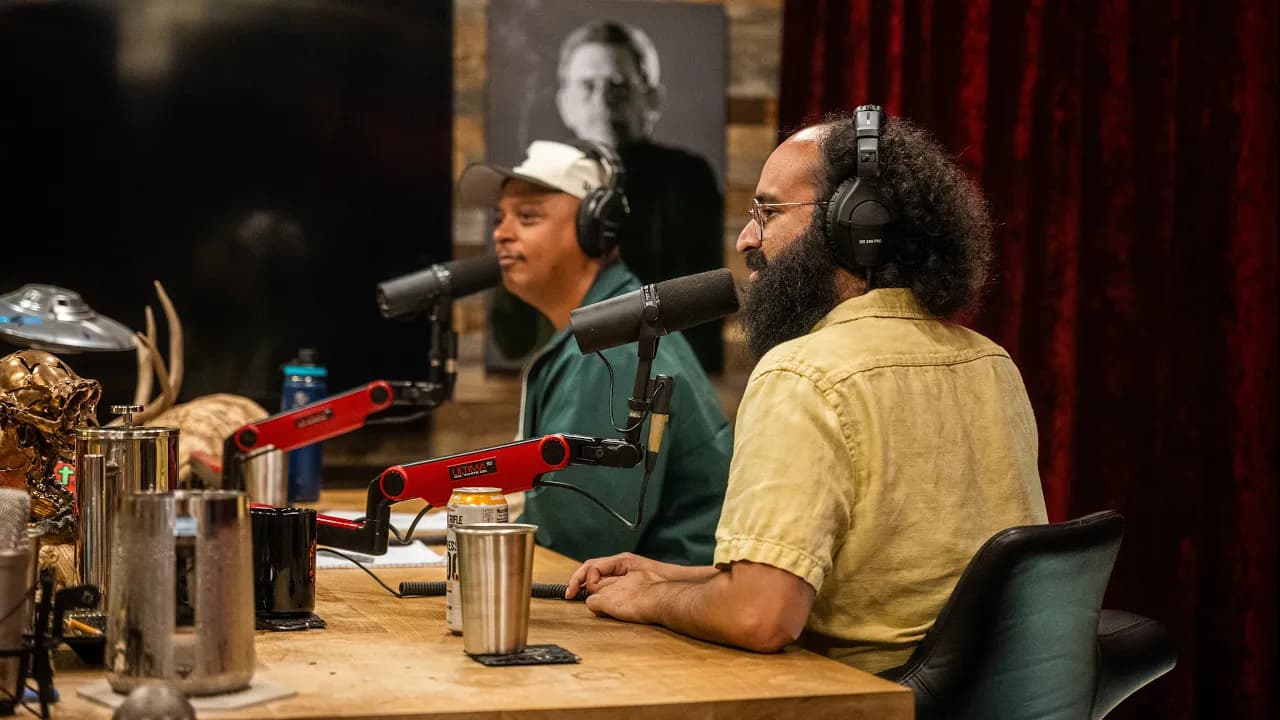
James Sexton, Rick Glassman, Matt McCusker - Mostly Wise #4
In a Nutshell
Divorce attorney James Sexton emphasizes that unprompted acts of care—like refilling granola or morning intimacy—reveal the true health of relationships, while their absence signals emotional disconnection. The group explores how early communication of needs, mutual effort, and avoiding score-keeping prevent resentment, and that prenups should be framed as mutual protection rather than transactional demands. They also note that conventionally attractive people often underperform sexually because they rely on appearance alone, while those who developed personality through adversity tend to be both funnier and better partners.
These notes were generated by AI and may contain inaccuracies.
Chris Williamson is doing a live show in the UK and Ireland in October. Dublin is sold out with limited tickets remaining for other cities. The show has been a year in development.
James Sexton represented a woman in an ugly divorce case. The husband was in finance and received large annual bonus checks. Without her knowledge, he deposited these checks into a secret bank account and spent them in Vegas. The receipts showed he was spending $150,000-$200,000 in single nights at venues like TAO, removing his shirt and ordering bottles. The divorce required proving wasteful dissipation of marital assets to claim half of the spent money.
During a lunch break at Starbucks while waiting for testimony, Sexton asked the client if there was a moment she knew her marriage was over. She described how her husband used to refill her granola without being asked when it ran out. She felt loved and seen by this small gesture. When he stopped refilling it, she realized the marriage was ending.
Rick Glassman suggested that instead of waiting for a partner to notice something important, one should directly communicate needs. The discussion explored the difference between soliciting recognition versus having it offered unprompted. The client felt the granola refills were meaningful precisely because she never asked and he never sought credit.
Sexton asked the client what she used to do for her husband without being asked. She revealed that when they were dating, she performed oral sex on him in the mornings without solicitation. He would text her later saying it was hot and it put him in a good mood all day. She later stopped this practice as the relationship changed.
The discussion examined how both the granola and the morning intimacy were unprompted acts of care that stopped over time. Neither party owed these gestures to the other, but their cessation signaled a shift in the relationship dynamic.
Sexton discussed the dynamic of representing women going through divorces. Clients sometimes develop crushes on their divorce attorney. However, he stated that divorce lawyers see clients at their worst and would not find them attractive in that context.
Sexton recommends discussing prenups on the third date. He believes couples should clarify expectations, intentions, and what they mean to each other early in relationships. He frames this as establishing the economy of the relationship rather than an unromantic transaction.
Matt McCusker stated he believes the woman should get 100% of the money in a divorce, allowing the man to start over. Sexton noted this creates good business for divorce attorneys when people believe love alone matters and everything belongs to each other.
The group discussed a 1467 medieval German legal practice where married couples could settle disputes through combat. The husband was placed waist-deep in a pit with one arm tied behind his back, given three wooden clubs, and had to surrender a club each time he stepped outside the pit. The wife had freedom of movement and was armed with a heavy stone or brick sewn into a cloth sack.
McCusker revealed he did not know who Mr. Rogers was. The group discussed Fred Rogers' approach to teaching children about emotions, self-regulation, and validating feelings rather than pretending pain and sadness do not exist. This was contrasted with David Goggins' philosophy.
Rick Glassman named his podcast "Take Your Shoes Off" because Mr. Rogers would remove his shoes at the start of each episode.
Glassman asked whether people hide their friendship with Sexton from their spouses. Sexton acknowledged the optics are poor when someone mentions having dinner with a prominent divorce attorney while away on business.
The group discussed tactics for paying restaurant bills. Huberman used a move where he gives his card to the server at the beginning. Glassman described a strategy of asking the server to approach the table first and ask if anyone wants to secretly pay the bill.
Sexton is growing a mustache and discussed how trial lawyers need to maintain a middle-of-the-bell-curve appearance to appeal to diverse judges, including old-school white men and women from diverse backgrounds on the bench.
Divorce cases are bench trials, meaning the judge serves as the sole decision-maker with no jury involvement. Lawyers attempt to influence everyone present in the courtroom, including court reporters and officers, because these individuals interact with the judge after proceedings conclude. A good lawyer knows the law, while a great lawyer knows the judge and adapts their approach accordingly. Some judges appreciate theatrical performances and cross-examination flair, while others prefer formal deference and respect.
Female judges do not automatically favor female litigants. Women judges have been observed being harsher toward female clients, including comments about expensive clothing like Louis Vuitton bags worn to court. Female judges reportedly dish out harsher sentences to women on average.
The job of lawyers involves showing up authentically with facts while omitting information that harms their clients. The legal system operates on the presumption of innocence, burden of proof, and the right to zealous advocacy within legal bounds. Evidence rules prevent hearsay testimony, requiring confrontation of accusers through cross-examination. A mediocre lawyer with strong facts will defeat a skilled lawyer with weak facts, as facts ultimately surface despite attempts to obscure them with smoke and mirrors.
A lawyer can choose not to humiliate opposing counsel even when opportunities arise. The primary competition occurs between lawyers rather than between a lawyer and the opposing client. There are boundaries regarding cross-examination of witnesses, where lawyers must earn the right to aggressive questioning by first getting witnesses to commit to positions before confronting inconsistencies or lies.
Connection is required to maintain arousal during sexual encounters. Casual sex attempts from 2016 onward revealed that superficial attraction alone proved insufficient without emotional connection. Performance anxiety developed during this period of experimentation. Direct communication about intentions and expectations serves as an effective filtering system, with explicit statements made before someone visits about the possibility of sex without obligation.
Early romantic inexperience included not having a first kiss until nearly age 18, creating lasting anxiety about initiating physical intimacy. Pity sex occurs when obligation overrides genuine desire. The penis functions as an indicator of genuine interest rather than a moral compass, signaling whether real attraction exists beyond physical appearance.
Physical attraction patterns often conflict with long-term compatibility. Certain aesthetic preferences like big titty goth girls with daddy issues consistently led to negative outcomes. The best sexual experiences tend to emerge organically without predetermined expectations, often during casual Tuesday encounters rather than planned special occasions. Intentionality around connection rather than performance produces superior results.
The transcript ends with discussion of how conventionally attractive people may underperform in sexual contexts because they rely on presence alone rather than effort.
Rick Glassman shares that he initially assumed James Sexton might be good-looking but shallow, but was surprised by how much he'd read. James jokes that this means he benefits from low expectations. The group discusses the concept of an "emotional boner" - being excited to connect with someone rather than just physical attraction.
The conversation shifts to how name-dropping people you know during conversations feels strange and sales-like. Close friends would never do this, and it reads like a technique from How to Win Friends and Influence People.
Rick confirms that he has found it hard to find someone who is both funny and attractive. James explains this by noting that attractive people in their developmental years have less need to learn how to connect with people and offer value. When you see someone who is both very funny and very good-looking, they were likely unpopular or overweight when younger, which forced them to develop their personality.
The group discusses whether comedians would want to date other funny people. James states he would never want to date a lawyer, and Rick clarifies there's a difference between being a performer who's always on and annoying versus someone who's naturally funny. James reveals he's never had a girlfriend who wasn't funny.
James suggests dating another comedian might be a nightmare because comedians are inherently jealous of each other, and dealing with a partner's bad performance would be emotionally draining. When seeing someone doing their thing well, James finds it attractive, though Matt McCusker disagrees, stating competence doesn't turn him on - it's just like getting a high five.
James notes that Matt seems very comfortable in his own skin compared to most comedians he represents, who are often the least comfortable in their own skin. Matt wonders if this is an act or defense mechanism, or if it's genuinely how he is. James attributes it to Irish heritage, sharing that his ex-wife was Irish and refused to end their marriage, telling him "I'm Irish, I'll stay."
Matt is described as being very comfortable with people disagreeing with him. His beliefs don't require others to believe them, and he doesn't try to persuade people to agree with his views. The conversation contrasts this with how many comedians are paralyzed by reading comments and seeking validation.
Many podcasters and comics are obsessed with listener comments in a parasocial way. The group notes that if you believe the good reviews, you have to believe the bad ones. Some comics put their entire self-worth into audience recognition, where bombing on stage leads to feeling unworthy as a person rather than just having a bad night.
James suggests that when you're going into something with intention, that becomes your north star. If you go on stage wanting to try something new rather than kill, a bad performance doesn't hurt as much because you were there to get information. Matt tries to forget about himself and focus on making the audience laugh and have a good time.
James observes that comedians like Matt and Shane Gillis represent a new breed who seem to be trying to make themselves and each other laugh, with the audience just happening to be there. This resonates because everything else feels so performative, and this style makes people feel like they're "in on the joke" and part of the clubhouse.
Matt shares that when he and Shane started, he was 30, living on an air mattress, and had accepted he would be "one of those weird uncles that lives by himself." Shane had a similar acceptance that he was a loser. Their approach of just making each other laugh landed in a moment when everyone else is trying to convince people they're not losers.
Rick offers edibles to the group. James mentions having a hellish edible experience after taking what he thought was 10 grams but was likely 10 milligrams, describing it as feeling like he'd eaten three grams of mushrooms.
The podcast includes a sponsorship read for Function Health, which provides access to over 160 advanced lab tests for $365 per year, compared to typical annual physicals that test around 20 markers.
The group discusses a tweet from a tech executive named Brook Leblanc who posted her non-negotiables for a partner: 35-42 years old, healthy, masculine, smart, funny, light-hearted, provider/protector mentality, post-economic but still hardworking, kind, generous, thoughtful, no kids yet but decidedly wants kids, on a healing path, history of serious commitment, ex-therapist, books retreats, fit and sober, no previous marriages, works in tech, comfortable with risk.
James clarifies that "post-economic" means having enough money that you don't have to work but still choose to work hard. The group estimates this describes an unbelievably small number of men. James mentions being early in Uber and having invested well when young.
The group discusses the blend of yoga babble and business babble that's popular in New York, combining phrases like "helicopter view" and "paradigm shift" with "energy and vibes" and "align the aura."
James shares that when doing prenups for very successful wealthy women in New York, they typically have enormous collections of luxury goods like Birkin bags, watches, cars, and houses. Women tend to display success through travel, luxury goods, and homes rather than collecting watches or wine like men do.
The conversation notes that women tend to marry even or up economically, while men typically marry down. When asked what men look for in serious relationships, "good provider" is never in the top 10 - men prioritize attractiveness, thoughtfulness, being good with kids, and supportiveness.
James observes that people with inherited wealth tend to fall into two categories: overachievers who speak five languages and have graduate degrees, or complete screw-ups. He suggests this often correlates with birth order, with the eldest child being the overachiever and younger siblings developing learned helplessness.
The craziest enforceable prenup clause involved a weight-based alimony reduction: for every 10 pounds gained during the marriage, the spouse would lose $50,000 per year in alimony payments. This created significant financial consequences, as gaining 50 pounds would result in a quarter million dollar annual reduction.
A hypothetical discussion explored whether sexual acts could be unlocked based on weight gain, with one participant stating they would go as heavy as possible if their partner remained healthy and happy. The reverse scenario was considered more concerning: how thin someone would allow their partner to become before intervening, with agreement that seeing ribs would be a problem and preference for a "Reubenesque" body type.
A discussion about women being told they "deserve" certain treatment led to confusion about addressing female judges, with one participant accidentally saying "lady judge" before correcting to "your honor."
A video was discussed showing a woman at a sports game carrying multiple items including a diaper bag and child while her partner sat with his phone plugged in, apparently unconcerned. The video illustrated the concept of women being told they "deserve it all" while still handling disproportionate domestic responsibilities.
Personal experiences were shared about offering subway seats to women in New York, receiving polarized reactions: either strong rejection or overwhelming gratitude. The discussion explored how chivalry creates extreme positive or negative responses with little middle ground, noting that technically older individuals might benefit from such gestures regardless of gender.
Women are increasingly bringing demands to prenup negotiations, including specific monthly personal care budgets for cosmetic procedures. The conversation clarified that while men typically have more economic assets to protect, women can and do make specific demands within prenup agreements.
A framework was presented for prenup discussions: asking what each person would need to feel safe if the marriage ended in divorce rather than death. This approach frames the conversation around mutual protection rather than one-sided demands.
A medical condition called "buried penile syndrome" was discussed, occurring when significant weight gain causes the suprapubic fat pad to obscure the penis. Statistics indicate that 5% of American men cannot see their penis due to this condition.
Prenups originated in Germany around 1467-1497 and became enforceable in meaningful ways during the 1960s. They gained popularity with the general population approximately 20 years ago, coinciding with recognition of high divorce rates and the desire to create custom agreements rather than accept government-imposed terms.
Historical context was provided: in 1890s England, only about five divorces occurred annually nationwide, making formal divorce protection unnecessary for most people.
The discussion clarified that divorce rates can exceed 100% when calculated per person rather than per marriage, as individuals who divorce multiple times contribute multiple divorces to the statistics. Navy SEALs were cited as having over 100% divorce rates due to this calculation method.
Many couples separate without formal divorce, either through physical separation without paperwork or by remaining together unhappily due to financial concerns.
An obligation was expressed to communicate when noticing weight gain affecting attraction, emphasizing tact and focusing on health rather than superficial concerns. The importance of addressing changes before reaching dramatic thresholds like 50 pounds was stressed.
A distinction was made between relationships designed through active communication versus those operating on default patterns. Regular check-ins about changes in intimacy, body image, or other factors were recommended as healthy relationship maintenance.
Reality shows like The Bachelor and Love Island were recommended as conversation starters that allow couples to discuss relationship dynamics indirectly. This creates "safe distance" for exploring feelings and perspectives without direct confrontation.
Political differences were identified as increasingly destructive to relationships, with families refusing to speak to each other over political disagreements. The contrast was drawn with previous generations where significant political differences coexisted with loving, committed marriages.
A listener question was presented about navigating different political and social beliefs with a fiancé, noting agreement on core issues like child-rearing and living preferences, but conflict over economic policy, trans rights, climate change, and immigration.
The transcript cuts off mid-question from listener Billy regarding how to handle political differences that cause conflict or prevent honest expression of viewpoints.
A listener asks whether they should disclose their voting choices to their partner. The discussion explores the deeper motivations behind political preferences rather than surface-level party alignment. One perspective suggests that many right-leaning individuals are drawn to candidates who appear to speak directly rather than engage in evasive, performative responses. The contrast is made between politicians who answer questions with vague statements about believing in children versus those who give blunt, albeit sometimes false, answers.
The group discusses how critical thinking is often absent when people consume political content. Clips taken out of context can damage reputations, and certainty is frequently mistaken as a proxy for truthfulness and expertise. The conversation emphasizes that society appears to be craving authenticity in political discourse.
A suggestion is made to practice giving genuine compliments during first meetings. The exercise involves telling someone four things you already like about them, acknowledging their intentional choices in appearance and behavior. This approach recognizes that humans are meaning-makers who constantly interpret symbols and messages in how people present themselves.
The discussion notes how pleasant it feels to have someone acknowledge positive qualities they've observed, creating a more genuine connection than typical superficial interactions.
Details emerge about Don Jr.'s extravagant wedding, reportedly funded partly by Russian billionaire Umar Kremlev with ties to Putin. The wedding involved complex logistics including cakes transported by five different methods (van, private plane, helicopter, golf cart, boat) across two private islands at over $100,000 per night. The bride's reception outfit required 150 hours of embroidery. Notably, Donald Trump did not attend, citing scheduling conflicts with Iran and other matters.
The conversation turns to the emotional impact of a parent not attending their child's wedding, with speculation that this absence may be part of a lifelong pattern. The discussion acknowledges how children sometimes create elaborate events hoping to finally earn parental attention.
A divorce lawyer describes representing both victims and perpetrators of domestic violence, as well as individuals on both sides of substance abuse issues in marriages. This experience leads to the realization that people aren't simply evil or good, but rather hurt people hurting people who often mistake harmful patterns for normal behavior based on their upbringing.
The perspective emphasizes seeing people as aggregates of their moments rather than judging them by single instances of failure or success. This approach applies to both professional practice and personal relationships.
Practical advice emerges about handling relationship conflicts, particularly the danger of keeping score and engaging in internal resentful dialogue when away from one's partner. The key insight is recognizing when criticism triggers feelings of inadequacy rather than genuine concern about the issue being raised.
Marriage counseling helped reframe nagging as potentially coming from a place of wanting the partner to succeed, rather than mere criticism. The discussion emphasizes paying attention to changes in a partner and acknowledging them, rather than viewing marriage as inherently difficult work.
A distinction is made between anger and sadness, noting that anger often feels more active and controllable while sadness feels passive. The underlying desire in relationships is often to be seen as a good partner worthy of love and admiration. When criticism arises, the internal dialogue frequently involves feeling that previous efforts went unrecognized.
Practical relationship advice suggests that men should maintain emotional stability during their partner's hormonal fluctuations rather than pointing them out in the moment. The recommendation is to wait several days before gently acknowledging difficult periods, allowing the partner to feel seen without defensiveness.
The discussion notes that teaching about relationship dynamics is largely absent from formal education, leaving people to learn from their parents' examples or unrealistic romantic comedies. This lack of practical guidance contributes to relationship difficulties.
The conversation acknowledges fundamental biological differences between men and women, including hormonal variations that affect behavior and emotional responses. Rather than expecting identical rational responses, the suggestion is to appreciate these differences as inherent to gender rather than flaws to be corrected.
A humorous observation notes that everything men do from adolescence onward is ultimately driven by sexual motivation, using examples like status symbols and material possessions as mating displays.
A story illustrates how framing affects partner perception: a man who shaved during the week for work but not on weekends caused skin irritation for his sensitive-skinned girlfriend. The key insight is that how information is presented significantly impacts how partners respond to situations.
The discussion emphasizes that communication framing can transform potentially negative interactions into understanding ones.
Divorce rates among lesbian couples are super high. There are also high rates of domestic violence and many dead children in these relationships. James Sexton has represented multiple lesbian women in divorce cases and noted something uniquely strange about hearing a woman say, "If that [expletive] thinks she's going to get half my business, she's kidding." This struck him as odd because he was accustomed to hearing such statements from men, but hearing it from a woman about another woman felt weird.
Matt McCusker shared a story about a relationship that ended for reasons that might or might not have been related to the issue. He would shave during the week but not on weekends, and his girlfriend would complain about his scratchy beard when they kissed. The next woman he dated had sensitive skin and preferred clean-shaven men, but she framed it positively, saying "You're so sexy when you just shave. You're like Don Draper on Mad Men." This difference in framing made all the difference in how the same preference was received.
James Sexton emphasized how framing matters in relationships. Asking "How come we don't have sex as often as we used to?" puts the other person in a defensive position. Instead, he suggests bringing a partner back to positive memories, like remembering a restaurant from an early date and the intimate time that followed. This approach creates a more receptive atmosphere for discussing intimacy.
Rick Glassman was described as someone who calls out subtext in social situations. The group discussed how to handle being at dinner with a couple showing obvious tension. Rick said he would acknowledge it only if he felt compelled to serve others who might be experiencing the same discomfort. If the couple were friends, he would suggest being lighter and not doing it now. If the conflict involved something of real importance, like leaving a child in a dangerous situation for too long, he would translate perspectives rather than simply take sides.
The group joked about the difference between mediation and litigation, with James noting "There's no money in mediation" and that he does it for the justice, while litigation is where the money is. The conversation touched on the idea that good lawyers understand the law, but great lawyers live forever.
Rick discussed how he reads comments while they're being written during filming. He noted that good comments either feel wrong or like something he already knew, while bad comments that he disagrees with are simply part of the internet experience. Novel criticisms that haven't been heard before are appreciated, and accurate, funny insults actually create a connection with the person making them.
Rick mentioned watching outtakes from It's Always Sunny in Philadelphia as a form of self-soothing after long days. The insults hurled at each other are precision strikes, and many were improvised. Sometimes these insults hit so hard that the person breaks character and ruins the scene. He recommended watching It's Always Sunny outtakes on YouTube.
The group discussed the differences between multicam and single camera comedy. In multicam shows, you perform to a live audience like a play, gauging their reaction. James explained that in multicam, you do three takes, and the second take doesn't get as big of a laugh because the audience has heard it already. The challenge is performing as if the home audience hasn't heard the previous takes, even though they haven't.
The concept of "joking" was discussed - making a joke and then another joke that either adds to or cannibalizes the first. In multicam, heightening options can be funny to the live audience because they were part of something that won't translate to viewers at home. There's also danger in making jokes about sensitive topics like sexuality when the audience doesn't have context about the speaker's lack of hate.
The group discussed how being friends with someone who has gay friends and no hate in their heart provides context for jokes, but on a podcast or with new people without that context, the same joke could land badly. The internet removes context because everyone is seeing you for the first time. Assuming everyone is seeing you for the first time is safer but makes everything bland.
Matt mentioned that in training vlogs, they sometimes remove loud gym music using software, but the speakers are still shouting because they heard music that the audience doesn't hear. This creates a disconnect similar to removing studio audience laughter from shows.
The group discussed watching Friends episodes with the audience laughter removed, noting how strange it is and how many jokes aren't actually funny without the laugh track. This led to debate about whether Friends holds up, with some saying it's not in their top 10 and that the multicam format feels antiquated.
Multicam shows are the cheapest and easiest to make because everything is indoors with consistent lighting, at the same location, and with established camera blocking techniques. The most work is determining which way actors face for each joke. Writers face pressure to create constant jokes. Directors who know multicam are in high demand, and it's considered one of the cushiest directing gigs.
The group discussed how people develop a comedic palate based on what they grew up watching. Those who consumed multicam sitcoms found shows like Arrested Development and The Office refreshingly different. Young people who didn't grow up on multicam might find a well-done multicam show novel and interesting.
Vine and similar platforms changed how comedians reach audiences, allowing people to bypass traditional channels and be seen before earning the stage through standup specials. This created less curated, less polished content. The proliferation of platforms means multicam, single cam, network television, and other formats are now subcategories of what people watch, competing with YouTube, podcasts, shorts, and reality content.
The most concurrently viewed show on British television was Only Fools and Horses, with tens of millions watching in a country of about 30 million people. The funeral of Princess Diana had 32 million viewers. Other highly watched British shows mentioned include EastEnders and Coronation Street, with none of these cracking 2000 in viewership numbers after cable and internet fragmentation.
Modern movies often re-explain the plot every few minutes because audiences are distracted, watching television as one of two devices simultaneously. Writers constantly repilot the story, repeating information about missions and objectives that were already established. This differs from simply establishing exposition once and moving forward.
The Fast and Furious franchise serves as a barometer for changes in cinema, with scene duration getting shorter and shorter. The level of violence has escalated to superhero levels, with physics becoming unrealistic as cars get catapulted into helicopters. The franchise has lasted because audiences seek distraction rather than engagement with art.
Rick Glassman watches Beekeeper repeatedly but the group struggled with it. They prefer The Accountant films starring Ben Affleck. The speaker imitates the garage door timing technique from The Accountant, attempting to pull into the garage as the door opens and close it precisely behind the car.
A new term is proposed for actions men perform that they believe are impressive or skilled, but women typically don't notice or appreciate. Examples include timing a garage door closure perfectly while a passenger watches, or coordinating urination with a toilet flush so both complete simultaneously. The speaker notes this requires "prostate control" and timing precision.
Men sometimes employ a "sprint finish" when timing urination with a flush. The alternative strategy of "capping pee" - peeing into the bowl as water drains rather than into fresh water - is discussed and rejected as suboptimal.
When cleaning old poop from a toilet bowl, the speaker will do so for their own mess but refuses to clean stranger's feces in public bathrooms. Similarly, when picking up dog waste, they avoid touching their dog's poop if it's adjacent to another dog's waste, comparing it to sharing a straw with someone.
In Philadelphia during the coin-operated meter era, tin foil could be inserted into meters to make them display "out of order," allowing free parking. The speaker and their brother exploited this with their lunch truck, repeatedly using the same meter. Taking a photo of the "out of order" display provided evidence against potential tickets.
Matt McCusker was told he resembles Rosie the Riveter when making a fist gesture, which he accepted as a novel insult.
Dancing to music during any activity, including while on the toilet when a chorus approaches, is cited as another example of actions men find impressive. Knowing all movie lines and being able to recite them perfectly with friends is considered a bonding experience, particularly with Monty Python films like Life of Brian and Holy Grail, or standup routines.
When fans approach celebrities, they often preface compliments with disclaimers like "I don't know who you are" to reduce vulnerability. This is viewed as either insecurity or manipulation, making the interaction less genuine. The speaker argues people should simply state their appreciation directly.
People experience a "reality distortion field" around celebrities. Recognition manifests in awkward gestures like the "turtle" - people pointing and making strange faces. The speaker notes that even low-level recognition creates surreal interactions where people feel they know you without actually knowing you.
Several satisfying timing experiences are shared: closing a door so the latch catches perfectly without effort, arriving at a destination exactly as a song ends, and singing in the correct key before a song plays. The speaker also mentions harmonizing an octave above a song's key as an impressive feat.
If unable to sing along to a song properly, the speaker will deem the song inferior and turn it off. This is compared to disliking sports one cannot play well.
Natural skill fit is discussed - the speaker learned piano without lessons and feels competent, but guitar required formal instruction and never felt natural. They acknowledge being fortunate with their dog, which absorbed some of their character traits.
When asked about natural abilities, the speaker claims proficiency in football, wrestling, and fatherhood, but admits poor language learning ability. They joke about being unskilled at making love, specifying they can only do so with people they're actually in love with.
The group discusses playing basketball together while intoxicated. Training the non-dominant hand for layups opens new possibilities, with the philosophy that it's better to struggle with weakness training than never attempt improvement.
In BJJ, practitioners often rely on 3-4 techniques they're highly skilled at rather than developing weaknesses. The principle of "training the weakness" requires accepting temporary skill regression to improve overall ability, such as playing open guard despite being poor at it.
Discussion of an upcoming BJJ match between Mikey Musumeci and Nicky Rod. Mikey is considered technically brilliant while Nicky is physically gifted and uses weight effectively.
The UFC BJJ Instagram posted content joking that Mikey Musumeci "will not do gay stuff" during matches, representing the mainstreaming of what was previously an underground joke about BJJ's physical intimacy between men.
BJJ is described as "struggle cuddles" requiring tremendous physical trust - when someone taps, they're essentially saying "you just killed me" by either breaking a limb or choking them unconscious. The practice creates immediate bonding through physical contact.
A theory is proposed that women with daddy issues become strippers while men with daddy issues pursue BJJ, both representing paths to physical contact and attention from authority figures.
Various populations including Chinese, Black, and Jewish people are noted as having higher lactose intolerance rates. The French reportedly say English people "smell like milk," while the English call French people "frogs."
The French saying "marriage turns a lover into a relative" is shared as particularly insightful relationship commentary.
Society's tendency to overcorrect - treating minor issues with extreme solutions - is discussed, with the prediction that cultural attitudes toward language and behavior will swing back in the opposite direction.
The "going out for milk" excuse for leaving relationships wouldn't work in lactose intolerant populations, leading to speculation about different cultural divorce excuses like "going out for cigarettes."
Squatting position is promoted for proper GI tract alignment, hip flexor and quad strengthening, and spinal alignment, contrasting with Western chair-based posture.
A Japanese toilet features low-to-ground design with multiple buttons controlling water functions. It includes a heated seat and functions as a bidet with warm water. The warm bidet water initially feels excessive but becomes addictive, comparable to flying first class where the experience changes expectations. A Squatty Potty combined with a Japanese toilet would create optimal positioning for the rectal kink.
Using the bidet to fill the rectum with water creates uncertainty about whether water is exiting or drawing out more material. The technique involves precise control similar to Skee-Ball, where the user knows exactly how much water to introduce. The water collects before the sphincter tightens to release, creating a cascading effect. The speaker describes shooting water up the rectum with such precision that it goes "nothing but net."
The speaker addresses comfort levels with rectal openness, noting that everyone's sphincter relaxes during bowel movements. The comparison is made to childhood throat cultures, where the speaker would sit on their hands to manage panic attacks during medical procedures. This demonstrates learned tolerance for uncomfortable medical interventions through trust in the process.
The speaker argues that using only paper to clean after defecation is inadequate, comparing it to having feces on hands and merely wiping with paper. The recommendation is to use water for proper cleaning rather than relying solely on dry paper.
After ejaculation inside a partner, the speaker recommends the woman go to the bathroom first to prevent infection, while the man goes first if ejaculation occurred externally. The protocol includes providing warm and dry towels for cleanup. The speaker offers cool towels as an alternative if warm water takes too long, prioritizing partner comfort over personal convenience.
The speaker expresses self-consciousness about having a flat buttocks while being proud of penis size. After sex, the speaker walks to the bathroom sideways to avoid revealing the buttocks, concerned that the partner might judge the body negatively. The speaker jokes about getting a large back tattoo to draw attention away from buttocks size.
Lily Phillips appeared on the speaker's podcast. The conversation touched on body comfort levels and showing buttocks on camera. The speaker mentions being team Bonnie Blue rather than team Lily Phillips in their ongoing debate about sexual encounters with large numbers of men.
Bonnie Blue had sex with 1,000 men while Lily Phillips had sex with 100 men in a single day, though Lily later also reached 1,000. The debate centers on who achieved the milestone first. The speaker draws parallels to sports records, noting that being first matters more than total numbers in some contexts.
Women must balance comfort in bed with the need to urinate to prevent infection after intercourse. Semen becomes less viscous over time, and gravity affects its movement. The speaker notes personal observation that his semen becomes more viscous after ejaculation.
The speaker describes instances where semen reappears an hour after intercourse, suggesting the vagina may hold onto semen similar to how the body retains nutrients. This creates an awkward situation where additional cleanup becomes necessary long after the encounter.
The speaker underwent a vasectomy 27 years ago after his second child was born. The procedure was performed as an outpatient with local anesthetic while awake. Recovery involved applying frozen peas to reduce swelling, with a waiting period before resuming sexual activity. The speaker describes it as the best $40 copay in history.
A vasectomy cuts the vas deferens, preventing sperm from mixing with semen while maintaining the same volume and consistency of ejaculate. The speaker notes that sperm production stops rather than being absorbed by the body. The procedure did not affect sex drive or sexual experience. The speaker clarifies that semen originates from the seminal vesicles while sperm comes from the testicles.
The speaker's ex-wife had a prothrombin mutation causing excessive blood clotting during pregnancy. She developed deep vein thrombosis in the iliofemoral vein and nearly had a pulmonary embolism during her first pregnancy. Blood thinners were required for subsequent pregnancies. The speaker chose vasectomy over continued condom use or risking his wife's health with additional pregnancies.
The procedure involved numbing with local anesthetic while positioned in stirrups. The patient remained awake but could not see the procedure. Recovery included driving home afterward, with pain similar to being kicked in the testicles. The speaker waited six days before resuming sexual activity to clear remaining sperm.
The speaker had varicocele surgery in 11th grade, which initially resolved the condition. The varicocele returned later in life. The speaker distinguishes between varicocele (dilated veins in the scrotum) and vasectomy (severing of the vas deferens).
The decision to delay vasectomy surgery involves multiple factors. It acts as a contraceptive method making pregnancy more difficult, which is advantageous when not actively trying to conceive. Additional concerns include potential recurrence requiring repeat procedures, accumulation of scar tissue with each surgery, and uncertainty about future partner compatibility. The speaker had previously frozen sperm as a precaution, motivated by the desire to avoid the unhappiness of not having children. A video of a man losing his penis in a road traffic accident served as additional motivation to delay the procedure.
A story was shared about a man in London whose penis was severed in a bike accident involving spiked iron fences with points on top. The penis reportedly came off completely upon impact. This led to tangential discussion about whether Nick Cage appeared in a similar film scene.
A year and a half ago, someone made an earnest argument that ejaculating on oneself constitutes homosexual behavior. The person was described as ardent rather than joking about this position. The argument involved the use of toilet paper or similar materials placed beforehand as a "landing strip" to catch semen, which was presented as evidence of the act being "gay."
Various cleanup approaches were discussed during masturbation. Some participants use towels placed strategically, with one describing cutting a hole in a towel placed from the pelvic bone area. Others prefer pointing techniques to direct ejaculation. The discussion noted that body hair affects cleanup methods, and wetting towels was mentioned as an alternative approach.
The oldest participant (turning 54) asked whether others had ever given up midway through masturbation, describing the experience of starting and then stopping with "ah fuck it." Multiple participants confirmed having this experience. Morning wood was noted as sometimes non-functional, described as a "Trojan horse" that appears ready but isn't genuinely functional. Age-related observations included morning erections becoming frustrating when they don't occur during desired times.
Giving up during masturbation can sometimes feel like a "moral victory" - choosing not to engage despite the capability. This connects to the distinction between being "horny" versus being "porny," where someone might start considering masturbation but then decide against it. The conversation explored how this relates to running for president in a metaphorical sense.
One participant described masturbating sometimes simply because it's possible, comparing it to eating when not hungry but seeing available food. This includes situations of loneliness where someone might turn to porn rather than sit with feelings. The distinction was made between genuine hunger versus opportunistic consumption, with chocolate cake mentioned as an analogy for something one shouldn't necessarily eat.
Pornography was compared to processed foods, serving a purpose but recognized as potentially dangerous due to ease of access beyond what's "supposed" to be normal. The importance of moderation was emphasized across various potentially problematic behaviors including junk food and difficult conversations.
Playboy published the 2026 Gen Z sex survey with over 2,000 respondents aged 18-29. Key findings include:
- One in five Gen Zers are virgins
- 45% of those who had sex in the last 3 months had only one partner, indicating most sexual activity occurs within relationships
- 36% have not masturbated in the last 3 months
- Some respondents claim porn completely satisfies their sexual desires
Participants expressed skepticism about the 36% non-masturbation statistic, suggesting survey methodology flaws and that respondents might be lying due to shame. The survey covered both men and women across demographics. Discussion included whether 30% of men specifically hadn't masturbated, with biological arguments presented that "of course" people masturbate regularly.
Current discourse involves shaming men for masturbation and porn consumption. One participant described feeling "invincible" after going a weekend without masturbating during hotel stays. The relationship between porn and masturbation was explored, with the observation that skipping porn often enables skipping masturbation entirely. This was compared to not having cookies in the house reducing the temptation to eat them.
The oldest participant described growing up in the 1970s and 1980s when porn access was extremely limited. Methods included having a friend whose father had a Betamax with hidden porn tapes, requiring group viewing situations, or trading comics for Hustler magazines that would be viewed repeatedly. Growing up poor and in a strict Catholic household meant limited access to non-Vatican-approved media.
The speaker was an acolyte deeply involved in the Catholic church and still remembers the entire mass from beginning to end due to repetition rather than inherent memory ability. This includes knowing the Nicene Creed completely. Comparisons were made to memorizing AG1 ad reads and legal terminology like hearsay definitions.
[02:,59:30] Tour Dates and Contact Information
Rick Glassman mentioned upcoming shows in Houston, Salt Lake City, and Seattle, with rickglassman.com for additional dates. Matt McCusker listed Jacksonville Florida, Charlotte North Carolina, Tampa, Orlando, and Newark New Jersey dates at mattmccusker.com. James Sexton described his work facilitating divorces through trustedprenup.com and trustednycdivorcelawyer on Instagram.
The trustedprenup.com domain was available when sought, chosen because people want to "trust their prenup." Discussion included a dentist office sign advertising sedation dentistry with "no fear," and emerging trends of full anesthesia for tattoo procedures.
Anecdotal discussion about whether people with smaller body parts might get large tattoos to draw attention elsewhere. One participant jokingly suggested getting a large back tattoo to distract from a small butt. The conversation concluded with appreciation for "solidarity in small asses."
Keep Chris Williamson in your library
Save the videos and channels worth coming back to, and find them again in one place.