The Case Against Condoms & Fake Friendship - Rick Glassman (4K)
These notes were generated by AI and may contain inaccuracies.
Hosts discuss outfits. Rick wears a cozy jumper, optimizes for comfort and sleepability. Avoids clothes that offend. Wears versatile items for events or sleep. Guest optimizes for comfort too, but sportswear like Lululemon t-shirts struggles to elevate for dinners. Sports clothes elevate the body, not the clothes. Rick has a body that shows veins.
Rick's outfit likened to a cup of cocoa held with both hands. In a 2000s romcom, he'd be a beautiful woman in glasses and bun; removing them reveals attractiveness, causing a boner.
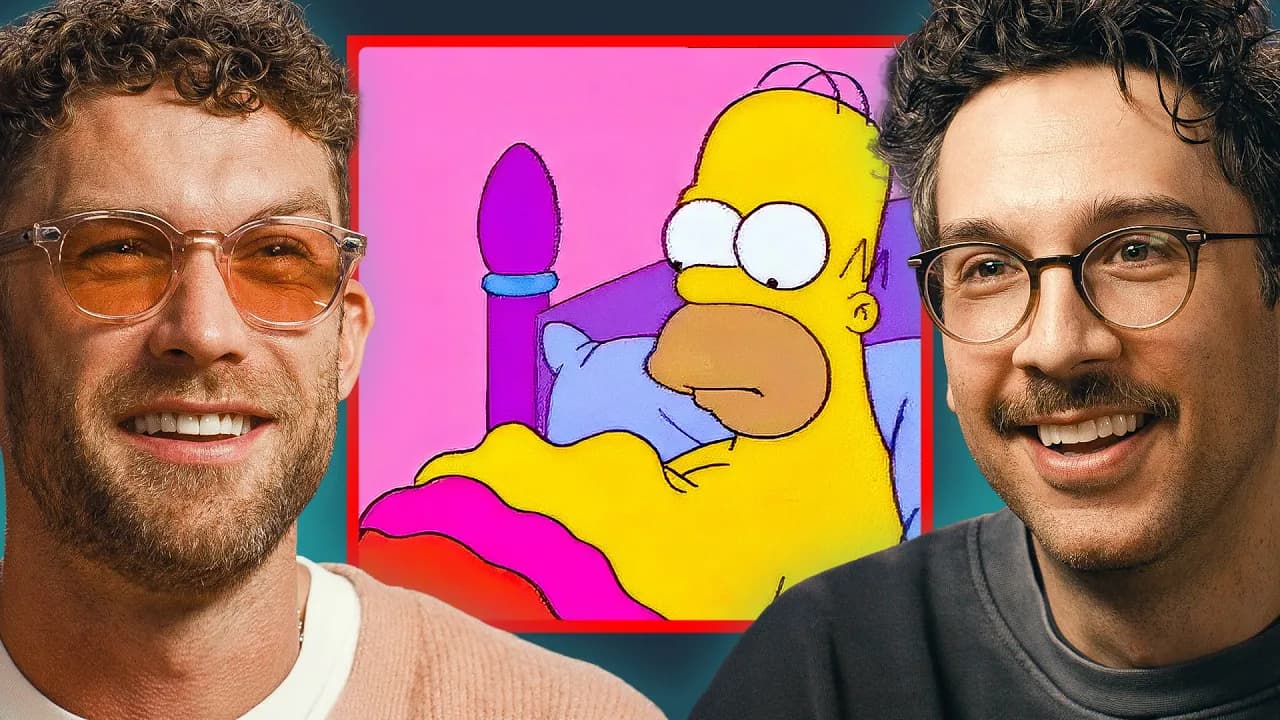
Rick heard host discuss random erectile dysfunction and negotiation on his show with Costa Contra, explaining to four black men who were accepting despite not experiencing it. One grew up watching The Simpsons and resonated most.
Conversation based on comfort. Rick sensitive to smells, textures, sounds. Like contacts, aware of condoms during sex, not present, like blinking a lot. Practice: only be physically intimate with those safe to tell, "I'm not present right now." Suggest making out or getting tested to avoid condoms.
Applies to friendships: prefers no metaphorical condom. Likes busting balls, playful banter, repartee. Hard to detect if others dislike it. Easier for them to drain battery than say, "I don't like this." Not responsible to make others feel safe, but recognizes some can't set boundaries yet.
When stoned, in bit mode, hilarious or annoying. Asks groups, "Are we doing bits?" If not, leaves. People roll eyes but don't say, later reveal annoyance. Important to have friendships without condoms.
"I just think it's important to have friendships where you don't have to wear a condom."
Guest understands, given Rick's OCD, vigilance, awareness of surroundings, feelings, sounds. Expected codependency: if not okay, he's not; scared of bits hurting feelings. Rick clarifies sensitivity is self-focused, not tuned to universe or others.
Emotionally believed he knew others' thoughts/feelings without question. Assumed everyone's uncomfortable, makes joke. Realized no idea what others think/feel; many not in touch themselves.
Feels talking too much now, offers interruption. Wants people to say, "Rick, be quiet," "I don't like this," "Do more."
"That's why I don't like wearing condoms. I want to be with people who just say, 'Rick, be quiet.'"
Pro-boundary person, welcomes others setting boundaries. Great with own boundaries. Example: Dean wanted to move Rick's keys/hat; if for himself okay, but prefers in sight. Always asks for things, like friend's toys as kid; friend gave them despite not wanting to, never said no. Realized as adult people avoid saying no.
People avoid calling out the game. Like ping pong, ball goes back/forth; hitting sideways discordant, breaks flow. Rick argues clarifying game isn't breaking it, just understanding it. Makes people uncomfortable.
Asks how feeling right now, not "how are you doing." Shares with dates: fears first kiss reciprocated procedurally, not genuinely—call/response, pity, easier than refusing. Same as "How you doing? Good."
Takes things at face value until realized can't; now skeptical. Asks many questions for info. After short kiss, asks if okay to make out later. Some baffled, others (raised by Simpsons) reciprocate questions.
Example with girlfriend (dating over a year): spoiler-sensitive, hates them. She spoils show unintentionally; he reacts passionately thinking he knows plot. She acts with red herrings; he calls it out. Energy shifts; asks what happened. She says he hurt feelings. Rick cries, not just for hurting her, but cluelessness as adult.
Bit: didn't have friends growing up, thought everyone busy until 30.
If unnoticed, she'd not say; keeps punching. Likes when people say, "I don't like this"—thanks them. Asks repeatedly how someone feels, not convinced of honest answer.
Excavates to find acceptable behavior boundaries. Retrospect: plowed through situations believing one reality, others different. Gained self-awareness 8 years ago, realized missing stuff.
Post-awareness: over-checks, "Is this okay? Sorry." Grew up with supportive parents believing he's funniest, most charming, everyone loves him—not true. Happier deluded than realizing bothering people.
Graduated to knowing annoys, can't control fully. Cares what others think but considers without prioritizing if disagrees. With friends who say, "You're being loud"—apologizes, quiets.
If tired, maybe dehydrated, not lacking sleep/caffeine. Proper hydration needs electrolytes (sodium, potassium, magnesium). Element: science-backed ratio, no sugar/color/artificial. Reduces cramps/fatigue, optimizes brain/appetite. Used by Andrew Huberman, Olympic athletes, FBI snipers. Lemonade flavor daily. Refund policy, free sample at drinklement.com/modernwisdom.
People don't see self/world same way. Become comfortable with correction, seek it proactively, pick friends who give it: "Rick, shut up." Mutual selection—friends okay with him, he's too much/not enough for others.
Value feedback as information, not criticism: "You're too loud" means uncomfortable volume for their ears, not identity. Choose response. Analogy: booger in nose—thank teller, happier than unaware.
Aware of self-deception? Want reasons for actions/breakups to connect/improve. Prefer forewarning before black bags out. Other may lack permission, scared— their issue.
Rick not present 30 seconds, checks focus/annoyance of movements. Loves discussing with someone seeing often, dating.
Discuss having extended conversations about personal wiring before dating or working together, so future issues can reference prior discussions. Suggest a one-page document that evolves, listing faults beneficial for others to know, like interrupting a lot—not due to disinterest, but requiring checks like "Hey, Rick, I wasn't done yet." This acts as a name tag for meeting people.
Propose a one-page introduction for friendship or relationship induction day, emphasizing checking section four at the bottom to avoid future issues. Examples include taking criticism personally and getting defensive even when not attacked, going quiet in arguments (response takes longer), or responding fast to fill space without knowing what to say.
When that thing happens, "Oh, that's that thing."
Get to know both pleasures and obstacles in people. Fall in love with uniquenesses, not common traits.
George's mom hates fighting—no UFC, no boys fighting. Driving in UK, sees two teenage boys squaring up by pavement in traffic. Stops car, runs across road yelling "No fighting!" amid honking cars. Brother on phone: "Mom stopped in traffic, intervening in strangers' fight."
At her funeral, remembered not for punctuality, but for stopping traffic to stop strangers' fight—that's where we fall in love.
Non-fungible humans—like NFTs—what's non-fungible about this person?
Fall in love with spiky bits, tumors, divots making someone unique—not performative weirdness, but embracing imperfections to stand out from smooth, generic shapes.
Art to line between self-love and self-improvement—not mutually exclusive. Avoid "take it or leave it" after core breakdown.
Always has neurosis: changes into indoor clothes at home, anything touching outside becomes outdoor. Not germs, just illogical contamination (rain okay). Pain in ass, but choice. Doesn't burden guests by requiring changes; instead, blankets everywhere as house condom—like old black woman with plastic, constantly washing.
Dating someone accepting, but still enforces: new clothes after shower become outdoor if sat in gym-used car. Better than hazmat suits. Guests sit on blankets; podcast guests too. Progress: someone sits off blanket—now calmly asks to move instead of freaking out.
Tell people quirks beforehand; explaining and enforcing simultaneously feels like police pulling over for unknown law. Learned to disclose early because comedian style makes it seem like joke—boy who cried wolf, or boy who cried blanket.
Drinking AG1 every morning for years—best all-in-one drink, partnered with them. Got family and friends on it. Over 75 vitamins, minerals, whole food-sourced ingredients, probiotics, prebiotics, NSF certified for Olympians. Go to drinkag1.com/modernwisdom for stuff.
The self-love movement is beautiful and necessary, but not at the expense of growth.
From insecure overachiever hustle-grind background—overachieve due to insecurity. Build big things desperately wanting to be liked. Productivity debt: wake up overdrawn, must flawlessly nail day's work to claw back to zero from minus (e.g., -2, -5). Morphing from life hacks, self-improvement focus.
Like balance board (skateboard deck on cylinder) or ankle rehab board with ball—constant micro-adjustments, never fully flat/balanced. Tension: accept self (don't whip into permanent misery/lack) vs. improve (don't burden others with pathology).
Victim on one end, unrelenting self-tyrant on other. Depends on culture, current balance board position.
Before stand-up, nervous feeling between "what am I going to do" and knowing it'll be fine. Mom says "be funny"; respond "I'll try," but control only presence. Being present best shot at funny—if not present and not funny, wouldn't be anyway.
Optimizing upstream of outcome. Affirmations like "I'm good enough" useless if unbelieved. Accept: "This is my best right now."
Actor/coach David Sullivan: didn't learn lines, not present in audition. Advice: "Don't put yourself in that situation next time." Do prep if possible; no shame if not—change next time or accept.
Self-acceptance for today; tomorrow review yesterday's self.
Eight-year journey: okay talking too much about feelings, not doing bits, sty on eye? Don't want to care about anything (too far). Constant balance.
I love who I am so much. I think I'm so funny.
On stage, thinks own jokes funny—might be wrong, but don't want opposite (no growth). Check reception: if accurate and not loved, okay; if not, better setup or one-pager needed.
Frequencies differ—not better/worse. If close, adjust; if not, no need to learn incompatible language. For work/family, adapt: dress, squint, firm handshake.
"How you doing?"—call-response, not literal. Therapy homework: say "Good, how are you?" even if lying—builds habit, like blankets.
Sometimes loops: both say "Good, how are you?"—"You started it."
Brian Regan joke: "Happy birthday" → "You too."
Innate reciprocity: give back what received.
Opposite of most: learns shallow communication (small talk, social mores, elevator/dog chats)—set point resists, consciously teaches self. Most drain it; like conditioning kids to say please, avoid strip club truths.
Telling truth not excuse for unkindness—tact needed. Not telling truth to avoid bad perception is selfish people-pleasing—protecting self, not pleasing others. Allows seeing as-is vs. curated image.
Most protein powders are untested after leaving the factory. Momentous tests every batch for purity and banned substances. Whey protein sourced from grass-fed European cows, no hormones, antibiotics, or GMOs. Fast absorbing, low in lactose, designed for gut health, mixes smoothly. Chocolate flavor recommended. 30-day money-back guarantee, ships internationally. Up to 35% off first subscription with code modernwisdom at livemomentous.com/modernwisdom.
People-pleasing ensures the other person is okay with you so you can be okay. Test: reluctance to tell someone they have a booger in their nose, but relief when someone else does. Not about the information, but who delivers it. No obligation to share every truth. Deliver valuable information if you would want to know it yourself.
Boundaries and Calibration
Set boundaries like leaving a hat. Can't assume others want what you want. Imperfect humans must accept annoying others. Limit effort policing reactions. Use disclaimer: "I'm a little high, doing bits. If you don't want bits, I'm out."
Obligations in Interactions
Obligation to be as nice as possible, but not turn into a pretzel. Calibrate more if they're post-breakup or parent sick.
Lived in New York for a month on Upper East Side, East 83rd Street dog park. Small 100-yard strip for 90-second conversations. Mutual awareness of limited time prevents deep openings. "How are you?" exchanges are social mores like flashing lights to wave across junction—minimal information.
Handling Surface Interactions
Response to "How you doing?" when not wanting to talk: "Hi back," or "I'm in a little mood, don't want to get into it, but okay." Satisfies rules without compromising own. Like kissing on first date: surface check vs. deeper.
Moment of fear: do they want this? In podcast, commitment to 60-120 minutes means continuation regardless. Professionalism: awareness without worry.
Trust and Truth Tests
Never know true feelings early—still "with condoms." Host manages expectations? Truthfulness uncertain. Stress test: willingness to give feedback like shifting position or removing hat.
Friend at 30th birthday: "Who can you sit with in silence without filling it? Who can you speak to with least filter?" Both ends of communication unencumbered, frictionless. Analogy to sex without condom when safe enough for vulnerability like admitting performance anxiety.
Compatibility Tests
People who chose to watch The Simpsons, think farting funny = nice, innocent. Not thinking farting funny may indicate trauma (e.g., maternal pressure to be beautiful). Baseline: if they think farts gross, incompatible.
Never dated someone who didn't laugh at farts. Test: do they hide farts or go to bathroom? Farting feels good. Pants as fart condoms—contain particles, but not zero microscopic poo through jeans onto couch/blanket.
Toilet Seat Rule
Close toilet seat before flush to prevent atomization of particles (even pee). Japanese toilets (heated, bidet, automated) suggested but don't fully solve—some close during flush, but particles escape like Indiana Jones under door.
Inevitability: if need to fart, will; hiding worse. Gratuitous farts funnier. Offset shame by making bit of it.
Got dog for OCD immersion therapy (ex's dog ignored rules: no paw wipe but butt/belly on bed okay). Also forces leaving house (previously 3 days indoors editing podcast). Now allows outdoor clothes inside without sitting if wet.
Humor Hack for Shame
Turn embarrassment into bit: valuable, seen differently, relatable connection. Not joking everything, but craft for uncomfortable talks: "Something on mind, not deep, have 5 minutes?" Or "Sty in eye, can we do sunglasses?"
"Buttholes have the best comedic timing."
Farts always funny regardless of timing.
US: redneck. UK: Chav (Gypsy without caravan).
Discussed men struggling in school/work amid internet crossfire targeting Tucker, Candice, Nick Fuentes. Survived unscathed. Also hosted Trevor Wallace (2+ hours), Huberman (3.5 hours).
John Bellion (producer for Justin Bieber, Rihanna, Ed Sheeran; billions of plays). Did two stadium shows in Long Island after 5-6 years no touring, minimal 3-day rehearsal to minimize family time away. Curated life around family.
Kids and Truth
Kids unfiltered, innocent—project intention allows more leeway. Balance growth/self-acceptance, truth/kindness. Kids skewed to truth.
Misophonia with chewing/eating sounds, but loves dog licking penis/butthole sounds (cute). Human version disturbing.
Marilyn Manson rib rumor for self-fellatio.
PFAS (forever chemicals) in non-stick pans, packaging, water, testicles. Linked to hormone disruption, infertility, cancer. 97% Americans have detectable blood levels. Function adds PFAS testing to 100+ biomarkers (hormones, heart, nutrients). $499/year ($399 with $100 off at functionhealth.com/modernwisdom), physician-reviewed.
A musician curated his life around his family, deciding to do two stadium shows on back-to-back nights. He rehearsed for only three days to spend minimal time away from his kids. His new album is Father Figure, all about being a good dad, with an amazing dad's show on Prime. The venue is a 15-minute drive from his house. He brought his kids, including his five-year-old son in a playpen with toys at the back. Excited after not touring for ages, he finishes the show and asks his son, "What do you think of the show?" The son replies, "I didn't like it." Reason: "You sang the first song and then you just kept singing. You just kept on singing more and more songs and I thought, 'When's dad going to be done so he'll come play with me?'" This is someone saying what they want bluntly. The kid critiqued not the show itself but dad doing a show instead of playing.
Rick saw Andrew Huberman at the airport. Huberman played with Rick's dog, which has emotional support credentials. Rick felt if Huberman knew who he was, he'd want to do his podcast, but didn't pitch. Same reason he wouldn't ask a woman met at the gym on a first date—it's not right. In networking/business, asking is fine; they share an agent, could forward an email saying they met at the airport. Producer Rick books himself, feels like high school following up, doesn't want to bother. Pitching Huberman while petting the dog would be like a first kiss without enough data—what if he says yes but feels obligated? Women traditionally fear more; analogy: entering coffee shop with big unattended dog—not afraid but watching it constantly, like women feel around men.
Rick stopped coffee two years ago; gets too high or anxious 1/20 times. Takes Magic Mind green shot with right caffeine amount for him. Huberman takes something with theanine, twice as much as sleep supplement. Losing train of thought feels like too much/little caffeine solution. Empathy for women's difficulty: 20% brain on staying alive while men get fellatio and caffeine casually. Asymmetry exists. Didn't approach Huberman like a woman. Fan since 2019 via ex in London; applied advice like morning sunlight, histamines, nightshades. Huberman successful for audience appreciating his knowledge. Reverence: treat properly, like girl you really like.
Fewer relationships start with sex on first date vs. fourth or tenth. Giving it up quickly indicates less care. Biological: value scarce things more. Time to intimacy suggests not just for sex. Last three relationships: long-distance FaceTiming months before first in-person, 50 hours spoken. Even local, not scared of dates but FaceTime tests compatibility (e.g., if farting is funny). Podcasting similar: no private practice, bin bad episodes. Data collection via Instagram limited; dating first dates less about showing true self—farting on first date kills it.
FaceTime (or group hangs) shows dynamics without pressure. Can hang up easily. Safety: share location/time with friends. Less physical safety risk, also social battery comfort. Learned communication editing podcast: used to say "I'm bored, change topic" but realized not bored by topic, just not connected (e.g., wondered if in focus). Now asks: "Could you say that differently? I wasn't listening." Sometimes bored means get out; value in relationship: laugh, teach, feed, or sex. Hospital friend counter: showing up selfishly feels good, like charity.
Grandfathered childhood friends loved but boring—no excitement. New people after three dates/friendships: if no laughs, not interesting, okay to drop. Podcast not funniest but interesting, learn/challenges mind. Boring = mismatched frequency. Life too short for boring friendships/relationships. Skeptical of "some people boring"—means talking uninteresting things to me. Third FaceTime (45 min total < one date) built excitement or avoided waste.
Jenny Jerome (Winston Churchill's mother) dined with PM Benjamin Disraeli and rival William Gladstone consecutive nights. After Gladstone: "cleverest man in England." After Disraeli: felt like "cleverest woman." Difference: interesting vs. making feel interesting. Reverse charisma: prefer feeling seen over electric aura. Jazz hands energy doesn't make seen. Lower-energy/thoughtful/shy people not boring if good at asking questions ("How did that make you feel? Why? What did you mean?"). Turns shortcoming (nothing to say) into superpower: admit "You guys charismatic, I have no idea what to say"—invests others.
Strategy: call out the game. Escaping Flatland (1850s book): 2D world, 3D sphere appears as growing/shrinking circle (moving through unseen dimension). Preference: call out game (why racket? feet? no net? hit up?). Rick stays within game (e.g., nightclubs: include shy, quiet extrovert within rules). Less social bravery to break rules vs. achieve outcome inside. Reflection: how much punk the game vs. within confines?
Decade+ running nightclubs/front door: quick games within rules (e.g., drunk person: realize not entering, get £5 downstairs). Fun challenge: move shy to included, extrovert to quiet, funny to funnier—within game.
Calling out the game versus playing within it isn't separating worlds. In pickleball, if you've never played but know tennis, you can start and learn rules like not stepping in the kitchen through play or by pausing to explain: "Hold on, let me explain—this is what we're doing." Social rules are unwritten unlike explicit pickleball rules, though they're written somewhere. Few read the official document. A friend in Austin, Texas, read them, invented a new move that broke pickleball so badly it required litigation to ban it—like adding the three-point line. He's Indian.
Idea for a book called Unwritten Rules Written documenting social expectations, like bringing flowers or wine to someone's house even if they don't want it, so you can choose to follow or not knowingly. This is like a prep document for being human, based on intuition versus explicit expectations.
List of hardest things to do with dignity:
- Picking up a moving ping-pong ball (tumbling after it).
- Starting a stopped bicycle.
- Turning around.
- Eating a little bag of cereal with hands.
- Consuming soup that's too hot.
- Eating from a melting ice cream cone (move quick around sides).
- Figuring out how to sleep in a blanket in a room that's too hot while you're too cold, or vice versa (arms under like a mummy or arms out?).
Extends to bedroom: making love then walking to bathroom naked with a small ass—either moonwalk back to show "big rockhard" dick or say "I have a little ass, don't look." Vulnerability in being seen soft: humiliating if woman sees penis soft before hard, fearing she thinks that's its hard state. Used to be embarrassed naked, but intimacy means it'll happen.
- Sidling into a booth at a sports bar at the very end.
- Closing a car door while holding two bags of luggage (use knee or keep low and nudge—romcom style after date).
- Drinking from a straw during a fight.
- Catching a straw when cup is aside while watching or talking (looks like a horse).
Getting on the same page means setting up rules explicitly. Pros of saying "Wait, I'm confused" or "We have to serve to the opposite end": clarity. Con: breaks conversational flow and momentum, feels uncomfortable. Pickleball rules have legitimacy from an ancient scroll; social rules don't, making people less comfortable discussing them.
Pickleball performance isn't tied to self-worth (error like stepping in kitchen doesn't make you lesser), but social performance is: conversing well, making others comfortable, group acceptance all link to sense of self. Example: Early in show, got diction coach and improv to improve speaking. Friends worried about losing North British accent, but no one says that to a pianist improving technique. Speaking seen as core to self, piano not—improving speech feels like warping self.
Pickup artists trigger women's ick because curated dating skills question authenticity: "Who are you really?" Conversation merges person and game more than pickleball.
Piano has phrasing—unique accent, movement between chords like speaking accent or acting style. In multicam TV (live audience, no fourth wall, precise blocking), Jim Parsons on Chuck Lorre show: hit marks, words, pauses exactly, but phrasing adds uniqueness or you're a robot. Comedians find voice; can't replicate Sebastian Maniscalco's jokes despite knowing words—it's phrasing, faces, timing.
Past 40 minutes involved contradicting, but fun meandering conversation. Inverse charisma: make others believe they're interesting by asking good questions—helps shy/introverted people progress to storytelling. Black belt: call out the game itself (e.g., "I'm bored, anyone else? Talk about something else"), requires bravery most lack, especially one-on-one.
Recent story: Followed woman on social media for years, mild flirtation when single. In a city for sold-out shows, saved two guest list tickets for her (not big deal). She bails day before first show (out of town), wants second. Day before second: asks for two tickets for her and friend (already saved). 15 minutes after show starts, texts can't make it. Post-show: "Really want to see you."
Plan date: Free at 5 PM after commitments. She pushes: shower, meet at 7, then 7:04 no place picked, 7:30 to 8:30 (running late), 8:30 to 9:00 (if not too late, still want to meet). Missed dinner, shows; she comes to hotel lounge (convenient, not hookup vibe). Ego bruised from flakes and unused tickets—couldn't just say nice to meet without calling out the game.
Wrote unsent text letter (glad friend advised against sending):
Rick wrote a text to express his frustration before meeting a woman, but a friend advised against sending it pre-meeting. The friend argued that if shared indirectly later, it would seem insane: "Hey, Rick's a bit much. Let me show you this text he sent a girl that he never met." Rick agreed but shared it for context.
I wanted to share something before we meet because if I didn't, I think I'd end up cancelling or showing up in a way that doesn't feel genuine. I've been feeling frustrated. We were planning to meet at 5, then moved to 7:00 and then to 8:30. I turned down a stand-up show and another podcast so we could get together, which I was happy to do, but it left me feeling like my time wasn't really being considered. Same with yesterday. I didn't send this. I held my last two tickets for you, and when you let me know you weren't coming, the show had already started. I totally understand that plans changed, but the timing left me feeling overlooked. I know you've had a busy week traveling. I get that things have been a lot. I'm not saying this to guilt you, only I'd rather tell you where I'm at than show up hiding. If meeting up doesn't feel right after hearing that, I'll understand.
The meeting moved to 9:30, then 10:00; she apologized because her friend was going through something. Rick messaged from his hotel: "Hey, at this point I'm at my hotel. If you want to come, I'd love to see you. If not, it is what it is." At 10:20, she said she was in the car, then "waiting for the car is now still okay." Rick said yes. She said Uber was 10 minutes away. 30 minutes later, Rick asked if she was coming; she said "Yes, sorry, five minutes." After 20 more minutes, Rick sent a passive-aggressive message: "Oh, I didn't realize you were crawling here." She arrived at 11 something, drunk.
Rick finds drunk people unattracted, especially visibly: "your lips aren't the way they're supposed to be." He was forced into a 90-minute podcast-like conversation despite this. Daniel Craig was there; Rick pointed him out, but she didn't recognize James Bond and said "That's not him."
Rick stayed 90 minutes because she was unbelievably beautiful, even drunk. Distinction: attracted to somebody vs. thinking they're attractive. He was glad it wasn't okay with him but not enough to leave immediately. Conversation wasn't the worst; if a podcast, he wouldn't post it. More childish excitement: in a cool city, cool hotel, beautiful girl, fun to flirt. He likes flirting. Despite rescheduling bitterness, he powered through to equanimity.
Within five minutes, he told her about the unsent text, which relieved tension and enabled the 90 minutes. She apologized and expressed embarrassment upon arrival.
Self-conscious admitting beauty kept him, but not the main driver—novelty like high school: pretty person wants to hang out. Rick feels this with podcast guests like Sebastian (no way he'd come without the podcast). Analogy: porn star at work—sex happens due to cameras. Or forced friends in basketball (shared goals) or improv with Lisa Gilroy (funniest person, feels glad she wants to be friends).
Having friends is crazy: not filling a void, just "having friends is crazy." Amplified with attraction: feels good to look, want to kiss. Childhood note-passing for bus rides after school felt magical: "that's crazy all day."
Thrill not exclusive to attractive people—varsity team, pretty/funny/cool/rich/interesting people. Anyone with what others want (laughter, basketball skill). Shallow transactional: invest in company, hire someone. Better if intentions defined: "I'm a huge fan... be a great partner... offers value."
Manipulation: coerce without full info. Sales lesson from marketing/theater/retail: don't sell product, sell overcoming their obstacle. If no benefit, waste of time—manipulative otherwise. Hollywood fake friendship: talking only for potential gain, ditching for better option.
When with someone, fully present: pause TV if bathroom break, don't check phone. If distracted (e.g., Dwayne Wade nearby), call it out classily: "Hey, listen. I know this might be rude, but there's Dwayne Wade... huge fan... get a picture. Come with me or I'll come back."
Hiding distraction is cowardly, suppressing desire vs. shame/codependency. Better: acknowledge immediately ("I wasn't listening for a second. I'm back")—cool and classy. Clunky honest vs. smooth: include them ("isn't that sick? Should we go over? Do you want to come with me?")—"this is us, our little secret."
Key tool: When sharing feelings/observations, ask: "Is this including this person?" Not just telling how you feel, but inviting them in.
Rick learns even outside wheelhouse; conversation cozy/intimate. Rick likes the show as performer: believes authenticity, documents growth (subscribers, semen retention). Connects via shared POVs, curiosity, not self-help—"I've noticed... Let me listen."
Reciprocal praise: Rick's show feels cozy (jumper vibes, Sunday afternoon), living room intimacy (no publicist, no studio). Cinema shoots challenge: cameras/lighting fantastic but hard to feel unencumbered/natural. Professionalism: turn up despite nerves/tiredness.
Podcast tips:
- Right foreplay before camera: no more than 10 minutes.
- Meet on camera ("producer Rick" intro outside).
- Dinner after recording, not before/night before—to preserve fresh best conversation.
Dinner is way too much foreplay. Limit foreplay before interactions. In one-on-one settings, even 15 minutes of small talk feels like creeping out because there's not much below-the-surface content to discuss without it bursting through awkwardly. Groups help as others can carry conversations.
The show focuses on the guest, giving them the longest rope to shine or falter. Provide a pedestal or trampoline for them to perform. Goal is to get the best version of their argument, even if pushing back. Examples include Bernie Sanders on the show in New York last week, supposed Kamala Harris appearance that fell through, appearance on Tucker's show, Ben Shapiro. Not good at being disagreeable, brusque, or spiky. Start with a quick, snappy, lowball first question to let them go: e.g., to Huberman on cortisol, "Most people think cortisol is bad. Is that true?" He responds, "Absolutely not."
Can't force connection. Learned term vagal authority from Joe Hudson: in interactions, one person's nervous system dictates others'. If someone gets excited, does yours match (co-regulation) or do you stay calm, bringing them down? It's like an alpha from a vagal perspective—who owns the nervous system's tone? Can cede vagal authority with low ego: let them have their excited moment, then reclaim if needed by being blunt, e.g., "Let me get back to the thing."
Non-verbally, take purposeful 3-second pauses after their question to chill their nervous system: breathe, consider deeply, signal respect. E.g., "h" pause shows you're taking in their question seriously, like "You've never been asked that before" or "Unbelievable question." This calms without calling out nerves directly (vs. saying "You seem nervous"). Both direct and indirect approaches can work when the other doesn't.
Rick Glassman on tour: Vegas, Cleveland, Phoenix. punchup.live/Rickglassman for tickets and email list (notified only if within 50 miles). Setting up next year tour.
Podcast: Take Your Shoes Off. Start with David Corenswet (plays Superman)—silly yet connected. Favorites: Paul Rudd 1.0 and 2.0 (didn't know him before, nearly didn't post second due to something wild he allowed). Living room setting disarms guests for connection.
Shoe Removal Ritual
Guests take shoes off upon entry, even non-comedians. They acknowledge it playfully, e.g., "You want me to take my shoes off?" Shows host's weakness (OCD, used to require hand-washing pre-dog), builds immediate comfort and reciprocity. Guests reveal their OCD traits early, mirroring host.
Appreciate tuning in. Revelations on farting in bed/house, fighting all over house. Jimmy Carr—British revelation. Go watch him.
Keep Chris Williamson in your library
Save the videos and channels worth coming back to, and find them again in one place.