Neil deGrasse Tyson: Bring Out The Aliens!
In a Nutshell
Neil deGrasse Tyson argues that while intelligent life likely exists elsewhere given the universe's size, age, and chemistry, no compelling evidence of alien visitation has been presented—demanding actual proof rather than testimony. He rejects the simulation hypothesis, explains black hole physics like spaghettification and time dilation, and notes that dark matter and dark energy make up 95% of the universe's driving forces. Geopolitics, not science, drives lunar missions, while unregulated satellite launches risk triggering Kessler syndrome and destroying orbital infrastructure.
These notes were generated by AI and may contain inaccuracies.
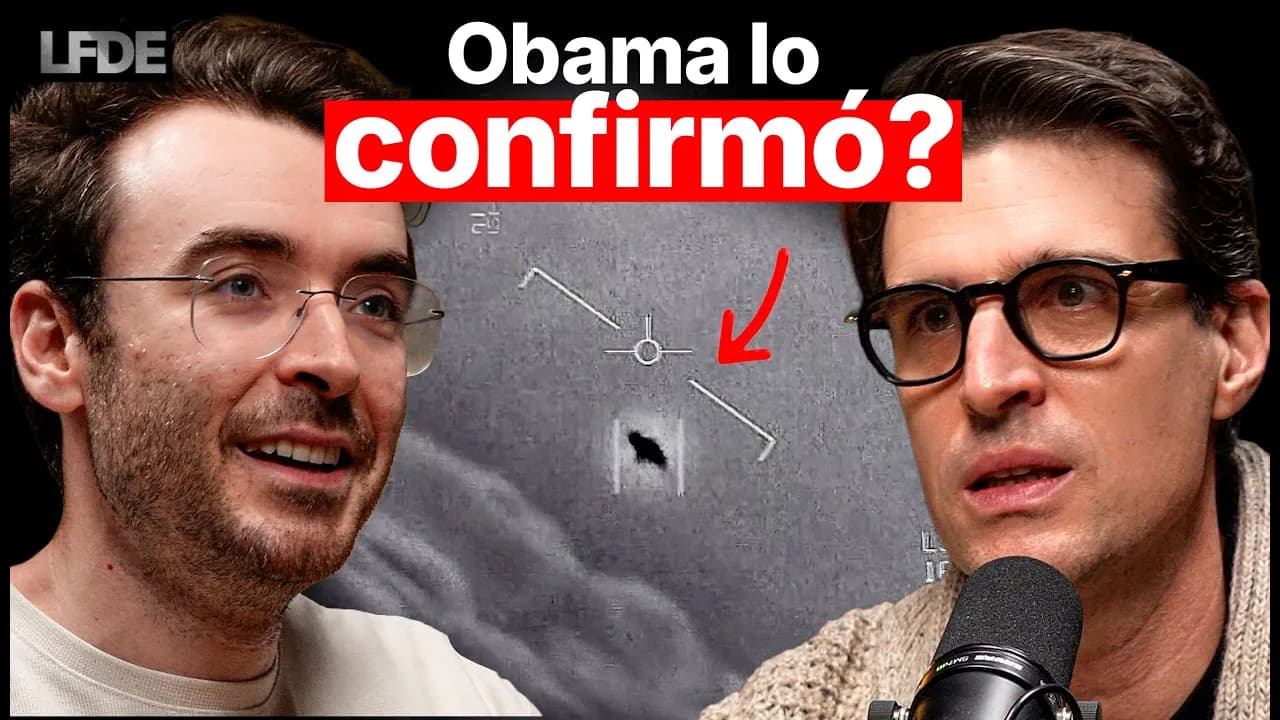
Obama stated that aliens are real but he hasn't seen them and they're not being kept in Area 51 unless they hid it from the president. Obama is scientifically literate. If aliens existed and authorities didn't want the president to know, the president wouldn't know.
Interest in returning to the moon is geopolitical. China announced plans to go to the moon, prompting renewed American interest 50 years after the original missions. There is no economic upside to lunar missions. The motivation is not wanting China to go to the moon without the United States. Space law is currently a wild west with no established ownership of the moon.
The moon missions, both historically and currently, were never about science.
Neil deGrasse Tyson expressed skepticism about the simulation hypothesis.
If sucked into a black hole, an observer would see the entire future history of the universe unfold. The difference in gravity between feet and head increases until the person snaps into two pieces, likely at the base of the spine.
No specific UFO sighting was detailed in this section.
Neil deGrasse Tyson discussed how his views on religion have evolved through studying the universe.
No specific answer was provided in this section.
People ask Neil deGrasse Tyson whether we are alone in the universe. This question is heavily influenced by pop culture. When the movie Ghost came out, polls showed more people believed in ghosts after the movie than before. Pop culture exerts a huge force on beliefs about what is true. Other pressing questions include whether we have been visited by aliens and how the universe will end. Questions about God also frequently arise.
There's an assumption that people who study the universe might stumble upon God because gods are depicted as living in the sky. When Apollo astronauts returned, people asked if they saw God or heaven.
Humans are comfortable sleeping on their backs, which is vulnerable since the belly is exposed. Most animals do not sleep this way. When sleeping outdoors at night on one's back, the first thing seen upon waking is the night sky with comets, meteors, the moon, and planets. The moon changes shape and position nightly, and stars appear to move. This exposure to the universe at night may be embedded in human DNA as a source of curiosity about the night sky.
Neil deGrasse Tyson's first encounter with the night sky was at the Hayden Planetarium in New York City as a child, which inspired him to study the universe.
Ancient people were not dreaming up aliens but were looking at the night sky itself. Using the term gods instead of aliens, most deities are placed in the sky. In ancient Greece, gods lived on Mount Olympus. Religious posters typically show sunbeams through clouds. Images of deities often resemble what people now imagine as aliens, with supernatural powers like floating, walking on water, or having snakes for hair.
Watching Cosmos made the viewer feel insignificant in the grand scheme of the cosmos, particularly regarding the size of the Milky Way galaxy compared to an individual.
Thinking in powers of 10, humans are small compared to the universe but huge compared to atoms and molecules. Life forms could theoretically be the size of galaxies or atoms. Humans may be biased by what their senses can perceive at their own size scale. Life the size of molecules would feel small. Life requires metabolism, which is difficult to fulfill at extremely small scales. Viruses are debated as to whether they are alive. Some have speculated life could be the size of nucleons, where things happen very quickly, and such life might wonder why humans live so slowly.
The laws of physics manifest differently on different scales. You cannot simply scale everything up. This is why there are no human-sized insects—their legs would break under their own weight. Heavy animals have thick, chunky legs. An ant can fall from a height and keep walking, but a human falling from a roof dies. In the film A Bug's Life, a mosquito at a bar receives a blob of liquid rather than a glass because surface tension holds small amounts of liquid together. Surface tension occurs when molecules at the outer surface of a liquid are more tightly gathered because there are no forces above them pulling them into the solution.
The feeling of smallness after watching Cosmos comes from entering with an ego that was unjustifiably large. Neil deGrasse Tyson feels large when looking at the stars because the elements in human bodies—oxygen, carbon, nitrogen, iron—were forged in stars that exploded and scattered enrichment into the galaxy. Early in the universe, these ingredients did not exist. Humans are chemically connected to the cosmos. Not only are humans alive in the universe, the universe is alive within humans. This borders on the spiritual and provides a pathway of relevance to the universe. Humans are part of the great unfolding cosmic story.
Humans are solar powered. Calories from food trace back through the food chain to plants that receive sunlight. A cow is a machine invented by humans to turn grass into steak. Essentially 100% of caloric value is traceable to stars, specifically the sun.
Religion gives people a sense of significance, which explains its value and persistence throughout time and across cultures.
By age eight, religion was not making sense to Neil deGrasse Tyson. Belief systems do not have to make sense—that is why they are belief systems. If something makes complete sense, it would be objectively true. If a belief system lends itself to testing and the test shows the belief is false, most people do not stop believing. Neil deGrasse Tyson has read religious tracts to have more informed and nuanced engagement with religious people. He has never embraced the title of atheist. Titles are lazy because they give license to stop thinking about who and what a person actually is. The word atheist is unusual because it describes what someone is not. There are very few words for things people are not. The exercise of saying you are either with us or against us never ends well and typically leads to war and bloodshed. Leading atheists like Richard Dawkins reject God's influence on politics and society. Neil deGrasse Tyson is not that person and has behavior that would be rejected by modern atheist thinkers.
Neil deGrasse Tyson relates to the term agnostic. He identifies first and foremost as a scientist.
The leading view of where the universe came from is the Big Bang, which is thoroughly supported by observations and experiment. Approximately 13.8 billion years ago, everything in the universe began in an infinitely dense point—the birth of space and time. The universe has been expanding ever since. Energy can be compacted to any size. Temperature measures the energy. As the universe expands, it cools, and cooling energy makes matter according to E=mc². It took time to cool enough to form stars and galaxies. The universe is still expanding today. Dark energy is a pressure in the vacuum of space making the universe expand faster than allowed by the collective gravity of all galaxies. Dark matter is an unknown source of gravity. Together, dark matter and dark energy comprise 95% of what drives the universe. Everything humans know about biology, chemistry, physics, food, and molecules is 5% of what's going on.
There is no idea what was around before the Big Bang. There are suspicions of a multiverse, a medium pumping out universes, with ours being one of them. The multiverse came out of mathematics related to quantum physics and Einstein's relativity. What caused the multiverse is unknown. It is a frontier question. There is no crime in asking questions at the frontier of knowledge. People who have to have answers do not make good scientists. The urge to have an answer can be influenced by bias and culture. Origin stories flow out of the cultures from which they emanated.
Dark energy is something in the vacuum of space making the universe accelerate in its expansion. From the original explosion, galaxies, matter, and gravity should cause expansion to slow. Instead, measurements show the universe is accelerating. This discovery won the 1998 Nobel Prize. Einstein had a term in his equation for negative gravity that he rejected, setting its value to zero. The term dark energy is considered a bad term because it leaves the witness—it is not known what it actually is.
Dark matter is also unknown. The term dark matter is similarly problematic.
Former President Obama stated that he has never seen aliens but affirmed that scientifically literate people would conclude aliens probably exist in the universe. He explicitly denied that any aliens are being kept in Area 51 or any underground government facility, noting that such a scenario would require an enormous conspiracy hidden from the President of the United States.
Despite Obama's clear scientific statement, his remarks were twisted by alien-adjacent culture into claims that aliens exist in the basement of the White House or in government custody. Obama had to return to clarify his position, though the clarification seemed unnecessary to those who understood the original scientifically literate framing.
In response to Obama's comments, Trump stated on Air Force One that Obama had given classified information and made a mistake by revealing it. Trump claimed he did not know whether aliens are real but insisted Obama violated classification rules.
Following the presidential exchange, the Pentagon announced the release of UFO files, which generated significant public interest. Google trend data shows corresponding spikes in searches related to aliens coinciding with these events and media coverage.
High-ranking whistleblowers, including former intelligence officers and military personnel, provided sworn testimony before Congress regarding UFOs. These official government sources elevated the credibility of the discussion beyond previous anecdotal reports from civilians.
The position taken is that if claims of alien evidence exist, the evidence itself must be produced. The question "Do you believe in aliens?" would become irrelevant once an actual alien is presented, similar to how no one asks whether someone believes in elephants since elephants have been shown.
Given the size, age, and chemical ingredients of the universe, there is no reason to doubt that intelligent life exists elsewhere. Life on Earth emerged within 100 million years of conditions allowing it, representing roughly 5% of Earth's total timeline. This rapid emergence suggests the process could occur frequently given the number of planets available.
Over 6,000 exoplanets have been cataloged, all within a small search radius around our Sun. The first exoplanet was discovered in 1995, when the interviewer was three years old. The rapid growth from one to 6,000 discoveries demonstrates accelerating progress in identifying planets outside our solar system.
The Milky Way contains approximately 100 billion stars. When viewed externally, the galaxy appears as a cloudy structure that resolves into individual stars when observed through a telescope, as Galileo demonstrated. The observable universe contains at least 100 billion galaxies.
Astronomical quantities span such enormous scales that being off by a factor of two represents a strong level of understanding. Galaxy star counts are estimated using total galactic mass and average stellar mass, yielding several hundred billion stars despite the lack of an exact census.
Many star systems contain multiple planets. Scaling observed local planetary frequency across the galaxy suggests millions to possibly billions of planets exist in the Milky Way alone. Not knowing exact numbers differs from having no understanding of the scale.
The actual universe extends beyond the observable horizon, analogous to how sailing past a ship's sea horizon reveals additional ocean. Whether the universe is infinite remains unknown, and no philosophical prerequisite should be imposed on the universe simply because infinity challenges human intuition.
Copernicus proposed a heliocentric model but retained perfect circular orbits because circles were considered the perfect geometric shape appropriate for a divinely created universe. This assumption delayed acceptance of elliptical orbits, which were confirmed approximately 50 years later. The lesson is that assumptions derived from philosophy or religion have repeatedly proven incorrect when tested against observation.
Galactic centers contain the highest stellar density because most mass concentrates centrally during galaxy formation. At the exact center lies a supermassive black hole, with measurements earning a Nobel Prize. The pictured galaxy shows dramatically higher star density in the core compared to outer regions.
A black hole forms when escape velocity equals the speed of light. Earth's escape velocity is 7 miles per second. Stronger gravity increases escape velocity. When escape velocity reaches light speed, light cannot escape, rendering the object black. Nothing that falls in can return because reaching light speed is impossible.
Einstein's equations mathematically predicted black holes, though he found the implications too strange. Black holes were understood mathematically in the 1960s, with the first discovery (Cygnus X-1, an X-ray source) occurring in the 1970s. Supermassive black holes, millions of times the Sun's mass, are now known to exist at galaxy centers.
Black holes do not reach out to pull objects in. If the Sun became a black hole, Earth would retain the same orbital distance and stability. Only objects crossing the event horizon are trapped. An ergosphere region exists around black holes where stable orbits become impossible and infall is inevitable.
Crossing the event horizon leads to a new spacetime region according to general relativity mathematics. Time dilation causes time to slow for the falling observer relative to the external universe. The observer would witness the entire future history of the universe unfold during descent. The event horizon marks the boundary beyond which escape is impossible.
Tidal forces increase dramatically near black holes. Gravity differs measurably between a person's feet and head on Earth, but the difference becomes extreme near a black hole. The falling person stretches head-to-toe until structural failure occurs, typically at the spine. Subsequent pieces continue fragmenting. Simultaneously, the person occupies an increasingly narrow volume of spacetime, experiencing extrusion through the singularity.
General relativity predicts the black hole center is infinitely dense and infinitely small. Whether something prevents this mathematical outcome remains unknown, representing the current limit of Einstein's theory.
Consistency compounds over time in sales and business operations. Small teams naturally maintain consistency through direct knowledge of all deals. Growth introduces missed follow-ups and cold leads unless systematic processes replace informal coordination. Effective scaling requires daily systems that track every deal stage and required next actions.
Pipedrive provides an intelligent CRM platform used by over 100,000 companies. It delivers real-time pipeline visibility showing deal stages and required actions. The platform maintains operational consistency whether a team has five or fifty members. A 30-day free trial is available at piperive.com/ceo without requiring a credit card.
HeyGen AI technology converts recorded video into other languages while preserving the speaker's voice, timing, and expressions. The service supports over 175 languages and is used by 30 million people including 85% of Fortune 100 companies. Studio-quality video avatars can be generated from 15-second recordings. The first three videos are free at heygen.com/dac.
Given the universe's size, age, ingredients, and the speed of life's emergence on Earth, intelligent life elsewhere appears probable. Brain size rankings place whales, dolphins, and elephants above humans. Humans rank fourth in absolute brain size among animals.
The brain-to-body-mass ratio places humans at the top among mammals but not overall. Certain midsized birds including magpies and parrots exceed the human ratio. Efforts to mathematically position humans at the top of intelligence metrics reflect ego rather than objective assessment.
Civilization requires technology, art, and communication capabilities beyond basic intelligence. The operational definition of intelligence relevant to alien contact may include the ability to communicate across interstellar distances or construct spacecraft. Historical human civilizations such as Rome lacked electricity, computers, and space travel, raising questions about how such societies would be classified by external observers.
The New Horizons spacecraft reached Pluto using the most powerful available rockets with minimal payload mass. Redirecting that same spacecraft to Alpha Centauri, the nearest star system, would require 50,000 years. Space remains largely empty, making interstellar travel extremely difficult even at current maximum velocities.
The question of where aliens are, given the apparent likelihood of their existence, may be answered by the difficulty of space travel. An additional hypothesis suggests that intelligent aliens observing Earth's orbital debris field may choose to avoid the planet due to collision risks. Space debris accumulation continues as nations launch increasing numbers of satellites with no regulatory framework governing orbital density.
SpaceX Starlink satellites create significant challenges for ground-based astronomy. While the satellites provide high-speed internet access to remote locations including the middle of the ocean, the Arctic, and deserts, they create visual noise in astronomical data. When tracking asteroids that might be headed toward Earth, thousands of satellite streaks can obscure the target. If a satellite passes directly in front of an object of interest, it contaminates the collected data.
The future of telescopes will need to shift toward space-based telescopes and lunar telescopes to avoid this interference.
Five thousand satellites were launched into orbit in 2025, with even more projected for 2026. As of mid-2026, SpaceX had launched 10,500 satellites. Projections indicate there will be 100,000 active satellites in orbit by 2040, and possibly more.
The economic value of satellites extends far beyond their physical worth. Satellites enable entire economies, including modern commerce that depends on GPS. Without GPS, services like Uber would not exist. This utility explains the establishment of the U.S. Space Force, which was previously the Air Force Space Command. The Space Force was formally created during Trump's first administration.
Kessler syndrome, proposed in 1978 by physicist or mathematician Kessler, describes a threshold scenario in Earth's orbit. When a satellite is destroyed—whether through collision or intentional missile strike—it breaks into pieces traveling at orbital speeds of approximately 17,000 miles per hour. Each fragment can destroy additional satellites, creating a cascading effect. A single satellite breaking into 10 pieces can lead to 100, then 1,000 pieces, potentially destroying 100% of satellites in orbit within a few orbits if the density threshold is reached.
China, India, Russia, and the United States have each destroyed satellites through missile tests. The United States has conducted four such tests on its own satellites, demonstrating capability that could be applied to others.
In low Earth orbit with few satellites, debris would orbit or fall harmlessly. With high satellite density, destruction cascades become possible. The film Gravity depicts this scenario.
Objects in orbit travel at 17,500 miles per hour, equivalent to 5 miles per second. At these speeds, even a fleck of paint carries the destructive power of a rifle bullet or exploding grenade. A collision produces shrapnel that damages objects beyond the initial target.
Space law remains largely undeveloped, often described as the "Wild West." No entity currently owns the Moon or plots of land on Mars. Questions remain unresolved regarding who owns minerals extracted from asteroids. The current situation suggests that whoever reaches a celestial body first may claim ownership.
The United States did not return to the Moon after 1972 despite multiple opportunities in subsequent decades. The Artemis program was initiated during Trump's first administration after China announced plans to send astronauts, called "taikonauts," to the Moon. The name Artemis references the twin sister of Apollo in Greek mythology.
The motivation is geopolitical rather than scientific. When China announced lunar plans 50 years after the U.S. Moon landing, the United States responded competitively. NASA functions as a geopolitically responsive organization. The program continued under the Biden administration despite originating under Trump.
NASA maintains a branch called In-Situ Resource Utilization (ISRU) focused on using lunar resources. Water is believed to exist at the Moon's South Pole. Plans include using lunar silicates with 3D printers to manufacture tools on-site rather than transporting everything from Earth.
Temperature on the Moon depends entirely on exposure to sunlight due to the absence of atmosphere. Facing the Sun causes one side to burn while the opposite side freezes, necessitating either rotating systems or highly insulated spacesuits.
The Moon is three days away at minimum energy trajectory. It could become a tourist destination once bases, hotels, and restaurants are established. Initial lunar missions would not be economically driven but would enable future commercial development.
Most UFO footage released publicly is monochromatic and low resolution. Most UFO sightings have natural explanations such as cloud formations, lightning, or twilight conditions. Some sightings remain unexplained, including the Tic Tac incident, which showed an object with unusual movement characteristics captured on gimbal footage alongside pilot testimony.
No released footage has been compelling as evidence of alien technology. Whistleblower claims include assertions of recovered alien bodies, crash parts, and reverse-engineered technology.
Most Hollywood depictions of aliens are humanoid, featuring heads, two eyes, noses, mouths, ears, and limbs with elbows, fingers, and knees. Examples include ET, the xenomorph from Alien, and the Predator. The xenomorph is depicted as parasitic and would not build spaceships.
The most surprising outcome would be discovering that aliens are humanoid. Most life on Earth is not humanoid, including oak trees, worms, and lobsters, despite sharing DNA. Aliens resembling insects, called "insectoids," would be particularly unappealing to humans.
Reported alien sightings fall into archetypes. "Little green men" were common in the 1950s and 1960s. "Grays" represent the most common contemporary archetype, typically depicted as bald. Other reported types include Arcturans from Arcturus, aliens from the constellation Lyra, and Sirius aliens. Additional categories include "tall whites" and insectoids.
People who have used DMT frequently report encounters with insectoid entities. English-speaking cultures report vastly more alien sightings than other cultures. This pattern suggests either that aliens preferentially visit English-speaking countries or that reporting practices differ across cultures.
Neil deGrasse Tyson has never used psychedelics. He argues that the human brain barely functions accurately under normal conditions, as demonstrated by optical illusions that confound perception. Introducing additional chemicals would further disrupt an already unreliable system and would not bring one closer to objective reality.
Scientific measurements can be performed outside human sensory limitations. Ultraviolet light, which humans cannot see, can be measured with detectors that produce results multiple observers can agree upon. Einstein's equation E=MC² led to atomic weapons with real physical consequences, demonstrating that scientific understanding reflects objective reality rather than imagination.
Science developed specifically to separate objective measurements from neurochemical brain processes. Tools extend human capabilities beyond physiological limits, including microscopes for the small and telescopes for the large.
Humans can only perceive what was necessary for evolutionary survival. Other species, such as bats and dogs, perceive different aspects of reality. Spirits or other phenomena could theoretically exist without detection if they posed no survival risk. Science provides dozens of additional senses through instrumentation.
If subjective experience is entirely chemical, then reality could theoretically be a simulation created by an advanced civilization. Tyson stated that humans are probably living in a simulation, possibly created by a child in an alien parent's basement.
The laws of physics behave differently across scales, so human societies cannot be modeled the same way microbes behave in a petri dish. Petri dishes are sized for bacteria; larger systems require different rules. Scaling up microbial behavior does not produce accurate predictions for humans because people interact with their environment in fundamentally different ways.
Neil deGrasse Tyson states he does not want to believe humanity exists inside a simulation. The classic simulation argument posits that advanced civilizations create powerful computers that run full-world simulations. Simulated beings inside those worlds believe they possess free will. Once those simulated beings develop computers, they create their own simulations, producing nested layers of simulated realities.
Tyson notes that if one randomly selects a universe from this sequence, the probability strongly favors landing in one of the manufactured simulations rather than the original base reality. However, only universes possessing sufficient computing power can generate further simulations, which is why the sequence continues.
Current human civilization lacks the technological capacity to simulate an entire universe containing beings who experience what they perceive as free will. Because we cannot yet create such simulations, we cannot occupy any intermediate position in the chain. This leaves only two possibilities: humanity either inhabits the original base reality that has not yet developed simulation technology, or we are the final simulated layer created by a prior civilization that has not yet produced its own successor simulation.
This framing reduces the odds from roughly 100 billion to one down to approximately one in two.
Tyson clarifies that simulated universes need not be one-to-one copies of their creators' reality; a simulation could consist entirely of Mario characters. He acknowledges that exponential technological growth makes eventual simulation capability seem inevitable, yet emphasizes that humanity has not reached that threshold today.
Even if other civilizations elsewhere in the universe reached simulation capability first, we would still occupy either the originating universe or the terminal simulated layer because we lack the ability to generate further universes. Branching structures (where each civilization creates multiple simulations) do not change this conclusion: we remain either at the root or at a leaf node.
One speculative idea raised is that advanced civilizations might trigger new Big Bangs, effectively creating fresh universes. The observed uniformity of physical laws across the cosmos could represent the fixed rules programmed by the simulators. Tyson notes there is no external vantage point from which to test this possibility.
A simulation could begin at the Big Bang and evolve through single-celled life, multicellular organisms, intelligence, and technology, or it could simply instantiate fully formed intelligent beings with implanted false memories. The latter scenario resembles the premise of The Matrix.
Tyson distinguishes between serving a deity and finding personal meaning. He finds the idea that an omnipotent being requires praise and obedience puzzling. Instead, he creates meaning rather than searching for it externally.
His personal framework includes two core practices:
- Learn something new each day to expand awareness of objective reality, thereby gaining wisdom and insight.
- Perform at least one action daily that reduces the suffering of others.
He values happiness because it enhances the experience of being alive, but stresses that helping others is done for their benefit, not for self-gratification. Spreading goodwill without expecting repayment creates ongoing chains of positive action throughout society.
Tyson declines any statues, plaques, or personal memorials. He selects a quotation from 19th-century American educator Horace Mann:
"Be ashamed to die until you have won some victory for humanity."
This reflects his educational mission: improving the world for others rather than seeking recognition.
Modern schooling often produces students eager to finish each period, the school day, the week, or their entire education. Tyson argues this indicates a failure to cultivate curiosity. If education successfully sparked wonder, students would want to continue learning after graduation.
He distinguishes between the institution of school (which has acquired negative connotations) and the broader goal of education as lifelong curiosity. Effective education should make students say they miss the experience of learning.
Tyson discusses his book Take Me to Your Leader: Perspectives on Your First Alien Encounter. One chapter, "Alien to Us," examines human behaviors that would appear strange to extraterrestrials, such as the need to lie down in semicoma for one-third of Earth's rotation (sleep). Another section warns against assuming universal customs like handshaking apply to aliens.
In the complementary chapter "Alien to Them," Tyson imagines aliens landing on the 405 freeway in Los Angeles and concluding that automobiles are the dominant life form. They would observe cars transporting other cars (on haulers), receiving "food" through drive-through windows, and being repaired after accidents, leading them to view humans as the squishy interior components of the primary life form.
The book aims to challenge anthropocentric assumptions about both how aliens would perceive humanity and how humanity would perceive aliens.
Keep The Diary Of A CEO in your library
Save the videos and channels worth coming back to, and find them again in one place.