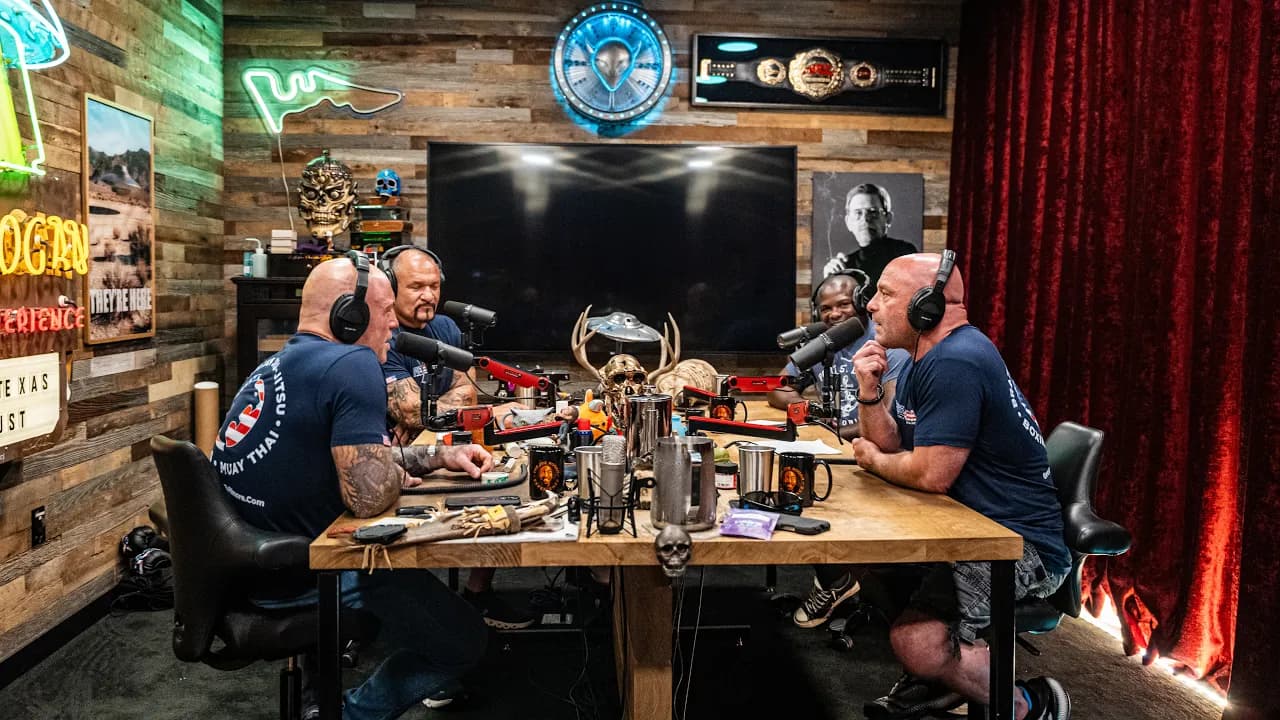
Joe Rogan Experience #2520 - Tommy Lee
In a Nutshell
Tommy Lee and Joe Rogan discuss the chaos of rock stardom versus the grounding effects of nature, with Lee crediting bonsai tree cultivation for providing daily peace and balance after decades in Mötley Crüe. They explore how modern entertainment's oversaturation and short attention spans have destroyed the conditions that once allowed long, unconventional songs to become classics, while criticizing record label interference that damaged careers like Billy Squier's. The conversation also covers music's physical and emotional power, from "Kickstart My Heart" as workout fuel to sound frequencies' potential healing properties, alongside Lee's experiences with high-risk drum rigs, exotic cars, and the generational impact of sustained musical careers.
These notes were generated by AI and may contain inaccuracies.
Tommy Lee has a diamond in his tooth. Joe Rogan mentions his friend Cam got a gold tooth and is considering getting one himself to replace a cap from a root canal.
Tommy Lee is leaving immediately after the podcast to attend his son's wedding in LA. His son is 29 and has been with his girlfriend for seven years. Tommy expresses happiness that his son took the opposite approach from him by being patient and investing time in the relationship, increasing the chances of long-term success.
Tommy notes his son chose a more stable path with a yard and picket fence despite the chaotic environment of having a rock star father in LA. He contrasts this with how easy it is to ruin one's life in the wrong circles, mentioning meth use as an example of how bad decisions can lead to addiction even for good people.
Joe observes that the rock and roll world attracts chaotic people. Tommy agrees it's difficult to find sane, balanced people in that environment. He reflects on the impossibility of being normal as the drummer for Mötley Crüe, describing the surreal experience of playing in front of massive crowds.
Tommy brought his sons on tour, assigning them roles such as working with the lighting crew or managing after-show passes. He describes watching his son handle the passes and interact with people as a memorable experience.
Joe asks how surreal it feels to achieve what every young musician dreams of. Tommy says he still pinches himself daily and feels lucky. He attributes success to a combination of luck, talent, and timing, noting that when these align, events happen at supersonic speeds and much becomes a blur requiring others to remind him of what occurred.
Mötley Crüe opened for the Rolling Stones on Halloween in Toronto. Twenty minutes before the Stones went on stage, their tour manager brought Tommy to their dressing room where Mick Jagger, Keith Richards, and Ronnie Wood were drinking heavily. Keith and Ronnie were visibly intoxicated. Despite this, once the lights went out and they started with "Start Me Up," they delivered a flawless performance. Tommy describes them as masters of their craft who can control their level of intoxication when needed.
Tommy shares a video of Rick Springfield, age 76, performing "Jesse's Girl" with high energy and physical fitness. He finds the passion and enthusiasm at that age inspirational, noting Springfield appears to be in excellent shape and performs as if he just wrote the song.
Joe notes that in the 1980s there were no old rock stars touring. The Rolling Stones' decision to tour again around 1988-1989 changed perceptions. Tommy and Joe discuss how older artists across genres, including hip-hop acts like Public Enemy performing with Bruce Springsteen, continue touring because they love what they do.
Tommy points out that Spotify releases approximately 300,000 songs per day, making it difficult even for industry professionals to keep up. He argues this excess creates static that buries original, high-quality work. Joe agrees there is too much content across music, movies, and television, making it hard for audiences to find and commit to anything.
Joe compares the abundance of entertainment options to dating apps, where people quickly move on without giving anything a real chance. He speculates that viewer retention on platforms like Netflix is much lower than in the past, with many abandoning shows or movies within minutes.
The short attention span environment forces creators to grab attention within the first three or four seconds or risk losing the audience. Tommy and Joe note this affects artistic decisions across all media.
Joe cites Led Zeppelin's "Whole Lotta Love," which features a minute and a half of cymbal sounds before the main riff, and Lynyrd Skynyrd's "Free Bird," a seven-minute song with one of the greatest guitar solos in history. Both were initially criticized by record companies for being too long or unconventional but became enduring classics.
Tommy states that when Mötley Crüe was on Elektra Records, label executives were not allowed in the studio. When one executive was permitted in and suggested changes, the band immediately removed him, insisting he would receive the finished product. Joe and Tommy discuss how non-musician executives make decisions based solely on commercial metrics, often giving poor advice driven by financial motives rather than artistic merit.
Tommy and Joe reference Zach Bryan's song about the music industry, describing executives as vampires who build empires from artists' work while claiming insight they do not possess. They note that many artists have damaged their careers by following label advice.
Billy Squier was a major star in the early 1980s with hits like "The Stroke" and "Lonely Is the Night." A single music video, believed to be for "My Kinda Lover," featured an effeminate presentation that alienated his audience and effectively ended his mainstream success. Joe and Tommy discuss whether the video concept originated with Squier or was suggested by others, noting the lasting damage from one creative misstep.
The discussion covers a Billy Squier music video for the song "Rock Me Tonight" from 1984. The video shows Squier dancing around in a bed with pastel colored satin sheets while wearing a pink tank top. The video is described in a 2011 book titled "I Want My MTV: The Uncensored Story of the Music Video Revolution" as one of the worst music videos ever made. Squier's concert ticket sales immediately declined after the video's release, and he later fired his managers. Squier has accused the video director Ortega of deceiving him and altering his original concept, though Ortega denies this. While Squier believes the video was solely responsible for the decline in his popularity, other commentators are less certain.
Joe Rogan recalls kids in high school reacting negatively to the video, questioning what Billy Squier was doing. Rogan notes that Squier was previously considered "the man" and could have had the longevity of someone like John Mellencamp, but the single video effectively ended his career as a singles musician.
The conversation shifts to Mötley Crüe and the enduring success of bands from that era. Rogan mentions that hearing "Kickstart My Heart" while working out makes him feel stronger, describing the song as "fuel" and comparing it to a drug that gives energy. He notes that the song is one of the most American songs ever made. The hosts discuss needing to cut the song for YouTube due to copyright concerns.
Rogan explains that certain songs can change your physical state, giving goosebumps and making your hair stand up. He describes music as "an encapsulation of emotion with sound frequencies that just changes your physical state." Unlike jokes that lose power with repetition, great songs can be listened to repeatedly without losing their impact. Rogan sometimes puts a single song on repeat while working out because it makes him feel energized.
Tommy Lee mentions a story about a doctor in China or Japan who is close to healing cancer through sound and frequency. While neither has seen this specific research, they find it plausible given music's known effects on the body. Lee brings up the 432 Hz tuning theory, explaining that some conspiracy theories claim that music by composers like Bach and Beethoven was originally tuned to 432 Hz, and that Hitler allegedly changed the tuning to 440 Hz to make music more aggressive and give soldiers more angst.
Rogan notes that soldiers were also given methamphetamine. The conversation jokes about how "Kickstart My Heart" in German combined with meth would have been problematic for the Nazis.
Lee asks about sound therapy and healing through frequencies. Rogan mentions that people do sound baths as meditation experiments where someone makes sounds while participants lie on their backs. He notes that sound has a profound effect on the human body, as evidenced by how great songs change how you feel and give you energy. Rogan suggests that sound could provide therapeutic benefits to injured or sick people.
The hosts agree that listening to good music would be better for recovery than hearing people moaning in hospital rooms. Rogan emphasizes that getting positive vibes and good energy should be part of recovery.
Lee describes putting on YouTube videos of Japanese gardens in Kyoto with bonsai trees and koi ponds as background music. He finds these videos relaxing and notes that he keeps them on frequently. Rogan agrees that this puts you in a different state or space.
Lee explains that his interest in bonsai began during trips to Japan, where he visited Japanese gardens at temples. He was struck by the peaceful and beautiful atmosphere and started studying bonsai about eight years ago. He found videos on bonsai work and has continued the practice ever since, calling it the coolest thing he's ever gotten into.
Lee spends hours every day working on his bonsai trees, starting his day with nature. He has a workshop with works in progress on the bench, trees being bent, trees being treated for pests, and trees being wired and pruned. The practice allows him to escape everything and check out for a couple of hours.
A bonsai tree is a regular tree that would grow big if not maintained through dwarfing techniques. The term "bonsai" means "tree in pot" rather than referring to a specific type of tree. Lee notes that bonsai originated in China in the 6th century, with the Japanese later adopting and altering the practice.
Lee owns two bonsai trees that are over 300 years old. These trees have been continuously worked on—roots cut back, pruned, and maintained over the centuries. He clarifies that the trees are the same trees that existed 300 years ago, just maintained in their dwarfed form.
Lee has started entering his trees in bonsai shows and exhibitions, having done two so far in the current year. The previous seven to eight years were spent learning the practice. Rogan notes that bonsai is the complete opposite of being a rock star and serves as a great balancing tool.
Lee's musical peers have become interested in bonsai after seeing how much joy it brings him. Rogan connects this to the peacefulness and clarity associated with zen gardens and bonsai, noting that these practices have a spiritually attractive quality.
Lee explains that Japanese culture approaches design with purpose. In zen gardens, paths are never straight—they are strategically curved to slow people down. The objective is to get visitors to slow down, and nothing is revealed until you come around a corner. Bridges over lakes or ponds are rarely straight; they are arched or zigzag to force people to stop at each corner, take in the surroundings, and be present.
Lee says this practice has helped him slow down in his own life. He finds that starting his day with bonsai work sets him up for a good day. Rogan notes that zen garden design with its flow of nature is exciting to people.
Lee observes that newer architecture and homes are being built with minimal Japanese flavor meant to create peaceful spaces rather than ostentatious displays. Rogan contrasts this with houses featuring giant windows overlooking cities, noting that he has lived in such houses and found that the view doesn't really do anything compared to having a winding sanctuary.
Rogan states that nature is therapeutic, and putting nature in an artistic form like a zen garden is particularly therapeutic. He prefers seeing trees, nature, and green living things over city environments.
Lee mentions that he always looks for trees when entering a city, suggesting he may have been a tree in a past life. Rogan agrees that human beings are connected to plants and nature. He praises the designers of New York City for creating Central Park, an 843-acre park in the center of the city. Rogan stayed at a hotel on the edge of the park and found it incredible that such a large natural space exists in the middle of the city.
The hosts joke about real estate developers as "vampires" trying to take over park space for apartment buildings. Rogan mentions their podcast "Protect Our Parks" with Ari Shafir, Shane Gillis, and Mark Norman, which originated from an episode where Ari discussed a park being turned into apartment buildings.
Lee mentions seeing an Instagram video of a fatal accident involving a horse and buggy in New York City. A horse got spooked, flipped the cart, and the passenger died on the way to the hospital. The driver had left his seat to take a photo of the passengers, which is against protocol. Rogan expresses that he is not a fan of horses walking around the city, stating that horses belong in fields and mountains, not clicking around on asphalt.
The hosts agree that the horse and buggy practice is a gross touristy thing, though cops sometimes use horses for breaking up riots. Rogan notes that a horse is not supposed to be in the city, just as a cow would not belong there.
Tommy Lee describes riding elephants in Thailand and establishing a relationship first by feeding them sugar cane and petting them. The elephants decide whether you're acceptable based on the peaceful, gentle, friendly energy you give. He questions the necessity of riding them, stating he would have been content just feeding them and hanging out. Joe Rogan agrees it's weird but notes people like it and elephants are beautiful animals. Tommy emphasizes he doesn't need to ride animals, though he understands others enjoy it.
The conversation shifts to horses and the intense bonds people form with them. Tommy mentions knowing horse whisperer types who exhibit next-level connection with the animals. Joe notes equine therapy exists, including incline therapy used in rehabilitation settings. Tommy participated in a rehab program that included a couple days with horses and found it meaningful. They discuss the peaceful quality of horses, especially broken ones that are generally chill and enjoy being petted.
Tommy expresses unease about horses' large teeth when feeding them, warning about keeping fingers clear. Joe mentions people have been bitten. They discuss the jaw power of horses and imagine the consequences of an annoyed horse clamping down on someone's hand demanding a carrot.
Joe notes the ability to smoke in the studio. Tommy confirms he smokes cigars and has done so forever. He attempted to quit a few years ago and nearly made it a year. After a few months he felt out of the woods, but the quit didn't last. Joe asks what brought him back, and Tommy attributes it to drinking at the time, noting cigarettes and alcohol go hand in hand. Tommy explains he quit originally because he was trying to quit everything and hit the reset button, going through a phase of attempting to quit all vices.
Joe observes that cigarettes are often the last vice for people in recovery. Tommy references Keith Richards continuing to smoke cigarettes at an advanced age. He had his lungs examined with a full body scan and was told he was fine, which surprised him given his smoking history.
Joe explains that a very small percentage of the general population gets lung cancer, and even among cigarette smokers it's a small percentage. However, more smokers get lung cancer than non-smokers, which is why the association appears strong in data. Jamie pulls up statistics showing 10 to 20 percent of people who smoke at some point will develop lung cancer, with many studies landing around 15 percent. One in seven current smokers develop lung cancer, while never-smokers have a 1 to 2 percent lifetime risk. Smoking causes 80 to 90 percent of lung cancer deaths.
Joe references a discussion from the previous day about Europeans with high polyphenol diets, particularly from olive oil, fruits, vegetables, whole grains, tea, and wine. Some studies suggest these diets connect to better cardiovascular risk profiles and lower heart disease risk. Tommy finds it interesting that olive oil's antioxidant and anti-inflammatory properties might balance free radicals from smoking. However, current evidence shows polyphenols cannot neutralize cardiovascular, cancer, or lung damage risk from smoking, only modestly improve overall risk markers.
Joe mentions that during COVID there was discussion about smokers potentially being protected. Tommy recalls never getting COVID and jokingly credits nicotine. They discuss how nicotine provides a manageable high and may benefit cognitive function. Tommy references Pink Floyd writing The Wall while smoking heavily. Joe notes Stephen King said quitting cigarettes affected his writing, with his "kidnaps" not firing as fast. Tommy noticed everything tasted better when he quit smoking, suggesting cigarettes numb the mouth and dull taste receptors. Many creative and intelligent people, including professors, use tobacco despite health risks.
Tommy corrects earlier information about David Gilmour, noting some Pink Floyd members smoked. The conversation moves to seeing Roger Waters live. Joe describes the show as featuring enormous screens with incredible visuals accompanying the music. Roger Waters' performances are politically loaded. Tommy recalls seeing a Wall tour where the wall slowly built over the entire set. Joe mentions Ari Shaffir was on acid during one show and cried throughout, describing him as an experienced passenger capable of riding waves.
Tommy states he pinches himself daily and feels he shouldn't technically be alive. He considers himself lucky and attributes it to genuinely wanting to be here. He expresses frustration that society hasn't progressed to Jetsons-level technology with personal spaceships. Joe suggests problems with people flying around include the difficulty of catching them compared to controlling street-level movement.
Joe mentions flying cars exist, including a company called Jet One making one-man helicopter drones. Tommy and his manager considered purchasing some but decided to wait for the technology to mature. Joe compares it to early glitchy cell phones that needed bugs worked out. They discuss concerns about what happens when these devices run out of gas or batteries mid-flight, comparing it to people pushing their luck with cars running on empty.
Joe describes a documentary about a young man working at an airport who stole a Horizon airplane, flew it over Puget Sound, and crashed on a remote island. The documentary titled Sky King shows him having conversations with air traffic control while admitting he didn't know what he was doing. Joe notes the man was essentially a dead man the moment he took off, as landing the plane was not realistic. Tommy hasn't seen the full documentary but saw clips of the attempts to talk him down.
Tommy released a song called Stupid World a couple weeks prior, addressing what he sees as epic levels of stupidity in society. Joe notes Tommy lives in Los Angeles, which he considers one of the stupidest places on earth. Tommy acknowledges the paradox of loving LA for its beauty, perfect weather, and friendly people while questioning why he lives there. Joe observes that a percentage of people make the city difficult, though the majority are cool.
Joe describes LA as slowly becoming a new Detroit, with the film business, television, and late night TV drying up. The entertainment industry previously fueled much of what made LA special. He argues that regulations, taxes, and policies make conducting business and feeling safe increasingly difficult. Tommy notes surprise when people leave, but questions what officials expect given the conditions created. Despite statistics showing people leaving LA, Tommy observes the traffic remains unchanged and questions whether the exodus numbers are accurate or whether LA is simply too large for population loss to be noticeable.
Tommy describes driving to Orange County at 4 PM as a real decision requiring self-reflection. The 405 freeway is particularly problematic. Joe shares that if he commuted from Irvine to LA, he would wake at 5 AM, drive with no traffic, and get a gym membership in LA to make use of the time. He would rather wake early than deal with both directions of commute traffic. They calculate that people living 20 minutes away in no traffic spend three hours daily commuting, representing years of lost life over time.
Joe recommends books on tape and podcasts as productive uses of commute time. With his Tesla's autopilot feature, he can engage it during heavy traffic and the car handles lane changes, braking, and stopping at lights. He keeps his fingers on the wheel and eyes on the road while listening to content, transforming stressful driving into relaxed sitting time. Tommy prefers audiobooks over reading because focusing his eyes on text causes fatigue and loss of interest, whereas listening allows sustained engagement without eye strain. Joe notes reading always makes him want to sleep, especially at night.
Joe Rogan listens to audiobooks during workouts in the gym, in the sauna, and during his commute to work, accumulating several hours of listening time each day. This approach allows him to absorb information from guests like astrophysicists when he lacks the time to sit down and read physical books. He emphasizes the need to stay diligent while listening, noting that intense workouts can cause distraction, requiring rewinding to catch missed content. When a workout becomes too demanding, he often turns off the audiobook entirely.
Rogan points out that true multitasking does not exist, and attempting to focus on two important tasks simultaneously reduces performance on both. He finds his best workouts happen in silence, allowing full concentration on the physical activity, though he makes an exception for music, which serves as fuel without the distraction of lyrics or complex information.
David Goggins, the former Navy SEAL and ultramarathon runner, avoids using music during workouts, considering it cheating because it provides external motivation rather than relying solely on mental strength. Goggins has completed eight 100-mile races over eight consecutive weekends, totaling 800 miles. He is known for extreme spontaneous workouts, such as deciding on the spot to complete a 60-mile ruck with a weighted backpack. At age 50, he maintains this level of fitness despite having knees that are bone-on-bone from years of impact, having undergone multiple operations.
Goggins views music as an unreliable crutch that may not always be available, preferring to build mental resilience through direct confrontation with discomfort and negative thoughts during intense physical challenges. Rogan acknowledges the validity of this perspective for someone operating at Goggins' level but prefers using music as an inspirational supplement to enhance workout energy.
The conversation shifts to the diversity of people in the world, with Rogan noting that Tommy Lee has likely encountered nearly every type of individual due to decades in the spotlight. Mötley Crüe broke out around 1980 when Lee was 17 or 18 years old. The world at that time lacked cell phones and internet, creating an environment where "anything goes" and people could get away with extreme behavior without documentation or consequences.
The 1980 cultural landscape featured Jimmy Carter as president until Ronald Reagan took office in 1981. Lee reflects on how modern fans, particularly 18-year-olds, express disappointment at missing the unrestricted rock lifestyle depicted in the band's autobiography and the film The Dirt. The era allowed for complete freedom without the constant presence of recording devices.
Lee and his father, a mechanic, built an elaborate drum riser featuring lights and switches for early performances. His father also constructed pyro setups by drilling holes in wood blocks, running electrical prongs through them, and creating small explosive charges using gunpowder-filled pipes. These experiments often occurred in the backyard, alarming neighbors with sudden mushroom clouds. Lee's father would drive him to gigs in a van loaded with equipment, providing extensive hands-on support for his musical career.
Lee describes a gyroscopic drum riser that rotated in multiple directions—right to left and back to front—allowing him to play drums while positioned halfway upside down. Playing in this inverted position required significant physical adjustments: instead of gravity assisting downward stick motion, he had to actively push against it, tripling the physical effort. Bass drum pedals needed springs installed underneath to prevent them from falling when inverted. Cymbals and hi-hats, designed to hang in one direction, required additional spring mechanisms to remain functional when upside down.
The concept originated from watching Pat Travers Band drummer Tommy Aldridge perform a drum solo. Lee observed audience members leaving to get drinks, use the restroom, or smoke during the solo, indicating the drummer failed to maintain visual engagement. This experience motivated Lee to create drum setups that provide audiences with a better view of the performance, since drums lack the visual accessibility of guitar playing.
A later iteration featured a roller coaster-style rig that traversed the entire length of arenas or stadiums while rotating and turning the drummer upside down. At one point, the rig descended so close to the audience that fans could nearly touch Lee while he played. Each performance on this apparatus lasted approximately nine minutes, requiring an oxygen bottle afterward due to the extreme cardio demands. The rig required Lee to complete the journey forward and then repeat it in reverse before Mick Mars would begin his guitar solo.
Lee discovered through an old-style pedometer clipped to his shoe that he covered 13.3 miles during a typical two-hour show. This level of constant movement explains his consistent weight since high school despite eating freely without a structured diet. The physical exertion combines rapid arm movements, footwork on bass drums, and intense breathing, creating a cardio workout comparable to shadow boxing for extended periods.
Drumming ranks among the most athletic activities in music, requiring sustained endurance that would take considerable time to rebuild after periods of inactivity. Lee notes that out-of-shape drummers are rare because the physical demands make it nearly impossible to maintain performance without fitness.
As the drummer, Lee views himself as the heartbeat of the band, responsible for setting the pace and physically moving the audience. He states that a band's quality often depends on its drummer, and the energy projected outward returns through audience movement, creating a feedback loop. While draining, this responsibility remains deeply fulfilling for him.
Lee learned drums primarily on his own after early exposure to marching band rudiments in grade school. He borrowed the school's jazz drum set and played along with favorite records, developing his skills through imitation rather than structured instruction. He never took physical drum lessons and figured out stick grip independently, similar to how Jimi Hendrix taught himself guitar and adapted to playing left-handed and upside down.
Lee discusses how modern drumming techniques produce more powerful sounds than early rock and roll. He describes drum circles as creating a tribal, collective energy where multiple drummers generate movement through rhythm—an aggressive form of power distinct from the emotional impact of instruments like piano. Drums have held cultural significance throughout human history, used on ships to maintain rowing pace and serving as a fundamental heartbeat in tribal contexts.
In recent years, Lee has experimented with hand drums, specifically the hang drum, a melodic, UFO-shaped percussion instrument with a soothing, zen-like quality that contrasts with aggressive rock drumming. He remains constantly engaged in searching for new percussive sounds, often modifying objects that produce drum-like tones or pitching sounds in unconventional ways to create fresh rhythmic elements.
Lee describes his songwriting approach as fluid and inspiration-driven rather than following a fixed method. Ideas may emerge from personal experiences as chants or words, prompting him to pick up a guitar, or a beat may arrive first, leading to added instrumentation. He avoids rigid structures like always beginning with lyrics, preferring to follow whatever feels creatively compelling at the moment.
When creating music, getting people to stay listening or move comes before they even hear lyrics or melody. The priority is whether the music moves the listener emotionally. Having multiple creative methods prevents work from sounding repetitive and opens up different results.
Writing happens on paper, but a computer is used extensively for demos. Demos allow presenting finished-sounding songs to the band where guitar, vocals, drums, and bass are all performed by one person. Songs are intentionally left somewhat open so the other band members can contribute their own creative input.
Mötley Crüe hit in 1980, and the passion for the music remains strong 46 years later. The goal in life is finding something you're passionate about that continues growing and stays exciting and captivating.
The solar system is not stationary. The entire system moves through space while planets orbit the sun. Since 1980, Earth has moved to a completely different position in the universe. Using AI to check the distance traveled yielded two to three light years. A light year equals 5.88 trillion miles, meaning Earth has traveled roughly 15 trillion miles since the band's breakthrough.
Becoming famous at 18 provided access to almost anything desired. The first major purchase was an 82 Corvette T-top in champagne color, a silvery-gold shade. In 1982, the Corvette stood out as one of the few American cars with lasting visual appeal, while Mustangs and Camaros from that year looked dated.
A blower and fuel injection were added to the Corvette. Custom exhaust cutouts were installed with choke levers in the glove box that allowed switching between quiet mufflers and straight pipes for maximum volume. This predated modern exhaust switch systems in custom cars.
The Shelby Cobra was another desired car with its massive pipes and 427 engine in a lightweight fiberglass body. The car weighs almost nothing and delivers enormous power. Modern recreations allow experiencing the same driving sensation without the multimillion-dollar price of originals.
A black-on-black Ferrari Testarossa was purchased through a broker when the car first came out, costing between $200,000 and $250,000. Upon delivery, it was discovered that the car had no stereo because Enzo Ferrari believed the engine sound was the only music needed. A stereo system was added including a Bazooka tube subwoofer behind the seats and an Alpine receiver.
Ferrari engines produce a melodic, heavenly sound distinct from American muscle cars. The experience combines engineering excellence with the feeling of driving on winding roads. Ferraris represent passion and artwork in engineering form, essentially race cars made accessible.
Ferrari made a mistake by removing manual transmissions. Porsche kept the manual option and the gated shifter experience. The electric Ferrari recently released looks boring and uninspired both inside and out, especially compared to earlier models like the 458 Italia.
The 458 Italia is considered Ferrari's masterpiece and best-looking model. The F8 Tributo was purchased and described as an incredible car. Ferraris feel more sophisticated than Lamborghinis, which can seem more ostentatious. The 65 Continental convertible with suicide doors is another favorite, especially in a resto-mod version with a modern engine.
Lamborghinis produce a higher, whinier sound compared to Ferraris. Driving a Lamborghini on a track once felt loose. The newer models are extremely wide. At high speeds near 200 miles per hour, the realization hits that a single small error would be catastrophic.
The new Corvette ZR1 comes from the factory with 1,000 horsepower and can reach 0-60 in two seconds. Early Corvettes had no traction control, no anti-lock brakes, and no safety systems. Driving at high speeds requires understanding apexes, braking points, acceleration timing, and proper racing lines.
Time was spent at the Skip Barber school learning technical driving skills. Understanding when to brake, when to accelerate, and the correct lines through turns makes a significant difference in lap times. The experience involves much more than simply steering the car.
Tommy Lee and Joe Rogan discussed the new Ferrari electric car, criticizing its design as looking like an iPhone rather than a Ferrari. They noted that one of the designers was involved in designing the iPhone, which explains the plain aesthetic. Lee stated that you cannot design a Ferrari just because you made an iPhone, as the car needs to look like art when people are paying four million dollars for it.
The electric car was mentioned as costing around $333,000, with speculation that only two wealthy buyers would purchase it. They contrasted this with the SF90, calling it one of the best-looking cars ever made, describing it as gorgeous and incredible.
The conversation covered multiple Ferrari models including the LaFerrari and the F80. They questioned how the same company could produce both the stunning SF90 and what they described as a poorly designed electric car. Lee suggested the designers might have previously worked for Lamborghini and infiltrated Ferrari to sabotage it from within.
They discussed how companies make blunders occasionally, comparing it to a band releasing a bad record. They suggested Ferrari should admit they are not in the electric car business and move on from the mistake.
The discussion shifted to why people do not want electric cars, particularly used ones. Examples included Porsche Taycans and Audi electric models that are available at half price because nobody wants them. Lee explained that people view electronics as disposable items, comparing it to not wanting to buy a ten-year-old phone.
They noted that engines are different from electronics because mechanical cars hold value over time, with 2005 Porsches becoming very valuable. As things become more electric and digital, people increasingly appreciate the sound and feel of traditional engines.
Tommy Lee expressed excitement about touring again in mid-July after taking an extended break. The previous stadium tour with Def Leppard lasted two and a half years around the world. The last major break was in 2016, making the recent time at home especially meaningful.
Lee described the unique experience of seeing multiple generations at shows, with original fans now bringing their children who are experiencing the music for the first time. He mentioned seeing kids on their parents' shoulders doing devil horns and air drumming, calling it incredible to witness a new generation discovering the music.
Lee reflected on how this generational connection can only be achieved through time and is one of the main reasons he loves performing. He described watching fans grow up and bring their own children to shows as something that puts a nail in why he continues doing it after all these years.
Joe Rogan closed the conversation by acknowledging Lee's amazing life and ride, expressing happiness that he is still enjoying it. Lee thanked Rogan for having him on the show.
Keep PowerfulJRE in your library
Save the videos and channels worth coming back to, and find them again in one place.