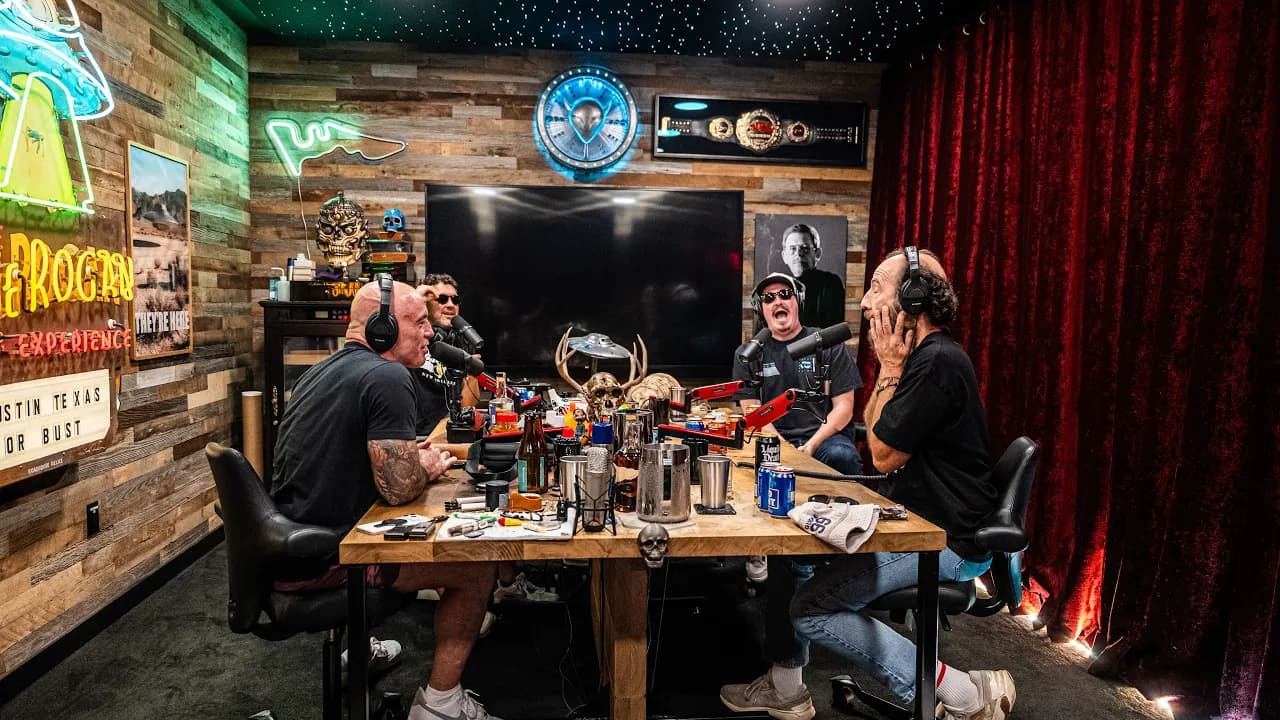
Joe Rogan Experience #2550 - Rick Springfield
In a Nutshell
Rick Springfield, at 77, maintains exceptional performance energy and health through consistent training, sauna therapy, cold plunges, and advanced stem cell treatments, crediting his longevity to loving his work and proactive medical monitoring. The conversation traces his path from Vietnam War performances in 1968-69 to writing "Jessie's Girl" at age 31 after a decade of industry struggles, revealing how DJ support—not record label strategy—ultimately made it a hit. Key insights include the irreplaceable role of live performance rituals in modern culture, the necessity of ego-driven ambition balanced with craft-focused execution, and how Britain's genetic mixing and intensive Hamburg club performances created the Beatles' mastery through volume rather than substances.
These notes were generated by AI and may contain inaccuracies.
The conversation begins with speculation about advanced alien civilizations and their potential methods of space travel. The hosts discuss how a species would need to survive long enough to develop faster-than-light or light-speed travel technology. They theorize that such civilizations might use propulsion systems that fold space and time rather than moving linearly through space. The wormhole theory is mentioned as a possible mechanism for connecting distant points and bypassing conventional travel limitations.
A key point raised is that the main challenge isn't the technology itself, but rather whether any species can survive long enough to achieve such capabilities. The hosts note that humanity is only beginning to approach this level of advancement. They also consider the possibility that alien civilizations may not have evolved in the same violent, competitive environment that drove human innovation, raising questions about what would motivate their technological development.
The hosts explore the theory that extraterrestrials might be monitoring humanity to ensure we successfully pass through an "adolescent phase" of evolution. They reference instances where UFOs have been reported hovering over nuclear bases, suggesting these beings may be concerned about our handling of dangerous technology.
Joe Rogan welcomes Rick Springfield to the podcast and expresses amazement at his physical condition and performance ability at age 77. Springfield explains that audience energy continues to fuel his passion for performing, making it difficult to become jaded about playing songs like "Jesse's Girl" that he's performed countless times. He notes that the live connection with audiences keeps the experience fresh and energizing.
Springfield describes his lifelong passion for music, which began when he first held a guitar at age 11. He started performing around age 15 with a school band but was eventually kicked out of 11th grade for not attending classes. During this period, he struggled with serious depression and found solace in reading horror writers like Robert Bloch and August Derleth while teaching himself guitar. These interests became his primary education after he stopped attending school.
Springfield's family moved frequently during his youth, living in Australia until age 10, then England until approximately age 13, before returning to Australia. In England, he discovered both girls and guitars, with Cliff Richard and the Shadows being a significant influence. At age 18, he participated in a band that toured Vietnam during 1968-1969, performing for American troops. The band was hired because they had female members who reminded soldiers of home, allowing them to tour from Cam Ranh Bay to the DMZ.
The band experienced intense combat situations while performing, including mortar attacks during shows and being shot at and rocketed. They befriended Navy personnel at Marble Mountain outside Da Nang and performed free shows for them. During one overnight stay, they took cover in perimeter bunkers during an attack, with Springfield positioned in a radio shack where he was instructed to throw mortars down a tube.
Springfield describes sleeping in hooches that were often rat-infested and dealing with constant fear during their four-month stay in Vietnam. The band members got stoned regularly, which helped manage the psychological stress of being in a war zone, though it sometimes intensified fear responses. He recalls bizarre encounters, including a soldier who, after watching their performance while heavily intoxicated, announced he was going "to go out and see what I can kill now."
Springfield reveals that during the attack on Marble Mountain, he threw approximately five or six mortars and was later informed that one had hit a Viet Cong fighter. He describes this as still being difficult to process, noting that while it occurred in wartime and he was acting without full understanding of the consequences, the responsibility for ending a life remains a "hard place to land" even decades later.
Upon returning home, Springfield's mother observed that he appeared "haunted" and would jump at sudden noises like car backfires. The band leader, Pete Watson, died at age 25 from a rare lung disease contracted during their time in Vietnam, possibly related to Agent Orange exposure. Springfield and other band members underwent medical examinations following Watson's death.
Springfield discusses how his songwriting themes have evolved with age. His early work, including the album Working Class Dog released when he was 29-30, focused primarily on themes of sexual relationships. His newer material addresses getting older and confronting mortality, though sexual themes remain present but less dominant. He notes that when he began his career, there were no 76-year-old rock stars, as rock music was considered exclusively a young person's domain.
The conversation examines how rock stars like Mick Jagger and Paul McCartney have defied expectations about aging performers. Jagger maintains an intense fitness regimen with two tractor-trailers full of gym equipment that travel with the Rolling Stones, allowing him to continue high-energy performances. Springfield observes that the live performance aspect of rock music creates a unique connection that differs from recorded music or acting, as audiences experience both the recorded work and the immediate live energy simultaneously.
Springfield and Rogan discuss how live concerts have replaced traditional communal experiences like church attendance. Unlike sports events that typically create opposing sides, concerts unite audiences in shared appreciation of the same performers and music, creating a powerful collective experience that feels almost drug-like in its intensity and emotional impact.
Performing for fans creates a uniquely positive exchange of energy. The job of musicians is to give audiences 90 minutes to 2 hours of freedom from daily problems. This experience is mutual—performers are also freed from their own mental chatter during shows. The average person will never experience the amount of positivity that performers give and receive on a normal night.
Art is created because artists have to create it, not because it needs to be liked. The ego wants art to be liked, and this ego drive is what gets artists into the business. Without ego and the desire for attention, most people wouldn't enter the industry. Many start from a place of feeling like an outcast seeking attention, hoping the spotlight will fill that hole—but it never does.
The smart approach is to transfer focus from wanting people to like you to putting all energy into the craft itself. Thinking about whether audiences will love something poisons the creative well. Once grounded in the experience, all energy should go into doing the best possible work rather than seeking attention.
"Jessie's Girl" was not Rick Springfield's first hit. His first hit was "Speak to the Sky," which reached number 10 in America and was also a hit in Canada. The song was written for his mother and had a country, "holy roller" style that was very different from what he later became known for.
After "Speak to the Sky," managers pushed him toward teen magazine press with headlines like "Cuddle Up With Rick" and "Is Rick Too Tall to Love?" This was not the music-focused press he wanted. He leaned into this teen idol image temporarily, but it led nowhere creatively. He was writing songs about serious topics like suicide and infidelity, but managers wanted material like "Cherish" and "Doesn't Somebody Want to Be Wanted."
Rick met Elvis on a plane while returning to Australia after visa issues. Elvis was flying first class while Rick was in the back. Elvis looked great—skinny, jet black hair, powder blue suit. Elvis did something unusual: before the plane landed in Hawaii for refueling, he walked back through the plane signing autographs and taking photos with everyone, rather than hiding behind sunglasses like most celebrities.
Rick mentioned his manager Steve Binder, who directed Elvis's 1968 comeback special. Elvis said he loved Steve. Rick asked Elvis to sign an autograph for his girlfriend Allison, which Elvis did. However, Australian customs confiscated Rick's tape recorder (suspecting it might contain pornography) and the Elvis autograph was stolen from inside it.
Elvis's relationship with Colonel Tom Parker was described as creepy. The Colonel was characterized as a clueless, weird, and jerk-like figure who enabled Elvis's pill problem, shielded people from him, and kept him isolated. The Colonel reportedly had Elvis perform in Vegas to pay off the Colonel's gambling debts.
Brian Epstein, the Beatles' manager, was noted as a rare positive example—a smart guy who cleaned up the band's image and had good intentions, even if he didn't fully know what he was doing.
One notable late-career performance was Elvis singing "Unchained Melody" while overweight in Vegas. Despite being clearly high, fat, and sweaty, when he started belting out the song, the magic came through. The performance demonstrated how live performance magic can transcend physical and drug-related deterioration.
Rick's father died at age 51 from a burst ulcer on a major stomach artery. He had avoided doctors because he feared cancer diagnosis. He died twice—his heart stopped for 15 minutes before being revived. After revival, he had the mental capacity of a 5-year-old and couldn't remember basic family relationships.
This experience motivated Rick to take proactive health measures. He works out 6 days a week, eats clean organic food, and does regular blood draws. He gets Prenuvo full-body MRI scans to monitor internal health rather than ignoring potential issues.
Rick started running in the early 1970s when it became popular. He would run 20 minutes out and 20 minutes back from tour buses, sometimes through questionable city areas. The band would return from tours in better shape than when they left, using gym time and clean living rather than drugs and alcohol.
He ran until about 15 years ago when his knees gave out. His wife introduced him to skincare routines, overcoming his initial embarrassment about men using skincare products.
Rick participates in a 4-year clinical trial with a company called BMI that uses his own cells. They take cell samples from behind his ear, grow the cells, extract growth serum, and create a facial treatment from his own growth factors. This differs from SkinMedica's approach, which uses newborn foreskins for growth factors.
He noted that as people age, their own cells become less effective, which is why younger stem cell sources like muse cells may work better than older autologous cells.
Rick has had bone marrow stem cells injected into his hips for joint issues from weightlifting. While effective, these don't work as well as newer muse cell technology. Some people travel to Saudi Arabia and Dubai for advanced stem cell treatments not available domestically.
Joe Rogan recommended Ways to Well clinic in Austin, which offers state-of-the-art stem cell technology, hyperbaric chambers, and red light therapy. Russell Crowe visits regularly for treatments.
Hyperbaric chambers show promise for improving sleep and recovery. A study from an Israeli university found that 60 sessions of 90 minutes over 90 days lengthened telomeres equivalent to a 20-year difference in biological age. The therapy creates a hyper-oxygenated environment that enhances recovery metrics on devices like Whoop straps or Oura rings.
Rick experiences sleep difficulties, waking every couple of hours and unable to sleep through the night. Finnish research following a large sample group over 20 years found that people using dry saunas 4 times per week for 20 minutes had a 40% decrease in all-cause mortality, including fewer strokes, cancer, and heart attacks.
The benefits come from heat shock proteins developed during heat exposure. Sauna also increases cardiovascular output similar to static cardio as heart rate rises in response to heat. Contrast therapy—alternating between sauna and cold water—is commonly used, with some having cold plunges at 34 degrees adjacent to saunas.
Cold exposure immediately after exercise blunts recovery and reduces hypertrophy because muscle growth depends on the inflammation that occurs during exercise. The body heals and strengthens after training, but cold exposure right after blunts that recovery process. Rick Springfield performs his cold plunge first thing in the morning before his workout, doing three minutes in the cold, then immediately begins mobility exercises outside to warm up and get his heart rate elevated. He performs his strength workout after this, then uses the sauna after completing his workout.
The endorphin release after cold exposure is significant. Norepinephrine and dopamine spike, creating a powerful feeling of well-being that Springfield describes as worth the discomfort. He notes that if a pill could replicate this feeling, it would be on every shelf. Beyond physical benefits, the practice builds mental toughness and discipline through the act of doing something you don't want to do routinely.
Springfield hates walking into the gym but loves walking out. This is a common experience where the hardest part is taking the first few steps to begin. Once started, the activity becomes easier. He maintains a home gym close by to eliminate excuses about distance or timing, though he prefers training at an actual gym facility.
Being on stage provides a similar endorphin hit to the cold plunge. However, Springfield notes you cannot rely on performance alone to feel good, as you cannot perform every day. Having positive practices in daily life alongside performance is valuable.
Springfield takes the IM8 all-in-one supplement. He uses creatine before workouts and protein after. Creatine provides mental benefits beyond physical performance, increasing cognitive performance and mitigating brain fog from sleep deprivation. Studies show it helps performance when sleep-deprived. Springfield takes 10 grams twice daily, morning and night, and brings it when traveling. He takes extra creatine when he knows he'll be tired from travel.
His diet consists of 80-90% meat with fermented vegetables. He occasionally eats sandwiches, pizza, or pasta but maintains mostly animal-based nutrition. Springfield does not eat chicken due to a childhood experience where he raised chickens as pets and then ate them. The smell of cooking chicken triggers a memory from age 30 that prevents him from consuming it. He does eat turkey, noting that turkeys are less intelligent than chickens and will drown by looking up at rain.
Wild turkeys have exceptional eyesight, making them difficult to hunt. Hunters must remain completely motionless, often wearing ghillie suits and sitting with their backs against trees. They use turkey decoys and box calls that make turkey sounds. Springfield hunted turkey once but prefers hunting mammals like deer or elk because they provide more food and better nutrition. Mammals are more nutrient-dense with higher iron and amino acid content.
Springfield has eaten kangaroo and ostrich. Australia has more camels than Arab states and significant kangaroo populations. The country has numerous invasive species including cane toads introduced to control rats in cane fields, rabbits brought by the English for food, and Asian water buffalo in the Northern Territory. Many animals in Australia are invasive rather than native.
Springfield became a US citizen 10-15 years ago. He jokes that one motivation was to be eligible for jury duty, though the real reason was tax considerations for estate planning between him and his wife. He has served on jury duty once and was dismissed when he mentioned being involved in his own lawsuit at the time.
The lawsuit, referred to as "buttgate," involved a woman claiming Springfield hit her with his rear end while interacting with the audience, causing her to fall and sustain brain injury. The case never reached a settlement figure. He was called to testify in New Jersey twice but fought the case rather than settling.
Springfield has lived in America since 1972, returning to Australia only to visit his mother who lived to 96. He became a citizen because his family, friends, and life are now in America. He attributes career longevity to loving what you do, noting that the energy from performance and passion for work sustains people like Mick Jagger and Keith Richards. Richards continues performing despite not following the health practices that Jagger maintains.
Springfield notes that many people choose jobs for retirement benefits rather than enjoyment. He considers himself fortunate to love his work, though he acknowledges luck played a role alongside preparation and hard work. He mentions that fear of success and fear of failing to succeed can prevent people from pursuing opportunities.
Beyond performing, Springfield writes novels, authored his autobiography, and is writing a book on his health and life practices. He considers himself a writer first and only began performing because no one would record his songs. His first band was Zoot, a four-piece group from 1969-1970. He arranged their version of "Eleanor Rigby," which was their first major hit in Australia. The band had a "Think Pink" theme where members wore pink outfits. Springfield pushed for heavier guitar-driven music inspired by Led Zeppelin.
The band received interest from EMI in America but split up before securing a deal. Springfield came to America while the bass player later formed Little River Band. A female writer who was a fan encouraged him to pursue a solo career rather than join another band, leading to his release of "Speak to the Sky," which became a hit and secured his American record deal.
The decade between 1959 and 1969 represents one of the most radical changes in culture and music in all of human history. The transformation from Buddy Holly to Jimi Hendrix exemplifies the most dramatic shift in rock and roll music. Multiple factors drove this change, including the psychedelic movement, the anti-war movement, and broader sociological shifts. Music serves as both a soundtrack to cultural events and a driver of what happens in society.
By 1969-1970, rock music had gained significant cultural weight after initially being considered disposable entertainment for kids. People who grew up with the music were now adults and continued to value it. Rock and roll music from the 1960s maintains a shelf life that exceeds anything that came after it, with songs like "Whole Lotta Love" still resonating powerfully today.
Jimmy Page wanted Terry Reid, an English singer, to be the vocalist for Led Zeppelin, but Reid declined because he had a touring commitment with the Rolling Stones. Instead, Reid recommended Robert Plant from a local pub band. Page discovered both Plant and John Bonham in that same small club setting. Bonham's drumming was unique not just technically, but sonically - his drum sound and laid-back yet precise feel distinguished him from other drummers.
Britain's outsized contribution to rock music includes the Beatles, the Rolling Stones, Led Zeppelin, and the Who. This phenomenon may stem from Britain's history as a collection point for genetic material from invaders including the Romans, Vikings, and Germans. Eric Clapton was born in the UK to Canadian parents. The English language also helped spread British music globally.
For decades, music flowed primarily from America to Britain and Australia, with little crossing back. The Beatles' breakthrough coincided with Kennedy's assassination, when Americans were looking away from domestic issues. The Beatles provided an escape through their mop-top image and great music. They became the first real super band, causing fans to faint and scream at concerts, similar to reactions previously seen with Frank Sinatra and even Mozart.
Elvis was probably the first super-famous individual whose level of fame was almost unsustainable for a human being, especially without any roadmap. Michael Jackson took fame to an unprecedented level. The Jackson 5 and the Beatles both started in 1964, with McCartney at 22 and Harrison at 21. The pressure and stress for Jackson was overwhelming - he couldn't go anywhere without being swarmed.
When Thriller came out, it was so massive that Boston's WCOZ "Rock of Boston" station played "Billie Jean" despite it not being rock and roll. MTV initially refused to play the video, stating they didn't play black artists. Atlantic Records executive Ahmed Ertegun threatened to pull all their artists unless MTV played "Billie Jean" within ten minutes. The Thriller video, featuring special effects by Rick Baker, was unprecedented in its production quality.
Elvis, the Beatles, and Michael Jackson are the three artists who absolutely transcend all others in terms of cultural impact. The Beatles wrote such a range of songs that there aren't many left to write. The fragmented modern music audience makes it difficult for any single artist to achieve the same unified cultural dominance, though Taylor Swift may be approaching that realm with her primarily young female following.
Rock and roll has faded from radio prominence, with the guitar becoming somewhat uncool after disco. While great rock music continues to be made, it's rarely heard on mainstream radio. FM radio was where big music was played in America, but current stations lack DJs with music selection control. The local FM rock station that plays at the mechanic's shop has no DJs making independent choices.
"Jessie's Girl" was released in 1981 when Springfield was 31 years old. The song became a hit through DJ support rather than being released as a single by the record company. DJs who liked the song started playing it, generating phone calls, which prompted the record company to officially release it. RCA was Springfield's label at the time, the same label as Elvis.
Springfield had visualized and manifested his success for so long that when it happened, it felt expected. Despite the teen magazine attention suggesting he lived in a mansion, he was actually living in a $180-a-month apartment in a seedy Hollywood area, eating TV dinners and collecting quarters from a piggy bank for milk.
Springfield took the General Hospital role because he needed the money - $500 per episode was significant income in 1980. Keith Olsen, who produced "Jessie's Girl," advised against it, but Springfield had four previous albums that hadn't succeeded. The Luke and Laura storyline made General Hospital the biggest soap opera ever.
Keith Olsen had previously worked with Sammy Hagar, Fleetwood Mac, Pat Benatar, and Foreigner. He produced Springfield's first album and removed clicks from the vocal tracks. The record company initially wasn't going to release Springfield's breakthrough album because they didn't know what to do with a guitar-based pop record during the disco era.
"I've Done Everything for You," written by Sammy Hagar, was the first single released because Hagar was a known quantity. When Olsen produced two songs for the album, he chose one of Springfield's originals ("Jessie's Girl") and brought in the Hagar song. Springfield was initially disappointed but recognized that Olsen knew what he was doing. The DJs' independent decision to play "Jessie's Girl" proved crucial to its success.
Without DJs like Wolfman Jack making independent music choices, there are no longer taste makers in radio. These DJs had personalities, knew music deeply, and could introduce listeners to new artists. Springfield knew all the Boston DJs like Mark Parenteau and Charles Laquidara when he was young. The pre-internet era relied on these personalities to learn about culture and discover new music.
Rick Springfield's uncle Vinnie worked for Howard Marks Advertising, the company responsible for all Kiss album covers. As a child around seven to twelve years old, Springfield visited his uncle's office and saw the album artwork before the general public. He met Ace Frehley without makeup, which he found surreal given the band's theatrical image. The album covers featured intricate artwork, and when opened, revealed additional interior artwork. The solo albums had each band member's image printed directly on the vinyl records themselves.
Springfield recalled having a photo taken with Ace Frehley after a gig. His drummer, for whom Kiss represented what the Beatles represented to others, had Ace sign a red Fernandez guitar. Springfield later pranked his drummer by having an identical guitar signed and smashing it on stage during a performance.
When Springfield's fame peaked in the early 1980s, he found the experience exciting but not shocking. He had anticipated success after ten years in the industry and channeled his energy into performing and writing rather than partying. He recalled receiving phone calls from DJs about rising record charts and feeling the momentum was overdue rather than unexpected.
He described an incident where approximately 4,000 fans surrounded a police car attempting to tip it over, noting his calm acceptance that this was simply what fame felt like.
Springfield's first experience of an audience recognizing opening chords occurred at the Beach Boys' Fourth of July show aboard the Queen Mary in Long Beach. As the opening act, his band began playing in D, and the crowd erupted. He recognized this as the feeling he had witnessed watching English bands perform in Australia during the 1960s, including the Rolling Stones, Beatles, Kinks, and The Who.
After the Beach Boys finished their set, Brian Wilson, a General Hospital fan, followed Springfield across the stage with his mouth open. Springfield also recounted meeting Sammy Davis Jr. on a red carpet for the "100 Stars" event, where Davis Jr. tugged on his jacket and expressed admiration for Springfield's soap opera work.
Approximately fifteen to twenty years ago, Springfield met Paul McCartney at an event. When McCartney asked what Springfield was promoting, he replied he was simply there to see McCartney. McCartney requested a photo, and Springfield jokingly asked for "10 quid" before they posed together. Springfield keeps this photograph.
Springfield owns an original cutout of H.G. Wells from the Sgt. Pepper's Lonely Hearts Club Band album cover, which Paul McCartney signed. Wells, one of Springfield's favorite authors known for political and science fiction writing including War of the Worlds, represents a connection between two of his heroes.
General Hospital achieved unprecedented cultural impact as a daytime soap opera, with viewership three times higher than today's most popular soaps. The Luke and Laura storyline, which began with a rape before evolving into a romantic relationship, captivated the nation. Elizabeth Taylor appeared on the show, and Springfield filmed scenes with her. During one scene, Taylor remarked, "Isn't acting stupid?"
The show reached 30 million viewers for Luke and Laura's wedding. Universities reportedly rearranged class schedules knowing students would skip to watch. Springfield joined the cast for six weeks initially, later returning for anniversary appearances.
Before appearing on General Hospital, Springfield lived in a small house in Montrose purchased with BMI advances. After two weeks on the show, strangers began recognizing him on the street—a level of recognition musicians typically achieved only after three albums in the pre-MTV era.
Production quality was notably low, with scripts sometimes handed to actors twenty minutes before shooting. Springfield became skilled at reading teleprompters while maintaining eye contact with scene partners, memorizing subsequent lines during takes. The show featured established actors including Doug Davidson as Paul Drake on The Young and the Restless.
Producers monitored audience phone calls to gauge reactions to storylines and characters. Gloria Monty, the producer credited with the show's success, worked with head writer Pat Falken Smith to refine scripts. Springfield was asked to perform "Jesse's Girl" on the show but initially declined, feeling he already had sufficient attention from his acting role.
During a cast party, actors including the professor from Gilligan's Island who played Springfield's father became intoxicated while filming a drinking scene, requiring reshoots the following day.
Springfield has written two novels exploring post-apocalyptic themes involving a plague that eliminates two-thirds of the world's population. "Magnificent Vibration" was published in 2014 and became a New York Times bestseller, followed by the sequel "World on Fire" in 2021. Both works employ dark humor.
He wrote his autobiography independently and has maintained an interest in writing since childhood, when essays were his strongest academic subject. He approaches song lyrics with deliberate revision, contrasting with the more instantaneous nature of musical composition.
Springfield writes on a computer and maintains original handwritten drafts of his songs, including "Jesse's Girl," stored in a closet. He collects Beatles memorabilia, particularly handwritten lyrics, sourced through a friend who authenticates items for Christie's and Sotheby's.
His collection includes the original handwritten lyrics to "Lucy in the Sky with Diamonds," which contains contributions from both John Lennon and Paul McCartney. The song originated from a painting Julian Lennon created of his school friend Lucy, which John Lennon adapted. Springfield also owns Paul McCartney's original drawing for the Sgt. Pepper's cover concept featuring the band in Victorian attire with curtains, as well as drawings of "rocking horse people."
Springfield referenced Malcolm Gladwell's "Outliers," which discusses how the Beatles achieved mastery through extensive performance volume in Hamburg, playing five to six hours nightly, six days a week for approximately two years. This intensive practice schedule created the tight musical unit that astonished audiences upon their return to Liverpool.
He compared this to Robert Johnson, whose sudden improvement in slide guitar technique after a period away from performing led to legends about selling his soul at the crossroads. Springfield emphasized that while substances may have influenced creative direction, they did not create talent—rather, they potentially removed inhibitions that might otherwise constrain artistic expression.
Paul McCartney became the bass player for the Beatles when Stuart Sutcliffe left the band after falling in love with Astrid, the woman who gave them their famous haircuts. Both John Lennon and George Harrison refused to play bass, leaving Paul to take on the instrument. He found the famous beetle bass in Germany, and a photo exists showing it leaning against the wall while he played piano at the strip club where they performed.
Rick Springfield reflects on how his 42-year marriage came together through a series of coincidental events. He was in Australia while his future wife was in Wisconsin. After moving between England, California, and Australia, they both ended up working at Sound City at the same time. She met an English woman who worked there and became friends, which led to her employment at the studio where Rick met her.
Rick emphasizes that luck occurs when you stay in the game. Success requires being ready when opportunities arise, which means practicing your craft, being competent, having something to offer, and believing in yourself enough to perform when the moment presents itself.
Rick played with his back to the audience for the first three months of his first band experience. He was 15 years old in a blues band with members who were 25 and had been in prison. The band members were rough types who would fight at pubs on weekends, and Rick was shy being the youngest member. His mother explained to the band that he was probably shy, and they accepted this explanation until he eventually turned around.
Rick wrote "Jesse's Girl" after taking a stained glass class while between record deals. He was trying to support his family by making things with his hands, including clay mirrors. At the class, he saw a woman he found attractive who had a boyfriend named Gary. When he tried to chat with her, she wasn't interested. He went home and wrote a song about her, first trying Gary as the name but it didn't work, then trying Randy which also didn't work, finally settling on Jesse.
Oprah's team searched for the woman who inspired the song as part of a segment on the women behind famous songs. They found the stained glass instructor, but he had died two years before and all the paperwork had been thrown out a year after his death. No one has ever come forward claiming to be the subject of the song.
Joe Rogan concludes the interview by praising Rick Springfield's continued energy and performance ability, noting the viral video of him performing "Jesse's Girl" shirtless. Rick mentions that the song was written closer to the end of World War II than to the present day.
Keep PowerfulJRE in your library
Save the videos and channels worth coming back to, and find them again in one place.