Left Behind; South Africa's Refugees; Is That Art? | 60 Minutes Full Episodes
These notes were generated by AI and may contain inaccuracies.
Drive 350 miles from the nation's capital to McDowell County, West Virginia, where affordability is the difference between buying groceries and heating a home. Clean drinking water is hard to come by here. A turn of the tap can look like this. This shouldn't be the case anywhere in the world, let alone in the wealthiest nation in the world.
There is one group of refugees being welcomed to the United States. President Trump says white farmers from South Africa are victims of a genocide.
These are burial sites right here. Burial sites over a thousand of white farmers. We went to South Africa to see for ourselves. It definitely wasn't a burial site. I mean, those crosses were there for less than 48 hours. Rafik Anadol invited us inside this space at his LA studio. Every image that surrounds us, Anadol created using artificial intelligence. So, those are not real birds. Nope. Take it in. Whoa. A hypnotic flow of shapes and colors that can make you feel like Alice in Wonderland stumbled into Studio 54. Is this a party trick? I don't think so. I feel like it's a new form of art.
For some, these are the boom times. 401ks are surging. The stock market has hit an all-time high. But drive just 350 miles from the nation's capital. And the conversation isn't about how to get rich, but how to survive. McDowell County, West Virginia, was once the nation's largest coal producer. It is now one of the poorest places in the country, where the food stamp program started and later the opioid crisis took hold. Today, one in three households there depends on those food stamps. And now the program that has fed families for decades is facing the largest cuts in history. We went to McDowell County last month and learned that this is an all too familiar pattern. Government help comes and goes. Promises are made and broken and the people are left behind. McDowell County sits deep in the southern coal fields of West Virginia, stretching more than 500 square miles across the Appalachian Mountains. There's just one traffic light and more churches than we could count. It's a place where clean drinking water is hard to come by. A turn of the tap can look like this.
I think if you would ask probably nine out of 10 individuals here, they would tell you that they feel very much forgotten. By who? Everybody, the government, every institution that you can think of.
Pastor Brad Davis grew up in the coal fields just over the county line and now leads congregations at five United Methodist Churches in McDowell. He spends his days listening to those who trust God, each other, and not much else.
I've heard directly people say, "Well, why don't people just move?" And my response to that is, "Why should we? Why should we have to move? This is home."
Now, we're coming into Anawalt.
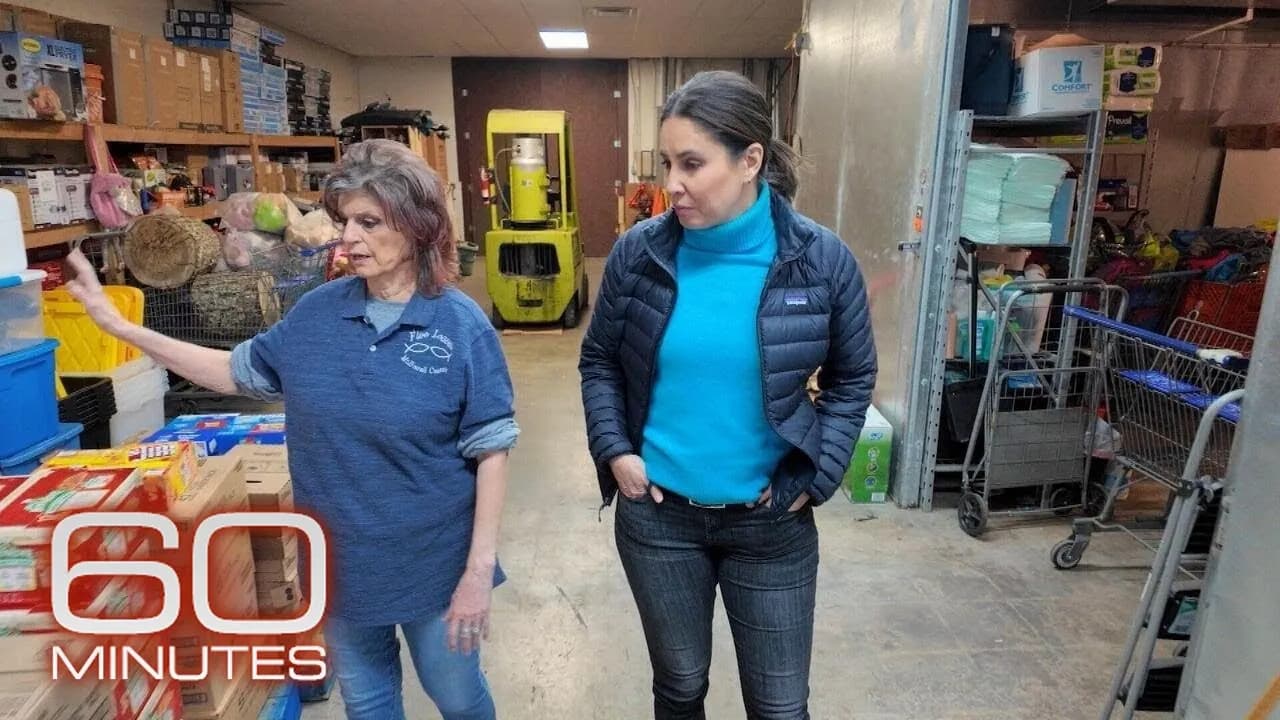
Home sweet home. Home. Betty Stepp has lived in the town of Anawalt for all of her 76 years. Long enough to remember when there was still a school, a theater, and a doctor. If you run out of milk, you got to drive how far? 45 minutes. 45 minutes. Two mountains. That's if you can afford a car. Many here can't. Yet, the only business left in town is Tom and Donald's mechanic shop. This is Tom. Hi. How you doing? How are you? Donald, the famous Donald. Donald and Tom are beloved by all the widows in this area. A retired teacher's aide, Betty and her husband live on a fixed income. These days, everything feels expensive. If I go to the grocery store, I can't get out of there in less than $200. And that is that's a week. Sometimes it's $300. Groceries are really high. What have you had to cut back on in these times? Beef for sure. I cut back on chicken, vegetables. She's not alone. Across the country, families are feeling the squeeze. Food prices are almost 20% higher today than in 2022.
I've heard a lot of folks from this community say,
"If we don't help each other, no one's going to help us." Nobody's going to come and save us. We saved each other. Linda McKinney runs the county's largest food bank, entirely on donations and volunteers since the government shutdown this past fall when Americans around the country lost SNAP benefits or food stamps for weeks. Linda says more new faces have been coming in. Lately, we have a lot of young mothers that come and they'll say, "I never thought I'd have to come." And the children is what breaks my heart. They didn't ask to be brought into this situation and they suffer daily. Every weekend, more than 100 children receive backpacks filled with food so they have something to eat when they're not in school. The thing that we're finding, we have parents that say, "Well, my kid didn't get a snack bag." And then you find out the child on Friday is eating that food on the bus. They're hungry. They're so hungry. The food that's supposed to last them through the weekend, they're eating on the bus. They're eating on the bus.
It's a tale of two economies. At the White House, you'll hear about job growth and victory over inflation.
We just had fantastic reports on inflation way down. But in McDowell, the median household income is about $30,000. Affordability isn't a buzzword here. It's the difference between buying groceries or paying for heat. In the 1940s, McDowell County was rich in coal jobs. These mines powered America, helping to build railroads and cities. At its peak, nearly 100,000 people lived here, earning some of the nation's highest hourly wages. But as machines moved in, mining jobs dwindled and the local economy collapsed. In 1960, John F. Kennedy campaigned for president here. I think there are at least four or five things the government can do. The poverty he witnessed led him to launch the modern food stamp program. McDowell County residents were the first recipients. Today in McDowell, there are fewer than a thousand coal jobs left and only 17,000 people remain.
We lack so much. We lack jobs. Just in the county alone, there is not enough jobs for everyone. 26-year-old Tabitha Collins was a stay-at-home mom until her fiance was hit by a car on the job last year and left disabled.
And how often are you here? I'm here 5 days a week. She works at a local nonprofit, Big Creek People in Action and is the sole income earner for her family of six. Along with caring for their toddler, she's also helping to raise her fiance's three younger siblings. It's up to you to raise these kids in a decent manner, you know, and try to teach them about the drug epidemic and how it can affect others. Because that's a lot of what we struggle with in a county ravaged by opioids. It's a common story. The epidemic claimed a generation of parents, leaving family members like Tabitha raising more children on less. Even with food stamps, she often comes up short. We still struggle food wise. I still have to take a lot out of my payday, which therefore doesn't go towards bills. And in the winter time, our power is very high. You live in paycheck to paycheck? Yes. And when you say the electrical bills were high, how high are we talking? In the month of December, my electrical bill was $480. You got a shut off notice. We sure did. I mean, it was scary. I was trying to figure out which bill is more important, you know, and it comes down to that.
That choice is about to become more difficult. SNAP and Medicaid benefits are facing the biggest federal funding cuts in history, more than a trillion dollars over the next decade as a result of President Trump's sweeping domestic policy bill passed last year. It will be up to states to pick up more of the costs and recipients will face stricter work requirements. Tens of thousands of West Virginians will likely lose benefits.
We rely on the benefits very much and it's not because we're taking advantage of the government. It's because we actually need these things. I wonder if you think that that's what the perception is that some people have. I do, but I don't believe that. I mean, we are a lot of us are working citizens and we're still barely making it by. Outsiders are often quick to assume this is Trump country, but politics here defy easy labels. For decades, McDowell voted blue, backing Barack Obama in 2008 and Bernie Sanders in the 2016 presidential primary. In the last three elections, President Trump won the county, which had the lowest voter participation in the state. I think we as a community collectively are so desperate to see some sort of change that when someone comes along and says, "I'm going to make coal great again," we desperately cling to that with a death grip. And I think that goes a long way in explaining why the political climate here has shifted the way it has. Earlier this month, coal executives and miners handed President Trump a trophy, declaring him the quote undisputed champion of beautiful, clean coal after his latest executive order aimed at boosting the coal industry. In McDowell, whether from the White House or the state house, they've heard it all before. What are the promises that have been made and not kept? Economic resurgence, renaissance of the coal industry, the elimination of poverty, fixing our water systems. Big promises. Big promises. And nothing ever changes.
Nowhere is the failure of government more clear than in the county's water supply, which at times is not clear at all. Few trust that it's safe enough to drink, and angry residents have documented the black and brown that oozes from aging pipes and contamination left behind from the coal industry. West Virginia's governor recently set aside $8.3 million in federal funds to upgrade sewage and water lines in McDowell. A drop in the bucket compared to what county and state officials say is still needed.
This is tap water. When Pastor Brad isn't in church, he's often pleading with politicians to do more. You see this as a public health crisis? Absolutely. There are people in parts of this county who haven't taken a hot shower in 6 years or longer because the fumes from the water makes them physically ill. Reports of skin rashes and burns are not uncommon. Many families spend upwards of $150 a month for bottled water on top of their water bills. It's a luxury not everyone can afford. So they fill up here at this old mine shaft shooting water from the side of a mountain. I think it's going to be hard for a lot of folks to get their mind around that. You've got American citizens getting a ride to a spring on the side of a road to bring a jug to fill up because that's their only access to water. And it should be hard for people to wrap their minds around because this shouldn't be the case. This shouldn't be the case anywhere in the world, let alone in the wealthiest nation in the world. To ease the burden, Betty Stepp and other retirees, the youngest of whom is 70, go door-to-door delivering heavy cases of water to neighbors. I think our government needs to hear us. We've worked our whole life here. Why won't they help us? Does it matter who's in charge? It doesn't matter if it's Republicans or Democrats. It doesn't matter. In McDowell County, people face two choices. Stay and scrape by or scrape together enough money to leave. Tabitha Collins is staying. You're 26 years old and you're raising four kids. That's a lot of responsibility. It's a lot. I don't know how I get through it, but I do. I just want to live the dream like anyone else does. you know, have a family, have a home, and not stress about the hardships that we have around here. Parishioners have told you that they feel like they're tired of living in what feels like a third world country. And that's a direct quote. What do you say to someone who says that to you? Amen. Amen. Cuz I'm tired of it, too. It's gone on long enough.
In November, President Trump announced he would quote, "permanently pause migration from all third world countries to the US after a member of the National Guard was killed and another badly wounded in Washington, allegedly by an Afghan refugee. But there is one group of refugees the Trump administration is welcoming. It's expediting the resettlement of white South Africans, mostly Afrikaners who are descendants of Dutch settlers. President Trump says that white farmers are victims of a genocide. The South African government disputes that. We went to South Africa to see for ourselves. In the rolling hills of KwaZulu-Natal Province in the southeast of South Africa, we met Daryl Brown, a 7th generation rancher and farmer.
Did you grow up knowing you would be a farmer? It was always in my blood. It's a calling. But that calling has often come with risks. 10 years ago, his 82-year-old father was brutally attacked on the farm by robbers looking for guns and money. Then in 2020, Brown's friends Glenn and Vita Rafferty were murdered in a robbery on their farm nearby. Your father was attacked. You've had friends murdered. Do you live in fear? I certainly live carefully. We aware of what's happening around us. We don't take silly chances. We came to Daryl Brown's farm because of what President Trump said last May about the murders of South African farmers. It's a genocide that's taking place that you people don't want to write about, but it's a terrible thing that's taking place and farmers are being killed. They happen to be white. Nine days later, South Africa's president Ramaphosa came to the White House. Elon Musk, who was born in South Africa and has also made claims of genocide, was there too. What happened next seemed to take Ramaphosa by surprise. Excuse me, turn the lights down. President Trump showed several videos. Proof, the White House said, of the violence targeting white farmers. These are burial sites right here. Burial sites. over a thousand of white farmers. We found the spot where those white crosses were once planted. It's a lonely pothole road not far from Daryl Brown's ranch. It definitely wasn't a burial site. I mean, those crosses were there for less than 48 hours. It was purely an avenue of crosses that we planted there in honor of commercial farmers in South Africa that had lost their lives. Brown knows about the crosses because he put them there on the day of his friends Glenn and Vita Rafferty's funeral. He keeps them locked in a shed. In 2024, he brought them out again for the funeral of his best friend, Toli Nell, who was also murdered on his farm. Toli's wife, Renee, still lives there. Her husband was killed in front of her trying to fight off burglars. Her son Tinus was tied up while they stole cash and guns. No one has been arrested. My life has changed. I've got nothing to look forward to. Tinus now runs the farm. He carries a weapon with him almost all the time. The only time I don't have it on me is when I'm in the shower. Really? Cuz I don't ever want another situation to arise where I feel that I'm a victim. The Nells have hired private security guards and fortified their property with electric fences and cameras. Many in South Africa feel they can't rely on the country's ineffective and overwhelmed police to keep them safe. When you heard President Trump talk about a genocide, what did you think? Well, I just thought he was using the wrong word. In your opinion, it's not a genocide here. Not what I know as a genocide. Not what I've heard of what a genocide is. I see our attack as a opportunistic attack. They knew there was money. They knew there were firearms. Whites make up only about 7% of the population of South Africa, but still own 72% of all privately held agricultural land and many of the country's large commercial farms. But according to Wandile Sihlobo, a leading agricultural economist, the overwhelming number of farmers and those working on farms are black. The white farmers may have a bigger part of the proportion of income, but the vast majority of people operating the farms in South Africa are black. There is crime on farms. There are murders on farms. They affect black farmers as well as white farmers. They affect black farmers as well as white farmers and also farm workers who are largely black.
Nlala Zuma farmed this 9-acre plot for 20 years. He was used to having equipment stolen, but in 2024, a group of men shot at him and broke into his house.
Did you think at the time they were going to kill you? 100%. After the attack, he decided to sell the farm. There are a lot of black farmers that are attacked and the voices are not out. People don't pay attention. It's just another number, not a statistic. South Africa is one of the most dangerous countries in the world. The murder rate is 7 times that of the United States, and the majority of victims and perpetrators are black. According to police, more than 25,000 people were murdered here in 2024. It's estimated 37 of them were killed on farms. 37 out of 25,000. For us as farmers, that 37 is too much. Johan Kotze is an Afrikaner who's head of South Africa's largest agricultural organization. It's actually not about white genocide. It's about criminality in South Africa. That's what's happening on farms. It's what's happening in streets in Johannesburg and other major cities. It's crime. It's crime. The fact that it happened on a farm doesn't make me special as a farmer. It's horrendous. Any murder is horrendous. South African police only began publishing the race of those murdered on farms under pressure last year. In the first quarter of 2025, they reported six farm homicides. Five of the victims were black. Poverty is the biggest driver of crime in South Africa. And how do you solve that? South Africa remains one of the world's most economically unequal countries. 44% of blacks here live in poverty compared to 1% of whites. Kotze went to Washington last February to talk with administration officials about the economic problems here. He was surprised by what they focused on. They ask us about the white genocide and the first thing I said is how Afrikaners is what you can get. I grew up Afrikaner and I never witnessed that. South Africa's 2.7 million Afrikaners descend from Dutch settlers who arrived on the continent 400 years ago. Every year they celebrate their culture and language in the shadow of the Voortrekker monument which was built as a symbol of Afrikaner nationalism. Millions of black South Africans were forcibly evicted from their land and lost their rights to it by law in 1913. When Afrikaners took power in 1948, they instituted apartheid, a brutal system of racial segregation and discrimination. Blacks had virtually no rights and laws restricted where they could live and work. That all changed in 1994 when black South Africans were allowed to vote and elected Nelson Mandela. God bless Africa. In the decades since, there has been progress, a growing black middle class, and a reduction in poverty. But some controversial government efforts to redress inequalities have been plagued by graft and cronyism.
White supremacists in the US and elsewhere have long portrayed Afrikaners as victims of discrimination and worse genocide. But those claims didn't go mainstream until 2018 when then Fox News host Tucker Carlson began alleging Afrikaner farmers were being killed and having their land seized.
an embattled minority of farmers, mostly Afrikaans speaking, is being targeted in a wave of barbaric and horrifying murders. President Trump then tagged Tucker Carlson in a tweet, saying there were large-scale killings of farmers in South Africa, and the government was now seizing land from white farmers. Are there large-scale killings of farmers and is the government seizing land? They are. It is not happening. Donald Trump was fed this information. This link farm murders, genocide. There is no such a thing. Max de Vries is a prominent Afrikaans journalist and former newspaper editor. Are you the victim of unjust discrimination? I've never been discriminated against and I'm a loudmouth citizen because I'm a journalist. So I express myself very strongly also against this inept corrupt government. Discrimination is outlawed under South Africa's constitution which also protects property rights and due process. But in January last year, the South African Parliament approved a land expropriation act which critics say violates that constitution. The government compares the expropriation act to eminent domain in the United States which allows it to buy private land for public use. What's different is that South Africa's Expropriation Act could in some cases allow the government to take land without compensation and not just for public use, but to redress past discriminatory laws. Land owners have the right to fight back in court, but that might take years. The Expropriation Act isn't in effect yet and it's being challenged in court by South Africa's second largest political party and by Kallie Kriel the CEO of the AfriForum rights group who's repeatedly traveled with others to Washington to lobby for support. There is a serious threat to property rights. There is a serious threat to the lives of farmers and that needs to be recognized. Are white farmers being killed for their land? Yes. I believe so. Is there a white genocide going on in South Africa? We've never used the term white genocide. We saying there are tortures. People are being murdered. We are sing a call for genocide. Shoot to kill. Kill the Boer. Kill the farmer. The call for genocide Kriel is talking about is this song. Kill the Boer, kill the farmer, which President Trump played a video of in the Oval Office in May. In the 1980s and 90s, it was sung at protests against apartheid and is still used at rallies by the man singing, Julius Malema, a racebaiting opposition politician who wants the government to seize white-owned land. You know what the rhetoric is? is that we hear the same people that chant kill the Boer used the narratives to try and portray Afrikaners and farmers as thieves. Has any farmer had their land taken in the last 30 years of black rule here in this country without compensation or without having redressed through court? Because the legislation did not allow it. The new legislation allows it. President Trump cited the Expropriation Act in his executive order last February, cutting off all aid to South Africa and allowing for the resettlement of Afrikaner refugees, escaping government sponsored race-based discrimination. The first group of 59 Afrikaner refugees arrived in May. Now almost 2,000 are here. Did you ever imagine that virtually the only group of refugees going to be allowed in the US would be white Afrikaners? That shows up the complete absurdity of this Afrikaner refugee thing because they're saying these white Afrikaner refugees, their lives are more important than the bona fide refugees from everywhere else in the world that wants to come there. They're saying white lives are worth more than other lives. Remember Daryl Brown, the farmer who organized the protests with the White Crosses? He says he won't be packing his bags to become a refugee in America anytime soon. I'm an African. I've been burnt by the African sun and I'm not going anywhere. There's a lot of sun in Florida. I'm very positive about South Africa. This is my home.
When you think about the way art is created, you might imagine painters, photographers, or sculptors immersed in their work at their studios. But what about a person sitting in front of a computer screen using artificial intelligence and data to create visuals? Is that art? It's a question that is being asked and answered by some of the most prestigious museums, critics, and auction houses in the world. Some artists call AI a revolutionary new medium. Others call it theft. We wanted to see it for ourselves, so we went to Los Angeles to meet Refik Anadol. The 40-year-old Turkish American artist is considered a pioneer in the world of AI art. If you're wondering what that world looks like, grab your Dramamine.
This is Whoa. Refik Anadol invited us inside this space at his LA studio. Every image that surrounds us, Anadol created using artificial intelligence. So, those are not real birds.
A hypnotic flow of shapes and colors morph and evolve in mirrors and LED screens. It feels like Alice in Wonderland stumbled into Studio 54. A device around the neck pumps out AI-generated scents such as rain and flowers. Eventually, another device will monitor viewers' vital statistics like heartbeat, using that data to change the art in real time.
I don't think so. I feel like it's a new form of art like we are discovering a new place that never been before.
Rafi Anidol's massive mindbending images have been stretched across the Sphere in Las Vegas, the facade of the Walt Disney Concert Hall in Los Angeles, and Antonio Gaudi's Casa Batllo in Barcelona.
When people ask you what you do, what do you say? So, I'm a media artist and I'm using data and AI in my work. More than 16 years I paint with a thinking brush.
Thinking brush: Information and data around us has its own voice. Anidol imagines geometrically in his mind's eye, even if he doesn't draw traditionally.
To create art, Anidol uses data like 200 million photos of Earth from NASA. Data doesn't need to dry; it can move in any shape, form, color, and texture.
It is trippy because I think as artists we ask, what is beyond reality? We can connect this one to another one.
Using a gaming controller, Anidol controls a new algorithm. His team curated 153 million images for a piece on California landscapes. Images are converted into data points representing color, texture, and shape, plotted into multi-dimensional space. AI learns from this to create new versions from prompts. Images exist only in the mind of a machine.
This isn't a real place. This is not. This is AI dreaming this world. And now we are reshaping this world together.
Special algorithms blend images into Anidol's fluid style.
Are you a computer programmer or are you an artist? I am an artist, but I love computers. But now with AI, I feel like I have now program it in a way that I never imagined before. How much of this is driven by you and how much by the machine? I try my very best last 10 years to make a 50% machine 50% human.
Treating AI as a co-creator. Teamed up with Google, MIT, and Microsoft for large public installations. Sold pieces for upwards of $1 million at auction. Exhibited at museums worldwide.
In 2022, Museum of Modern Art New York commissioned Unsupervised, a colossal 24ft high installation filling the MoMA lobby. Trained on publicly available metadata of the entire MoMA collection (digital DNA describing and identifying art). Algorithms allowed data from one object to evolve into another, creating never-before-seen objects.
It was a utter extraordinary hit. People sat in front of it for hours, literally transfixed by what they were seeing. It's an amazing painting.
Glenn Lowry, MoMA director for three decades (retired September), noted it became one of the most popular images in the collection. Typical museum visitors spend 28 seconds on great works; for Unsupervised, 38 minutes.
Jerry Saltz, Pulitzer Prize-winning art critic for New York Magazine:
It's like a giant lava lamp that you can't take your eyes off of. It's like an Etch A Sketch... a half million dollar screen saver splashing into.
Popularity is not the sign of success. How long you spend with a work of art is not a sign of success so much as your willingness to get quiet within yourself. Go to uncomfortable places... In front of a Rafi Anidol, you sit down, go into a stupor and you don't have to think much... Renoir morphing into Picasso, morphing into an amoeba. It's something to look at. Is it art?
AI is art. AI will be art. But AI is one day old... Most of what you see in AI, Sharon, is crap. 90% crap. But 90% of the art made during the Renaissance was also crap. Things take time.
Glenn Lowry: Skepticism around AI mirrors reaction to photography 200 years ago, when human hand was removed from image-making. Can't stop technology.
Molly Crabapple, New York-based artist and author:
You've called this the greatest art heist in history. Yes. When we talk about art heist, typically we're talking about one painting being taken from a museum, two, three. They stole billions and billions of images.
Museums, galleries, auction houses shouldn't buy or display AI art trained on other artists' work without consent. Popular AI image generators are corporate plagiarism bots trained on art scraped from the web, including hers. Example: Crabapple's illustration of Aleppo, Syria. AI prompted for "Syrian skyline in the style of Molly Crabapple" produced strikingly similar image in seconds.
Did anyone ever ask you, hey, can we feed your images into this system? Certainly not. No artist has been asked for their consent. No artist has received compensation. In fact, we don't even see credit.
AI companies claim fair use; AI studies like a human. Artists filed class action lawsuit against four AI companies for copyright infringement. Anidol agrees it's theft but uses only his own data since 2020, ethically sourced datasets with permission and known origins.
Anidol building 20,000 square foot museum dedicated to AI arts in downtown Los Angeles called Dataland.
There are some people that say AI can never truly create art because it lacks emotion, it lacks lived experience and it lacks intent. Yes, these are all true. That's why I believe human machine collaboration. We are really completing that bridge... celebrate this new age of imagination.
Get immersed in Anadol's AI work at 60minutesovertime.com.
Last minute sponsored by United Healthcare.
Mike Eruzione, captain of 1980 US Olympic hockey team, scored game-winning goal against Soviet Union for greatest upset in American sports history. Reflecting 46 years later:
The lesson that our team showed in 1980 by winning an Olympic gold medal, by beating the Soviets, a team that nobody in the world thought we could beat, is a great example of what makes our country so great. Herb Brooks, our coach, called us a lunch pail hard hat group of guys... If you believe in something and you're willing to work for it, you can accomplish it.
In 1980, America needed something to feel good about; people still remember where they were.
I'm Cecilia Vega. We'll be back next week with another edition of 60 Minutes.
Keep 60 Minutes in your library
Save the videos and channels worth coming back to, and find them again in one place.