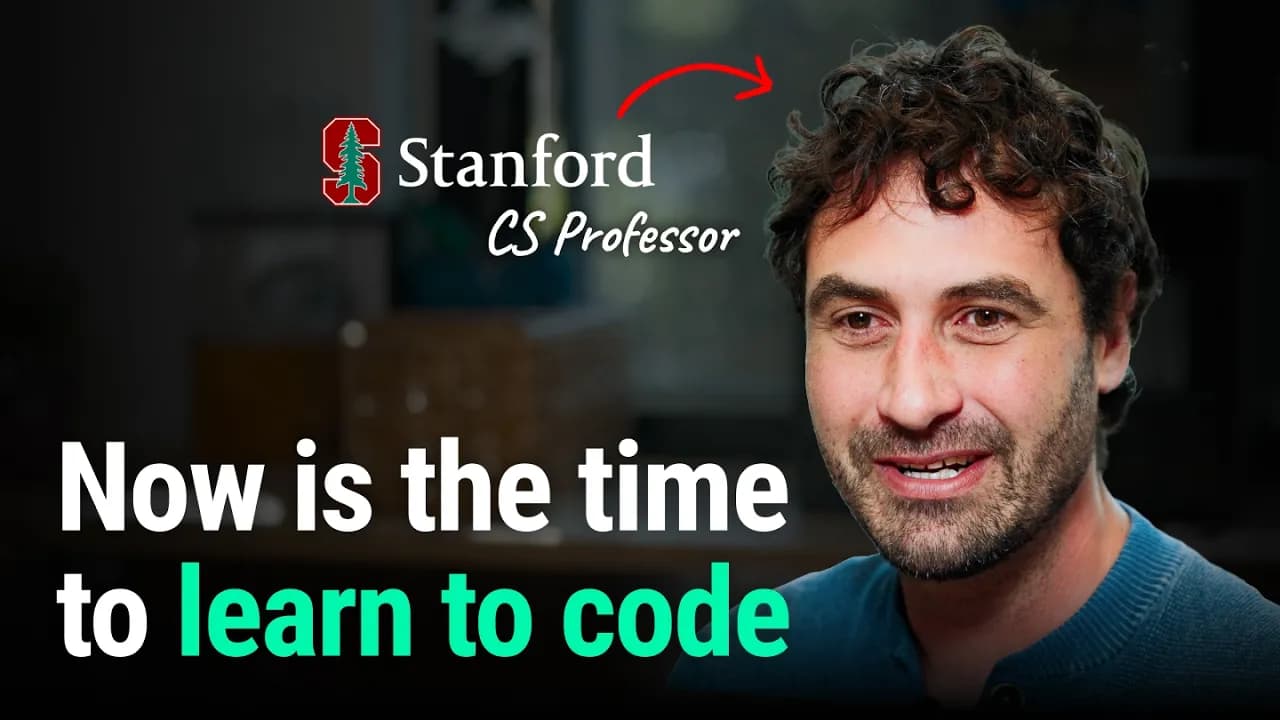
Legendary Chef Jacques Pépin — The Pursuit of Mastery, Meeting Julia Child, and More
In a Nutshell
Jacques Pépin emphasizes that mastery comes from distilling cooking into universal basic techniques—like boiling an egg or peeling a carrot—rather than memorizing full recipes, allowing anyone to build confidence and adaptability across cuisines. His career trajectory—from cooking for French presidents to mass-producing recipes at Howard Johnson and teaching marginalized communities—demonstrates how practical skill-building, frugal resource use, and generosity in knowledge-sharing create both professional excellence and personal fulfillment. He advocates learning by following recipes twice to establish a reference, then improvising, while viewing the kitchen as an equalizing space where technique trumps background.
These notes were generated by AI and may contain inaccuracies.
Helen McCauley would talk to James Beard every day for hours. She was very immersed in New York's culinary elite circles. At one point, she called Jacques Pépin and said, "You know what? That lady is here. She has a book and sent it to me, and she's coming to New York next week, would you like me to cook for her at my apartment?" Pépin said, "Absolutely." Helen said, "She is a very tall woman and has a terrible voice." That was Julia Child. Pépin met Julia there and they became friends. They spoke more French than English. Her French was better than his English at that time.
Filming started in the house during the pandemic. There were 300,000 followers before the pandemic and reached about two million followers. They were filming about 10 to 12 episodes a day, each 3, 4 or 5 minutes long.
Preparation is very important, but it should be invisible in a sense. To make it seem natural, which it actually is. Pépin makes sure the components are in the right place. He visualizes in his head what he's going to do with the recipe, what comes next, what he needs next. For his PBS shows, he would take the photographers on a tour through the program and say, "I'm going to start with B1, which is the first stove. I put something here and something there." He would go through the whole program with about three, four, or five recipes. He doesn't have great memory. He thinks in his head, "I'm going to put that on the stove. It'll take a minute or so, so I can open the oven and put that in." During that time, he can work while cooking, following the recipe itself, instead of relying on memory.
Pépin has been involved with painting for many years. "Fringe of the wood" and "Fleur" are two pieces the interviewer particularly likes. There are parallels between cooking and painting. Cooking came long before painting. Often, like with a recipe, you have to taste all the time. If you put A and B together, taste and adjust, taste and adjust, keep building the recipe until it's good. With painting, especially if working on something more abstract, you start with one or two colors, react to the color of the painting itself, add something, add something else until you're happy with it. If you're happy, you stop there. Pépin is probably better at cooking than painting, but he's been doing painting for less time.
Pépin was a chef to three French heads of state and never gave an interview to a magazine or newspaper. At that time, a chef was definitely at the bottom of the social ladder. He worked in Paris in palaces like Maxim's and Fouquet's. He was drafted into the navy during the Algerian War. He was supposed to go to Algeria, but they sent him back to Paris because his brother was already in Algeria. He ended up being a naval officer in Paris and started cooking for the officers there. A friend who worked for the Minister of the Treasury asked him to come help prepare dinner. He started working there. Under the Fourth Republic, governments changed fairly quickly. He ended up with one of the heads of the treasury, and when the government changed, that person became Prime Minister of France. Pépin was there under three different presidents. The one he started with, Félix Gaillard, was there for six and a half months. He eventually got to de Gaulle and stayed with him, organizing state dinners. He survived the World Air Route to Macmillan. He never had an audience. He worked with Madame de Gaulle to coordinate weekly dinners for the family. When it came to state banquets, people would come from outside to advise them.
Cooking for heads of state was more focused. You're concentrating on one person and the kind of things they want to eat. On one hand, it's easier or more complicated depending on how you look at it. Pépin felt relatively comfortable in that role. They usually cooked dinner for 4, 6, 8, or 10 people. Twenty-five was the maximum he ever did. If they had very large events with more than 100 or 200 people, another organization would come in.
Pépin's mother could cook with almost nothing, which shaped his style of frugal cooking. His mother never threw anything away in the refrigerator. That became his motto too. "Fridge soup" is one of the best examples. They would open the fridge and find a wilted salad, an onion that's been there for weeks. They'd take all that with water and salt, put it in a pot to make soup. She called it fridge soup, which they'd make and finish with some pasta or rice, or nothing at all. His mother had a small restaurant and cooked that way. She didn't have a refrigerator in the modern sense, but rather a fridge with an ice cube back then. She would buy meat and have to use it within a couple of days. All women in his family in France had small restaurants or cooked that way. Even when he was with the president in France, his aunt in Notre-Dame kicked him out of her kitchen because he used too much butter.
Pépin was offered a job cooking at the White House for John F. Kennedy but took a job at Howard Johnson instead. He initially worked in Paris for several years. He loved America at the time, jazz and all that. He wasn't married. He decided to go to America for a year or two to explore New York. He came on a student boat. He met one of the teachers who spoke French and asked for advice on improving his English. The teacher recommended Columbia University. He came courtesy of a small restaurant called La Tour Blanche. The owner met him in Paris and said if he wanted to come, he could. At that time, it was very easy for the French to come. He got his passport within a few weeks. He came thinking he would stay for a year or two. The restaurant didn't have a job but said they had a friend at Le Pavillon, the best restaurant in New York, and they needed people like him. He started working at Le Pavillon with Pierre Frani. After a few months, there was a falling out with the staff and the union and with Pierre, and the restaurant was about to close. At the same time, Howard D. Johnson Sr. was a customer at Le Pavillon. He contacted Pierre and said, "Can you come and work with me?" Pierre said he didn't know, he'd never done that before, but maybe. When Pépin heard that, he said, "Can I go with you too?" He ended up going with Pierre to Howard Johnson.
Howard Johnson was a completely different business. They got a free pass from Mr. Johnson to do pretty much whatever they wanted. In the test kitchen, they'd start with three chickens, boil them, then take them out to make a creamy chicken sauce, and end up with 3,000 pounds of chicken in a 1,000-gallon boiler. He had never written a recipe before, so he started doing that. It was a completely different world, the world of production. He ended up spending 10 years at Howard Johnson. He learned a lot about recipe writing and about American eating habits. When he left Howard Johnson, he opened a restaurant on Fifth Avenue called La Poterie, which did soups in mass production. Then he opened the World Trade Center restaurants with Joe Baum as the head chef, serving 40,000 people a day in different restaurants. He was a consultant at the Russian Tea Room. He could never have done those kinds of jobs without the training at Howard Johnson. Howard Johnson was an addition to what he knew and changed his life.
Pépin made decisions to maximize learning opportunities. He seems to be very curious by nature. This gives insight into how he teaches.
Pépin's training in France in how to handle ingredients made it very important to have the right technique. Those techniques are universal, whether you're cooking French, Italian, Spanish, or whatever. An egg is an egg. Whether you're boiling an egg, peeling a tomato, or deboning a chicken, this could be applied to any of them. He realized that these techniques and this way of analyzing things suited his personality and what he wanted to do. This is how he can teach people, and it's how they'll remember it. Instead of memorizing a complete recipe, remember how to do those specific things, how to boil an egg the right way. He started focusing more on the technique than the recipe. People would ask him to do demonstrations. At one point in his life, he had a very bad car accident. He had 12 fractures. It broke his back, his knees, and his legs. Even his arm was completely wrecked. His wife signed a waiver at the hospital to have her left arm amputated. It was completely broken, and they managed to save it. Most of the demonstrations he did were after that. He can't bend it more than a certain amount. When he started, cookware stores were opening in New York with a little cookery school in the back. They asked him, starting with Bloomingdale's, if he would like to come and give a class there. He said absolutely. He did a demonstration or two, and then started going around the country doing it. He was amazed when he peeled a carrot and someone said, "Wow, that's how you peel a carrot." He couldn't believe it. He said, "Go back and focus on the right way to do this, on the technique." That's where he started writing book after book.
The interviewer studied many things and works with many instructors. They read books about skills they never intended to learn just to see how they're taught. They studied languages like Chinese and Japanese. In Japanese, there are about 114 basic building blocks for all characters. If you learn those basics, you can put them together in many different ways. Pépin's skill in distilling things down to these basic techniques and teaching them in a very logical sequence is remarkable so that people build confidence as they go through.
The transition to teaching from being a practitioner was very natural. Pépin hadn't really started by breaking it down like that. He began by teaching cooking, teaching how to cook, the basic recipes. If you learn how to boil an egg, you've learned how to boil an egg. You can do it the Chinese way or the Italian way or whatever, but it doesn't really matter at that point. He wasn't really trying to stick to the French way or just teach French cooking. He was trying to teach people how to cook, to make your life easier and faster. In a restaurant, at 11:00 a.m., you have 100 people sitting down at 12:00. You have three boxes of artichokes to clean. It's not just about doing it, it's about doing it in about 45 minutes too. Speed becomes very important in the cooking process. He started by trying to break down the different techniques and show how to do them, regardless of whether those techniques are French or Italian or whatever.
The 90 Years and 90 Dinners campaign was a national dinner series Pépin did for his 90th birthday to raise money for culinary education. There were 37 chicken dinners, 40 egg dishes, and 30 birthday cakes.
Chicken and eggs have a special place in Pépin's heart and teaching. People sent him videos about making omelets. He has a piece of art that's all chicken faces, all chicken heads. He was born in Bourg-en-Bresse, France. Bresse chickens are very well known for their white feathers and blue feet. They're considered one of the best breeds of chicken you can eat in restaurants. They call it chicken Bresse. During his apprenticeship and before, he's always been connected to chicken, not just slaughtering and plucking chickens when he was an apprentice. Eggs are always one of the greatest things. There are so many variations you can do with eggs. He often comes back to chicken or eggs whether he realizes it or not.
Pépin's daughter Claudine is better at organizing things than he is. She married a chef who teaches at Johnson & Wales for about 15 years. The chef took over and created the Jacques Pépin Foundation. The chef said, "You've done hundreds and hundreds of videos and programs, who would you like to teach?" Pépin thought about it and said, "People who may have felt somewhat marginalized in life, people who come out of prison or ex-drug addicts." He feels that in five or six weeks, if he works with someone, he can teach them how to wash a salad, boil an egg, and do the basics they do in the kitchen. That person, if they stay in that kitchen, in a year and a half or two years, could become a chef and start rebuilding their life. In the kitchen there are no political dimensions. They all go to do the same thing, which is to make people happy. Pépin has started doing more of that thanks to his brother-in-law, who organized the Jacques Pépin Foundation.
Pépin published The Other Half of the Egg with Helen McCauley in 1967, the same year his daughter Claudine was born. Becoming a father changed him. You always cook for someone. His wife was very good at cooking at home. It was very important. It reminded him of when he was a child, coming home from school and going into the kitchen. That's the comfort zone, the place where the smell, the look, the whole feeling of the kitchen was a part of his life. He wanted it to be the same for Claudine. In the end, she didn't want anything to do with cooking, and then she married a chef. They have a saying: "All are equal at the stove." In the kitchen, there's no pretense. They really have a great time in the kitchen.
Claudine worked with chickens or eggs too. When she was at Boston University, Pépin ended up teaching there. She had a small apartment. He went there to cook in their small apartment. One time she invited him over, and the chicken she bought, she bought the most expensive chicken she could find to roast for him, which ended up being an old rooster, a cockerel. It was very tough, rubbery. She's a great cook in the kitchen and that makes her happy. Pépin never thought when she was in school at Boston University and then went to France that she'd marry a chef, but she did.
Pépin's connection with the American culinary trio happened at Le Pavillon. Craig Claiborne, who had just started working at the New York Times, came to review Le Pavillon. He wrote a really great review. They closed down not too long after that. Pépin lived at 50th Street and 1st Avenue, and Craig lived at 53rd Street. They became friends. Craig introduced him to Helen McCauley, who lived at 52nd Street and 1st Avenue. Helen was the food editor for McCall's and other publications. She was a woman in her sixties who took him under her wing, becoming a surrogate mother to him. She would say, "Don't wear that. Do this. Do that." Helen was talking to James Beard every day for hours. She was very much immersed in New York's culinary elite. At one point she called Pépin and said, "I have that woman here. She had a book and sent it to me, and she's coming to New York next week. Would you like to cook for her at my apartment?" Pépin said, "Definitely." She said, "She's a very tall woman with a terrible voice." That was Julia Child. Pépin met Julia there and they became friends. They spoke more French than English. His French was better than his English at the time. He remained friends with Julia for years, and with James Beard as well, but in a different way. The food world was very small at that time. He didn't know anyone except Pierre Frani and a few others. He didn't know a single French chef.
Usually, the chefs in different hotels were Swiss, or German, or sometimes Italian. Not many French. The landscape changed dramatically over time.
There are remarkable coincidences in life and incredible luck in living close to so many influential people. The cards sometimes fall in the right way.
Being in New York changed Jacques Pépin completely. He loved America and loved school, eventually enrolling at Columbia University in 1959.
After arriving, Pépin took the subway and found someone who spoke French. He enrolled in an English course for foreign students. Having left school in France at 13 to pursue vocational training, he returned to formal education at Columbia from 1959 to 1972.
Pépin proposed a doctoral dissertation on the history of food, context, culture, and literature. The department initially questioned studying food as an academic subject, stating "Food? You can't talk about food in a doctoral dissertation." Food was considered at the bottom of acceptable topics, but they eventually awarded the doctorate after years of work.
Pépin started teaching at Boston University, where Claudine also attended. He approached the president of Boston University about creating a Master of Arts in Culinary Arts program, which was unique at the time. The president agreed, and they began teaching the program, with Julia Child also joining as faculty.
Claudine attempted to make Toll House cookies but was instructed to change the recipe. The result didn't taste like the original Toll House cookies, creating a lasting impression.
The principle is to follow a recipe exactly as written at least twice. After that, knowing the intended taste allows for adjustments to achieve it better and faster. However, people who cook without following recipes at all are not following this approach. The goal is to first establish a reference for the taste before attempting to improve upon it.
Baking requires more precise adherence to recipes compared to cooking. The analogy used was: "How do you decide between sweet and savory if you have to choose one path?" The response was asking whether someone likes arranging their socks in their sock drawer—if so, they might prefer baking.
Claudine's first cooking attempt was spinach with béchamel sauce, which she initially messed up. The experience was transformative.
In 1949, Julia Child came to France to start cooking. When they began cooking together, she was still using traditional methods. During one spinach preparation, Pépin used a modern technique of putting wet spinach directly into a pan, while Julia insisted on the old method of boiling it first in large pots of water, then draining, cooling, and squeezing it into balls before sautéing.
They prepared spinach with cream sauce using a béchamel made from roux, milk, and cream. Julia initially threw the spinach directly into the béchamel sauce, but Pépin insisted they needed to boil it first. The compromise led to a successful dish that retained all nutrients.
After following a recipe twice, adjustments can be made based on personal taste preferences—more cream, different flavors, or even without cream entirely. The key is having the original recipe as a reference point first.
Pépin's wife would say "Don't touch anything" when he entered the kitchen, even though he was a renowned chef. This was her standard response rather than asking for his opinion or assistance.
Growing up in a household full of cooks was a unique experience that shaped his understanding of food and cooking.
Pépin's fairness is notable—he cooks from "carrots to caviar," never putting anyone down based on their economic circumstances. If someone cannot afford truffles, that doesn't mean they shouldn't learn about them or want to learn about them. This represents a merit-based approach to teaching.
Unlike the traditional French chef stereotype, Pépin never claimed French superiority. He was always excited to encounter new foods and techniques, even when they seemed unusual, such as seeing béchamel sauce on pizza or crème anglaise served with roast chicken in China.
The taste of potato soup made with fresh potatoes from the garden stays with you forever. Ordinary ingredients prepared simply can create lasting memories.
Making a perfect salad involves many details: proper washing and thorough draining to remove excess water, correct proportions of oil, vinegar, and mustard, mixing at the right moment to prevent wilting, and serving at the right temperature. These small details determine whether a salad is considered perfect.
Claudine described her father as educated, a teacher, and impatient. She noted that only a person truly knows another person, and she identifies as being very similar to him in temperament.
Impatience manifests in different ways—wanting immediate action when requesting something like "Clean it up now" or "I want to see that book," meaning right away, not in five minutes. This trait appears connected to a passion for learning and reaching rewards quickly.
At age 10, Pépin would go to restaurants and drink large amounts of water. If his glass remained empty for more than two or three minutes, he would go into the kitchen as a customer to find water and refill his own glass.
Chefs like Thomas Keller and Pierre Franey are respected for their ability to organize kitchens that run smoothly like ballet. In well-run kitchens, there is minimal shouting or visible stress, contrary to what might be expected from media portrayals.
At Thomas Keller's restaurants, the kitchen operates in complete silence, more like a library than the chaotic environment often depicted. The phrases on wall tiles emphasize excellence and precision, creating an atmosphere combining a library and operating room.
Daniel Boulud, also from Lyon like Pépin, has his own distinctive style. Pépin feels more similar to Thomas Keller in approach, though both Boulud and Keller represent different expressions of excellence.
Thomas Keller began working in kitchens at age 14 or 15 at L'Ardoise, a small French restaurant in upstate New York in the Catskills, where his brother placed him.
At the Plaza Athénée in Paris, there were 48 cooks in the kitchen. They prepared specialties like lobster soufflé where any of the 48 could have made it, and the final product would be indistinguishable regardless of who prepared it.
Professional kitchens require structured organization with specific assigned tasks for each person. This differs significantly from small restaurants or home cooking where one person handles everything from market shopping to final preparation.
The structured approach ensures people develop a body of knowledge. Those with talent can then take that foundation and develop their own style beyond it.
Professional kitchens operate more like military structures with clear hierarchies and defined stations. This differs from home cooking or small restaurant operations where menus are created daily without the same concerns about quantity and standardization.
Great chefs like Thomas Keller demonstrate generosity in mentorship, feeling happy and supportive when former trainees succeed independently rather than feeling resentful or possessive.
Some of the most elegant cooking techniques can be observed in staff meals rather than customer dishes. Thomas Keller's simple roast chicken preparation involved cooking breast-side down at higher temperatures than expected, resulting in surprisingly perfect results.
Chefs at the highest level are generous with recipes. When the same recipe is given to five different people, five different dishes result because each person brings their unique touch. The recipe serves as a tool, but the final outcome depends on the individual.
"We're all equal in the eyes of the hearth" serves as a guiding principle. Another saying warns that "You'll never be as good as you were today," which functions as a Confucian-style reminder about maintaining quality standards.
The jp.foundation website provides hundreds of hours of free recipes and educational content. Users can search by books, programs, ingredients like eggs or chicken. The foundation's mission includes providing free learning opportunities rather than charging for educational content.
The focus is more on teaching home cooks than professionals, as professional kitchen quantities and methods differ significantly from home cooking. Pépin worked at the Russian Tea Room, where three people behind the stove might serve up to a thousand people.
At the Russian Tea Room, asparagus and broccoli preparation involved discarding ends and stems due to time constraints and production scale. While this contradicts waste-reduction principles, the volume of production made it impractical to utilize all parts.
Approximately 30 to 40 percent of food produced in the United States is wasted, with most waste occurring in home refrigerators rather than professional kitchens.
For those starting to cook: have a glass of wine, don't overthink the process, and accept that results will be edible even if not perfect. Analyze what went well and what didn't, then make adjustments for next time. Learning comes through trial and error.
People should check out the jp.foundation website. Jacques Pépin is turning 91 this year and has two more books in the works.
One book is a remake of a collaboration done with Julia Child in 2000, 26 years ago. The new edition will include more of Jacques Pépin's drawings and paintings.
The second project is a menu book. Jacques Pépin has about 12 menu books spanning over 50 years. The practice began when his wife wanted to create menus for dinner parties. People sign the opposite page with their impressions. The books contain memories of his two brothers who have passed away, his mother, his wife, and many others. The published menu book will contain 250 menus.
The menu books serve as a record of what was cooked when people visited. Jacques Pépin notes that people will come back the following year and ask what was cooked the last time they were there. He also keeps wine corks from bottles finished at home, with friends signing the corks. The list book format allows people to fill in their own lists, while the narrative format does not.
Jacques Pépin and the host exchanged thanks for the conversation. The host mentioned taking Jacques Pépin's advice about having a glass of wine at some point. The episode notes are available at tim.blog/podcast, with the closing message to be kinder than necessary to others and to yourself.
Keep Tim Ferriss in your library
Save the videos and channels worth coming back to, and find them again in one place.