New reports on the Holocaust | 60 Minutes Full Episodes
In a Nutshell
On the 80th anniversary of WWII's end in Europe, three Jewish women pregnant in Auschwitz hid their conditions from Mengele, gave birth amid slave labor and death marches, and miraculously survived liberation at Mauthausen as "Holocaust babies" now 80, later reuniting as siblings to honor their mothers' defiance. The luxury liner Cap Arcona, converted into a floating concentration camp crammed with 4,000+ prisoners in Lübeck Bay, was mistakenly bombed by British Typhoons on May 3, 1945—hours before planned liberation—killing ~7,000 in one of WWII's worst friendly-fire tragedies, with only ~400 survivors like Manfred Goldberg and Willie Neyrath bearing witness. Survivors' stories underscore improbable endurance, Nazi atrocities, and the imperative to remember so life prevails over annihilation.
These notes were generated by AI and may contain inaccuracies.
Last spring marked the 80th anniversary of the end of World War II in Europe and the liberation of the last remaining Nazi concentration camps. Three young women, married and newly pregnant in 1944, were sent to the notorious death camp Auschwitz, then assigned to work as slave laborers in Germany. Pregnancy was an offense punishable by death in the camps. Their story of deceiving Nazi captives to give birth to three babies now 80 years old involves narrow misses, impossible twists of fate, luck, unimaginable suffering, and miracles.
Everyone keeps calling you the babies. Yes. And you're 80. Yes. Are you okay with that? Oh, yeah. Absolutely. We're proud of it. Totally.
Eva Clark, Hana Burger Moran, and Mark Olski are among the youngest Holocaust survivors, born April 12th, April 20th, April 29th, 1945, just before Germany's surrender in May. They were Nazi prisoners. Their story begins with their mothers: Eva's mother Anka from Czechoslovakia, Mark's mother Rachel from Poland, Hana's mother Priska from Czechoslovakia.
Anka grew up in a small town; her parents owned a little Jewish cafe. Rachel had eight siblings from a textile manufacturing town. Anka was east of Prague, champion junior backstroke swimmer of Czechoslovakia. They fell in love with their husbands as Europe descended into war. Anka's father was a journalist; they met in a nightclub across a crowded room. Rachel never told Mark much about his father but told grandson Charlie: > She told me that I looked like him. And I said, "Really?" and she said, "But that's it. He was so elegant. You're nothing like him."
Soon after newlyweds moved into first apartment in Warsaw, German soldiers seized it; Rachel was in nightgown with toothbrush, sent to streets. Mark's grandparents taken 1942, aunt 1943. Nazis occupied Poland and Czechoslovakia; Jews rounded up in ghettos and sent to camps. Mark's parents in Warsaw and Lodz ghettos. Eva's parents sent to Czech camp Theresienstadt where she was conceived, violating camp rules.
To become pregnant in a concentration camp was considered a crime by the Nazis. For a Jewish person to get pregnant was a crime because they were trying to annihilate every member of the Jewish people.
By mid to late 1944, killings accelerated; remaining ghettos liquidated. All three women, newly pregnant, loaded from different cities onto packed freight cars to Auschwitz. Priska alongside husband; on train to Auschwitz, > if it's a girl it's going to be Hana. If it's a boy it will be Michael. They knew Auschwitz were death camps.
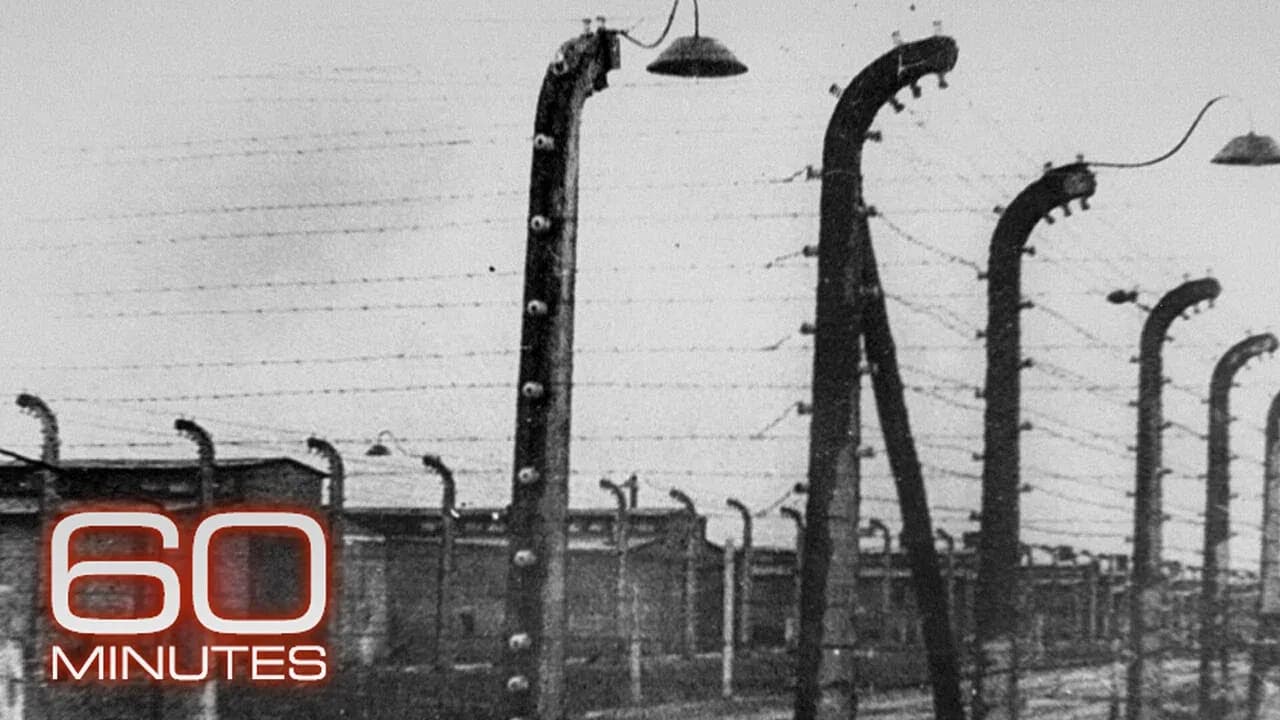
Arrival platform at Auschwitz-Birkenau: families ripped apart; most including mothers with children and elderly sent to gas chambers murdering 6,000 people a day at peak. Lucky few for work, including three women, stripped, shaven, sent to barracks. Priska saw husband once a week after across barbed wire: > Be careful and think only good thoughts. Last time they saw each other.
Frequent selections, some by Joseph Mengele. All three met Mengele naked in line. He asked if pregnant; each denied it despite danger.
Author Wendy Holden studied Auschwitz, wrote book on three babies and mothers. Each sensed great danger and denied pregnancy, sent to slave labor camp Freiberg Saxony. They never met or knew of each other. Over 1,000 women worked 12-hour shifts in converted porcelain factory for German fighter plane parts, diet of water, ersatz coffee, thin soup, tiny bread.
Wore baggy Auschwitz clothing from gassed victims. Became starved and obviously pregnant over six months, but Germans didn't realize or would send back to Auschwitz to kill.
Early spring 1945, Allies advancing, Auschwitz liberated, Germans planned to eradicate evidence by gassing slave laborers. No more work or food. Priska went into labor on factory floor on plank across table; guards watched, bet on boy or girl.
My mom said it was like a show and I said, "Mom, were you embarrassed?" I didn't have chance to be embarrassed. You were being born. That was all that mattered to me.
36 hours later, laborers and newborn Hana loaded onto open filthy coal wagons death train for 16 days, no food, hardly water, seeking camp to kill them. Farmer gave Priska glass of milk, saved her life. Rachel, under 70 pounds nine months pregnant, in sick car; people died, thrown off train. Gave birth with woman's foot on stomach amid dying. Thought baby dead, no milk, but alive and she had milk. Learned date April 20th: > Somebody announced on the train, it's Hitler's birthday today.
You were born on Hitler's birthday. Yes.
After nine more days, reached Mauthausen camp in Austria, meant to be end. Anka went into labor as train arrived April 29th. Climbed off unassisted onto cart pulled up steep hill by others while in labor. Thought she'd die seeing beautiful Danube blossoms and birds, last thing she'd see. Gas chambers used last day before: Nazis ran out of gas April 28th.
So wait, you arrived one day after the gas ran out. Every little tiny factor of this story is amazing. I call them the miracle babies and with very good reason.
Survived Mauthausen almost a week; baby Hana with infected sores until help arrived. Priska saw green army car, heard "Roll out the barrels", knew not German. Young soldier with red cross helmet; she showed Hana in English. He got doctor; used new penicillin on wounds.
He said to my mother in English, "I'll get the doctor because your baby needs help." They took me. Next day nurse brought bandaged Hana; > Is she dead? No, she's sleeping.
Mauthausen: fortress-like high on hill west of Vienna, over 95,000 prisoners died. Three babies and mothers arrived April 29th, 1945. May 5th, two dozen soldiers from 11th Armored Division, General Patton's Third Army, found camp checking bridges.
Leroy 'Pete' Peterson, 22-year-old medic from Illinois, scrapbook photos show emaciated corpses, man died in front of him. Triaged inmates; shocker: woman presented badly infected baby Hana. Used penicillin, sewed her up.
Literally, every time that we looked at this book, that was his final thoughts. I wonder what ever happened to that baby.
Freed prisoners traveled home seeking family; all three husbands died. Mothers remarried except Hana's; no other children. Babies learned war in bits; Mark enraged at 12-13: > I want to go to Europe and just kill as many Germans as I can. Mother: > They took so much from us. If this is what you become like, they will have taken your soul.
Hana raised in Czechoslovakia, moved to Israel then US; mother requested track American medic. Found 11th Armored Division, letter led to Pete at 81. Met May 2005, 60 years later.
I was so happy to finally touch him, see him. He was actually staring and looking at her. I saved that person. That's you. That's really you. And I was able to thank him finally. Truly thank him because he saved my life.
Helped his PTSD; called him Daddy Pete.
What's your relationship now? She's my big sister. Exactly. And he better listen to his big sister.
Pete died 5 years later; Hana spent week during final illness.
Eva raised in UK, reached out to liberators with photo of mother and three generations; on 11th Armored Division newsletter cover. Hana saw it: > You're not going to believe this. There was Hana's story. Up to that point, my mother had always thought that we were the only ones.
Met after 65th birthdays at Mauthausen memorial. Mark's son Charlie Googled, found site, matched story: Freiberg, pregnancy, ran out of gas, dates. Connected to Eva and Hana; all three met May 2010.
We spent the whole of the Saturday in one cafe talking, laughing and crying and talking about our mothers and comparing and contrasting their three stories. It was like we've known each other all this time and we just had to get caught up on what happened for the last 65 years. Hell of a birthday present. It was the best birthday present I ever got.
Marched at 65 and at 80 for 80th anniversary; thousands attended. Felt mothers' presence in barracks: > All I am thinking about is I've been here before. I have been here before, but I left.
Celebrated guests at 80th anniversaries. > How would you describe this relationship? It's one of siblings and I'm very glad to have siblings. We found each other. We should have been together from day one.
You certainly and your mothers absolutely were marked for death. You were supposed to be annihilated. My mother occasionally would say, "And in the end, we won because you all survived."
11 grandchildren total; mothers lived to 96, 90, 84.
The lines go on. Life goes on. Let's live. Lord be praised. To our life and to our mothers. To our mothers.
Cap Arcona, German Titanic: pre-WWII luxury cruise ship for well-to-do. End of war, Nazis made floating concentration camp in Lubeck Bay, Baltic Sea. Aerial attack hours before liberation killed nearly everyone on board.
Germany's Baltic coast idyllic but masks horror; beachside marker Cap Arcona, German for fear, panic, grief: graveyard.
British historian Bill Nunn studied Holocaust; at Lubeck Bay memorial for Cap Arcona and smaller cargo ship bombed May 3rd, 1945, ~7,000 lives lost, all nationalities including Americans, Greeks, Italians, Jewish (Star of David).
Bruno Nerath Wilson honors father Willie, political prisoner survivor; ~400 survived. Annual anniversary ceremony.
Cap Arcona launched 1927, Queen of the Atlantic, Europe to South America in 2 weeks: tennis court, heated swimming pool, wonderful restaurant, first-class cabins, luxury.
1933 Hitler power; 1939 invaded Poland, Nazis made floating barracks in Baltic. Last pre-war trip carried German Jewish passengers to South America safety. Most Jews couldn't escape.
94-year-old Manfred Goldberg, 11 at time: > We were rounded up and sent to the concentration camp. Just the three of us, my mother, I, and my younger brother.
Manford Goldberg was forcibly removed by Nazis from his hometown of Kassel in central Germany. He survived confinement in the Riga, Latvia ghetto and four different concentration camps. > The cruel experiences during my young years between 11 and 15, they're firmly lodged clearly in my mind to this day.
In Nazi-held Latvia, Goldberg, his mother Rosa, and other prisoners repaired bombed-out railroad tracks during the day. One night returning to camp, they learned the SS had taken Goldberg's little brother Herman and three other children. They were never seen again. > They just disappeared off the face of the earth.
The next morning, Goldberg and his mother had to line up and go to work as though nothing had happened. > What did that do to you and your mother? I was nearly as heartbroken as my mother at the loss of her little baby, so to speak. He was seven when he went into the camps and nine the day he disappeared.
Goldberg and his mother ended up in the Stutthof camp in Nazi-occupied Poland. Another young boy, George Schwab, was imprisoned there too. > The crematoria burning of bodies all the time, gassing, terrible.
Schwab is 92 but was only nine when German soldiers invaded his hometown of Liepāja, Latvia. Schwab's father, a prominent physician, tried to protect other Jews in town. He noticed SS trucks approaching and waved for fellow Jews to disperse; they arrested him, knocked out one eye, threw him down the cellar, and killed him.
Bruno Neyrath's father, Willie Neyrath, was not Jewish but actively opposed the Nazi regime. > My parents belong to the small minority of German people who fought against the Nazis. They didn't fight with weapons, of course. Fight with their words. Yes. Fighting with papers, with printed papers.
Willie was arrested for distributing anti-fascist flyers. They brought him to Buchenwald and from Buchenwald to the Neuengamme concentration camp by Hamburg. The Neuengamme work camp mostly held political prisoners. Inside this massive warehouse, historian Bill Nunn said prisoners like Willie Neyrath made bricks. > What does it feel like to walk in here? It feels like a factory of death. You can sense what went on in this place. But this was not a death camp. This is a work camp. It's a very, very slim distinction. During the course of this work, they die. They die in droves.
Willie Neyrath managed to survive.
Neyrath, Schwab, the Goldbergs, and the Cap Arcona all ended up at Lübeck Bay, one of the last Nazi defensive positions in 1945 as Allies closed in. The Cap Arcona, now rusted and battered, was repositioned to Lübeck Bay. SS Chief Heinrich Himmler ordered evacuation of concentration camps. > Why were they trying to clear these places out? There is an order by Himmler that no prisoner is to be delivered into the hands of the enemy alive. But I think the main concern was to get rid of evidence because prisoners are evidence. They can talk, they can tell, they can speak to those atrocities that were committed by the Nazis. So getting rid of the evidence meant getting rid of human beings.
Thousands of prisoners sent to Nazi holdout at Lübeck Bay. Willie Neyrath forced north from Neuengamme about 50 miles. From Stutthof in the east, Manford Goldberg, his mother, and George Schwab sent to nearby town Hell and put on barges. > What were the conditions? Oh, terrible. Just beyond description. No toilet facilities, hardly any food. You could hardly sit. You can certainly not sleep. Sounds like hell. Hell. Hell on earth. Absolutely.
Barges, each packed with about 1,000 prisoners, towed by tugboat for 6 days about 400 miles across the Baltic to where Cap Arcona was positioned. Cap Arcona arrived in Lübeck Bay on April 14, 1945, two weeks before Hitler killed himself and three weeks before end of war in Europe. Anchored 2 miles offshore, with engines barely running and little food and water, the former queen of the Atlantic became a floating concentration camp.
SS guards jammed more than 4,000 prisoners, including Willie Neyrath, onto Cap Arcona, a ship meant for 1,500 people. > Do we know what the Nazis intended to do with the prisoners on the ship? I think they intended them to die.
Prisoners already dying on barges fleeing Stutthof carrying Schwab and Goldbergs. In the bay, SS guards uncoupled tugboats, leaving prisoners adrift, supposedly on minefields. > They just abandoned you. Abandoned.
Schwab and Goldberg said mixed in with concentration camp victims were a few prisoners of war better fed and treated; they pried loose long floorboards and used them as oars to row into the night. Shortly before dawn, the barge ran aground. Norwegian prisoners on George Schwab's barge collected blankets, made sails, and sailed toward land.
Near death but desperate, Schwab and Goldbergs climbed out of barges, intercepted by SS and German troops on beach who shot and killed many on the spot. > We felt practically certain that we would be shot next, but instead they lined us up into a column. We were told that we were going to be shipped to a liner by the name of Cap Arcona.
While standing there, they saw large number of bombers overhead. Cap Arcona in the bombers' sights.
At beginning of May 1945, war in Europe all but over: Hitler dead, German forces in retreat, Third Reich crumbling. One last Nazi position at Lübeck Bay where German ships fled, including Cap Arcona.
As Allies closed in, SS evacuated camps and packed thousands onto Cap Arcona. Around noon on May 3, 1945, 13-year-old George Schwab ordered to line up to board; ship could not come close to shore, so transported by another ship. Schwab purposely got to back of line at dock near German naval base where Manford Goldberg and mother lined up too. > And it is while we stood there that we witnessed bombers and fighter planes coming along. Could you see any markings on the plane? No, we had no idea what nationality they were. You could see the planes coming. Oh, you could see the planes clearly. You could see the bombs dropping. Can you remember what it sounded like? There were some pretty powerful explosions, and there were quite a few.
Cap Arcona hit. With >4,000 prisoners on board, became fiery tomb. Attackers were British Typhoon fighters, Allied forces. > The British came to liberate these prisoners. They did. Yeah. And ended up killing. Yeah. Thousands of them. It's like horror on top of horror. It is. And yet some of them did survive to remember it.
Bill Nunn, British historian and Holocaust scholar, said mistaken attack on Cap Arcona and smaller ship one of most wrenching tragedies of war. > The prisoners knew that the war was nearing its end. I think a lot of them probably had hopes that they would survive and that gave them the strength and courage to hang on.
At Cap Arcona Museum in town of Neustadt by Lübeck Bay, Nunn described attack: British Typhoons struck in waves; Cap Arcona hit around 3:00 p.m. > Do you have any idea how many bombs were dropped on the ship? Some people say 60 or over 60. You can imagine the panic and the horror that broke out when the bombs hit the ship, especially for those concentration camp prisoners. We were in the very lower decks of the ship and they were unable to get up to the top because of the flames.
Was this the worst case of friendly fire in the Royal Air Force's history? Quite probably. Yeah.
Sebastian Cox, chief historian for Britain's RAF, blames fog of war. Cap Arcona targeted because Allies believed Nazi elements would flee across Baltic to Norway to continue war. > Did the British military have any idea that concentration camp survivors were on the Cap Arcona? If you mean did the pilots have any idea? Absolutely not. But other members of the British military did know what we learn from the records that the British were handed two opportunities very close to the 3rd of May in regards to the placement of prisoners on board the ship concentration camp prisoners on those ships. Indeed.
Daniel Long wrote PhD thesis on attack; at British National Archives in London showed fragile war documents: only official investigation into sinking. Shortly after bombing, British war crimes investigator interviewed intelligence officer for squadrons that attacked. Officer admitted on two occasions message received on May 2, 1945, that ships loaded with concentration camp prisoners. > That intelligence came in the day before the attack, which then leads to suggest that there was ample time to warn the pilots on the planes. That information did not make it to the RAF pilots. That's correct.
Report does not say why intelligence officer failed to inform pilots but blamed RAF personnel, called for further inquiry that never happened. > Why not? Attempting to conduct a detailed investigation would in many respects be a little pointless. What are you going to conclude to find out what went wrong? What mistakes were made? We know what happened. The RAF made a mistake. An individual made a very tragic mistake and we know the consequences.
About 7,000 prisoners perished when ships bombed in bay. Of >4,000 on Cap Arcona, only about 400 survived.
Bill Nunn said several survivors wrote accounts of hell endured at sea: thousands packed like herrings, stretched arms up crying > I want out. I want out. The fire suddenly got more and more intensive. And this was because the flesh of the prisoners was burning so strongly. It made this intensity happen. It's distressing to read.
Bruno Neyrath's father Willie trapped on ship when bombs hit. > My father managed to go to the back of the ship where it was not burning and there he survived because he couldn't swim. He survived because he couldn't swim. He did not jump into the water. And prisoners who jumped into the water were shot by the SS.
When British realized mistake, dispatched rescuers who plucked Willie Neyrath and others from listing deck and took to shore. On beach where father came ashore, Bruno said his mother Ava, a naval staff assistant transferred to Lübeck Bay naval base, saw bombing and went to beach. > She had only one hope, to know where is my husband? Is he still living? And maybe my husband is on the ship.
She came from one direction, saw man approaching she didn't recognize. > He must have been thin and weak and dirty from the burning, but he came over to her and called his nickname he had for her. Mupil. What does mup mean? Mup means something like I love your round face. She recognized his voice by this one word mup.
That ship was a graveyard for so many people, but yet it brought your parents back together. Yeah. I don't know if there are hidden meanings in life, but one meaning can be that I am alive now and can tell you about this story.
George Schwab pulled inspiration from horror: prize for helping Latvia into NATO; native of Liepāja moved to New York, earned PhD in political science, illustrious career as academic and peace broker. Photos with King Hussein, Bill Clinton. > Schwab. I think you knew everyone somewhat.
Manfred Goldberg and mother settled in London; she passed in 1961. Goldberg married, started business and family. In 2017, returned to Stutthof with then Duke and Duchess of Cambridge. Made it life mission to share story. > I consider that part of my revenge on the Nazis. They wanted to exterminate us and here we are not only having survived, we are now great grandparents. That's your revenge. My revenge on the Nazis. Yes.
Cap Arcona lay half-sunken in Lübeck Bay for 4 years before dismantled. Story little known beyond Baltic coast. Tradition on May 3 for families of victims and survivors to sail to site where ship bombed. They want the world to remember.
Keep 60 Minutes in your library
Save the videos and channels worth coming back to, and find them again in one place.