Stock Market About to Fall? Here's How to Prepare
In a Nutshell
Michael Burry shorted Palantir at peak valuations of 200-250x earnings, and the stock has since fallen 48% to $107 while still trading at a 112x PE—far above Apple, Nvidia, and Microsoft. Market sentiment has rotated away from Palantir toward AI and semiconductor stocks, leaving high-multiple names vulnerable if broader markets weaken. MicroStrategy has plunged 71-78% as Bitcoin fell, and investors are advised to cut leverage and manage risk aggressively amid volatile, uncertain conditions.
These notes were generated by AI and may contain inaccuracies.
Michael Burry, known for The Big Short housing bubble prediction, disclosed a short position on Palantir in November 2025 when the stock traded at highs of $200. Alex Karp, Palantir CEO, publicly criticized short sellers and called Burry batshit crazy for shorting the stock. Burry is rumored to have closed a portion of his short position that was reportedly valued at $912 million.
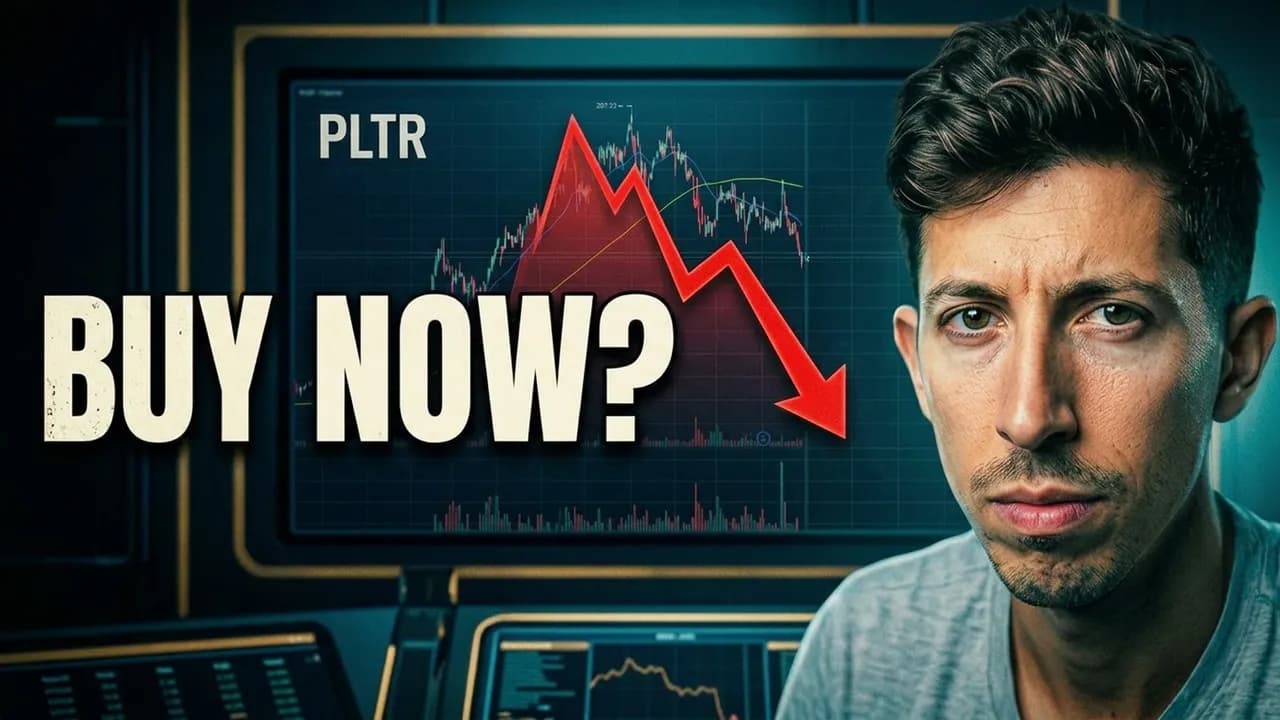
Palantir has since dropped from $207 to $107, representing a 48% loss from overall highs. The stock is among the worst performing stocks of 2026. Investors who bought in late 2025 entered at one of the worst times for the company.
Even after the selloff, analyst fair value estimates suggest additional downside remains. Palantir trades at a 112x PE ratio despite losing nearly 50% of its value. At its peak of $200-$250, the stock traded at a 200-250x PE ratio.
For comparison, Apple trades at 33x earnings after a sharp correction, Nvidia at 29x, and Microsoft at 20.9x. Meta trades at 19.5x. These established companies trade in the traditional 20-30x earnings range, making Palantir's 112x multiple appear significantly overvalued even after the correction.
Alex Karp encouraged investment at $207-$250 per share when the stock traded at 200-250x earnings. The speaker notes the contrast between Karp calling Burry crazy for shorting an overvalued company versus encouraging investors to buy at extreme multiples.
Palantir remains a successful company with accelerated growth. The core issue is that markets can stay irrational longer than investors can stay solvent. The 2025-2026 period saw aggressive capital rotation away from Palantir toward AI, semiconductor, and storage companies including SNDK, MU, AMD, and INTC.
Nothing fundamentally changed with Palantir itself. The shift occurred entirely in sentiment, hype, and market attention. The stock is down nearly 15% from all-time highs while broader markets remain bullish. If broader markets sell off, Palantir is likely to decline further. If markets continue rising, Palantir may benefit from the overall environment.
The speaker notes being more open to investing in Palantir at current levels than at $200, while cautioning that another 50% drop from $100 would still leave the stock overvalued based on the PE ratio. The company is viewed as fundamentally sound but no longer carrying the premium valuation.
Apple raised prices on MacBooks and iPads, with increases ranging from $100 to $200. Microsoft announced Xbox device price hikes due to memory chip costs within hours of Apple's announcement. The speaker notes this appears to be the cost of heavy AI investment being passed to consumers, contrary to expectations that AI would reduce costs.
OpenAI was expected to file for IPO in 2026 but is now considering pushing the IPO to 2027. The speaker attributes this to choppy market conditions and lack of enthusiasm. The timing decision involves weighing available capital against market conditions, with the risk that prolonged waiting could lead to a more desperate IPO situation if markets sell off further.
MicroStrategy stock is down 71% since Michael Saylor appeared on the cover of Fortune magazine. The speaker references criticism labeling Saylor as a fraudster following a Ponzi-like pattern: raising capital, buying Bitcoin, hyping the price to raise more capital, diluting shareholders, and borrowing against positions.
The pattern allegedly involves telling investors not to sell Bitcoin while Saylor sells, causing price crashes that affect MSTR valuation. STRC, STRF, STRD, and STRK are down significantly, with BTC down 45%, IBIT down 45%, and MicroStrategy down 78%. The speaker notes the company reportedly has only a few months of capital remaining if the downward spiral continues.
Nike is mentioned as a company that has not performed well but appears somewhat oversold. The speaker suggests adding it to a watchlist for potential future analysis.
The NASDAQ shows signs of weakness with uncertain, volatile trading over the past three days. The recommended approach includes watching position sizes carefully, managing and mitigating risk more aggressively than usual, and avoiding leverage during uncertain periods.
The speaker plans to watch semiconductor stocks, noting MU is already down 3.5% in extended hours. Many semiconductor stocks are described as overpriced in the short term, with potential for correction, though direction and price action must be confirmed before taking positions.
Viewers can use promo code MSTR for nearly 50% off LPP 3.0, receiving $335 off the one-time payment lifetime access program. The offer expires at midnight. Members who joined in 2018 received all updates to 2.0 and 3.0 at no additional cost and continue to access live trading sessions daily at market open.
Keep Ricky Gutierrez in your library
Save the videos and channels worth coming back to, and find them again in one place.