Stories about Ships | 60 Minutes Full Episodes
In a Nutshell
The US shipbuilding industry has collapsed while China's has exploded, creating a critical national security vulnerability—America builds 3 cargo ships yearly versus China's 1,000, and US vessels cost 5x more and take twice as long to construct. The Jones Act, steel tariffs, and labor shortages make domestic production prohibitively expensive, forcing the US to rely on foreign-built ships for critical trade and LNG transport. Meanwhile, China's naval expansion to 440 ships by 2030, aggressive Taiwan ambitions, and submarine capabilities threaten both American maritime dominance and global supply chains.
These notes were generated by AI and may contain inaccuracies.
The war in the Gulf and blockade of the Strait of Hormuz highlighted the importance of ships, not just warships, but cargo vessels carrying oil or gas. American shipbuilding is in shambles due to decades of short-sighted policies and neglect. The submarine building program is sluggish, and commercial shipbuilding is nearly extinct. China makes roughly a thousand cargo ships a year, while the US makes maybe three. The Trump administration called this a national security crisis.
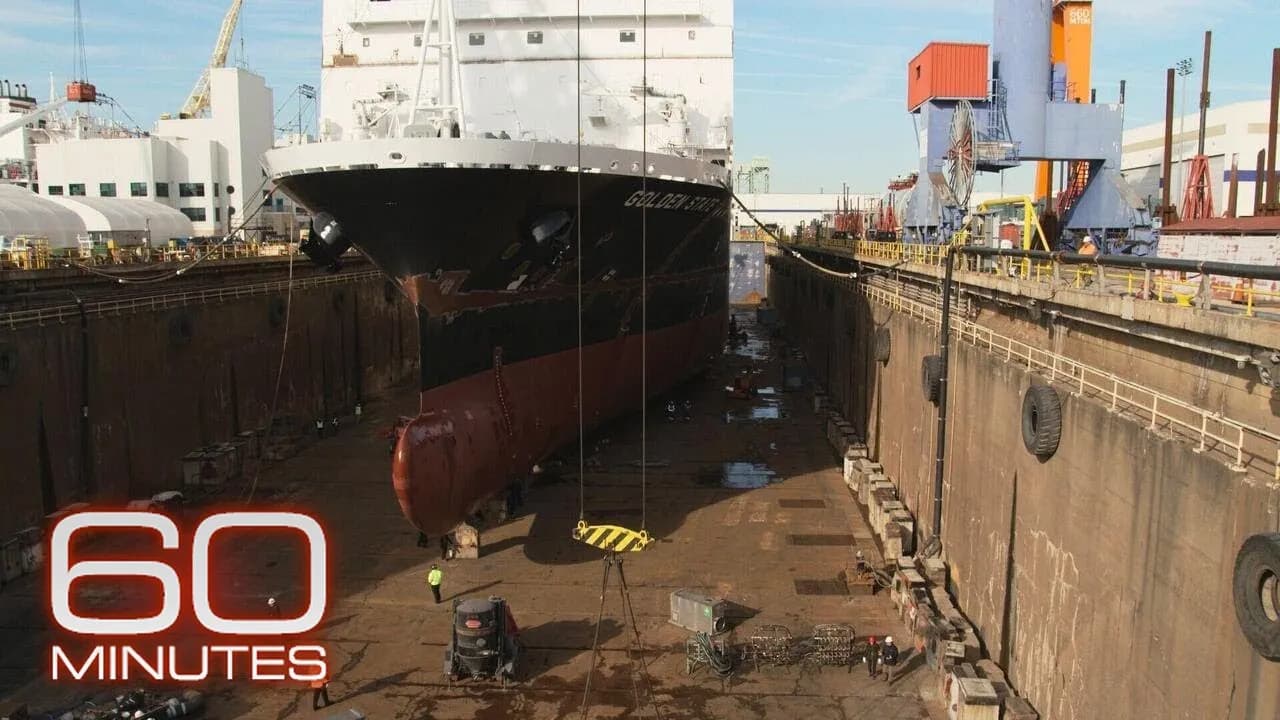
The Philadelphia shipyard is one of only two remaining in the US building large commercial cargo ships. Ships built here helped win American independence in the 18th century and World War II in the 20th. The shipyard has become a symbol of American industrial decline, a money loser falling decades behind global rivals. The yard still uses a crane from 1942. David Kim, the new head of the Philly shipyard, works for Hanwha, a giant ship maker from South Korea. Hanwha bought the yard in 2024 for $200 million, then poured in another $100 million.
At the Hanwha Philly Shipyard, they deliver one to one and a half ships a year, versus their yard in Korea where they deliver basically one a week. Not building ships in the US is considered a national security threat because if there's a conflict with China, Beijing could weaponize its substantial merchant fleet and cut the US off from global goods. Hanwha plans to spend $5 billion in Philly and has already sent 50 trainers from Korea to teach American workers. The aspiration is to get up to 20 ships a year at the Philadelphia shipyard, with plans to grow the workforce by 7 to 10,000 people.
There is a huge shortage in the US of skilled labor in shipbuilding, including welders and pipe fitters. The work is grueling, freezing in winter, scorching in summer, and dangerous. The yard has a training program that can only train 20 or so new hires at a time, and it takes three years. Apprentice Justin worked at Amazon as a grocery picker, Jeff was a cake decorator at a bakery, and Meg worked as a nanny. The apprentices noted they get paid while they learn, receive healthcare, and find the work more fulfilling than previous jobs, making them feel part of something bigger.
Ships that take 6 months to build in Korea or China can take twice as long in Philadelphia and cost five times as much. Key components must be brought to the US, such as propellers and even the engine. Michael Coulter, Hanwha's top executive in charge of US operations, says the way to lower prices is to scale up production. At Hanwha's shipyard in Korea, nine ships are being built at once, with rows and rows of robots. Even with all the automation, the human workforce keeps growing with over 26,000 workers on site, and the yard trains 400 workers at once compared to 20 in Philadelphia.
Hanwha builds submarines in Korea and has told the US government they will build submarines for them in the United States and in Philadelphia. The US submarine program is heading in the wrong direction. Hanwha also wants to help with transporting liquefied natural gas (LNG), hoping to build giant LNG tankers in Philadelphia. The United States is the largest producer of natural gas, yet doesn't have any LNG ships built domestically.
The Jones Act, a century-old law, requires that any cargo shipped between US ports must be on an American-made ship. If the cargo is LNG, it must be on an American-made LNG ship, but none are built domestically. Colin Graybo, a trade expert at the Libertarian Cato Institute, explains that building one LNG ship in Asia costs around $260 million, while in the United States it costs about a billion dollars. New England has to import pricier natural gas from abroad in winters, even though it's extracted only a few states away. Puerto Rico imported Russian natural gas the same month Russia invaded Ukraine.
President Trump signed an executive order creating a multi-agency action plan and a White House office of shipbuilding. The administration wants to build ships but has put 50% tariffs on steel, the main component in a ship. When heavy tariffs are placed on imported steel, American steel manufacturers raise their own prices. American steel is roughly twice as expensive as steel in China. The administration is also making it harder to grant skilled immigrants work visas, despite immigrants traditionally being willing to do shipbuilding work.
When President Trump threatened to put tariffs on Korean imports, Korea's president offered instead to invest $150 billion to revive the US shipbuilding industry, with Philadelphia being just the start. ICE raided a Korean battery plant in Georgia last September, alleging visa violations, and dragged off 300 Korean technicians and engineers in cuffs and chains despite their coming to train American workers. Hanwha's Michael Coulter was assured that the Philadelphia team would not be impacted.
The mouth of the Columbia River, where it spills into the Pacific Ocean at the border between Oregon and Washington State, is one of the most dangerous inlets in America. Up to a million cubic feet of water can pour out of the river's mouth every second, running into waves that have been moving across the Pacific for thousands of miles. Elite members of the United States Coast Guard come here once each year to earn certification as surfmen. The Coast Guard makes more than 5,000 rescues a year, and there are 20 surf stations where rescues may have to be made in breaking waves.
The National Motor Lifeboat School at the Columbia River mouth has about 130 active duty surfmen out of approximately 40,000 Coast Guard members. Being a surfman is sometimes compared to being a Navy Seal or in Army Special Forces, but this is a more exclusive club. Certifying as a surfman means the Coast Guard trusts you to drive a lifeboat on the most challenging rescue missions in 20-foot breaking waves and 50-knot winds. The surfman's medallions, called checks, go back to 1872 when the US Life-Saving Service began saving mariners in distress. Chief instructor Eric Kelly's surfman number is 545, and he has a tattoo of his surfing number.
The surf class is the final stage after basic and heavy weather courses. Derek Samuelson, Trenton Campbell, and Joshua Slaughter are trainees on Eric Kelly's boat. Most candidates need nearly four years of training to get certified, almost a college degree worth of training. The Columbia River Maritime Museum has a giant map illustrating how the mouth has earned the title "Graveyard of the Pacific" with at least 700 lives lost and thousands of shipwrecks over several centuries. Of all grain exported from the United States, just over 40% goes out the Columbia River.
"Squaring up" is pointing the bow of the boat directly into and through a breaking wave. The worst thing to do in a breaking wave situation is not be square to the wave, which could cause a knockdown (boat goes underwater but rights in the same direction) or a 360-degree rollover. The 47-foot US Coast Guard motor lifeboat is designed to handle knockdowns. Every day for four weeks, students take the helm with instructors signaling approval or corrections. Students drive in every kind of condition and run simulated missions like pulling someone out of the water.
On graduation day 2023, a mayday distress call came from a white boat called the Sandpiper with one man on board. Conditions were 25-35 foot breaking seas, 50 knots of wind, raining, hailing, and very dynamic. A rescue swimmer named John Walton was deployed from a helicopter and retrieved the individual just as a 30-plus foot break rolled the boat multiple times. All nine students in the class of 2024 completed the course and memorized the surfman's creed. Two students, Dorian Casey and Trenton Campbell, received their surfman medallions on graduation day with their commanding officers in attendance.
NATO held its largest military exercise yet in Norway last fall. Norway has a tiny military but is on the front lines with Russia and serves as NATO's eyes and ears in the high north. Norway's F-16s are on 15-minute alert 24/7. Every time Russian military aircraft are detected, pilots scramble to intercept them. Videos show nuclear-capable Russian bombers flying up and down the Norwegian coast. Lieutenant General Rune Jakobsen, Norway's Joint Force commander, reports seeing aggressive flying and simulated attacks against Norwegian exercises, with aircraft going to the point where they would release their weapons.
Norway shares a 120-mile border with Russia, some of the most remote, rugged, and beautiful landscape in Europe. Captain Karina Vinterdal guards the northern sector with 120 soldiers along the border 24/7. There are four observation posts manned at all times throughout the year. Soldiers are armed but have not had to use their weapons. Units rotate every three weeks on watch at the most remote outposts in the high north of the Norwegian mainland.
To reach the observation post, gear must be carried up a long, steep staircase partially covered to defend against Arctic winter conditions. The post is manned year-round, and from the summit, Norwegian soldiers can observe deep into Russia and far out to sea. This strategic location serves as a key piece of terrain for the NATO alliance, marking NATO's northernmost flank at the border with Russia. The Barents Sea beyond represents the home operating waters of Russia's northern fleet and remains under constant surveillance by the United States and Norway.
A map reveals the Kola Peninsula's military significance, housing Russia's northern fleet, naval bases, airfields, and nuclear weapons storage sites. This concentration represents Russia's single greatest military power, particularly in submarines. Admiral James Fogo, commander of US naval forces in Europe, notes the very capable Russian submarine force and increased submarine activity causing concern.
The Sevinsk (Sevastopol-class) represents a new class of nuclear-powered submarine armed with land-attack cruise missiles having a range greater than 1,000 miles. Described as very quiet and capable, the submarine's stealth characteristics make it harder to detect and track. Admiral Fogo confirms Russian presence has increased in all bodies of water around Europe and the Atlantic.
Pentagon officials disclosed that last summer the Sevinsk slipped into the Atlantic and evaded detection for weeks. Admiral Fogo acknowledges that losing a Russian submarine in the Atlantic during peacetime is embarrassing, but during crisis it could be a disaster. The discussion highlights global infrastructure resting on the ocean floor, specifically undersea fiber optic cables carrying 99.4% of data exchanged over the internet by the US and its allies and trading partners.
The Norwegian military allowed 60 Minutes aboard a maritime patrol plane to demonstrate submarine hunting operations. The crew scans the Norwegian Sea with radar and high-powered cameras while flying at less than 300 feet, clearly identifying surface vessels including cargo ships. For underwater detection, patterns of sonobuoys are deployed to send sound waves that bounce off submerged submarines.
Major Leaf Outerholm, the plane's tactical coordinator with experience since the 1980s, explains the operational area for this aircraft type is six times larger than Norway's land area. Russian submarines are encountered regularly when flying further east, and Norwegian patrol planes frequently spot Russian submarines while still on the surface.
The Mariotta represents Norway's newest spy ship, at sea nearly 300 days per year monitoring Russia's northern fleet. Though flying the Norwegian flag, much of its eavesdropping equipment comes from the United States. Its mission focuses on collecting intelligence on Russia's northern fleet operations, which Lieutenant General Yakerson indicates is arming itself with new precision-guided weapons tested in waters off Norway.
President Trump sent a letter of complaint stating Norway is the only NATO ally sharing a border with Russia lacking a credible plan to spend 2% of GDP on defense. Norwegian Foreign Minister Aa Ericson Sarida, the first woman in the position, acknowledges the fair point about needing to step up defense spending. Before her current role, she served as defense minister in 2014 when NATO members pledged to increase military spending to 2% of GDP.
Norway has not yet met the 2% pledge but is moving in the right direction with significant investments, including American-made F-35 stealth fighters. Norway is purchasing 52 F-35s at $89 million each to replace aging F-16s approaching 40 years old. Lieutenant General Yakerson confirms that Norway's current air force would be unable to operate in the northernmost part of Norway during a serious crisis.
Last fall, NATO conducted Trident Juncture, one of the largest exercises since the Cold War, involving 50,000 troops, 250 aircraft, and 65 ships under Admiral Fogo's command. The war game simulated repelling an invasion of Norway by an unnamed country, with the message that potential challengers should think twice. The USS Harry S. Truman carrier strike group operated above the Arctic Circle for the first time in nearly 30 years.
The Navy maintains one-third of its approximately 300 ships deployed at all times, with about 100 ships at sea globally. Admiral Samuel Paparro commands the US Pacific Fleet, comprising 200 ships and 150,000 sailors and civilians representing 60% of the entire US Navy. The USS Nimitz was visited near Guam, southeast of Taiwan and the People's Republic of China.
Admiral Paparro notes that in the early 2000s, China's navy mustered about 37 vessels, compared to 350 vessels today. Following Nancy Pelosi's August visit to Taiwan, the first by a senior US political figure in 25 years, China fired ballistic missiles around Taiwan and encircled the island with aircraft and warships.
The CIA assesses that Chinese President Xi Jinping has ordered the People's Liberation Army to be prepared to take Taiwan by force by 2027. If China invades Taiwan, the bulk of the US Navy would deploy rapidly to the Western Pacific. Admiral Paparro states the Navy is ready, though never admitting to being ready enough. President Biden has declared four times that the US military would defend Taiwan, a democracy and the world's leading producer of advanced microchips.
Aircraft carriers represent the most powerful ships in the US Navy, with air wings capable of 150 strike or air-to-air sorties per day and the ability to deliver 900 precision-guided munitions daily at surge levels. While China has two operational diesel-fueled carriers, the US maintains 11 nuclear-powered carriers carrying approximately 1,000 attack aircraft total, exceeding all other nations' navies combined.
Chinese pilots conduct aggressive intercepts within single digits of feet of other aircraft, flashing weapons, and maneuvering to deny turn capabilities in international airspace. China's increasingly aggressive moves include territorial encroachment, illegal fishing, and base construction in the South China Sea, prompting closer military ties between Japan, the Philippines, and the United States. Britain, the US, and Australia recently signed a deal to develop nuclear-powered attack submarines for Pacific patrol.
Taiwan represents the fulcrum in China's "first island chain," a constellation of US allies stretching across China's coast. Control of Taiwan provides strategic access to the Pacific and sea lanes carrying approximately 50% of world commerce. Admiral Paparro states the US is not seeking to contain China but wants compliance with international rules.
China has invested heavily in long-range precision-guided weapons including the DF-21 and DF-26 "carrier killer" missiles, practiced against mock-ups of American ships. From 1,500 nautical miles off mainland China, these missiles could potentially target US aircraft carriers if targeting systems are in place.
US submarine technology maintains approximately a generation (10-20 years) advantage over Chinese capabilities. About a dozen nuclear-powered fast attack submarines patrol the Pacific at any time. Since Nancy Pelosi's Taiwan visit, China's military leaders have been mostly silent and ignored US efforts to maintain communication lines open.
Several Pentagon sources indicate a China-Taiwan conflict could begin in outer space with satellite targeting, followed by cyber attacks on American cities and West Coast port sabotage. A recent non-classified war game showed the US prevailing but losing 20 ships including two carriers, which Admiral Paparro considers a plausible outcome.
The Navy is retiring ships faster than replacements are acquired while China's navy grows larger and more lethal. The "decade of concern" has seen a ten-fold increase in PRC Navy size. Under current plans, the US fleet will shrink to 280 ships by 2027, the same year China may achieve Taiwan invasion capability.
Republican Mike Gallagher and Democrat Elaine Luria, both serving on the House Armed Services Committee, share urgency about increasing threats from China and insufficient speed in building a larger navy. Gallagher chairs the new House Committee on China and warns the fleet will be weakest when the enemy is potentially strongest.
Over two decades, the Navy spent $55 billion on unsuccessful programs including the Zumwalt-class destroyers (only 3 of 32 ordered launched, costing up to $8 billion each) and the Littoral Combat Ship program ($30 billion, plagued by structural defects and engine trouble, nicknamed "little crappy ship").
The chief of naval operations is responsible for building, maintaining, and equipping the entire US Navy. When asked if the Navy is in crisis, he states it is not, and that the Navy is out on point every single day. Regarding whether it is being outpaced by China, he says no, the Navy is still in a position to prevail, though this is not blind confidence. He expresses concern with the trajectory China is on and China's behavior, but asserts the US Navy is in a good position if it ever gets into a fight against them.
When asked to describe what China has been able to do militarily over the last 20 years, the most alarming thing identified is the growth of not only their conventional forces but also their strategic nuclear forces, their cyber capability, their space capability, and how they are using that to force other nations' navies out of certain areas in the South China Sea. Instead of recognizing international law, they want to control where those goods flow and how.
Regarding lessons learned from ship building mistakes of the last 20 years, one key takeaway is the need to have the design well in place before beginning to bend metal. The Navy is going back to what was done in the 80s and the 90s. The Navy has the lead.
There is a tendency among the great powers to look at each other's naval buildups with deep suspicion. Toshi Yoshiara of the Center for Strategic and Budgetary Assessments may know more than any scholar in the West about China's Navy. According to the Pentagon, China will have about 440 ships by 2030.
China is able to build more warships more quickly than the US because it has clearly invested in defense industrial infrastructure to produce these ships, which allows them to produce multiple ships simultaneously, essentially outbuilding many of the Western navies combined. China's Navy piggybacks on a booming commercial ship building industry kept afloat by generous state subsidies, inexpensive materials, and cheap labor.
In the United States, after the Cold War ended, the ship building industry consolidated and many of the yards where ships were both built and maintained closed down. When asked what he sees when looking at China's ship building program, the response is that it is very robust. When asked if the US has enough shipyards, the answer is no, with a wish for more commercial shipyards. Over the course of a career, the number of shipyards has gone from more than 30 down to about seven that are relied upon on a day-to-day basis to build ships.
One of those yards is run by Huntington Les Industries, which built the state-of-the-art new Ford-class aircraft carrier. After controlled explosions in 2021 to prove it could withstand combat, the Ford got closer to deployment, 6 years late and billions of dollars over budget.
The Navy is struggling to build new ships on time. According to the Government Accountability Office (GAO), there is a multi-year backlog repairing the ships in the fleet. The maintenance backlog is one of the primary things being worked on to correct. Just three years ago, there were 7700 delay days, meaning extra days in a shipyard by ships when they were not operational. This has been cut down to 3,000, though this is not considered satisfactory.
Maintenance delays mean sailors can't come home because the ship that's supposed to replace them is not ready. It means longer deployments and being away from family more, which creates a big strain on the workforce. The more ships that can be made available to send at sea alleviates many of those problems. Sailors join the Navy to see the world, and the goal is to make sure maintenance delays go to zero and ships get to sea as quickly as possible.
In the last year alone, at least 10 sailors assigned to ships undergoing maintenance or working at maintenance facilities have died by suicide. This is a problem being taken very, very seriously. Every leader in the Navy has a responsibility to look out for each other and take care of each other. There is no wrong door to knock on when help is needed.
The US Navy's main advantage over China is America's sailors. The goal is to modernize the US fleet and have those sailors serving alongside hundreds of unmanned vessels by 2045. Unmanned is considered the future, and it is believed that some 40% of the fleet in the future is going to be unmanned. Some of these are underwater drones, and some are highly capable of delivering mines and perhaps other types of weapons.
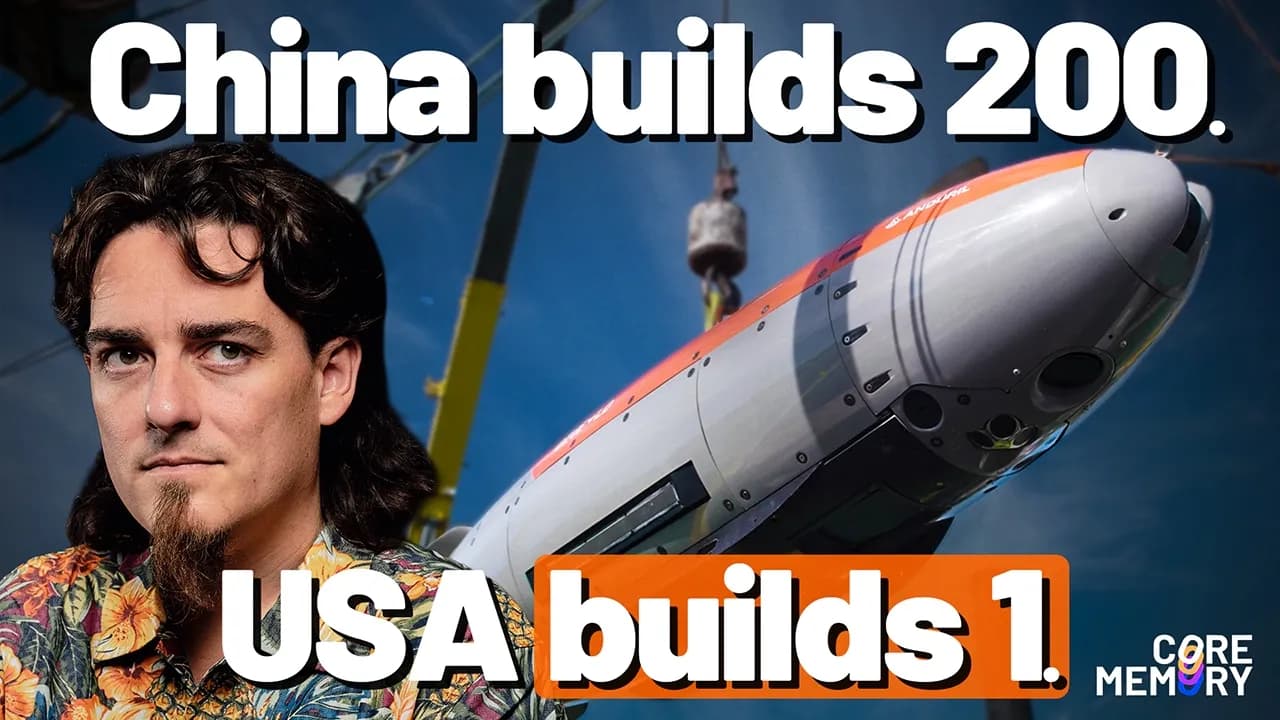
The Orca is an extra-large unmanned undersea vehicle. When asked what it will do, the answer is that at a minimum it will have a clandestine mine laying capability, done in a way that is very secretive but very effective. However, the GAO reports that it is already a quarter of a billion dollars over budget and three years behind schedule. It is acknowledged that this particular platform is behind schedule because it is the first of a kind. When it delivers, a very high return on investment is expected because it will be among the most lethal and stealthy platforms in the arsenal of the US military.
The Navy's total budget request for fiscal year 2024 is over a quarter of a trillion dollars, an 11 billion increase from last year. The focus is on China. The US defense posture is viewed as aggressive by the Chinese. The foreign minister has said to stop the containment, warning this may lead to conflict. The Chinese minister may not like the fact that the US Navy is operating in collaboration with dozens of navies around the world to ensure that the maritime commons remains free and open for all nations. The Chinese want to dictate those terms and so they do not like the US presence, but the presence is not intended to be provocative. It is intended to assure and to reassure allies and partners around the world that those sea lanes do remain open. The global economy literally floats on seawater.
Keep 60 Minutes in your library
Save the videos and channels worth coming back to, and find them again in one place.