The #1 Exercise to Lower Blood Pressure (It Beats Cardio in 270 Studies)
In a Nutshell
A 2023 meta-analysis of 270 trials found that wall sits (isometric squats) lowered systolic blood pressure more than any other exercise type—over 8 points—outperforming cardio, resistance training, and HIIT. The protocol requires just 24 minutes per week: four 2-minute wall sits at ~135° knee angle with 2-minute rests, performed 3 times weekly. The sustained muscle contraction temporarily restricts blood flow; upon release, a surge of nitric oxide relaxes vessels, producing the blood-pressure drop.
These notes were generated by AI and may contain inaccuracies.
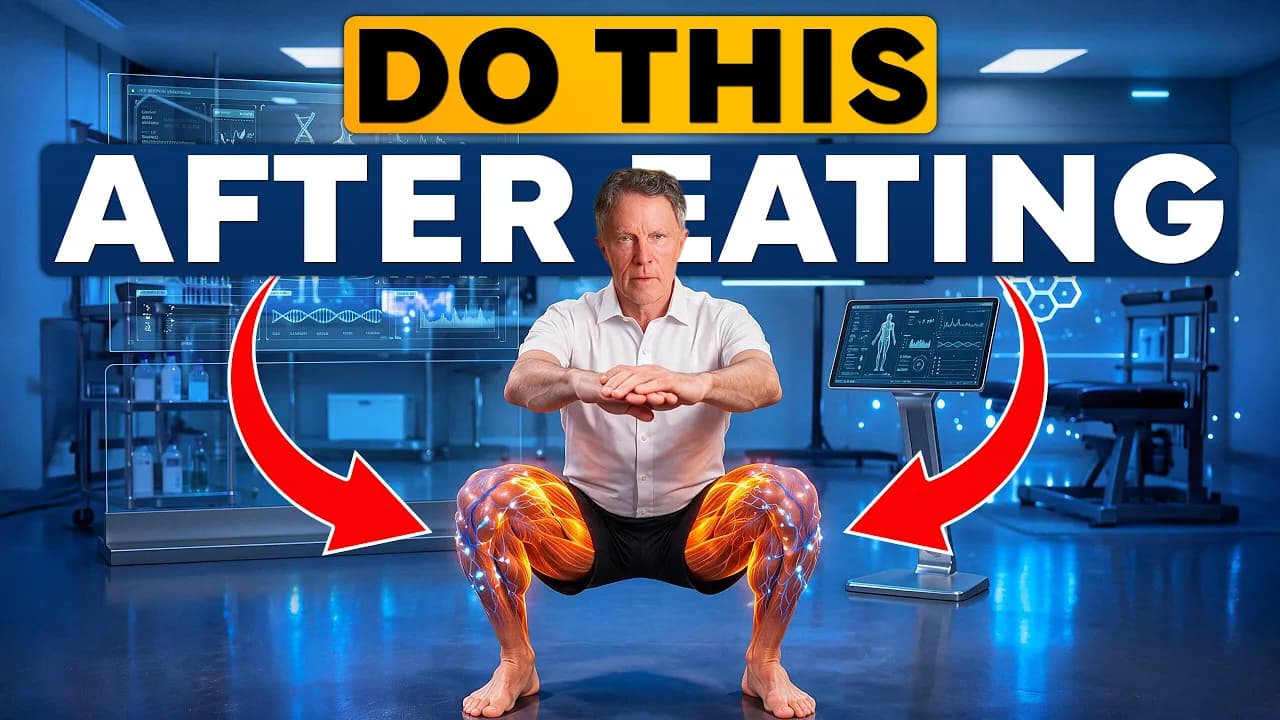
The number one exercise to lower blood pressure has beaten cardio in 270 different studies that involved almost 16,000 people. The winner was an exercise that involved no motion whatsoever. All you need is the wall right behind you. The absolute best exercise to lower the systolic blood pressure that won over every other exercise was a type of exercise called the wall sit or wall squat. This is an isometric exercise. That means you're not moving, but you're contracting your muscles. Virtually every single person watching can actually perform this exercise.
Over 50% of the adults in the US have high blood pressure and most of them don't even know it. It's earned its name the silent killer because a lot of times you don't feel high blood pressure.
Isometric exercises especially for blood pressure are completely underneath the radar. They're not really recommended by a clinical practitioner or a physician because when they initially studied isometric exercises way back in the day, they found that this exercise increased blood pressure. So they automatically ruled it out and actually told people not to do isometric exercises for blood pressure because it was going to worsen the problem. This also filtered through certain scientific committees. This is a thing that you did not want to prescribe for anyone with a heart problem or high blood pressure at all. Not based in any long-term studies, just some initial observations.
A tremendous amount of research in the area of exercise involves observational studies which are not nearly as credible. That's basically where they don't really recommend anything. They just observe the data. And so those things are then associated with some outcome. But they're just good guesses. Then when they finally did the research, they found that that high blood pressure was very temporary. But of course, in the meantime, they recommended cardio.
In 2023, the British Journal of Sports Medicine published a study where researchers gathered 270 randomized control trials. They pulled them together. They got just under 16,000 people involved, which is quite a large group of people. This is what they found in the study and this is relating to bringing down systolic blood pressure. That's the top number.
- Combination training brought the systolic pressure down just over six points
- Resistance training brought the systolic blood pressure down just slightly more than 4 1/2 points
- Aerobic: 4 1/2 points drop
- High-intensity interval training brought it down by four points
- Isometric training, specifically the wall sit, brought the blood pressure down more than eight points
They also found other types of isometric training that were slightly less than the walls, but they were better than the other types of workouts. For the diastolic blood pressure, if your diastolic blood pressure is the one that's high, cardio was the one that brought the diastolic down the best. But most people have a problem with the systolic, which is the top number.
A meta-analysis in the Lancet with 123 studies and 613,000 people found when you lower the blood pressure by 10 points:
- Major cardiovascular events dropped by 20%
- Coronary heart disease went down by 17%
- Stroke went down by 27%
- Heart failure went down by 28%
- Death from all causes went down by 13%
This isometric exercise, the wall sit was eight points, which is not far away from the 10-point drop. There are a lot of randomized control drug studies on blood pressure and a lot of them individually will show a decrease in blood pressure right around eight points. So this isometric exercise compares to a single drug effect reduction in blood pressure.
When you're contracting those muscles in a seated position against the wall, you're creating this sustained contraction that's squeezing down on those vessels or those pipes, restricting blood flow, very similar to having a kink on your water hose. When you then stand up, you release the contraction or the constriction and the blood flow comes back in rapidly. Suddenly the velocity of that blood flow that gets released rushes through the blood vessels against the inner lining called the endothelial lining and then it turns on a certain mechanism that spikes something called nitric oxide. Nitric oxide is a very powerful vaso dilator. It relaxes the blood vessels. All the resistance through the blood vessels is lowered. Now the blood pressure is coming down.
When you do the exercise, you're going to do four of them in a row, each for two minutes, resting two minutes. Between those exercises, you do those three times a week. That's 24 minutes a week of exercise. Your arteries are going to become more and more relaxed. What you're really doing over a period of time is you're remodeling the artery. You're also changing the nervous system that's controlling those blood vessels.
The reason why the wall sit is the best exercise is you're working the largest muscles of your body, your thigh muscles and your glute muscles. So the bigger the muscle you're working on, the bigger the drop in blood pressure.
The key thing is the knee angle. You're going to start out at a 135°. That's basically almost with your knees extended fully. We're just slightly bending the knees down. Then if they can tolerate that after two minutes they'll drop down 10 degrees lower. So we're going to gradually do this every two minutes until you balance the difficulty of doing this with the intensity. So it's not too intense, it's not too easy and you're able to do it for 2 minutes. The goal is over time to strengthen your body so you can actually do this wall sit at 90°.
What determines the intensity is you're able to have a conversation without straining your voice, without shaking. So, you want to feel like you're in control. You want to breathe steady. Don't hold your breath. You're going to slowly breathe in and out through your nose.
If for some reason your knees are really really arthritic and they're very very bad, you can do the isometric hand grip training.
Get a quality blood pressure cuff to monitor your blood pressure before and after the exercise and also through the day as well. This is all very interesting. It's a great technique. It's going to help a lot of people.
Keep Dr. Eric Berg DC in your library
Save the videos and channels worth coming back to, and find them again in one place.