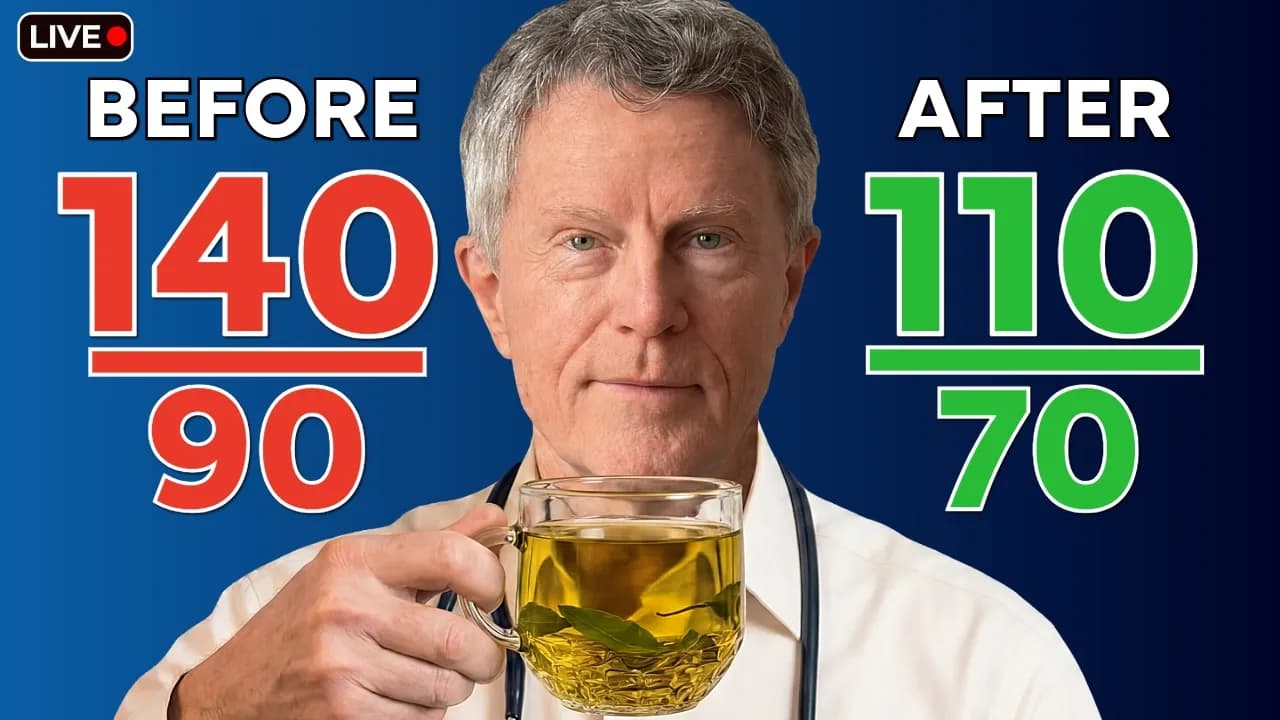
The #1 Mineral Deficiency in High Blood Pressure (Hypertension)
In a Nutshell
High blood pressure, affecting nearly half of US adults, stems largely from low potassium intake (average 2,500 mg vs. needed 4,700 mg) and a poor sodium-potassium ratio, not just excess sodium; Harvard studies show doubling potassium cuts cardiovascular risk by 18% per 1,000 mg, while high sodium-potassium imbalance doubles heart attack death risk. Potassium relaxes blood vessels, lowers adrenaline, boosts nitric oxide, and improves insulin sensitivity—mechanisms diuretics undermine by depleting it. Boost potassium via diet or supplements (despite outdated low-dose limits) to naturally lower BP, as ancestral intakes reached 15,000 mg daily.
These notes were generated by AI and may contain inaccuracies.
Over 120 million Americans have high blood pressure, nearly half of all adults in the US. Standard treatment is to cut salt and take a pill. 90% of hypertension is essential, meaning unknown cause, despite over 50 years and billions of dollars in research.
Reducing salt could be the opposite of what you want. It's a business model to keep people on blood pressure medication. Wikipedia states unknown cause, needing more research. Drug companies have no motivation to find the root cause; finding a cure would lead to attacks.
Doctors recommend reducing sodium. Harvard researchers tracked over 10,000 adults across six major studies, measuring sodium and potassium against cardiovascular outcomes. For every 1,000 mg of potassium daily, 18% reduction in cardiovascular risk. For every 1,000 mg of sodium, 18% increase in cardiovascular risk—symmetrical but opposite.
People with highest sodium to lowest potassium ratio doubled heart attack death risk compared to lowest ratio. Problem is the ratio between sodium and potassium, viewed together.
Average US person consumes 3,400 mg sodium and only 2,500 mg potassium. Need at least 4,700 mg potassium and roughly 2,400 mg sodium. Can tolerate more sodium with more potassium.
Paleolithic ancestors consumed 11,000 to 15,000 mg potassium daily. Bodies developed for higher amounts. In practice, increasing potassium lowered blood pressure in hypertension patients.
- 1. Potassium relaxes blood vessels, causes vasodilation on smooth muscle of artery walls. Low potassium causes constriction and stiffens arteries, reducing elasticity, leading to high blood pressure.
- 2. Potassium lowers adrenaline, acts as natural beta-blocker, supports rest and digest, calms sympathetic nervous system.
- 3. Protects endothelial layer of arteries, increases nitric oxide for better vasodilation and circulation.
- 4. Supports insulin sensitivity, keeps insulin receptors sensitive, prevents resistance. Low potassium increases insulin resistance risk, a primary driver of hypertension. Supports pancreatic insulin-making cells and regulates insulin; mutual dependency with insulin.
Diuretics for hypertension cause potassium loss with excess fluid, depleting the mineral needed to correct blood pressure. Leads to prescription potassium chloride (available over-the-counter). Question: Taking enough potassium initially could lower blood pressure without needing diuretic or supplemental potassium.
ACE inhibitors retain potassium and are highly effective for hypertension.
Potassium supplements are 99 mg tablets despite 4,700 mg RDA. Based on 1960s-1970s studies linking high potassium chloride (enteric-coated) to GI lesions/ulcers. Studies combined potassium chloride with diuretics, involved cardiac patients on aspirin/NSAIDs (known to cause ulcers). No independent studies on potassium alone. Potassium wrongly blamed; manufacturing stuck to 99 mg.
$28 billion industry lacks motivation for higher potassium. Magnesium also key for hypertension: helps make energy in mitochondria, beyond muscles or cortisol reduction.
Conventional potassium-rich foods should be avoided for certain reasons (detailed in another video).
Keep Dr. Eric Berg DC in your library
Save the videos and channels worth coming back to, and find them again in one place.